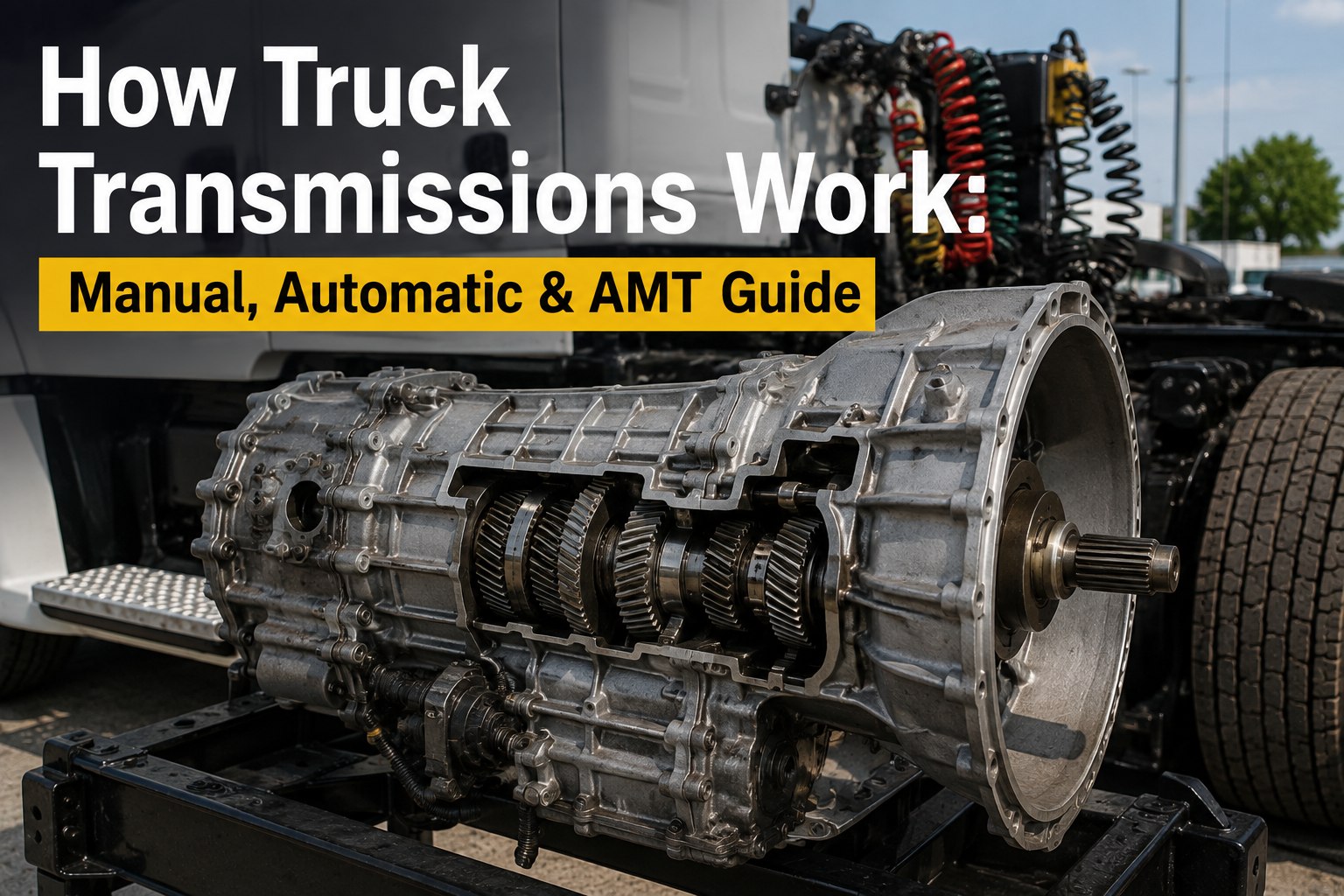
A heavy-duty truck transmission is what turns an engine that makes peak torque at 1,200 RPM into a vehicle that can pull 80,000 pounds up a 6% grade at 30 mph and cruise on the flat at 65 mph with the engine turning 1,400 RPM. That range — from full torque multiplication for pulling to overdrive efficiency for cruising — is what the transmission does. It gives the engine 10 to 18 different gear ratios to choose from, keeps engine RPM in the narrow power band where diesel torque and fuel efficiency are highest, and multiplies engine torque by 10x or more in the lowest gears. Modern trucks use three fundamentally different transmission designs to accomplish this: the traditional manual transmission, the fully automatic torque-converter transmission, and the automated manual transmission (AMT) that has become dominant in Class 8 trucks over the past decade. Each works differently, has different failure modes, and needs different maintenance. This guide walks through how heavy truck transmissions actually work: the physics of gear ratios and torque multiplication, the mechanical differences between manual, automatic, and AMT designs, the components that fail predictably, the warning signs of failure, and the maintenance rhythm that keeps transmissions running to 750,000+ miles. Ready to track transmission health across your fleet? Start a free trial of our fleet maintenance software, or reach out to our support team for a walkthrough.
How Heavy Truck Transmissions Work: Manual, Automatic & AMT Guide
Three transmission types, one goal — keep a diesel engine in its narrow power band from full-torque pulling to overdrive cruising. Here's how each design does it.
The Core Principle: Why Trucks Need So Many Gears
A diesel engine makes peak torque in a narrow RPM band — typically 1,100–1,500 RPM. Outside that band, torque and fuel efficiency both drop. The transmission's job is to keep the engine in that band regardless of vehicle speed. Multiple gear ratios make that possible.
The 3 Transmission Types Side-by-Side
Three fundamentally different designs power heavy trucks today. Each has its own mechanical philosophy, its own strengths, and its own maintenance profile.
How a Manual Transmission Actually Works
The manual transmission is the foundation of heavy-truck drivetrain design. Understanding it makes AMT intuitive — an AMT is just a computer doing what the driver used to do.
How AMT Transmissions Actually Work
The automated manual transmission is mechanically similar to a manual — same gears, same shafts, same shift forks. What's different is that a computer with actuators does the clutch and shift work. Here's the AMT workflow.
Sensor Reads Vehicle State
ECM monitors RPM, road speed, throttle position, load, and grade. Decides when to shift and to what gear.
Air Actuator Operates Clutch
Pneumatic actuator engages/disengages clutch just like the driver's foot would. Precise timing eliminates driver variability.
Shift Actuators Move Shift Forks
Air-powered actuators move shift forks to select the correct gear. Same mechanical action as manual, no human involved.
Engine Speed Matched Automatically
ECM rev-matches engine to output shaft speed before clutch re-engages. Result is smoother than most humans can shift.
Predictive Shifting on Grade
GPS-integrated AMTs know upcoming terrain. Downshift before a grade, upshift after crest — optimizing fuel and momentum.
How Automatic Transmissions Actually Work
The automatic transmission uses completely different technology from manual or AMT. No clutch. Instead, a hydraulic torque converter connects engine to gearbox — and planetary gearsets provide the ratio changes.
Side-by-Side: How the Three Types Compare
Every fleet has to choose between these three transmission types. Here's the head-to-head comparison that matters for a purchasing decision.
Track transmission health across the fleet
Fluid life monitoring, shift-quality alerts, clutch wear tracking on AMT and manual — all in one platform.
Gear Ratio Physics: The Math That Matters
Gear ratios seem abstract until you see the actual RPM and torque math. Here's how a 10-speed manual keeps a diesel engine in its 1,100–1,500 RPM power band from 2 mph to 65 mph.
The 6 Signs of Transmission Trouble
Transmission failures rarely appear without warning. Six specific symptoms show up before catastrophic loss. Catch any of them and you're addressing a $2,000 repair instead of a $15,000 rebuild.
The 5 Most Common Failure Modes
Transmission failures fall into five categories. Which one you're dealing with determines both the repair cost and the prevention strategy.
Clutch Wear (Manual & AMT)
Clutch disc wears with every engagement. Aggressive shifting, hill-holding on clutch, and overloading accelerate wear. Replacement at 400K–600K miles typical. Prevention: driver training and load management.
Fluid Contamination
Metal particles, water contamination, or oxidized fluid damages internal clutches, seals, and bearings. Prevention: fluid and filter service at manufacturer intervals — every 250K–500K miles.
Overheating
Trans cooler failure, chronic overload, or extreme grades cause fluid to overheat. Overheated fluid loses viscosity, causes seal failure, and cooks internal components. Prevention: cooler inspection, load management.
Synchronizer or Gear Damage
Manual: forced shifts, poor rev-matching. AMT: sensor failure or actuator wear causing missed shifts. Automatic: shocked planetary elements. Repair often requires transmission removal.
Electronic Control Failure (AMT/Auto)
ECM, shift solenoids, sensors, or actuator failure. Modern transmissions rely heavily on electronic control — component failure disables shift function even when mechanicals are perfect.
Maintenance By Transmission Type
Manual, AMT, and automatic transmissions have different maintenance profiles. Following one schedule for all three is how fleets destroy expensive transmissions early.
Frequently Asked Questions
A heavy truck transmission provides 10–18 different gear ratios that let a diesel engine stay in its narrow 1,100–1,500 RPM power band across a wide vehicle speed range (2–65 mph). The transmission multiplies engine torque up to 15x in first gear for pulling heavy loads at low speeds, and reduces to 0.85:1 overdrive in top gear for fuel-efficient highway cruising. Track transmission health across your fleet in our maintenance software.
Manual transmissions have a driver-operated clutch and gear lever. Automatic transmissions replace the clutch with a hydraulic torque converter and shift through planetary gears automatically. AMT (automated manual transmission) is mechanically identical to a manual — same clutch, same gears — but a computer operates the clutch and shift mechanism. AMT gives near-manual efficiency with automatic simplicity, which is why it's become dominant in Class 8 trucks.
Depends on the application. Long-haul general freight: AMT dominates for its fuel efficiency, low driver fatigue, and easy driver onboarding. Vocational/refuse/stop-and-go: automatic transmissions handle constant shift cycles better than clutches. Owner-operator long-haul: manual is still competitive for fuel economy if the driver has skill. Most new Class 8 orders today are AMT.
Manual transmissions typically last 750K–1M miles with proper maintenance and driver skill. AMT transmissions last 600K–900K miles, with clutch replacement at 500K–800K. Automatic transmissions last 400K–700K miles — they run through more heat cycles and have more internal components to wear. All three can go much longer with disciplined fluid service and load management. Contact our team about tracking transmission life.
Six signs: delayed or rough shifts, fluid leaks under vehicle (red for automatic, amber for manual/AMT), burning smell during operation, slipping under load (RPM climbs without acceleration), grinding or whining noises, and check engine or transmission warning lights. Any one of these means shop diagnosis is needed before problems cascade into rebuild-level damage.
Depends on transmission type. Automatic transmissions need fluid and filter changes every 100K–150K miles. AMT transmissions typically need fluid service every 300K–500K miles. Manual transmissions can go 500K miles or more between changes. Always use the exact fluid type specified by the OEM — mixing manual gear oil and automatic transmission fluid destroys transmissions quickly. Try free: sign up here.
Every transmission tracked, every mile
Fluid service intervals per transmission type. Clutch wear tracking on manual and AMT. Automatic filter and cooler service scheduling. Fault code monitoring on electronic transmissions. Everything a fleet needs to keep transmissions running to 750,000+ miles — one platform, one workflow.