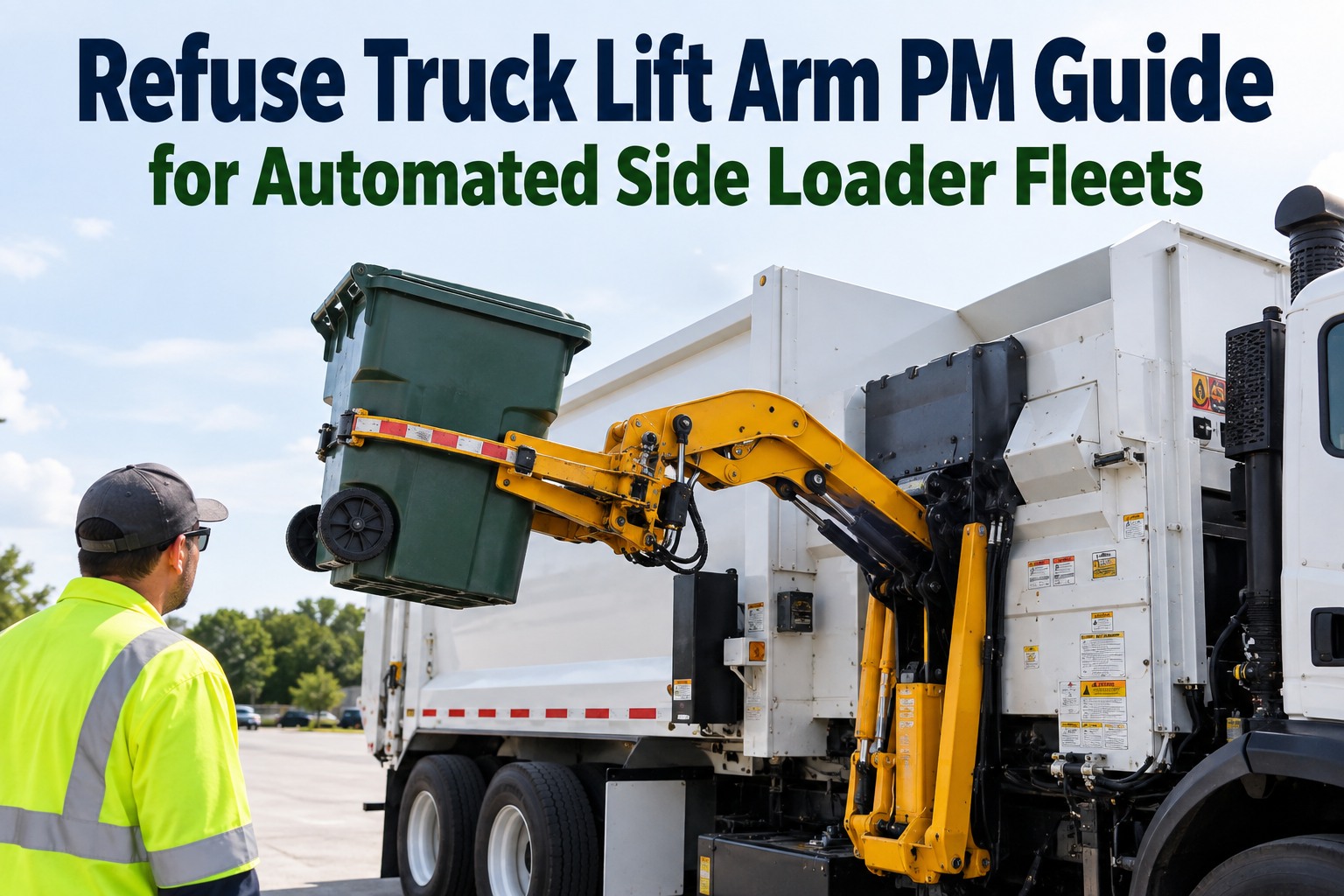
An automated side loader grabs, lifts, inverts, and returns a cart every 15 to 20 seconds 800 to 1,200 lift cycles a shift, all loading the same pins, bushings, cylinders, and bearings. That makes the arm the most maintenance-intensive part on the truck and the one most likely to strand it mid-route, and most arm wear stays invisible until it becomes drift, a dropped cart, or a seized joint two hundred stops from the yard. This guide walks the ASL lift-arm PM that keeps trucks on route — the wear points, the intervals that catch them, and the warning signs drivers can flag first. Our truck inspection and maintenance management software turns each into a mileage- and hour-triggered PM task, so a worn bushing surfaces as a work order, not a stranded truck. Start a free trial and put every arm PM interval on autopilot.
The Refuse Lift-Arm PM Guide for ASL Fleets
An automated side loader's arm cycles 800–1,200 times a shift — a punishing load no other truck sees, and a skipped grease point strands it mid-route. Our truck inspection & maintenance management software puts every arm PM on an hour- and mileage-triggered schedule, so a worn bushing or dry fitting surfaces as a work order instead of a breakdown. See it on your own fleet — hit Start Free Trial below, or talk to our team.
Why the Arm Wears Out Faster Than Anything Else
It comes down to physics, not mileage. A refuse truck stops roughly every 30 seconds on a residential route, and every stop fires a full arm cycle: extend, grip, lift, invert, return, retract. Do that a thousand times a day, five days a week, year-round, and the arm's joints see more load reversals in a month than most chassis components see in their lifetime. That's why refuse trucks run 3–5× the downtime rate of standard trucks — and why the arm, not the engine, is where the breakdowns start.
One cycle. Repeated 800–1,200 times a shift — each pass loading the same pins, bushings, and cylinder rods.
The Four Wear Points That Decide Uptime
Arm failures almost always start at one of four places. Each has its own failure mode, its own warning sign, and its own PM interval — and each one, left alone, cascades into the next.Start free and build all four into a guided ASL arm checklist.
Every pivot joint rides on a pin and bushing that grind under each of the 800–1,000 daily lifts. Worn bushings introduce play, and play becomes misalignment. Check monthly for measurable slop; if the grease gun is skipped, this is the #1 driver of premature arm wear.
Lift and grabber cylinders convert pressure into motion — and their seals wear with every stroke. Service every 250–500 hours: inspect seals, rod condition, and fluid cleanliness. Contaminated hydraulic fluid is the #1 cause of arm precision failure, so many OEMs require fluid sampling at each interval.
Gripper pads, pins, and bushings take the cart's full weight and wear fast at 800–1,000 lifts a day. Inspect monthly. Worn grippers cause dropped carts, missed lifts, and alignment errors that cascade into other arm failures if they aren't caught early.
On zero-radius and articulating designs, the slew bearing carries the full lateral load of every lift. Bearing wear causes arm drift — one of the most common ASL complaints and a direct cause of cart misses. Track it before drift becomes downtime.
The PM Interval Card
Arm PM isn't one schedule — it's several, each triggered differently. Miss the trigger and the component fails between services. These are the standard reference intervals for ASL arm maintenance.Book a demo and we'll load these intervals into your PM calendar.
| Component | Interval | What to check |
|---|---|---|
| Grease points (arm) | Daily / every shift | Hit every fitting — pins, pivots, carriage |
| Arm hydraulic cylinders | Every 250–500 hrs | Seals, rod condition, fluid cleanliness |
| Grippers & clamp assembly | Monthly | Pad, pin, and bushing wear |
| Pins & bushings | Monthly | Measurable play / slop at each joint |
| Slew bearing (ZR / artic.) | Per OEM schedule | Arm drift, lateral play |
| Hydraulic fluid sample | Each service interval | Contamination — OEM-required on many ASLs |
The Grease-Gun Problem
Here's what quietly kills ASL arms: they have a lot of grease points, and hand-lubing misses some. A single high-cycle side loader can carry 70+ lubrication points — 30 or more on the arm alone — and a missed fitting, an inconsistent interval, or a hard-to-reach spot leads straight to bearing failure and component damage.
- A missed fitting runs dry for a week
- Inconsistent intervals — some joints over-served, some starved
- Hard-to-reach points quietly skipped
- Result: bearing failure, pin scoring, arm drift
- Every fitting on a scheduled, logged task
- Consistent interval across the whole fleet
- Skipped points flag instead of disappearing
- Result: joints last, arm holds alignment
One Software System for ASL Inspections, PM & Work Orders
Our truck inspection and maintenance management software replaces paper DVIRs and PM spreadsheets with mobile inspections and hour- and mileage-triggered PM tasks built for refuse fleets. Arm grease points, cylinder service, gripper wear, and bearing checks each fire on their own interval; a flagged defect routes straight to a work order; and every record stays audit-ready — helping fleets cut breakdowns, lift PM compliance, and keep every truck on route.
Warning Signs Your Drivers Can Flag
The best arm PM catches problems before the shop does — and drivers feel arm trouble long before a technician measures it. Put these on the daily DVIR and a cylinder or bearing failure gets caught early instead of mid-route.Contact us to add these to your ASL driver checklist.
Frequently Asked Questions
Keep the Arm on Route, Not on a Hook
Our truck inspection and maintenance management software gives ASL fleets one mobile-first platform for DVIRs, PM scheduling, work orders, and compliance records — arm grease points, cylinder service, gripper wear, and bearing checks each on their own trigger, defects auto-routed to work orders, and every truck audit-ready year-round. Leading fleets use it to cut breakdowns, pass DOT audits, and give drivers a maintenance system they'll actually use.