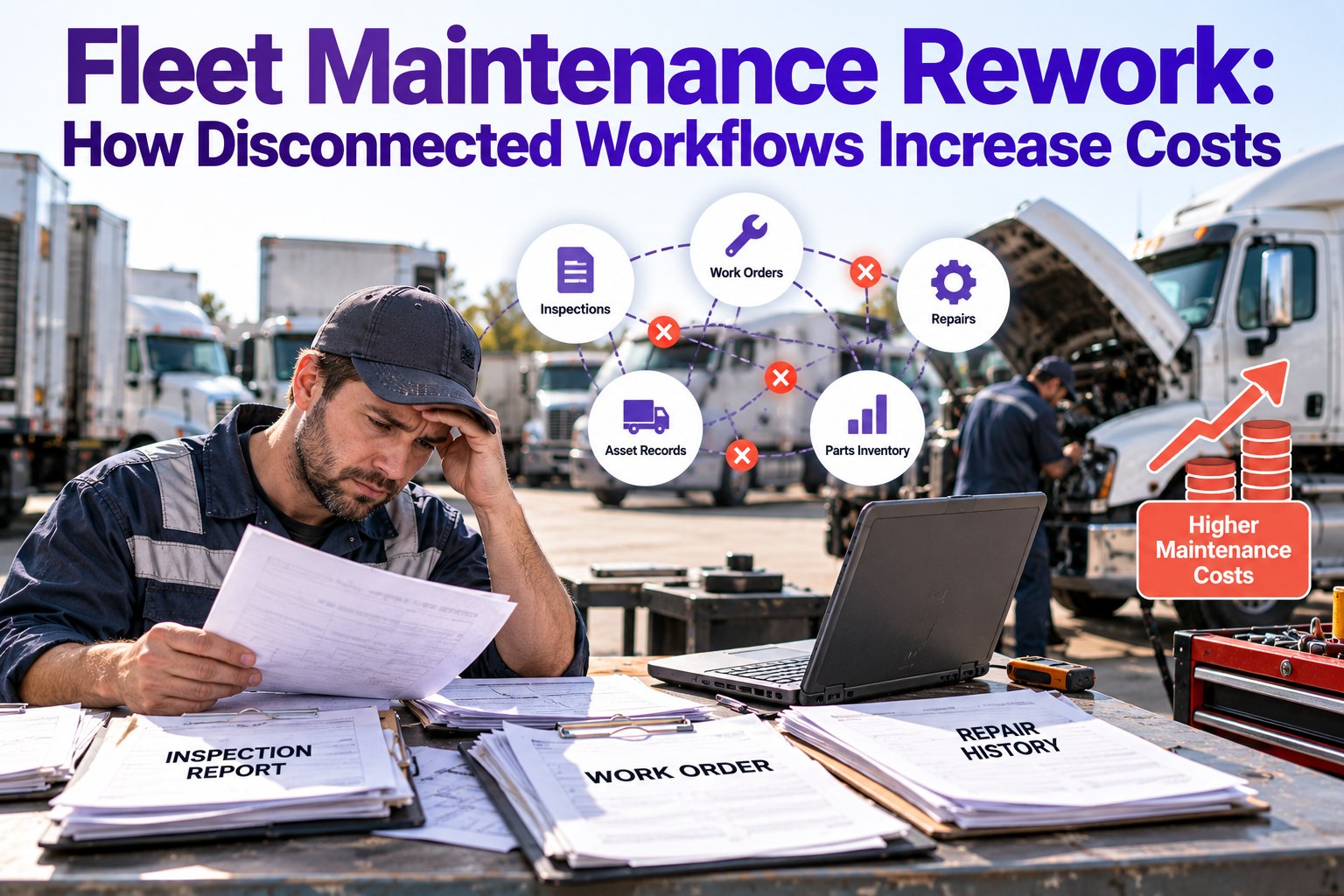
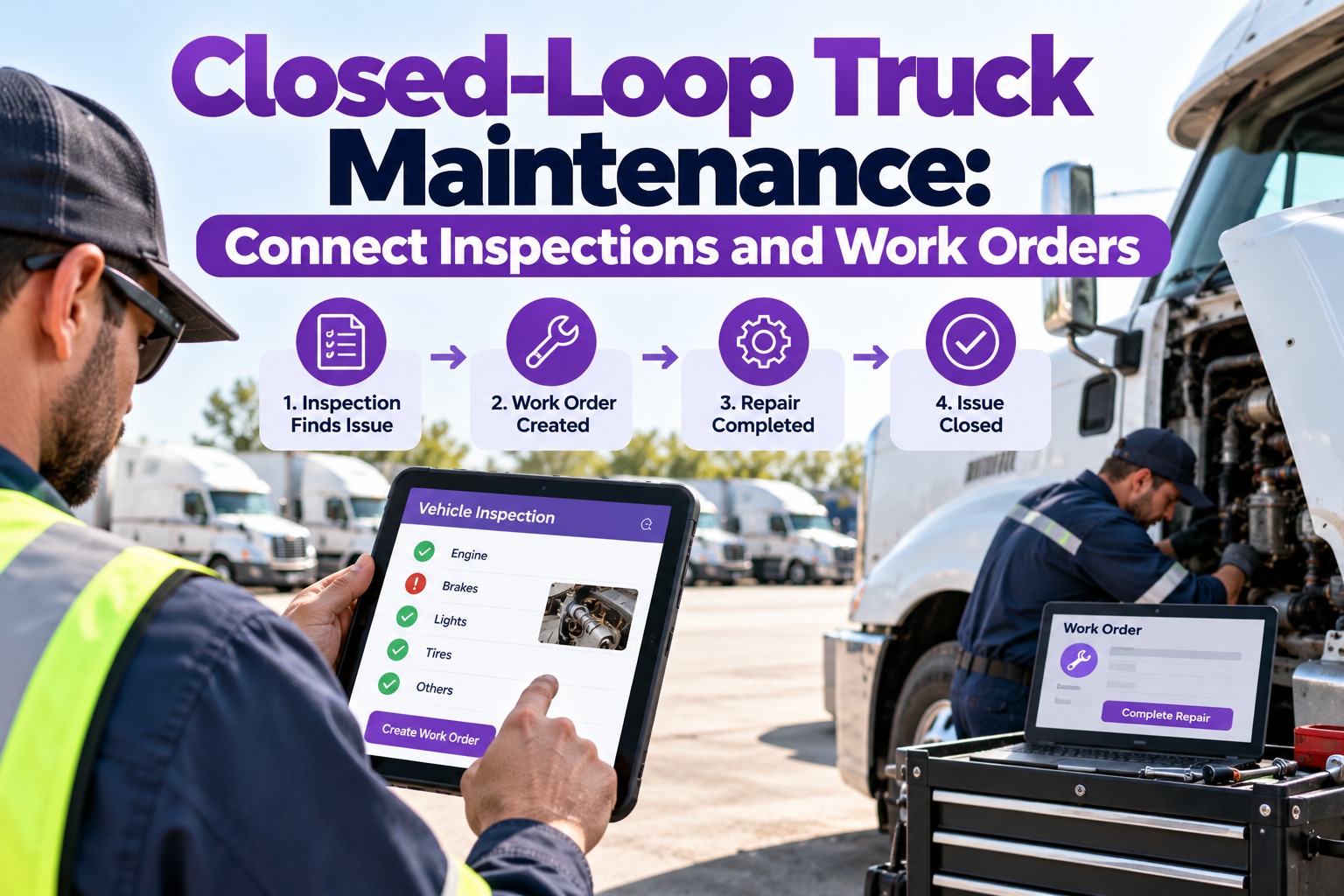
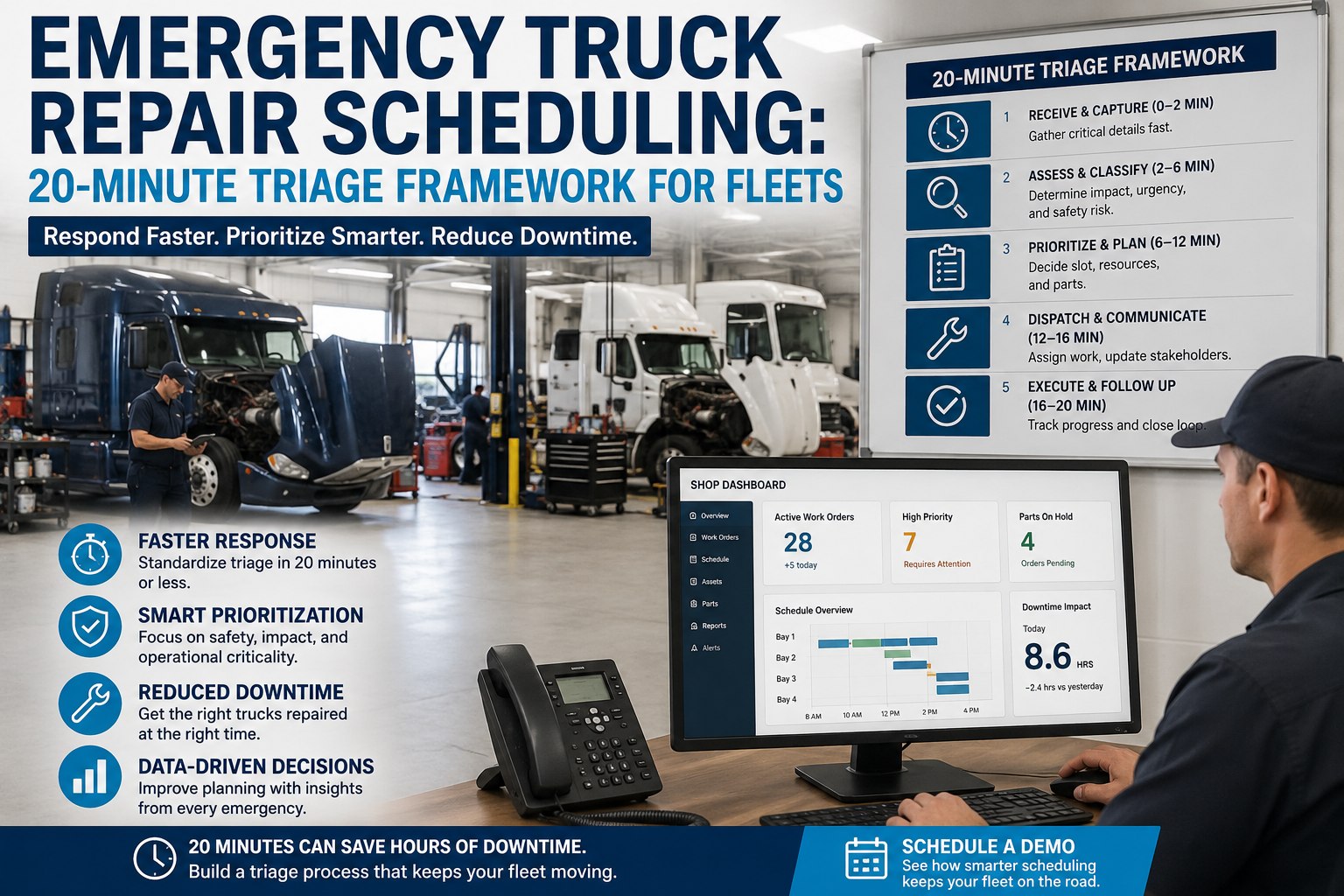
It is 6 AM and the shop has twenty open work orders: a loud exhaust leak, a cracked mirror, and a brake out of adjustment nobody has mentioned yet. Fix the loudest problem first and the dangerous one waits. This guide shows how to rank every truck repair by safety, urgency, uptime and cost — and how Truck Inspection & Maintenance Management Software does the ranking for you. Start free and put every repair in priority order.
Safety · Compliance · Uptime · Cost
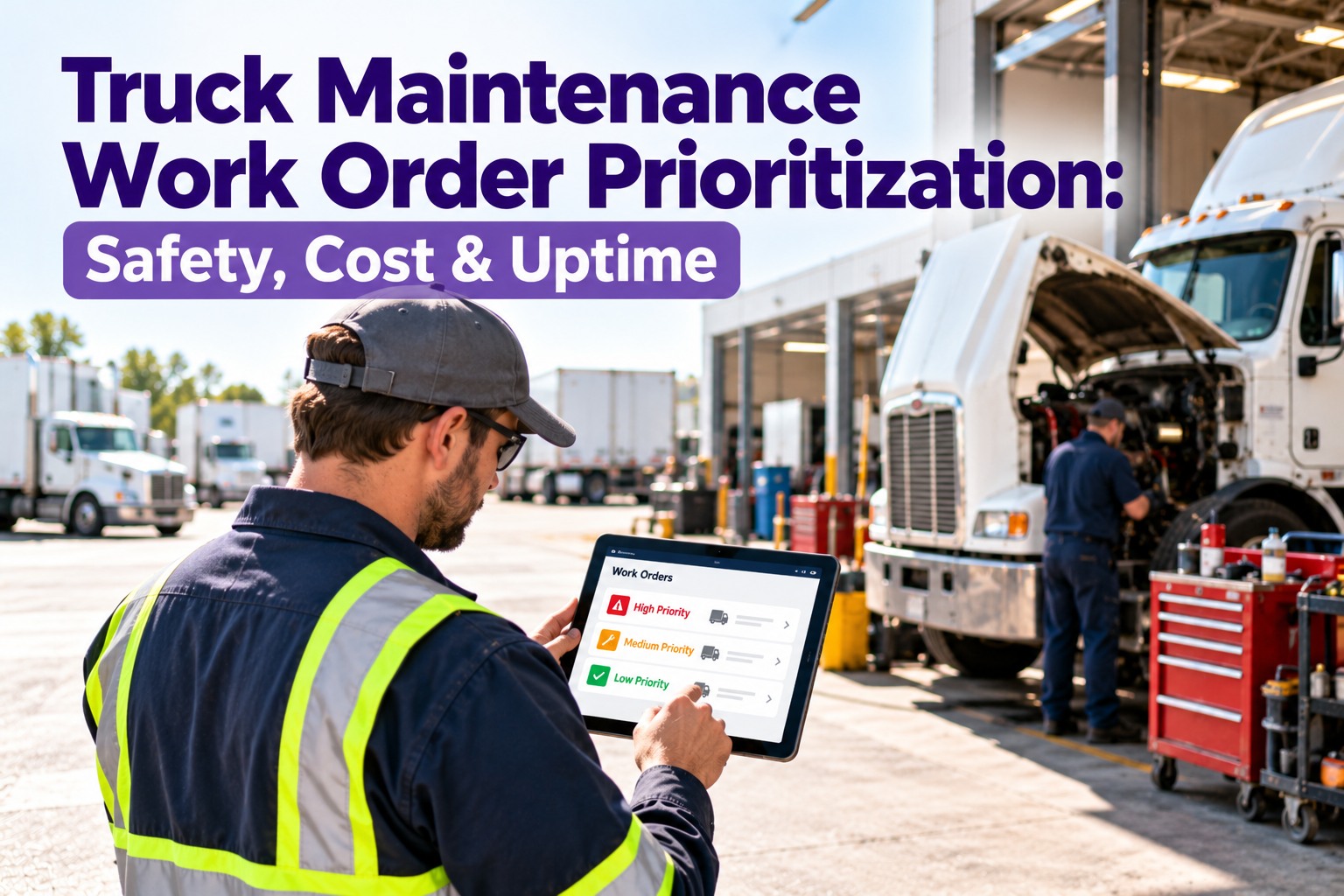
Truck Maintenance Work Order Prioritization: Safety, Cost & Uptime
Our Truck Inspection & Maintenance Management Software grades each defect when it is logged, places it in the right priority lane, and builds the day's work queue — so the brake that could park a truck always beats the dent that only looks bad.
75%+of vehicle out-of-service orders come from brakes, tires and lights
3–9×typical cost of an unscheduled repair vs the planned one
$448–$760estimated cost per truck, per day out of service
Four Priority Lanes: What Gets Fixed Now, Today, Next and Later
Most shops don't need twenty priority levels. Four lanes are enough, as long as each one has a clear trigger and a response expectation everyone agrees on.
P1
Stop-use safety defectThe truck can't move safely: failed brakes, steering or tire damage. The truck is pulled from service and worked immediately.
Immediately
P2
Unit down or route at riskThe truck is unusable or a delivery is in danger: air leak, cooling fault, no-start. Assess and plan recovery in the same shift.
Same shift
P3
Fast, but schedulableNeeds prompt action but can wait for a slot: an inspection due date, a worn belt, a lamp out on a trailer.
Next open bay
P4
Routine or cosmeticDoesn't affect safety, won't worsen quickly and doesn't change availability: trim, paint, interior wear.
Normal queue
One rule keeps the lanes honest: a safety item is never moved down a lane without an inspection and a recorded reason. Schedule our team to set up priority lanes that fit your fleet.
The Priority Score: Five Factors, 25 Points
Lanes sort the urgent from the routine. Within a lane, a simple score decides the order. Rate each work order 1 to 5 on five factors and add them up. Quick jobs with parts on the shelf score higher, so they clear the bay fast.
Brake repairHigh-use truck, 12 routes a day
Safety risk5
Vehicle criticality5
Compliance urgency4
Repair speed4
Parts on hand4
Priority score22/25
Cosmetic dentBackup truck, rarely dispatched
Safety risk1
Vehicle criticality1
Compliance urgency1
Repair speed2
Parts on hand1
Priority score6/25
Illustrative scores. Your fleet's weights can differ, but the logic holds: safety and criticality dominate.
The score never overrides common sense: any P1 defect jumps the queue regardless of its total. Start free and let the software score every work order.
Where P1 Comes From: Three Systems Cause Most Out-of-Service Orders
Prioritizing by safety isn't abstract. Roadside inspectors keep finding the same three failure areas, and your P1 lane should be built around them.
Share of vehicle out-of-service violations, 2025 CVSA Roadcheck
20% brake ruleA vehicle goes out of service when one-fifth of its braking system is defective, even if each defect looks minor.
Steer tire treadBelow 4/32 inch is out of service. Drive tires: below 2/32 inch.
Tire inflationBelow 50% of the maximum sidewall pressure is an out-of-service condition.
The Cost of Waiting: Planned vs. Unscheduled Repairs
Prioritizing well also shifts work from emergency to planned, where it costs far less. Industry estimates put an unscheduled repair at 3 to 9 times the planned one once towing, overtime and lost revenue are counted.
Worked example: brake job on a Class 8 tractor
6–9×Cooling system
5–8×Brakes
4–7×Electrical and charging
3–5×Tires
Fleets commonly cite a 47% reactive share for the average US commercial fleet, with under 20% as the target. Every repair you catch from an inspection and schedule in advance moves that number the right way. Book a demo to see where your fleet's reactive share stands.
How Truck Inspection & Maintenance Management Software Ranks Work Orders for You
Ranking by hand works for five trucks. At fifty, it needs software that grades the defect the moment it appears and keeps the queue in order all day.
1Defect loggedA driver or inspector records it on a digital inspection.
2Severity gradedThe defect is graded against safety and out-of-service risk.
3Lane assignedIt lands in P1 to P4 and gets a work order automatically.
4Parts checkedStock is checked so the shop knows if the fix can start.
5Closed on recordThe repair closes against the truck's history for audits.
What the 6 AM work queue looks like (illustrative)
P1Truck 114 — Steer-axle brake out of adjustmentOut of service · bay now
P2Truck 087 — Air leak at coupling, route 4 at riskSame shift · parts in stock
P2Truck 203 — Coolant leakSame shift · part on order
P3Truck 056 — Annual inspection due FridayNext open bay
P4Truck 142 — Mirror trim crackedNormal queue
Start each shift by reviewing the top five jobs. With the software, that list is already sorted, so supervisors spend the morning dispatching instead of arguing about what is urgent.
Fix What Matters First, Every Shift
Truck Inspection & Maintenance Management Software turns inspection findings into ranked work orders, keeps safety defects at the top, and records every repair against the truck. Fewer surprises at the roadside, fewer emergency bills, more trucks on the road.
Frequently Asked Questions
How do you prioritize truck maintenance work orders?
Work in this order: safety-critical defects first, then regulatory and compliance deadlines, then repairs on high-use trucks where downtime costs the most, and finally low-impact items that can be deferred. A 1 to 5 score on safety, criticality, compliance, repair speed and parts availability sorts the jobs inside each group.
Start free and apply this ranking automatically.
What counts as a safety-critical truck repair?
Brakes, steering, suspension, tires and required lighting. These are also the systems behind most out-of-service orders, which is why they sit in the top priority lane. Treat anything that could trigger an out-of-service condition, such as a brake system with one-fifth of its components defective, as P1.
Can a work order's priority be lowered later?
Yes, but only with a confirmation and a recorded reason. Safety items shouldn't be downgraded without an inspection. Keeping the reason on the record also protects you in an audit, because it shows the decision was deliberate.
How many priority levels does a fleet need?
Safety first · Uptime next · Cost under control
Stop Fixing the Loudest Problem First
Truck Inspection & Maintenance Management Software grades every defect, ranks every work order and keeps your shop focused on the repairs that keep trucks safe and moving.
No credit card required. Free for up to 3 trucks. Built for FMCSA-compliant fleets.