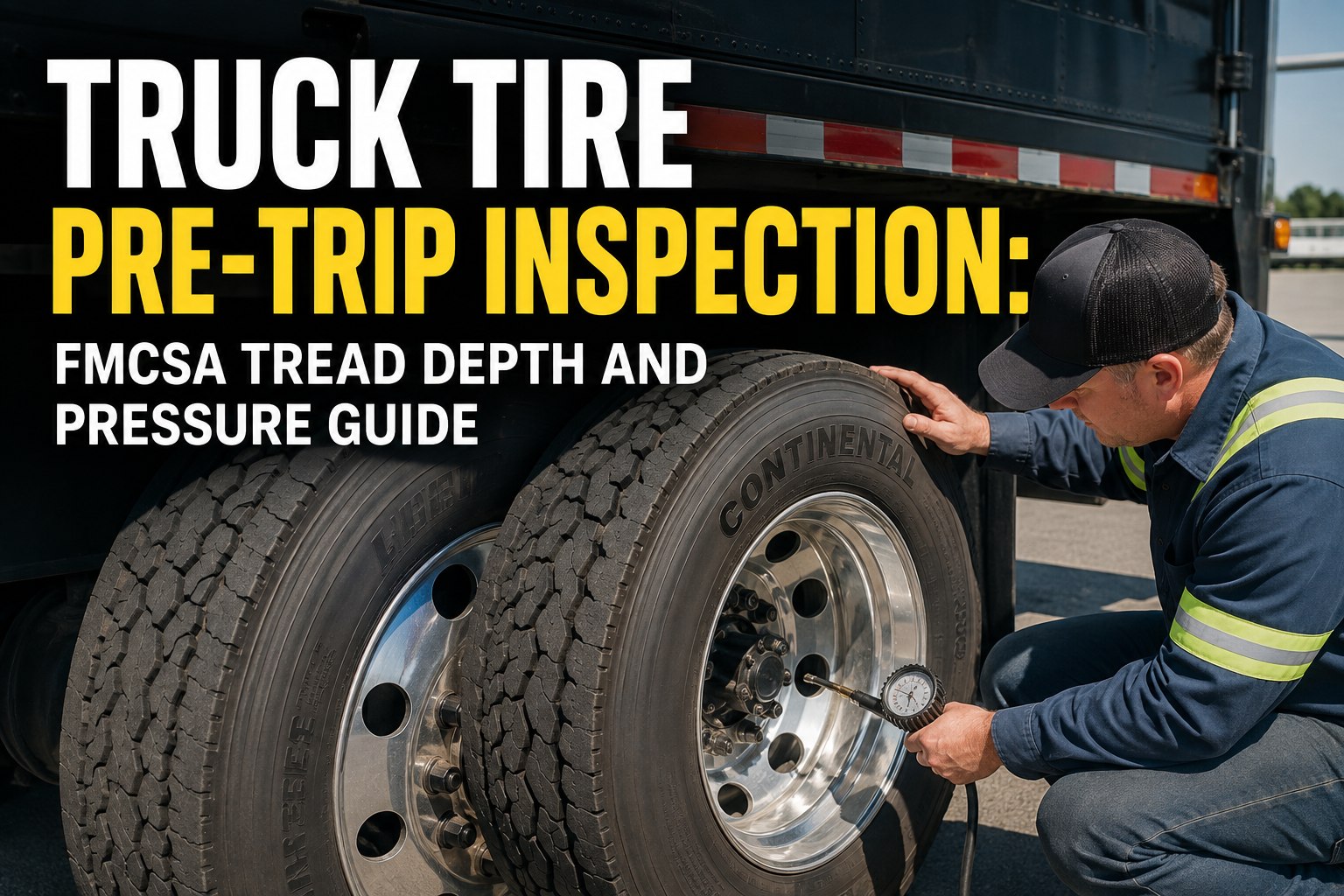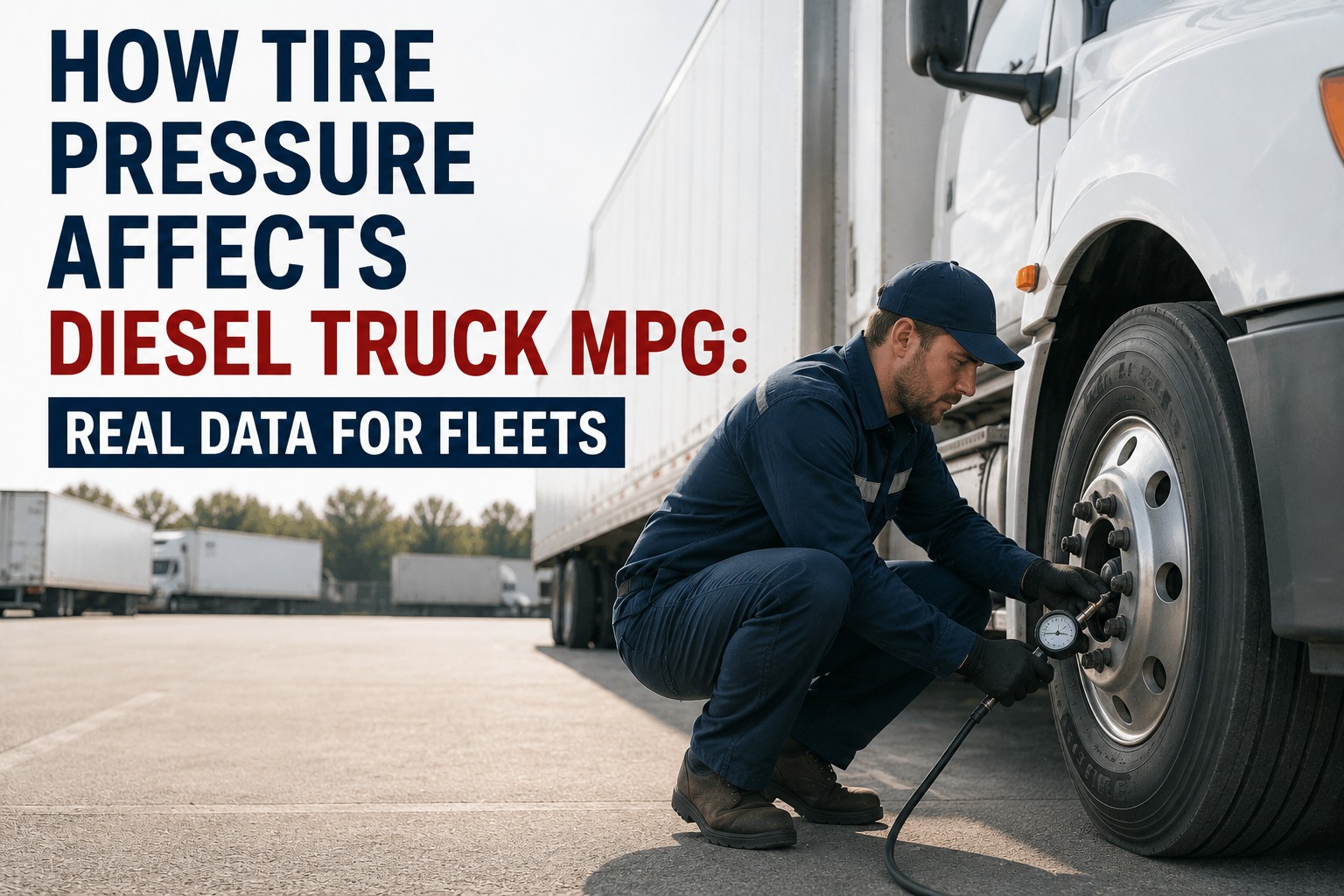
10 PSI under spec costs a diesel truck about 1.5% MPG — and roughly 12% of commercial fleets are running tires under-inflated by that amount right now, most without knowing it. Tire pressure is the highest-ROI, lowest-attention item in fleet maintenance, and the numbers behind it are hiding in every fleet's fuel data. This article breaks down the real MPG math, the axle-position multipliers most programs miss, and the 90-day tire pressure program that pays back inside a quarter. Start a free trial to add pressure tracking to your DVIRs this week.
How Tire Pressure Affects Diesel Truck MPG: Real Data for Fleets
10 PSI under spec costs a diesel truck 1.5% MPG. The numbers, the axle-position multipliers, and the 90-day pressure program that pays back inside a quarter — with the DVIR workflow that catches under-inflation before the fuel bill does.
The Real Math: What Each PSI Actually Costs
The U.S. Department of Energy pegs the baseline at 0.2% MPG loss per 1 PSI of average under-inflation across all tires. Tire manufacturers converge on a simpler rule of thumb for heavy trucks: 10% under-inflation costs 1% MPG. Neither number sounds dramatic on its own. Compounded across a fleet, the year, and today's diesel prices, they're enormous.
DOE baseline. Barely perceptible on a single truck; adds up fast across the fleet.
The pressure most tires quietly settle at within 30–60 days of a fill without active monitoring.
Industry rule-of-thumb threshold. About 12% of commercial fleets are running here right now.
Federal TPMS standard only alerts at 25% under-inflation. By the time the light comes on, most of the damage is already done.
The Axle-Position Multiplier Most Programs Miss
Not every under-inflated tire hurts the same. Continental's fleet research established that the axle position of the low tire changes its impact on total truck fuel economy — because different axles carry different loads and see different rolling-resistance sensitivity. This is why "fleet-wide" pressure averages hide the real problem.
Steer tires carry the tractor front end. Under-inflation here shows up in handling and wear before MPG — but neglect adds up over time.
Drive tires carry engine torque and much of the tractor weight. An under-inflated drive tire disproportionately hurts fuel economy — and dual mismatch multiplies the effect.
Trailer tires carry the majority of loaded truck weight. Ironically, they're the least-inspected — only ~15% of fleets run TPMS on trailers. Where the biggest MPG loss lives is where nobody's looking.
Why Pressure Drifts (And Why You Don't Notice)
Even a perfectly healthy tire loses roughly 1 PSI per month through the sidewall — natural permeation, no leak required. Add temperature swings, valve stem seepage, and small road-strike punctures, and the math compounds. Left alone, most tires drift into the fuel-penalty zone within 60–90 days.
Air molecules pass through the tire sidewall over time. About 1 PSI per month is standard, faster in heat and on high-mileage tires.
Pressure changes ~1 PSI per 10°F. A tire filled to spec on a warm afternoon reads 5 PSI low the next cold morning.
85% of pressure losses are slow leaks from small objects, not blowouts. They can drop pressure 5-10 PSI over weeks unnoticed.
Cracked, aging, or debris-fouled valve cores lose small amounts of pressure continuously. Often the culprit on a "won't hold air" tire.
The TPMS Gap: Why the Warning Light Isn't Enough
Every modern truck has some form of Tire Pressure Monitoring — but the federal standard only requires an alert at roughly 25% under-inflation. That means the driver's warning light stays dark through the entire zone where most of the fuel penalty accrues. By the time it triggers, you've already lost 4–6% MPG for weeks.
Catch Pressure Loss Before the Warning Light Does
Truck Inspection & Maintenance adds tire pressure logging as a native DVIR field — drivers record readings during walk-around, low readings auto-route to work orders, and per-unit PM reminders trigger formal pressure audits on your schedule. Mobile DVIRs, PM reminders, digital work orders — one platform for the whole loop.
The 90-Day Fleet Pressure Program
You don't need automatic tire inflation systems or a full TPMS fleet upgrade to move the number. A disciplined 90-day program using existing DVIRs and shop checks moves MPG measurably within one quarter. Start free and run the whole program through the mobile DVIR platform.
- Publish target pressures by tire position for every unit class
- Issue calibrated digital gauges to shop and drivers
- Baseline pressure log on every tire, every truck
- Set current MPG benchmark from fuel data
- Add tire pressure fields to weekly DVIR
- Any reading below −5 PSI = same-day work order
- Weekly shop audit on 20% of fleet, random sample
- Publish per-unit pressure compliance dashboard
- Compare MPG trend vs baseline — expect 1–2% improvement
- Publish results to drivers and shop
- Identify chronic-loss units for tire/valve investigation
- Lock cadence in: pressure now a permanent DVIR item
The Cost-Per-Truck Payback Model
A tire pressure program pays back its setup cost inside the first quarter for virtually any fleet size. The math is stark enough that it survives conservative assumptions comfortably.
Calibrated digital gauge, driver training, DVIR field configuration. One-time cost per truck.
Based on 3 PSI average pressure improvement across all tires at typical OTR miles and diesel prices.
Program pays for itself in the first quarter of operation, then generates savings every quarter after.
Bonus benefit: correctly-inflated tires last ~15% longer, adding thousands of miles per replacement cycle.
The Common Mistakes That Kill Pressure Programs
Programs die for predictable reasons. Recognizing them ahead of time is the cheapest way to keep yours alive past the first quarter.
Frequently Asked Questions
No. TPMS is optimization on top of a disciplined manual program, not a prerequisite. The 90-day program above runs entirely on driver walk-around readings and shop audits — a $50 digital gauge in every cab, a pressure field on the DVIR, and a per-unit compliance dashboard. TPMS accelerates detection, but consistent manual discipline captures 70–80% of the fuel opportunity at a fraction of the cost. Start free and add pressure to your DVIR this week.
Drivers spot-check every pre-trip and record a reading on every weekly DVIR. Shop does a full precision audit (all tires, calibrated gauge, cold pressure) at every PM interval — typically every 30 days. Any tire flagged low on driver DVIR gets same-day attention. This combined cadence catches natural drift, seasonal shifts, and slow leaks before any of them cost meaningful fuel.
Load-specific, always. The sidewall number is the maximum safe pressure at the tire's maximum load rating — not the correct pressure for your specific truck configuration. Every tire manufacturer publishes load-and-inflation tables giving the correct PSI for actual axle weight. Running to sidewall max on lightly-loaded trucks is inefficient and rides rough; running below load-specific spec on loaded trucks is where the fuel penalty and safety risk live.
For trailer-heavy long-haul fleets: yes, especially on trailers that see the yard infrequently. Automatic tire inflation systems (ATIS) maintain pressure continuously, eliminating the slow-drift problem entirely. Payback is typically 18–36 months depending on trailer miles. For tractors and shorter-cycle trailers, a disciplined manual program often delivers 80% of the benefit at 10% of the cost. Do the manual program first; graduate to ATIS on units where the ROI clearly justifies it. Ask about hybrid ATIS + DVIR approaches.
The physics is instant — correctly inflated tires reduce rolling resistance the moment they leave the shop, so per-truck MPG improves on the very next run. The fleet-wide trend line takes 60–90 days to show up in aggregate fuel data because it takes that long to move the whole fleet onto the new pressure discipline. Most fleets running this program see 1–3% fleet-wide MPG improvement within one quarter, which typically pays back the entire program cost several times over.
The Simplest Fuel Program You're Not Running Yet
Truck Inspection & Maintenance connects drivers, mechanics, and managers with mobile DVIRs, PM reminders, digital work orders, and audit-ready reports — turning tire pressure from an afterthought into a captured, tracked, MPG-recovering discipline. Small components managed correctly are how fuel economy compounds.