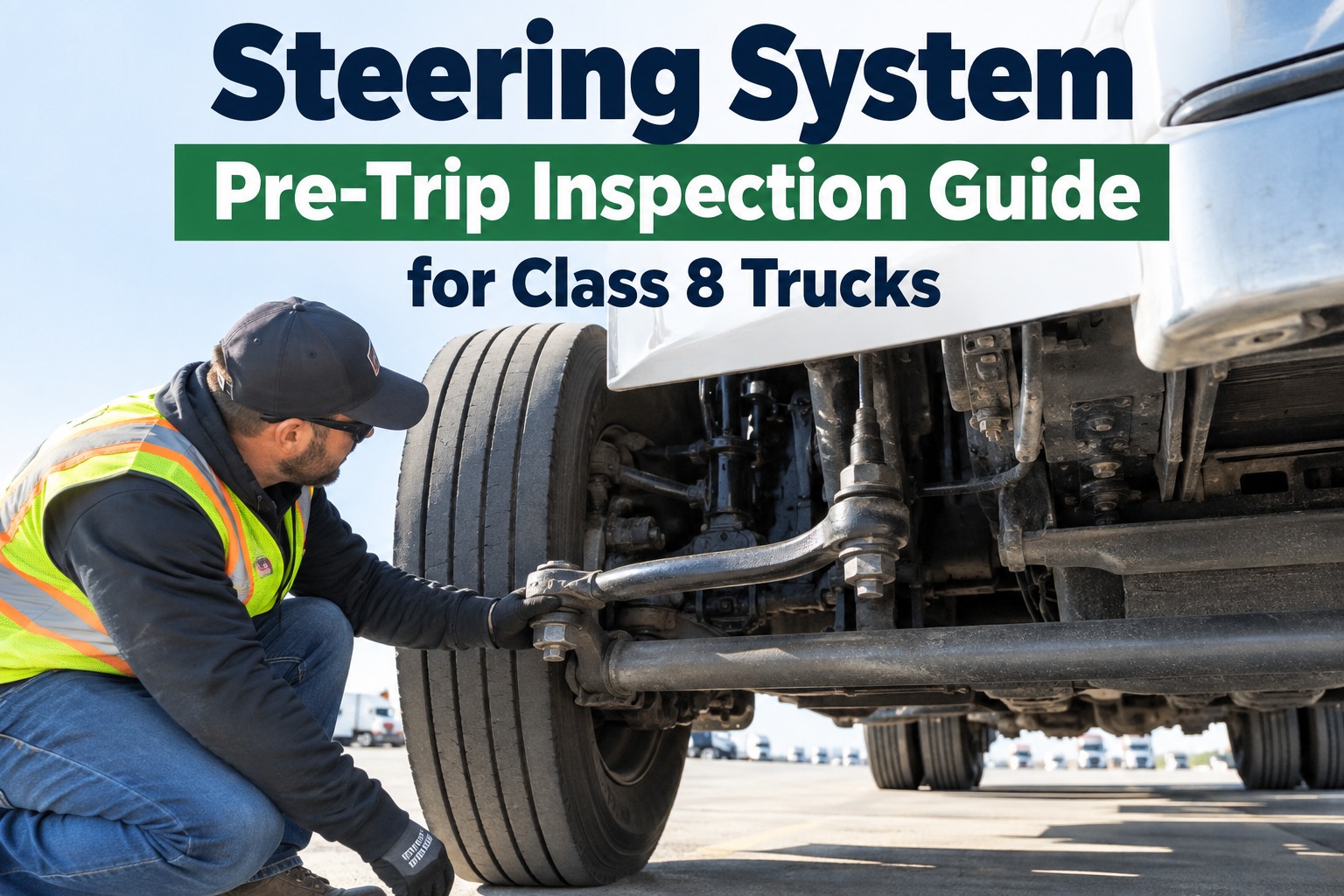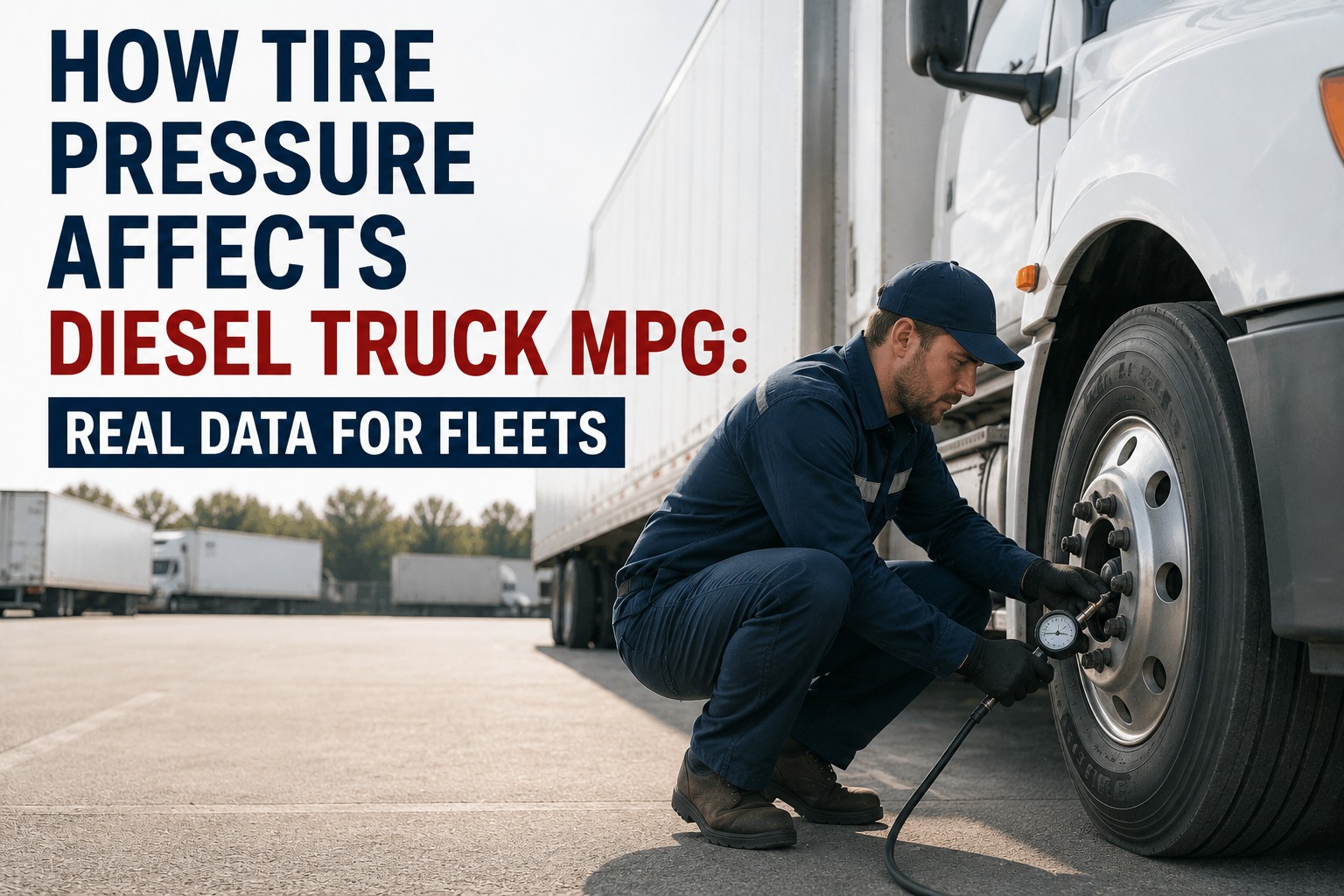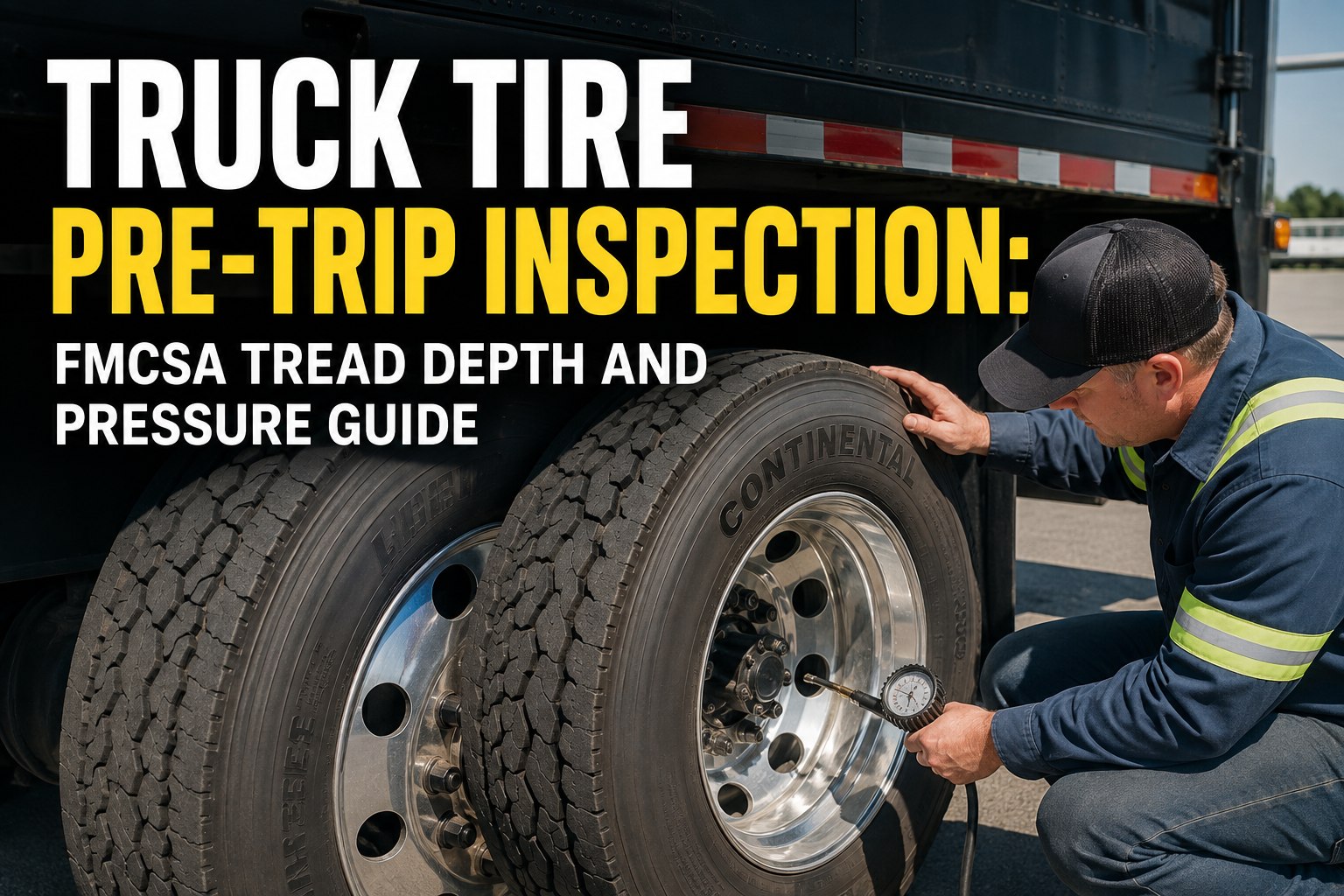
Tire defects are the single most common vehicle-related roadside violation in commercial trucking. FMCSA §393.75(a)(3) tire flat or audible leak violations alone have topped 456,000 across the last 5 years — 8 CSA BASIC points each, plus out-of-service until fixed. And it's the easiest defect to catch pre-trip: a tread gauge, a pressure gauge, and 4 minutes of walkaround per truck stops the entire failure chain. This guide covers the FMCSA §393.75 tread depth minimums by tire position, cold PSI targets, dual-tire matching rules, sidewall damage tolerances, load rating, and the pre-trip walkaround pattern that catches all of it. Truck Inspection & Maintenance runs the full tire program on driver phones — sign up free or contact our team.
Truck Tire Pre-Trip Inspection — FMCSA Tread Depth & Pressure Guide
A tread gauge, a pressure gauge, and 4 minutes per truck. Prevents the #1 roadside violation category.
Why Tire Pre-Trip Matters — The #1 Roadside Violation Category
Three numbers explain why tire defects show up on nearly every roadside inspection report and why fleets that master pre-trip tire checks pull ahead on CSA scores:
FMCSA §393.75(a)(3) flat tire or audible leak violations issued in a rolling 5-year window. Each carries 8 CSA BASIC points and immediate out-of-service.
Any tire with inflation below 50% of maximum sidewall PSI is automatic OOS under CVSA criteria — even if tread and sidewall pass every other check.
Complete tire pre-trip on a tractor-trailer takes 4 minutes with a tread gauge and pressure gauge. Skipping it saves 4 minutes; missing a defect costs $2,000+.
Stop leaking CSA points to preventable tire violations — start a free account and put position-specific tread validation on every driver phone this week.
Tread Depth — The Full FMCSA Rule
The §393.75 tread depth rule is short but strict. Read it as inspectors read it — no averages, no interpretations:
Measured at ANY POINT in a Major Tread Groove
Not the average, not the deepest spot, not the newest section. Inspectors measure the shallowest groove and the shallowest point in that groove. Uneven wear from misalignment or under-inflation fails long before average depth suggests.
Cannot Measure at Tie Bars, Humps, or Fillets
The regulation specifies that measurements can't be taken where tread wear indicators, tie bars, humps, or fillets are located. These are structural elements — the measurement is taken in the actual tread groove between them.
4/32" Applies to All Front Wheels of Buses, Trucks & Truck Tractors
§393.75(b) specifies "any tire on the front wheels" — this covers steer position on straight trucks, tractors, and buses. Trailers don't have a "front wheels" position in this sense; their tires all fall under §393.75(c) 2/32" rule.
Citation vs Out-of-Service Are Different Thresholds
FMCSA citation threshold for steer = 4/32". CVSA out-of-service threshold for steer = 2/32". A steer tire at 3/32" gets a citation but stays in service. Under 2/32" and it's grounded. Fleets should manage to the FMCSA number, not the CVSA number.
Want a printable tread-depth-by-position card for the shop wall? Contact our team and we'll ship one per truck, free.
Measuring Tread — Tools & Technique
Coin tests give a rough go/no-go. Real fleet inspections use a tread gauge. Here's the method that matches how DOT inspectors measure:
Use a Tread Depth Gauge — Analog or Digital
Both work the same way — probe extends into groove, base sits flush on tread blocks. Digital gauges read out in 32nds of an inch. Analog uses a sliding scale. Either accurate to 1/32" — accurate enough for compliance.
Measure Inner, Center, and Outer Across Tire Face
Uneven wear is common — inside shoulder wears faster on under-inflated tires, outside shoulder wears faster on over-inflated. Take measurements at three positions across each tire and record the shallowest.
Probe Perpendicular Into Major Groove Only
Insert the probe straight down (not angled), into a MAJOR tread groove (not a shallow siping cut). Avoid tread wear indicators — the raised humps at the bottom of grooves that appear as tread wears. Measurements taken at TWI are invalid.
Coin Tests — Rough Screen, Not Compliance Tool
Quarter (Washington's head visible) = tread at or below 4/32" (steer replacement threshold). Penny (Lincoln's head visible) = tread at or below 2/32" (drive/trailer OOS threshold). Useful for a fast check, not accurate enough for DVIR record.
Cold Inflation Pressure — The Rules You Won't Find in §393.75
The FMCSA rule requires "correct inflation" without specifying PSI — that comes from the tire manufacturer's sidewall marking. The CVSA out-of-service rule fills in the enforcement teeth:
Any tire with cold inflation below 50% of the maximum PSI marked on the sidewall is automatic OOS under CVSA criteria. Truck grounded until repair, regardless of tread or sidewall condition.
Fleet best practice: flag any tire below 80% of the OEM cold target. Below 80% accelerates tread wear, raises rolling resistance, and gets you closer to the CVSA OOS threshold.
Every position (steer, drive, trailer) has an OEM cold-inflation target. Check pressure with tires cold (parked 3+ hours, or driven less than 1 mile). Hot pressure runs 5–8 PSI above cold.
Dual-Tire Matching — Diameter, PSI, Tread
Duals share the load 50/50 only when they're matched. Mismatch on any of three dimensions and one tire carries more than its rated load — the classic setup for a blowout under load:
Duals within 1/4 inch of each other on overall diameter. Larger tire carries most of the load; smaller tire spins faster and wears out inner sidewall.
Both duals inflated within 5 PSI of each other. Different PSI = different diameter = same problem as physically different tires.
Within 2/32" of each other, minimum. Same tire brand and model wear at the same rate; different brands can wear unevenly even at matched original depth.
Never mix radial with bias-ply on the same axle. Never mix regroovable with non-regroovable in duals. Never mix different load ratings — the lower rating limits the pair.
Dual-match validation runs automatically on every DVIR when tread and PSI are logged per tire — sign up free and catch mismatches before they cause blowouts.
The One Rule That Catches Half of All Tire Violations — Check the Inside Dual
Roadside inspectors know which tire drivers skip: the inside dual on the rear axle. It's hidden between the outside dual and the frame, requires kneeling to see the sidewall, and its valve stem is often awkward to reach. That's exactly why FMCSA violations concentrate there. The rule every fleet should hard-wire into pre-trip: inspect and photograph the sidewall of every inside dual on every walkaround. Two seconds per tire. Prevents about half of all tire violations by itself. Start a free account and require inside-dual photo verification on every tire DVIR.
Sidewall & Automatic Out-of-Service Conditions
Beyond tread and pressure, six specific tire conditions are immediate OOS under CVSA §393.75(a) — the vehicle is grounded until repair, no exceptions:
Fabric or steel visible through tread wear or sidewall damage. Structural failure imminent.
Layers of tire visibly separating, bubble, or lifted section. Blowout risk on next load.
#1 tire violation category — hissing, visible flat, or below 50% max PSI on inspection.
Any cut on tread or sidewall deep enough to show internal structure. Repair or replace.
Off-road tires (industrial, mining, ag) on highway commercial vehicle. Instant OOS regardless of condition.
CVSA OOS threshold for steer position is 2/32". Under this = grounded (FMCSA cite starts at 4/32").
Run the full FMCSA §393.75 tire pre-trip on driver phones — tread readings, PSI logs, inside-dual photos.
Position-specific tread thresholds, PSI logging by tire, dual-match validation, sidewall photo capture. Free forever for up to 3 vehicles — create your free account or talk to our team.
The 4-Minute Pre-Trip Tire Walkaround Pattern
Standardize the walk pattern and drivers stop skipping tires. Here's the pattern that hits all 10 tires on a tractor-trailer in 4 minutes:
Tread gauge (inner/center/outer), PSI check with cold gauge, sidewall visual for cuts/bulges, valve cap present. Note reading in DVIR app.
Driver-side drive outer dual, then INSIDE dual (kneel, photograph sidewall), then trailer tires forward-to-rear. Same 3 checks per tire.
Trailer passenger rear tires, forward. Look UNDER trailer — spot any wet spots suggesting inflation loss or valve leak on inside duals.
Passenger drive inside then outside dual, then passenger steer. Same checks. End back at the cab door — walk complete, DVIR submitted.
Need help standardizing the walkaround pattern across your driver base? Get in touch for a free 15-minute driver training call.
The KPI Dashboard — 6 Tire Metrics for Fleets
Six numbers to track weekly on any fleet running a real tire compliance program:
Zero-tolerance target. Every OOS event triggers root-cause review on the truck AND the pre-trip that missed the defect.
Every pre-trip photographs inside dual sidewalls. Below 100% means the highest-risk tire is being skipped.
Roadside tire violations per inspection. Below 2% = pre-trip program working; above = walkaround shortcuts happening.
PSI captured in DVIR on every truck's pre-trip. Below 95% = pressure walk being skipped.
Duals out of matching spec (diameter, PSI, tread). Above 1% and blowout risk climbs disproportionately.
Total tire spend divided by miles. Above $0.03/mi suggests premature wear from inflation/alignment issues.
Track all 6 tire KPIs in real time with position-specific validation and photo evidence — create your free account in 10 minutes.
Frequently Asked Questions
What is the FMCSA minimum tread depth for commercial truck tires?
Under 49 CFR §393.75, steer tires must maintain a minimum tread depth of 4/32 of an inch measured at any point in a major tread groove. All other tires — drive axles and trailer axles — must maintain a minimum of 2/32 of an inch under §393.75(c). Measurements are taken in the shallowest major groove, not the average across the tire, and cannot be taken at tread wear indicators, tie bars, humps, or fillets.
What is the difference between FMCSA citation and CVSA out-of-service for tire depth?
FMCSA citation for a steer tire begins at 4/32" — a steer tire at 3/32" earns a violation and CSA points but the truck stays in service. CVSA out-of-service threshold for a steer tire is 2/32" — below that the truck is grounded until the tire is replaced. Two separate thresholds, both enforced during roadside inspection. Fleets should manage to the FMCSA number (4/32") to avoid the citation, not the CVSA number (2/32") which just avoids being sidelined.
What is the FMCSA minimum tire pressure for commercial trucks?
FMCSA §393.75 doesn't specify a numeric PSI minimum — it requires that tires be "adequately inflated" per manufacturer spec, which is marked on the tire sidewall. The enforcement teeth come from CVSA out-of-service criteria: any tire with cold inflation below 50% of the maximum PSI marked on the sidewall is automatic OOS. Fleet best practice is to flag any tire below 80% of the OEM cold target and re-inflate before the truck rolls.
How should dual tires on the same axle be matched?
Duals share load 50/50 only when matched on four dimensions: overall diameter within 1/4 inch of each other, cold PSI within 5 PSI of each other, tread depth within 2/32" of each other, and identical type and construction (never mix radial with bias-ply, never mix regroovable with non-regroovable, never mix load ratings). Mismatch on any dimension means one tire carries more than its rated share of the load — the classic setup for a blowout.
What tire conditions cause automatic out-of-service under CVSA rules?
Six specific conditions trigger immediate OOS under CVSA §393.75(a) enforcement: exposed body ply or belt material through tread or sidewall, tread or sidewall separation, flat tire or audible air leak, cuts deep enough to expose ply or belt material, tires labeled "Not for Highway Use," and steer tires under 2/32" depth. All six ground the truck until repair regardless of other conditions.
How does Truck Inspection & Maintenance handle tire pre-trip inspections?
Truck Inspection & Maintenance runs the full FMCSA §393.75 tire program on driver phones. Position-specific tread thresholds (4/32" steer, 2/32" drive/trailer) auto-validate as drivers enter readings, PSI captures by tire with dual-match validation, sidewall photos required for every inside dual, and defects auto-route by severity (steer under 2/32" or exposed ply grounds the truck immediately). Full 3-month DVIR archive per truck for FMCSA compliance. Free forever for up to 3 vehicles. Sign up in 10 minutes or contact our team for larger fleets.
Tire defects are the #1 roadside violation. A tread gauge and 4 minutes stops the whole failure chain.
Position-specific tread validation, dual-match checking, inside-dual photo verification, real-time defect routing. Free forever for up to 3 vehicles — no hardware, no contract, no credit card.