Misalignment is the most expensive maintenance problem a fleet can't see. There's no warning light, no roadside violation, no breakdown — just a truck quietly burning 2–2.5% more diesel and scrubbing 30–40% off its tire life, mile after mile, until the fuel reports and the tire budget say something's wrong. On a long-haul Class 8 unit, a badly aligned rig wastes $3,400–$5,700 a year against a shop bill that's a fraction of that. This article puts real numbers on how much alignment matters and gives you the MPG-tied ROI model to prove the case. Truck Inspection & Maintenance flags the fuel and tire-wear patterns that point to misalignment and turns them into a scheduled work order — start a free trial or contact our team.
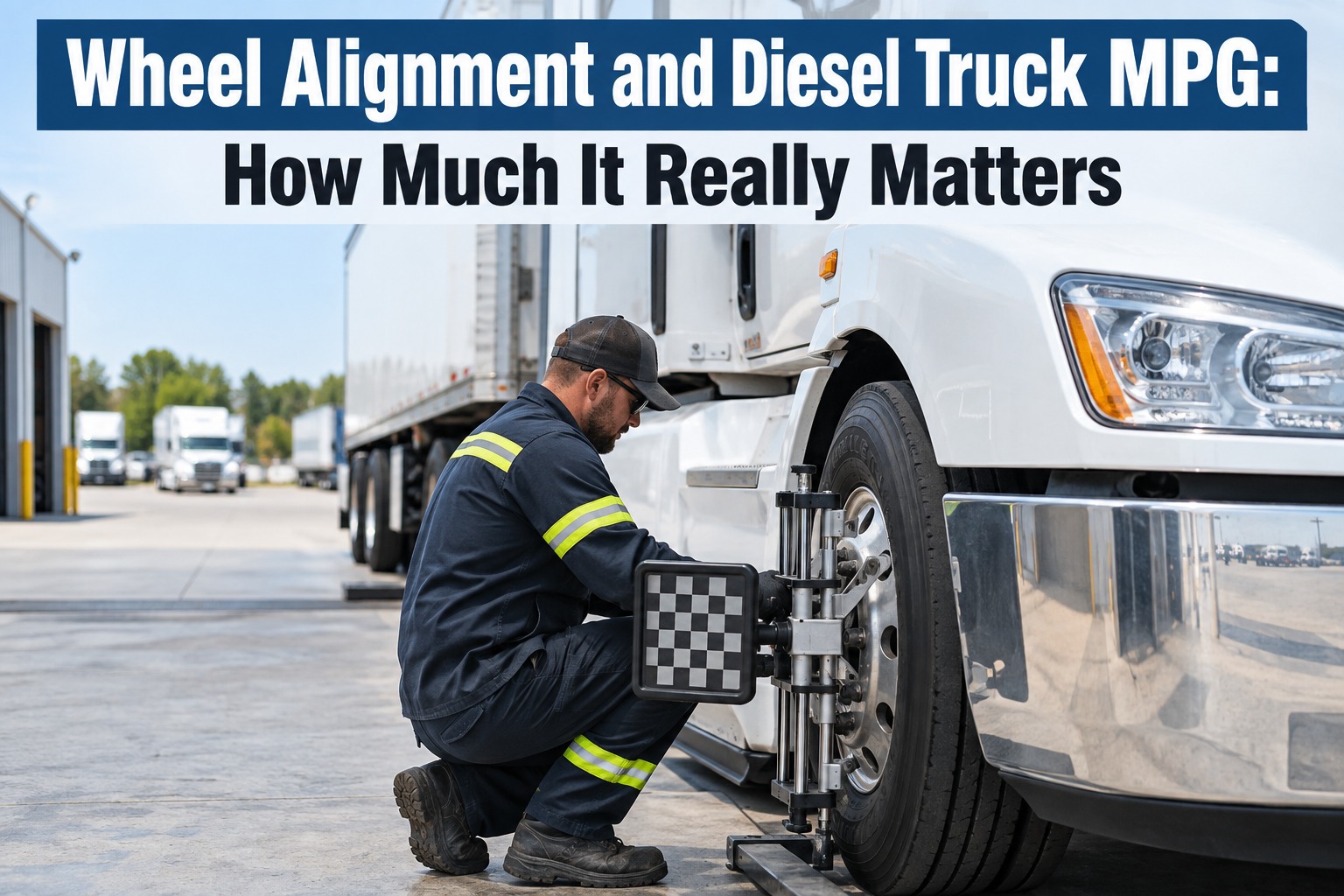
Wheel Alignment and Diesel Truck MPG: How Much It Really Matters
No warning light. No violation. Just 2–2.5% MPG gone and 30–40% of your tire life scrubbed away — every mile, invisibly. Here's the real cost, and the ROI math.
The Physics — Why a Fraction of an Inch Costs So Much
Misalignment doesn't just point a wheel slightly wrong — it drags the tire sideways against the road on every rotation, and the numbers scale fast:
The Cost Cascade — Three Bills From One Problem
A single out-of-spec alignment shows up as three separate line items, only one of which most fleets ever connect back to the cause:
Fuel — The Invisible Daily Bleed
Extra rolling resistance costs 2–2.5% MPG on front misalignment alone, up to 3–5% on a fully misaligned rig. At 120,000 mi/yr and 6 MPG, that's roughly 400 extra gallons burned — money gone with no event to trace it to.
Tires — The Budget-Wrecker
Just 0.5° of misalignment cuts tire life 30–50%, and 1/16" of toe can destroy a set in 20,000 miles through scrubbing. A full Class 8 tire set runs $8,000–$15,000 — so premature wear across six-plus tires becomes a serious replacement bill.
Suspension & Safety — The Downstream Damage
When alignment is off, bushings, tie rods, and springs wear unevenly and fail early. A misaligned steer axle also lengthens stopping distance and causes lane drift — turning a fuel problem into a safety one.
The ROI Model — One Truck, One Year
The case makes itself. Here's the math on a single long-haul Class 8 unit at 120,000 mi/yr, 6 MPG, diesel ~$3.90/gal:
Figures are illustrative and vary with lane, load, fuel price, and tire spec — but the ratio holds: alignment is one of the highest-ROI PMs a fleet runs.
The Number That Actually Catches Misalignment — A Sudden, Unexplained MPG Drop
Because there's no warning light, misalignment hides until you're watching the right metric — and that metric is fuel economy per truck, trended over time. A 5–10% MPG decline with no change in route, load, or driver is one of the clearest signals a truck is out of spec, especially after a pothole, curb strike, or storm-route impact. The fleets that catch it early aren't inspecting alignment more often — they're watching per-truck MPG and tire-wear patterns, and treating an unexplained drop as an alignment work order, not a mystery. Tie fuel data to the maintenance record and the invisible problem becomes a visible, schedulable one. Start a free trial and turn an MPG dip into a scheduled alignment check.
The Alignment PM Cadence — When to Check
Alignment isn't a one-time setup. Build these triggers into the PM schedule so a truck never runs out of spec for long:
Total alignment means all three axle groups referenced to the frame centerline and tracking parallel — not just a front-end "toe-and-go." Dog-tracking from misaligned trailer axles destroys tires and burns fuel even when the steer axle is perfect.
Watch the fuel number, catch the alignment problem — before it eats a tire set and a year of diesel.
Replace paper DVIRs and PM spreadsheets with mobile inspections, per-truck MPG and tire-wear trending, and alignment PM triggers that fire an automated work order on an unexplained drop — lifting PM compliance above 95% and turning fuel data into action. Start a free trial or talk to our team.
Frequently Asked Questions
How much MPG does misalignment actually cost?
Out-of-spec front alignment costs roughly 2–2.5% MPG, and a fully misaligned rig 3–5%, from the extra rolling resistance of tires scrubbing sideways. On a long-haul Class 8 unit that's about $3,400–$5,700 in wasted diesel a year — against a total alignment that costs a few hundred dollars.
How much does misalignment shorten tire life?
Just 0.5° of misalignment can cut tire life 30–50%, and 1/16" of toe error can destroy a set in about 20,000 miles through sideways scrubbing. With a full Class 8 tire set costing $8,000–$15,000, alignment discipline protects the single largest consumable in the fleet.
What's the earliest sign a truck is misaligned?
Usually an unexplained 5–10% drop in fuel economy with no change in route, load, or driver — because there's no warning light. Physical tells follow: pulling or drifting, an off-center steering wheel, feathered or one-sided tire wear, and squeal on low-speed turns.
Why isn't a front-end alignment enough for a Class 8?
Because a tractor-trailer has three axle groups — steer, drive tandems, and trailer — that all have to track parallel to the frame centerline. Over 70% of trucks run misaligned tandems, causing the steer axle to fight to compensate and the trailer to "dog-track," scrubbing tires and burning fuel even with a perfect front end.
When should a fleet check alignment?
At commissioning and each major (C) service, after any pothole/curb/debris impact, on any misalignment symptom, and on any unexplained MPG drop. Building these triggers into the PM schedule keeps a truck from running out of spec — and quietly wasting fuel and tires — for months.
How does Truck Inspection & Maintenance help?
It trends fuel economy and tire wear per truck, so an unexplained MPG drop or a developing wear pattern automatically fires an alignment work order — and keeps the inspection, repair, and PM records audit-ready. Fuel data stops being a report you read after the fact and becomes a maintenance trigger. Start a free trial or contact us.
A few hundred dollars of alignment protects thousands in diesel and tires. The only reason fleets skip it is that the cost is invisible — until you trend the MPG.
Per-truck fuel and tire-wear trending, alignment PM triggers, and automated work orders on an unexplained MPG drop — one platform that makes the invisible cost visible and turns it into a scheduled, high-ROI fix.