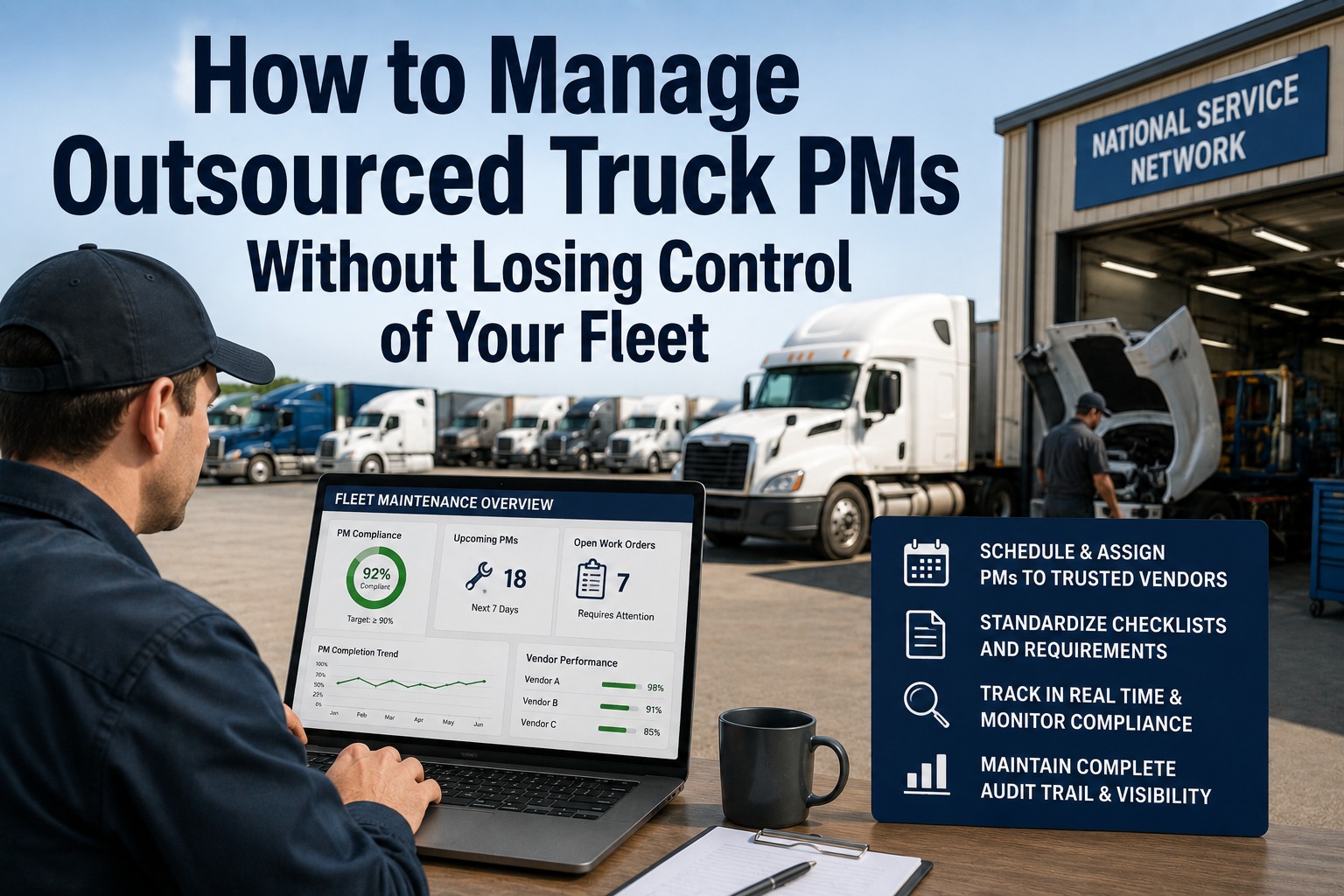
Outsourcing PMs looks like a win on paper. A national vendor network puts a certified shop within 25 miles of every truck on every route, converts the fixed cost of in-house mechanics into a variable cost per event, and lets fleet managers focus on dispatch instead of wrench time. What it does not do — and what most fleets discover after their first DOT audit — is transfer regulatory responsibility. Under the Federal Motor Carrier Safety Regulations, the motor carrier remains 100% liable for compliance even when maintenance is fully outsourced. If a vendor shop misses a brake defect and the truck causes a roadside OOS violation, the citation lands on your CSA score, not the vendor's. If a mechanic fails to certify a repair per 49 CFR 396.11, your carrier absorbs the audit finding. The upside of outsourcing is real; the downside is a slow-motion loss of control that shows up as rising comeback rates, ballooning invoice line items, missing PM records, and a fleet history spread across 40 different shop databases nobody can pull into one report. The fix is not to bring maintenance back in-house. The fix is to install a control system on top of the vendor network — a documented workflow that governs authorization, quality, records, and cost with the same rigor you would apply to an internal shop. Fleets running that control system report 95%+ PM compliance, comeback rates under 3%, and the ability to pull any truck's entire maintenance history in under 60 seconds regardless of which vendor did the work. This guide walks through the 5 control levers that keep outsourced PMs accountable, the vendor SLA structure that actually gets enforced, the KPIs that surface a failing vendor before your CSA score does, and how the free Truck Inspection & Maintenance app pulls every vendor's PM records into one audit-ready fleet history. Sign up free for up to 3 vehicles or talk to our team for larger fleet rollouts.
How to Manage Outsourced Truck PMs Without Losing Control of Your Fleet
Vendor networks scale you nationally. A control system keeps you compliant. Here is the playbook top fleets use to run both.
The Uncomfortable Truth About Outsourcing
The pitch from every fleet-management provider is identical: outsource maintenance, save money, focus on your core business. What none of the brochures highlight is the regulatory line that never moves:
If your fleet outsources functions such as vehicle maintenance, driver training, accident management, driver qualification files, drug and alcohol testing compliance, or driver hiring, your company remains responsible for complying with all the requirements outlined in the Federal Motor Carrier Safety Regulations.
The Citation Goes on Your DOT Number
Roadside OOS violations from missed vendor work — brakes, tires, lights — hit your carrier's CSA percentile, not the shop's business license. FMCSA audits your DOT number, not your vendor.
The Audit Trail Is Your Problem
49 CFR 396 requires 12+ months of maintenance records producible on demand. If those records are scattered across 40 vendor invoices, the burden of assembly is yours — regardless of who did the wrench work.
The Liability Follows the Motor Carrier
Post-crash litigation examines who owned the safety program, not who signed the last invoice. Weak vendor oversight is treated as negligent safety management, exposing the carrier to punitive damages.
The 5 Control Levers That Keep Vendors Accountable
Fleets running successful outsourced PM programs have installed the same 5-lever control system on top of their vendor network. Each lever answers a specific failure mode:
Authorization Gate
No work happens without a pre-approved authorization number tied to a specific truck, service tier, and dollar ceiling. Prevents scope creep, upsells, and "while we're in there" line items that add 20–40% to every invoice.
SLA With Real Teeth
Turnaround-time, comeback rate, and communication-response KPIs written into every vendor contract — with penalties for miss and rewards for exceed. Without written SLAs, vendor performance drifts to the vendor's convenience, not yours.
Centralized Record Repository
Every vendor invoice, work order, DVIR sign-off, and repair certification pushed into one system tied to the truck's VIN — not sitting in 40 separate shop databases. Audit prep becomes a search filter, not a fire drill.
Vendor Scorecards Monthly
Every vendor scored monthly on 4 KPIs: cost per PM, turnaround time, comeback rate, communication response. Underperformers get corrective conversations; repeat failures rotate out of the approved network. Data ends the loyalty-vs-performance debate.
Named Accountability Owner
One named person on your side owns vendor coordination for every event. Not a job description — an actual name. When a vendor's work fails, they know who calls, and it is the same person every time. Managed programs beat referral services here.
The Vendor SLA That Actually Gets Enforced
Contract language matters less than measurable thresholds. Every outsourced PM contract needs these four numbers written into the SLA, with defined consequences for missing them:
Truck in → truck out
< 8 hours for PM-B
Same issue in 30 days
Estimate + status updates
Status every 4 hrs
Invoice + parts + tech notes
Comeback Rate Is the Single Best Vendor Metric
Every other KPI can be gamed. Turnaround time gets shorter by skipping steps. Cost drops by using cheaper parts. Communication scores rise by sending templates. But comeback rate — how often a truck returns for the same defect within 30 days — measures whether the vendor actually fixed the problem. Fleets that track nothing else at least track comeback rate. Anything above 5% is a vendor conversation; anything above 8% is a vendor rotation.
The 3 Outsourcing Models — And Which Fits Your Fleet
Not every fleet needs full outsourcing. Match the model to your fleet size, geographic footprint, and existing in-house capability:
Hybrid In-House + Vendor
PM In-House + Emergency Outsourced
Fully Outsourced National Network
Pull every vendor's PM records into one audit-ready fleet history.
Truck Inspection & Maintenance replaces the 40-vendor invoice sprawl with one system that tracks every scheduled PM, every completed work order, every DVIR sign-off, and every repair certification per VIN. Vendor scorecards update automatically. SLA thresholds trigger alerts. Comeback rates surface in the dashboard before they become audit findings. Free forever for up to 3 vehicles with no hardware. Create your free account in 10 minutes or contact our expert team for a fleet demo.
The 6 Warning Signs Your Vendor Is Failing
Bad vendor performance rarely announces itself. It shows up as a pattern in the data. Watch for these six signals — any two together warrant a vendor conversation:
Rising Line-Item Count Per Invoice
Same PM, more "found while inspecting" items every quarter. Legitimate wear-related discoveries plateau; upsell-driven counts trend upward. Trend the average line count per vendor per PM tier.
Comeback Rate Above 5%
Same defect returning within 30 days signals rushed diagnosis or corner-cutting on parts. Comeback rate above 5% is a yellow flag; above 8% is a rotate-out threshold.
Missing Documentation on Complex Repairs
Vendor delivers invoice but no tech notes, no parts numbers, no diagnostic printout. Legitimate shops document what they did; failing shops send a line item and a total.
Turnaround Times Creeping Longer
4-hour PM-A drifting to 6 hours, then 8. Vendor's own workload grew, your fleet became the low-priority customer. Watch for schedule slippage that gets normalized.
Estimates Missing or Delayed
Vendor starts work before estimate is approved, invoices retroactively. Blows the authorization gate and eliminates cost control. Once tolerated, it becomes their standard practice.
Roadside OOS on Recently-Serviced Trucks
A truck that had PM at Vendor X last week and gets an OOS violation this week for a defect that PM should have caught. Single event = incident; second event = pattern; third event = terminate.
Frequently Asked Questions
Does outsourcing PM transfer regulatory responsibility to the vendor?
No. Under the Federal Motor Carrier Safety Regulations, the motor carrier remains 100% responsible for compliance regardless of who performs the maintenance. If a vendor misses a defect that later causes a roadside OOS violation, the citation lands on your DOT number and impacts your CSA score — not the vendor's business license. Post-crash litigation examines who owned the safety program, and weak vendor oversight is treated as negligent safety management. Outsourcing shifts the wrench work; it does not shift the regulatory burden.
What is comeback rate and why does it matter more than other vendor KPIs?
Comeback rate tracks how often a vehicle returns to the same vendor for the same issue within 30 days. It matters more than other KPIs because every other metric can be gamed — turnaround time gets shorter by skipping steps, cost drops by using cheaper parts, communication scores rise by sending template updates. Comeback rate directly measures whether the vendor actually fixed the problem. Industry benchmark is under 3%. Anything above 5% is a vendor conversation; anything above 8% is a rotate-out threshold. Fleets that track only one KPI at least track this one.
How do I keep audit-ready records when 40 different vendors service my fleet?
Install a centralized record repository that pulls every vendor invoice, work order, DVIR sign-off, and repair certification into one system tied to each truck's VIN. Instead of chasing 40 separate shop databases at audit time, DOT audit prep becomes a filter-and-export operation. Under 49 CFR 396, maintenance records must be retained and producible on demand — the burden of assembly is yours regardless of who did the work. Modern fleet maintenance software eliminates this problem by treating vendor documentation as fleet documentation.
What is the difference between a managed maintenance program and a referral service?
A managed program assigns a named accountability owner who carries responsibility for the fleet's experience across all events, all locations, and all trucks. When a vendor's work fails, one contact has the authority and relationship with the shop to resolve it. A referral service simply routes trucks to the nearest network shop and hands you an invoice. Referral services scale reach; managed programs scale accountability. For fleets running multi-state routes, the real value is not the repair work — it is the consistent maintenance record and single point of coordination when something breaks.
Can outsourcing PM actually save money vs in-house?
Yes, but only with strong vendor oversight. Outsourcing converts fixed costs (mechanics, facilities, tools) into variable costs (per-event billing), gives access to fleet-level pricing on parts, and eliminates carrying costs on shop space. Without oversight, invoices creep 20–40% higher via upsells and "while we're in there" line items, comeback rates rise, and unscheduled failures multiply. The math works when the 5 control levers — authorization, SLA, records, scorecards, named owner — are all installed. Without them, outsourcing becomes more expensive than in-house within 18 months. Talk to our team to model your fleet's outsourcing math.
How does Truck Inspection & Maintenance help manage outsourced vendors?
Truck Inspection & Maintenance replaces the 40-vendor invoice sprawl with one central system tied to VINs. PM schedules track mileage, engine hours, and calendar simultaneously — regardless of which vendor performs the work. Every invoice, work order, DVIR, and repair certification imports to one dashboard. Vendor scorecards update automatically on turnaround time, comeback rate, communication, and documentation completeness. Alerts fire when any SLA threshold slips. DOT audit prep collapses from weeks to hours because every record is filter-and-exportable by date, vehicle, or vendor. Free forever for up to 3 vehicles. Sign up in 10 minutes.
Outsourcing scales your reach. A control system keeps your CSA score and audit trail intact.
Every day a fleet runs on outsourced PM without a control system, invoices creep, records scatter, and CSA exposure builds silently. Truck Inspection & Maintenance installs the full 5-lever control system on top of any vendor network — authorization gates, SLA tracking, centralized records, vendor scorecards, named ownership. Free forever for up to 3 vehicles. No hardware, no contract, no credit card to start.