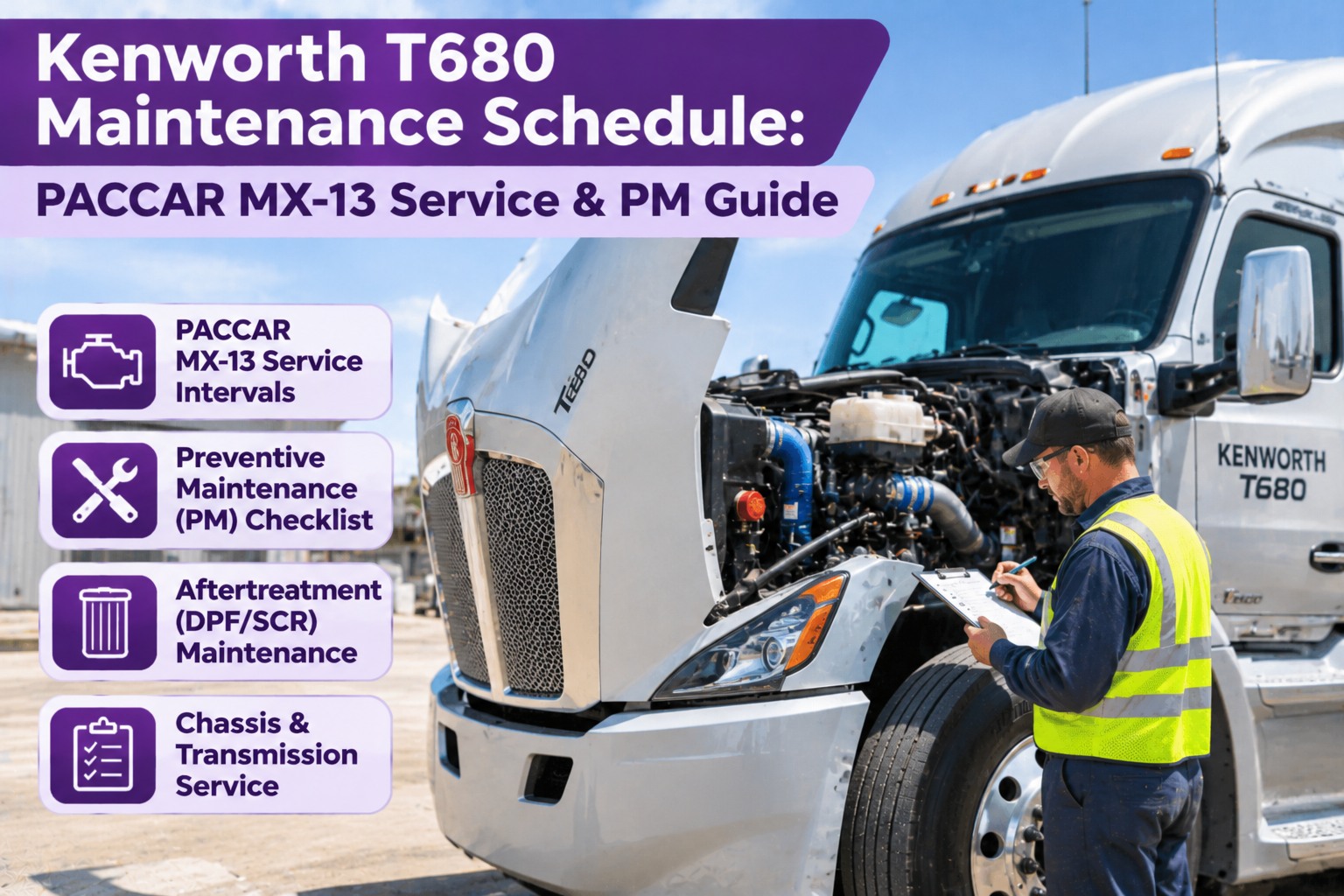
Everyone quotes the same number for a Kenworth T680 oil change 75,000 miles and for a lot of trucks it's wrong by half. PACCAR doesn't set the MX-13's intervals by fuel economy the way Cummins or Detroit do. It sets them by idle time, and one truck that creeps over 20% idle loses a third of that interval overnight. Get the duty profile wrong and you're either wasting services or voiding coverage. This guide lays out the real PACCAR MX-13 schedule for the T680 — and the severe-duty surprise most fleets miss. Start free and put every T680 on the right profile.
Kenworth T680 Maintenance Schedule: PACCAR MX-13 Service & PM Guide
PACCAR Measures Idle, Not Fuel Economy
This is the one thing that makes the MX-13 schedule different from every other Class 8 engine. There's no miles-per-gallon test anywhere in PACCAR's definition. The oil interval turns on how much the truck idles, and the linehaul class splits on a single line — 20% idle time — that's worth a third of the interval.
The Severe-Duty Surprise: The Biggest Cuts Are Outside the Engine
Most severe-duty schedules shorten the engine work and leave the rest alone. PACCAR does the opposite. Move a T680 to severe duty and the oil interval tightens — but the real reductions land on the driveline and chassis, the items most PM schedules never even list.
That wheel-end figure is the one that bites — a 76% cut on a part that almost never appears on a homegrown PM list, which is exactly how severe-duty T680s end up with a bearing failure nobody saw coming. Track the chassis items, not just the oil. Book a demo to put the chassis intervals on the board too.
The Full MX-13 Interval Reference
Here's the complete picture across PACCAR's three duty classes. Find your truck's profile column and read down — oil sets the rhythm, but the driveline and aftertreatment run on their own clocks.
The MX-13 One-Box Aftertreatment
The DPF, DEF system and SCR catalyst live in a single aftertreatment package, and on the MX-13 the headline service is a dry ash cleaning around 300,000 miles — sooner on severe duty, where more frequent regens pack ash in faster. The DEF pump filter and SCR sensors fall in the same window.
One Engine, Two Trucks, One Record
The MX-13 is identical in a T680 and a Peterbilt 579 — but TruckTech+ and SmartLINQ don't talk to each other, so mixed PACCAR fleets end up running two disconnected PM systems for one engine. Put every interval under the VIN instead and the whole fleet shares one due board.
TruckTech+ Tells You — It Doesn't Schedule You
Kenworth's TruckTech+ is a strong fault-alert and remote-diagnostic layer, and it belongs in the mix. But a telematics alert fires when something is already wrong; it doesn't group the next oil, DPF and wheel-end service into a planned visit, hold the duty profile per truck, or keep the warranty record. That's the PM loop's job — and on a mixed T680-and-579 fleet, it's the only way to run one standard instead of two. Book a demo to see telematics and the PM loop working together.
Why Kenworth Fleets Run T680 PM in Software
Frequently Asked Questions
It depends on idle time, not fuel economy. Linehaul under 20% idle runs 75,000 miles; linehaul at 20% idle or more falls to 50,000; severe or vocational duty is 30,000 — all on API CK-4 oil, with hour caps that idle-heavy trucks can hit first. Book a demo to set oil intervals by idle share.
Because PACCAR shortens the driveline and chassis items hardest. Severe duty takes steer wheel ends from 500,000 down to 120,000 miles and the TX-12 transmission from 500,000-plus to 250,000 — cuts far bigger than the oil, on parts most PM lists forget. Book a demo to track the chassis intervals.
The dry ash cleaning falls around 300,000 miles on linehaul duty and compresses toward 150,000 on severe duty, where more frequent regens load ash faster. The DEF pump filter sits in the same window, and tracking regen frequency is the best early warning. Book a demo to see aftertreatment tracking.
It's a real risk on the MX-13 — non-genuine fuel filters can trigger low-pressure fault codes or cause severe engine damage, and off-spec oil voids the published interval. Genuine PACCAR parts and CK-4 oil are what keep the schedule and the warranty intact. Book a demo to log parts and specs per service.
Stop Running Your T680 on a Half-Remembered Number
Truck Inspection & Maintenance Management Software puts the right PACCAR interval on every MX-13 by idle share and duty, tracks the chassis items that severe duty cuts hardest, and keeps a warranty-ready history under each VIN.