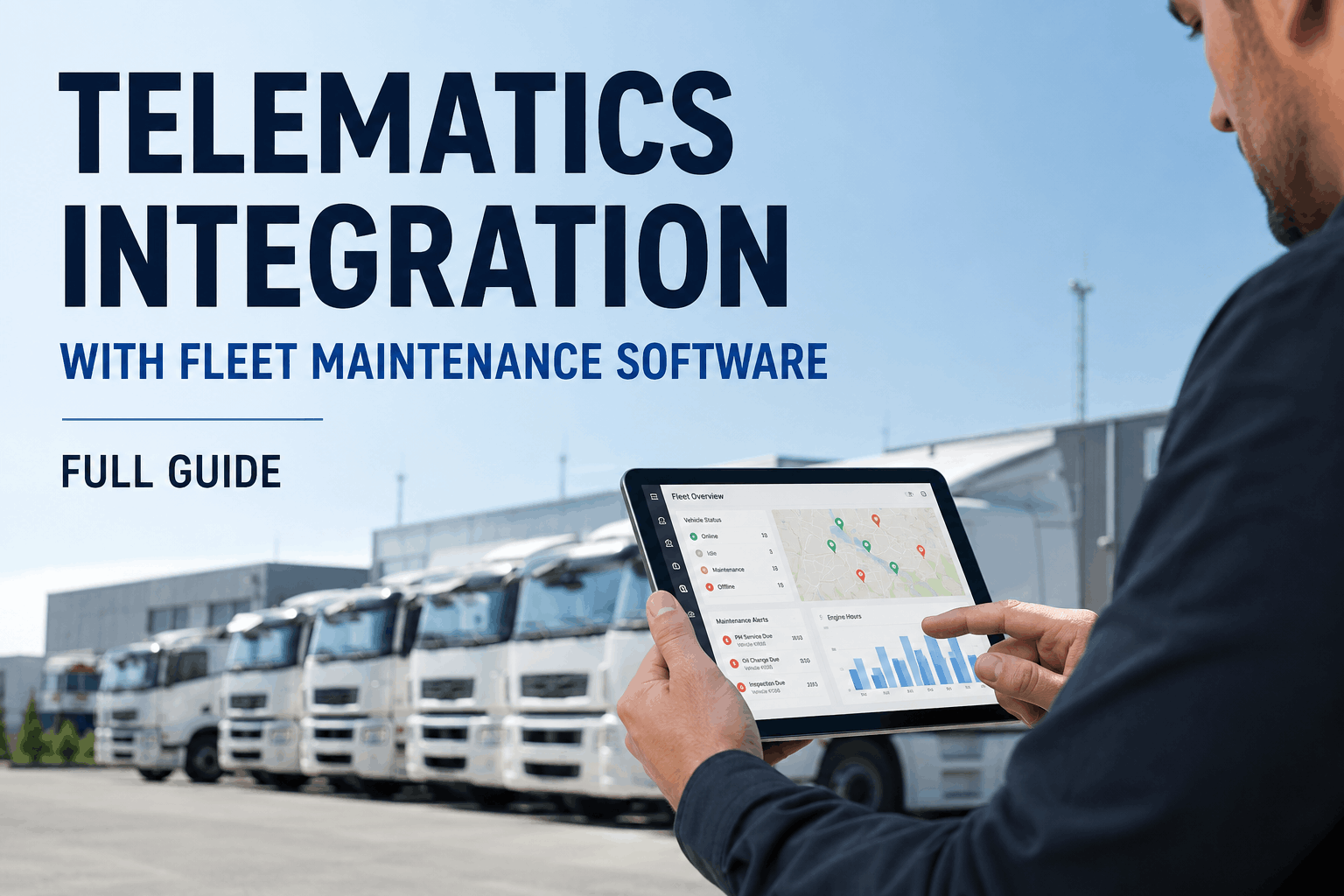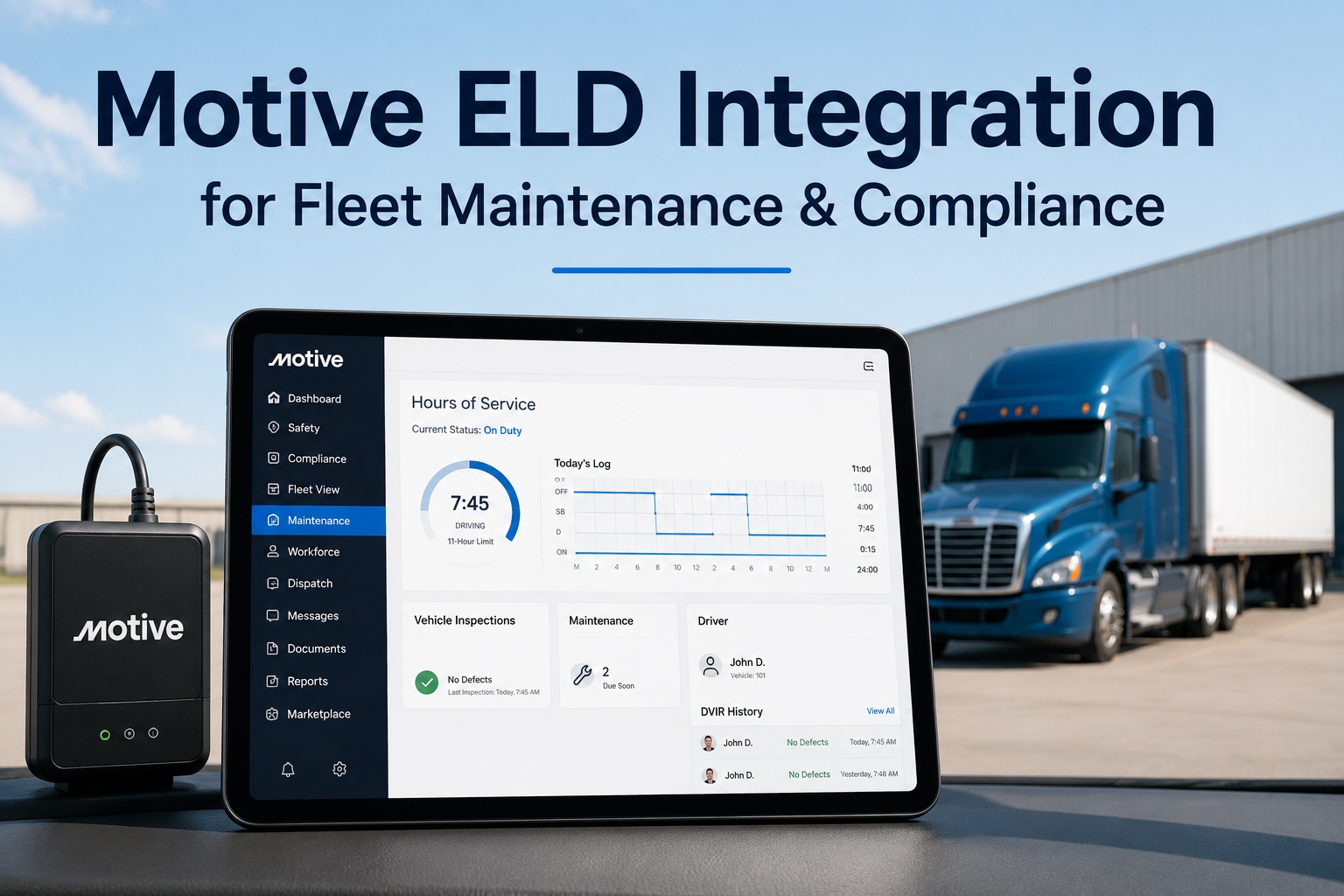
Your Motive ELD already knows more about your fleet than your maintenance system does. Every mile driven, every engine fault code, every hours-of-service log, every DVIR a driver submits — it's all flowing through the Vehicle Gateway plugged into each truck's diagnostic port. The problem is where it stops. In most fleets, that data lives inside the Motive app while maintenance runs on a separate spreadsheet or platform, so a defect a driver logs at 6 a.m. never reaches the shop, and a truck's real usage never drives its PM schedule. A proper Motive ELD integration ends that split — pulling HOS, diagnostics, odometer, and DVIR data into one maintenance platform where it triggers work, not just reports. This guide covers exactly what data flows, what it automates, and how Truck fleet management software turns your Motive feed into centralized maintenance and compliance.
Integration Guide · Fleet Compliance · 2026
Motive ELD Integration for Fleet Maintenance & Compliance
Connect your Motive ELD to one maintenance platform — centralizing DVIRs, preventive maintenance, HOS data, work orders, and compliance instead of toggling between apps.
~75%
Of fleet budgets go to fuel & service costs
2-way
DVIR sync closes defects across both systems
Minutes
OAuth setup — no API keys or dev work
395
CFR Part the Motive ELD records HOS under
Why the Data Split Costs You
Motive is exceptional at compliance and telematics — it was built ELD-first. But an ELD platform isn't a maintenance platform. When the two don't talk, you get the exact failures the integration exists to prevent: unsafe dispatches, duplicate data entry, and PM schedules disconnected from how the truck is actually used.
Two disconnected systems
DVIR defects sit in Motive, unseen by the shop
Odometer & hours re-typed by hand
Fault codes noticed only at breakdown
Two apps, two logins, two records
One integrated platform
Defects auto-create work orders instantly
Usage data syncs itself, no re-entry
Fault codes flag maintenance in real time
One source of truth for the whole fleet
What Data Actually Flows
A real integration isn't a logo on a slide — it's specific data streams moving automatically. Here's exactly what comes across from the Motive Vehicle Gateway into your maintenance platform, and why each one matters:
DVIR & inspection logs
Pre- and post-trip inspection results and reported defects flow straight into your maintenance queue.
Hours of Service
Duty status and HOS-remaining data, recorded under 49 CFR Part 395, kept beside your compliance records.
Engine diagnostics & DTCs
Fault codes and diagnostic trouble codes surface the second they trigger — not at the next breakdown.
Odometer & engine hours
Real usage meters that drive PM scheduling by actual wear, not a fixed guess.
GPS & location
Live vehicle location and route history tied to each asset's maintenance profile.
Fuel card transactions
Motive Card spend imported automatically for accurate cost tracking, budgeting, and IFTA.
The Two-Way DVIR Sync
This is the capability that makes the integration more than a data mirror. A one-way feed shows you defects; a two-way sync closes the loop — so a defect logged in Motive and fixed in your maintenance platform automatically clears on both sides, preventing an unsafe dispatch:
Driver reports in Motive
A pre- or post-trip DVIR flags a defect in the Motive Driver App — brakes, lights, a leak.
Work order auto-created
The defect flows into the maintenance platform and opens a work order with all the detail attached — no re-entry.
Fix resolves both sides
When the repair is marked complete, the matching DVIR defect in Motive closes automatically — the truck is cleared to dispatch.
Why it matters: without the return path, a fixed truck can still show an open defect in Motive — and a cautious dispatcher holds it, or a careless one sends it out unsafe. Two-way sync means no duplicate work, fewer delays, and no dispatching a vehicle that's actually been repaired.
Free · Up to 3 Vehicles
Connect Motive in minutes, not weeks
Truck fleet management software pulls your Motive DVIRs, HOS data, engine faults, and odometer readings into one maintenance platform — auto-creating work orders, scheduling PM by real usage, and keeping compliance records audit-ready. Standard OAuth connection, no API keys, no IT project. Sign up free for up to 3 vehicles and link your Motive feed today.
What the Integration Automates
Once the data flows, four maintenance workflows that used to eat hours of manual effort start running themselves. This is where the integration pays for itself:
Usage-based PM scheduling
PM triggers off real odometer and engine-hour data from the ELD, so service aligns with how each truck is actually driven — catching high-idle and high-mileage units the calendar misses.
Fault-code work orders
A diagnostic trouble code from the Gateway auto-generates a maintenance flag, so an engine problem gets triaged in the shop before it becomes a roadside breakdown.
Defect-to-repair routing
DVIR defects become work orders with zero manual handoff, and the two-way sync closes them on both platforms when the fix is done.
Unified cost tracking
Fuel-card spend plus service data in one place gives a true cost-per-vehicle picture — the visibility that turns your biggest expense line into a managed number.
Real Integration vs. a Checkbox
Not every "Motive integration" is equal. Some sync everything in real time; others just pull GPS pings on an interval and leave HOS and inspections as manual entries. Before you trust one, confirm it clears this bar:
DVIR defects flow in automatically and sync back on resolution
Engine fault codes and DTCs create maintenance flags in real time
Odometer and engine hours drive PM schedules, not manual meter reads
HOS and inspection records are visible in the maintenance view
Setup runs on OAuth in hours — no custom API work or IT project
Works alongside a mixed-ELD fleet if you run more than one provider
Frequently Asked Questions
What does a Motive ELD integration actually do?
It moves the data your Motive Vehicle Gateway already collects — DVIRs, HOS, engine diagnostics, odometer, GPS, and fuel-card spend — into your maintenance platform automatically. Instead of that data living only in the Motive app, it triggers work orders, drives PM scheduling by real usage, and keeps compliance records in one place, eliminating the double entry between two systems.
What is two-way DVIR sync and why does it matter?
A one-way feed shows you a driver's reported defect; two-way sync closes the loop. When the defect is resolved in your maintenance platform, the matching DVIR defect in Motive closes automatically. That prevents duplicate work and — more importantly — stops a repaired truck from still showing an open defect that either delays dispatch or risks an unsafe one. Contact our team to see the sync live.
Does the integration require new hardware or IT work?
No. If your trucks already run the Motive Vehicle Gateway, the integration connects through a standard OAuth authentication flow — no API keys, no developer involvement. Most fleets complete setup in hours, and data begins flowing within minutes. If an integration needs a custom API project, that's a red flag for any fleet under 200 trucks.
How does ELD data improve preventive maintenance?
Motive records real odometer and engine-hour data through the diagnostic port. Feeding that into PM scheduling means service triggers off how each truck is actually used — not a fixed calendar. High-idle and high-mileage units get flagged before wear becomes a defect, and diagnostic trouble codes can auto-create work orders the moment they trigger.
Can I keep using Motive for HOS and compliance?
Yes. The integration doesn't replace Motive — it complements it. Motive remains your FMCSA-registered ELD for HOS logging and roadside inspections under 49 CFR Part 395, while the maintenance platform centralizes the inspection, PM, and work-order side. You keep the compliance tool you trust and add the maintenance depth an ELD platform isn't built for.
Does it work if I run a mixed-ELD fleet?
Good integrations do. If you run Motive on company trucks and another provider on owner-operators, the right platform pulls data from multiple sources into one maintenance and compliance view — so you're not managing separate systems per ELD brand. Sign up free to centralize your fleet regardless of ELD mix.
One Platform. All Your Fleet Data.
Stop toggling between Motive and your maintenance system.
Truck fleet management software connects your Motive ELD to centralize DVIRs, preventive maintenance, HOS data, work orders, and compliance — with two-way defect sync, usage-based PM, and fault-code work orders. Free for up to 3 vehicles. OAuth setup in minutes. No new hardware, no contracts.