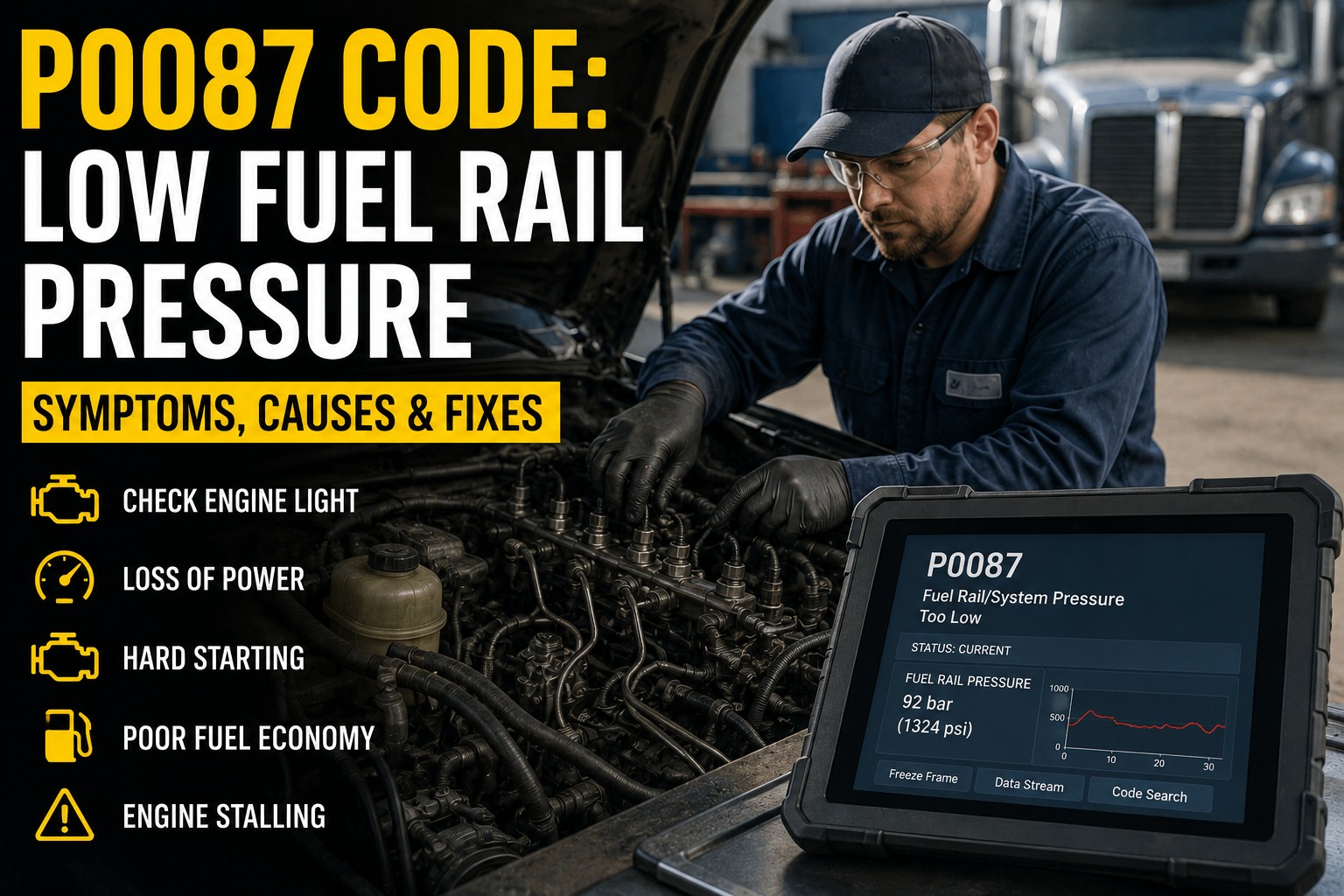
A P0087 code is your diesel's ECM reporting that fuel rail pressure has fallen below what it's asking for — the truck wants more pressure than the fuel system can deliver. Most of the time, this is good news disguised as a warning: the single most common cause is a clogged fuel filter, a $15 to $80 fix that accounts for roughly a third of all cases. But P0087 carries a darker possibility on modern trucks. On CP4.2-equipped Ford and GM diesels, this exact code can be the only warning you get in the weeks before the high-pressure pump self-destructs and sends metal shrapnel through the entire fuel system — a $15,000 to $30,000 catastrophe. The code itself doesn't know which one you're facing, which is why diagnosing it in the right order matters so much. This guide covers P0087's symptoms, causes ranked by likelihood, the correct cheap-to-expensive diagnostic sequence, and real repair costs — plus how truck maintenance software catches the pressure shortfall before it strands a truck.
Diesel Fault Code Guide · 2026
P0087: Fuel Rail / System Pressure Too Low
Symptoms, causes, diagnosis, and repair costs for the low-fuel-pressure code — usually a cheap filter fix, occasionally the first sign of a pump disaster.
What P0087 Actually Means
Your ECM constantly commands a target fuel rail pressure and watches the fuel rail pressure sensor to confirm the system delivers it. When actual pressure falls below the commanded value for too long, or by too much, it stores P0087 and lights the check-engine lamp. In plain terms: the engine is asking for more fuel pressure than the system can produce. It's the exact opposite of its sibling code:
Pressure too LOW
A delivery shortfall — the system can't build or hold the pressure the engine needs. Weak pump, restriction, air, or a leak bleeding pressure away.
Pressure too HIGH
Regulation failed on the high side — the system over-pressurizes. The opposite end of the same fuel-pressure circuit.
Symptoms of P0087
Low rail pressure starves the injectors, and the engine shows it — usually worst under load, when demand for fuel peaks. Watch for these signs:
Hard start or no-start
Without enough rail pressure to fire the injectors, the engine cranks long or won't catch.
Stalling under load
Pressure drops out during towing, acceleration, or sustained high load — and the engine dies.
Misfires & rough running
Fuel-starved cylinders stumble, shake, and run unevenly, especially at higher RPM.
Power loss & limp mode
The ECM limits power to protect the engine — noticeable sluggishness and a low ceiling on speed.
Hesitation on acceleration
A lag or stumble when you ask for power, as the system fails to keep the rail fed.
Poor fuel economy
An inefficient, struggling fuel system shows up as declining MPG over time.
The CP4 warning every diesel owner should know
On 2011-2016 Ford and GM diesels with a Bosch CP4.2 pump, P0087 can be the first — and sometimes only — sign of a pump that's beginning to fail internally. US ultra-low-sulfur diesel doesn't lubricate the CP4 well, and when a roller lifter finally fractures, metal shrapnel is driven through the fuel system at extreme pressure in seconds, destroying the rails, injectors, and lines. Before spending anything, inspect the fuel filter housing for metal shavings — if you find metal, do not restart the engine; that's a catastrophic CP4 failure, not a filter. And if P0087 appears alongside P0088, treat it as imminent pump failure and stop driving immediately.
The Causes, Ranked by Probability
The reassuring news: P0087 is usually a routine maintenance issue, not a disaster. Working the likely causes in order keeps you from replacing an expensive pump when a cheap filter was the culprit:
Clogged / overdue fuel filter
~35%A restricted filter chokes fuel flow to the high-pressure pump. By far the most common cause — and the cheapest fix. Always rule this out first.
Weak or failing lift pump
~25%The low-pressure transfer pump can't feed the high-pressure pump enough fuel. On 6.7L Power Stroke, the frame-mounted pump often fails first — check for 45-65 PSI at the secondary filter.
Air in fuel or restricted lines
~18%Kinked, cracked, or crushed lines and air drawn in through a loose fitting both prevent the system from building steady pressure.
Leaking injector return / regulator
~12%Injectors bypassing too much fuel back to the tank, or a worn pressure regulator dumping pressure, both bleed the rail below target.
High-pressure pump (CP3 / CP4)
~10%A worn HPFP loses output capacity, causing a shortfall under load. Least likely by count — but the most serious, and the reason to check for metal shavings.
The Right Diagnostic Order
The golden rule with P0087 is the same as with any pressure code: work cheapest-to-most-expensive and confirm actual pressure before condemning any part. Countless high-pressure pumps get replaced needlessly because a simple filter change was skipped first.
Replace the filter & inspect for metal
Start with a fresh fuel filter — the most common fix. While you're in the housing, inspect closely for metal shavings. Clean means proceed; metal means stop and address a CP4 failure.
Compare desired vs actual rail pressure
With a scan tool, read "Desired" and "Actual" fuel rail pressure at idle, 1,500, and 2,500 RPM. They should track within about 5%. A gap that widens at higher RPM points to a fuel-volume shortfall.
Test the low-pressure (lift) pump
Measure low-side pressure and the pump's current draw and voltage. A weak transfer pump is a frequent, mid-cost cause — confirm it before touching the high-pressure side.
Check lines, air & injector return
Inspect for kinked or leaking lines and air intrusion, then run a return-flow test to find injectors or the regulator bypassing too much fuel back to the tank.
Only then, the high-pressure pump
If the filter, supply, lines, and injectors all check out and pressure still falls short under load, the HPFP is the likely culprit. Confirm it last — it's the most expensive part in the circuit.
Free · Up to 3 Vehicles
Catch the shortfall before it strands a truck
Truck maintenance software streams live fuel-rail-pressure and fault-code data from your fleet, so a filter going restrictive or a lift pump weakening shows up as a trend before P0087 sets and the truck stalls in traffic. Every code is logged with the vehicle, timestamp, and repair history — turning a roadside surprise into a scheduled fix. Sign up free for up to 3 vehicles and stay ahead of fuel-system faults.
Repair Costs, Cheapest to Most Expensive
The range on P0087 is one of the widest of any code — from a pocket-change filter to a five-figure fuel-system rebuild. That spread is exactly why diagnostic discipline pays for itself:
Why the top of the range is so brutal: when a CP4.2 pump grenades, it doesn't fail alone — metal debris contaminates the rails, every injector, and all high-pressure lines at once, so a proper repair replaces the entire fuel system. Catching P0087 early, while it's still a filter or a lift pump, is what keeps you off that end of the chart entirely.
Preventing P0087
Because most P0087 cases trace back to fuel supply and quality, disciplined basics prevent the overwhelming majority of them — and dramatically cut the odds of the expensive version:
Change fuel filters on schedule
The single highest-value habit. On-time filter changes prevent the most common cause outright and protect the pumps downstream from strain.
Use clean, quality fuel
Contamination and water starve and wear the fuel system. On CP4 trucks especially, fuel quality and lubricity additives directly affect pump survival.
Trend rail-pressure data
A slowly widening gap between desired and actual pressure is an early warning. Monitoring the trend flags a weakening supply before it sets a code.
Log every code & repair
A P0087 that keeps returning means the real cause wasn't fixed. A documented history prevents the costly guess-and-replace cycle.
Frequently Asked Questions
What does the P0087 code mean?
P0087 stands for "Fuel Rail/System Pressure – Too Low." It means the ECM detected that actual fuel rail pressure dropped below the pressure it was commanding, for long enough to matter — the engine is asking for more fuel pressure than the system can deliver. It's the opposite of P0088 (pressure too high). On diesels it's a common code, most often tied to fuel supply problems.
Is it safe to drive with a P0087 code?
No. With inadequate rail pressure the engine can stall unexpectedly — including in traffic or under load — which is a real safety risk. And on CP4.2-equipped Ford and GM diesels, continuing to drive risks a catastrophic pump failure that destroys the entire fuel system. Get it diagnosed promptly, and if you find metal shavings in the filter housing or see P0088 alongside it, stop driving immediately. Contact our team about fleet-wide fuel-system monitoring.
What's the most common cause?
A clogged or overdue fuel filter — roughly a third of all cases, and a $15-80 fix. A weak low-pressure lift pump is the next most common, followed by air or restrictions in the fuel lines and leaking injector return flow. The expensive high-pressure pump is actually the least likely culprit by count, which is why you should always rule out the cheap causes first.
Why shouldn't I just replace the fuel pump?
Because most of the time it isn't the pump — and high-pressure pumps get replaced unnecessarily all the time because simple maintenance was skipped. A clogged filter or a weak lift pump costs a fraction of an HPFP and causes the same code. Always replace the filter, test the low-pressure pump, and compare desired versus actual rail pressure before condemning the expensive high-pressure pump.
What is the CP4 pump issue?
The Bosch CP4.2 high-pressure pump, used on many 2011-2016 Ford and GM diesels, relies on diesel for internal lubrication — and US ultra-low-sulfur diesel doesn't lubricate it well. As it wears, a roller lifter can fracture and drive metal debris through the whole fuel system in seconds, causing a $15,000-30,000 repair. P0087 is often the only advance warning, so on these trucks the code deserves immediate, careful diagnosis.
How much does a P0087 repair cost?
It has one of the widest ranges of any code. A fuel filter is $15-80, a pressure sensor $150-400, a lift pump $200-600, and lines or a regulator $200-800. A diesel injector set runs $1,000-3,000, and a full high-pressure fuel system after a CP4 failure can reach $15,000-30,000. Diagnosing in the right order is what keeps most repairs at the cheap end. Sign up free to track fault codes and repairs across your fleet.
Fix the Filter, Not the Pump
Turn fuel-pressure codes into documented, data-driven repairs.
Truck maintenance software streams rail-pressure and diagnostic data from your trucks, trends a weakening fuel supply before it sets a code, and logs every P0087 with the vehicle, timestamp, and repair history — so you fix the real cause once and stay clear of a five-figure pump disaster. Free for up to 3 vehicles. Works with your existing telematics, no contracts.