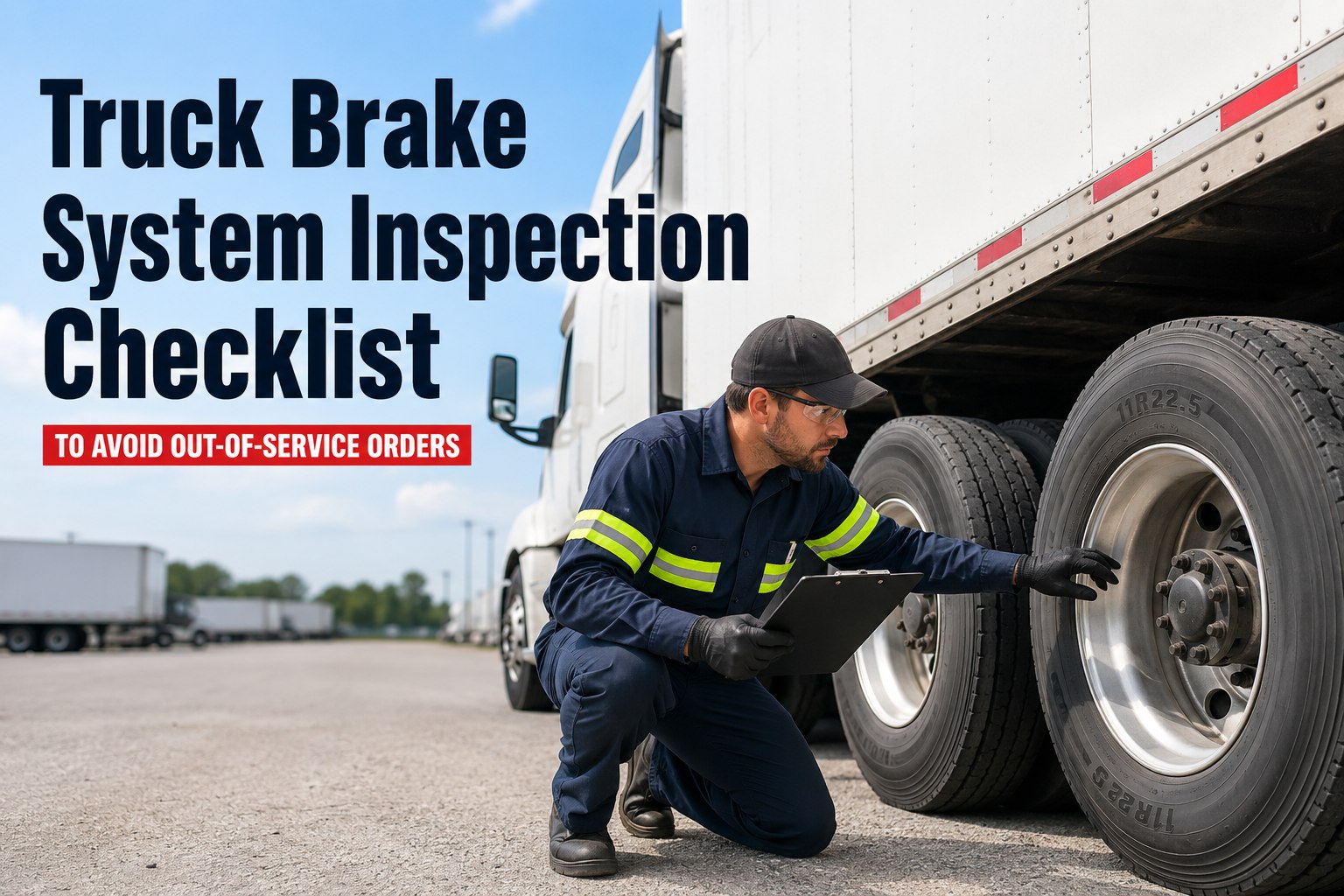
Brakes are the number-one reason commercial trucks get pulled out of service — year after year, no contest. Brake-related violations are the leading cause of out-of-service orders at roadside, accounting for roughly a quarter of all OOS violations during CVSA's International Roadcheck, and FMCSA research ties brakes to 29–30% of all truck crashes. The brutal part is how little it takes: under the CVSA 20% rule, if just 20% of a vehicle's brakes are defective or out of adjustment, the entire truck is parked — for a typical 5-axle tractor-trailer with 10 wheel-ends, that's only 2 bad brakes. And a brake can look perfectly fine and still be out of adjustment, which is why a real brake inspection goes beyond a glance to a functional air-brake test and measured pushrod stroke. Under the 2026 CSA overhaul, brake violations now carry the highest severity weighting of any maintenance category. This checklist covers the OOS criteria to beat, the walk-around, the 7-step in-cab air test, and the adjustment limits — so a defect gets caught in the yard, not at the scale house. Truck Inspection & Maintenance standardizes every air-brake check and flags adjustment issues before a truck rolls. Talk to our team to set it up.
Truck Brake System Inspection Checklist
Beat the 20% rule — catch the defect in the yard, not at the scale house.
The 20% Rule — What Parks a Truck
This is the criterion that grounds more trucks than any other, so understand it cold. If 20% or more of a vehicle's (or combination's) service brakes are defective or out of adjustment, the whole vehicle goes out of service — regardless of the stroke reading on any single brake. The math is unforgiving: it takes very few bad brakes to cross the line. Start a free account to flag adjustment drift before it reaches the limit.
Part 1 — The Walk-Around Visual Check
Every brake inspection starts outside the truck, before any in-cab controls. Work each wheel-end and the air system components methodically — most defects that count toward the 20% rule are visible here. Reach our team to attach photo evidence of lining wear to every check.
Linings & Drums/Rotors
- Lining ≥ 1/4" at center (S-cam)
- No cracks/voids wider than 1/16" on edge
- Drums/rotors free of cracks & deep scoring
- No contamination from oil or grease
Chambers & Slack Adjusters
- No mismatched air chamber sizes
- Matching slack-adjuster lengths
- Chambers secure, mounting bolts intact
- No broken/missing pushrod, clevis, springs
Hoses & Tubing
- No damage through the outer reinforcement ply
- No chafing, kinks, or audible leaks
- Fittings secure, no air loss
- Service air connections sound
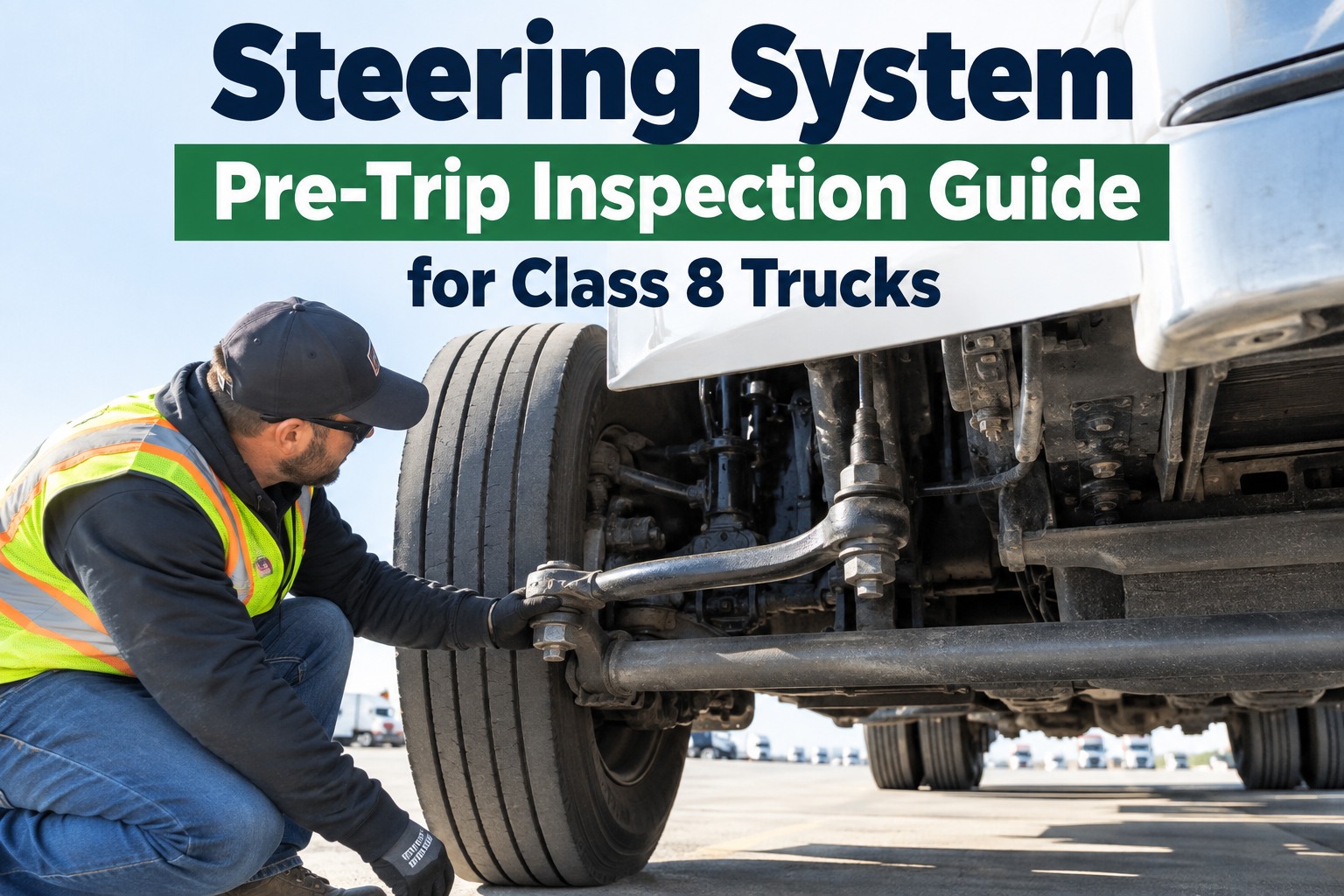
Steering Axle Brakes
- Both front brakes operative — a missing one is automatic OOS
- No mismatched components
- Linings within limit
- No cracked drums
Flag the brake before it crosses the limit
Truck Inspection & Maintenance standardizes the full air-brake check on every driver's phone — pushrod stroke fields, lining-wear photos, and automatic work-order routing the moment a brake is flagged out of adjustment. Catch it in the yard, not at the scale. No hardware, no contracts. Sign up free and keep every brake in spec.
Part 2 — The 7-Step In-Cab Air Brake Test
A visual check isn't enough — the air system has to be tested under pressure. This is the standard in-cab sequence every driver should run before a shift. Open a free account to put this test on every pre-trip.
Pushrod Stroke — Measure It Right
Stroke readings are only valid under the right conditions, and a small pressure error can flip a pass into a fail. Get the setup right or the number means nothing. Talk to our team about logging stroke readings per wheel-end.
Frequently Asked Questions
What is the CVSA 20% brake rule?
If 20% or more of a vehicle's (or combination's) service brakes are defective or out of adjustment, the entire vehicle is placed out of service — regardless of the stroke reading on any single brake. Calculate your threshold by multiplying total brakes by 0.2 and rounding up. For a 5-axle tractor-trailer with 10 wheel-ends, just 2 defective brakes triggers a full OOS. It's the single most common brake OOS criterion. Start a free account to flag brakes before they count.
How is a brake counted as "defective"?
A brake 1/4 inch or more beyond its adjustment limit counts as "1" defective brake toward the 20% total. A brake 1/8 inch or more (but under 1/4") beyond the limit — with no other defects — counts as "0.5." Each defective brake counts as 1 even with multiple defects. Other defects include broken or missing components, linings cracked wider than 1/16", contaminated linings, and inoperative brakes. Talk to our team about tracking adjustment status.
Why does a brake that looks fine still fail?
Because appearance doesn't reveal adjustment. A brake can look perfectly serviceable and still be out of adjustment — which is why a compliance-grade inspection includes functional air-brake testing and measured pushrod stroke, not just a visual check. Measuring stroke gives you evidence of actual brake setup. Automatic slack adjusters help but still drift out of adjustment, so they must be verified, not trusted blindly. Sign up free to record measured stroke.
At what pressure is pushrod stroke measured?
CVSA requires 90–100 psi with the engine off. Outside that range, readings become unreliable — roughly 0.1 inch of stroke per 10 psi of variation, so a 20-psi error can swing a reading by nearly a quarter inch, enough to flip a pass into a fail. Block the wheels, release the spring brakes, build to 90–100 psi, kill the engine, mark the pushrods, fully apply, and measure against the chamber-type limit. Contact us about standardizing the procedure.
What brake defects cause an automatic out-of-service?
Beyond the 20% rule, certain conditions park a truck on their own — an inoperative or missing brake on either wheel of the front steering axle, mismatched air chamber sizes, mismatched slack-adjuster lengths, and air hose/tubing damage extending through the outer reinforcement ply. Steering-axle brakes are scrutinized especially hard because of their role in control. Catch these in the walk-around before dispatch. Start free to standardize the walk-around.
When is the 2026 Brake Safety Week?
CVSA's Brake Safety Week is scheduled for August 23–29, 2026, with an additional unannounced one-day Brake Safety Day in the spring. But enforcement is year-round, and under the 2026 CSA overhaul brake violations carry the highest severity weighting of any maintenance category — so the smart approach is auditing adjustment status continuously rather than cramming before the event. A disciplined PM program is the highest-ROI compliance investment you can make. Contact us to stay ready year-round.
Catch every brake defect before a CVSA officer does.
Truck Inspection & Maintenance standardizes the walk-around and 7-step air-brake test, captures pushrod stroke and lining-wear photos per wheel-end, and auto-routes a work order the moment a brake is flagged out of adjustment — keeping you the right side of the 20% rule. Free for up to 3 vehicles, no hardware, no contracts.