Every engine failure has a story, and it almost never begins with the breakdown. It begins weeks earlier, when a sensor reading first drifts out of its normal band and the engine control unit quietly takes note. Real-time engine diagnostics is the practice of listening at that first moment instead of the last — reading the live stream of temperatures, pressures, and fault codes as the engine generates them, so a $150 part gets swapped on a Tuesday instead of a $12,000 block getting replaced after a roadside failure. This guide follows the life of a single engine fault from the first abnormal reading to the closed work order, and shows how Truck fleet management software turns each stage of that timeline into monitoring, alerting, and predictive maintenance from one dashboard.
Engine Health Guide · Real-Time Diagnostics · 2026
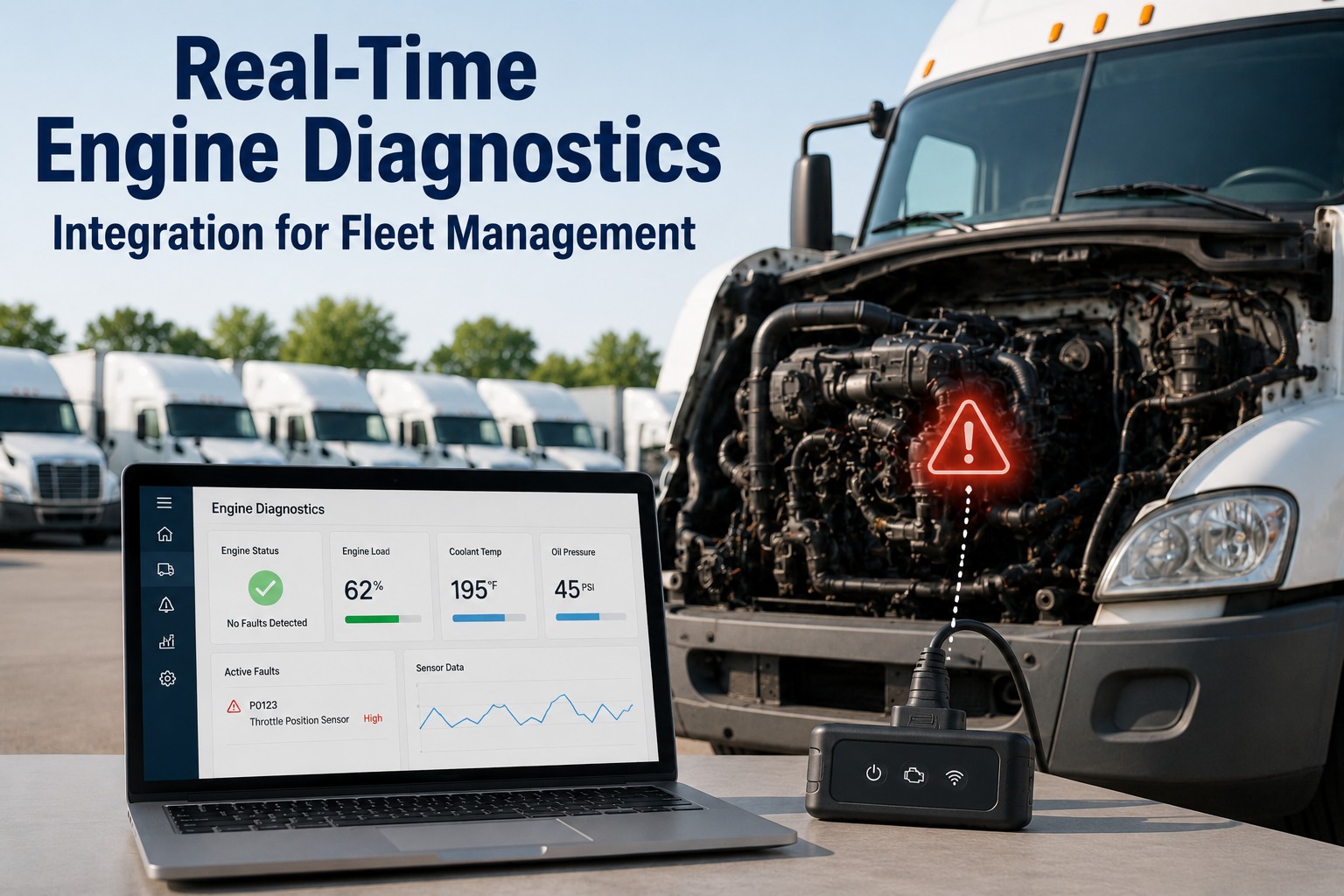
Real-Time Engine Diagnostics Integration for Fleet Management
Follow a fault from the first abnormal sensor reading to a closed work order — and see where live diagnostics let you intervene before a small problem becomes a catastrophic one.
forms Code
fires Dash
light Break-
down
Real-time diagnostics act at the left of this line. "Wait for the light" fleets act near the right — after most of the cost is already locked in.
Stage 1 — The Signal Nobody Hears
Long before any warning reaches the cab, the engine control unit is monitoring dozens of parameters and comparing them to normal ranges. A fault code is generated the instant a reading crosses a threshold — often weeks before the dashboard light illuminates. In a disconnected fleet, that signal has nowhere to go. This is the window real-time diagnostics exists to capture, and these are the readings it listens to:
Coolant temperature
A slow creep upward is the earliest signature of cooling-system trouble — visible in data long before an overheat.
Oil pressure
Falling pressure is among the most urgent engine-health signals — a direct threat to the block if unheard.
Engine RPM & load
Speed and load against normal ranges — the baseline that makes every other anomaly legible.
Fuel consumption
A rising burn rate quietly flags a developing mechanical fault or wasted idle time.
Aftertreatment & DEF
SCR, DPF, and DEF status — where many costly heavy-duty faults and engine derates begin.
Stage 2 — Decoding the Code
When the code fires, a real-time platform doesn't just pass along a number — it reads the code's structure. On heavy-duty engines a fault is a precise two-part address, which is what makes an instant, pinpointed diagnosis possible:
Suspect Parameter Number — what failed
Pinpoints the exact component. SPN 3226, for instance, points straight to the aftertreatment SCR catalyst — no hunting.
Failure Mode Identifier — how it failed
Describes the failure type: out of range, short circuit, abnormal rate — so the fix is known before the hood is up.
Mind the two protocols: vehicles under 26,000 lbs speak OBD-II; heavy-duty trucks and equipment speak J1939, which carries the SPN and FMI detail. A mixed fleet needs a platform fluent in both — a tool that decodes only one will silently go deaf to codes on the other class.
Stage 3 — The Alert Race
Between the code firing and a driver noticing anything is a race, and speed decides cost. A real-time integration wins it by pushing the decoded fault to the shop the moment it happens — not at the next manual scan:
Days later
The code waits in the ECU until a technician plugs in or the truck rolls into the shop. By then the damage has been compounding.
Under 400 ms
The critical fault is flagged in under half a second — fast enough to warn before an engine derate escalates and act while it's still cheap.
Free · Up to 3 Vehicles
Catch the fault at the start of its story
Truck fleet management software streams live OBD-II and J1939 diagnostics, decodes every code by component and severity, and pushes an alert the instant a fault fires — while coolant, oil-pressure, and fuel trends surface problems before any code appears. If your trucks have telematics, it likely just needs activating. Sign up free for up to 3 vehicles and go live in days.
Stage 4 — The Decision Window & Its Price
Here's the whole financial case in one picture. The same underlying fault costs wildly different amounts depending on where in the timeline you act. Real-time diagnostics simply move your decision to the far left — where the number is smallest:
Stage 5 — From Alert to Closed Loop
Capturing the fault is only worthwhile if it drives action. Once the live feed is connected, the last stage of the timeline runs itself — turning each decoded fault into a tracked, completed repair:
Work order, auto-created
Every DTC captured, decoded to component and severity, and opened as a work order — no codes lost in a busy week.
Predictive health, trending
Coolant creep, oil-pressure drift, and fuel-burn rise flag failures forming before a code even fires.
Fuel efficiency, watched
Live consumption and idle tracking expose waste and the mechanical issues quietly driving fuel up.
Fleet health, centralized
Every engine's live status, fault history, and severity in one view — health at a glance, not portal by portal.
Frequently Asked Questions
What is real-time engine diagnostics integration?
It's connecting your vehicles' engine control units to a fleet platform so live diagnostic data — fault codes, coolant temperature, oil pressure, fuel consumption, RPM — streams in continuously instead of staying in the vehicle until a shop visit. The platform decodes each fault, scores it by severity, and turns it into a work order, giving you engine health monitoring across the whole fleet from one dashboard.
How can a fault code predict failure before the warning light?
Because the engine control unit detects abnormal sensor readings well before it illuminates the dashboard light. Many fault codes appear weeks earlier — the ECU sees the coolant creeping or the oil pressure drifting first. Capturing that code in real time is what creates the lead time to fix a small problem on your schedule instead of reacting to a breakdown. Contact our team to see live monitoring in action.
Do I need new hardware?
Most likely not. Over 90% of vehicles manufactured in 2026 ship with embedded telematics, and if your trucks already have GPS tracking, they likely have fault-code transmission capability that just needs activating through your platform. Where a vehicle lacks it, a device installs in under 20 minutes on the standard OBD-II or J1939 port.
What's the difference between OBD-II and J1939 for diagnostics?
OBD-II is used on light- and medium-duty vehicles under 26,000 lbs; J1939 is used on heavy-duty trucks, buses, and vocational equipment above that. J1939 carries extra detail through the Suspect Parameter Number and Failure Mode Identifier that pinpoint the exact component and failure type. A mixed fleet needs a platform that translates both — a tool that speaks only one protocol will silently miss codes on the other class.
How fast are real-time alerts?
Very fast. On modern 5G-Advanced telematics, critical faults can be flagged in under 400 milliseconds — quick enough to warn before an engine derate escalates. Even on standard connections, the value is capturing the code the instant the ECU generates it rather than at the next manual scan, which is what turns a roadside emergency into a scheduled repair.
Does this really save money?
The math is stark. Catching a failing sensor early might cost $150; the same fault ignored can become a $5,000 roadside breakdown, and left longer, a $12,000 engine overhaul. Real-time monitoring catches the problem at the bottom of that cost curve — and eliminating the break-fix cycle protects uptime, delivery windows, and vehicle lifespan on top. Sign up free to start monitoring.
Catch It at $150, Not $12,000
Turn live engine data into maintenance that runs itself.
Truck fleet management software connects real-time OBD-II and J1939 diagnostics to monitor engine health, decode fault codes by component and severity, track fuel efficiency, and auto-create work orders — with predictive alerts that catch failures before the warning light. Free for up to 3 vehicles. Activate existing telematics, no new hardware for most fleets, no contracts.