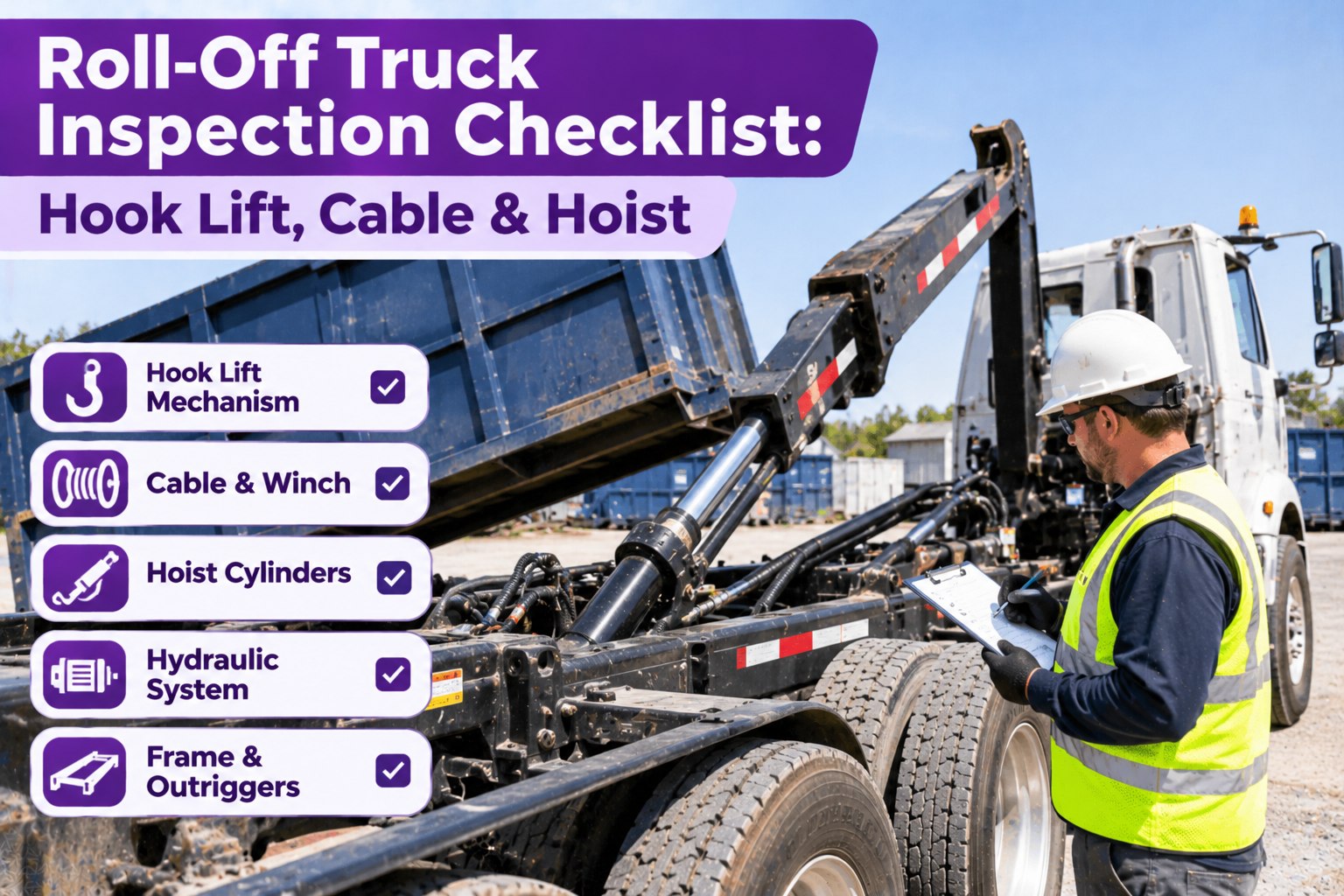
A roll-off truck's whole job is lifting tons of steel on a cable or a hook, and when the cable frays, the cylinder weeps or the hook wears, the container comes down — on a public road, a worksite, or a person. Most of those failures show themselves first: a few broken wires, a wet cylinder rod, a loose pin. The walkaround before each load is what catches them. This checklist covers every wear point on a cable hoist and a hook lift, the defects that park the truck on the spot, and when a cable is finished. Start free and put this checklist on every driver's phone.
Roll-Off Truck Inspection Checklist: Hook Lift, Cable & Hoist
Cable Hoist or Hook Lift? Know Your Mechanism
A roll-off body comes in two forms, and they fail in different places. Confirm which the truck has before you start — it decides whether Section 03 or Section 04 is the one that matters most.
Lives on its wire rope, sheaves and rollers. Handles the heaviest containers, but the cable is a wear item that must be inspected its full length and retired on criteria.
Trades the cable for a hydraulic arm, a hook and a few pivot points. Faster and lower-maintenance, but the hook, slide rails and pivot pins become the parts that wear.
Find any of these on the walkaround and the truck does not load until it's fixed. A replacement cable costs a few hundred dollars; a container coming down costs far more.
The Roll-Off Inspection Checklist
Work the truck in order, front to back. Tap each item as you clear it — anything that fails becomes a defect, not a memory.
Wire Rope: When the Cable Is Finished
The cable is the one part that can look fine and still be condemned. These are the retirement triggers from OSHA and ANSI wire-rope criteria for running ropes — any one of them, and the rope comes off before the next load.
A Frayed Cable Logged Friday Beats a Snapped One Monday
The difference is whether the flag reached the shop. Run the walkaround as a digital DVIR, tie each defect to a work order with a photo, and the cable gets replaced in the yard instead of failing on the road.
How Often to Run Each Check
Why Roll-Off Fleets Run This in Software
Frequently Asked Questions
Front to back: cab controls and warning buzzer, PTO and hydraulics, the hoist cylinder and safety prop, the cable or hook, the subframe and rollers, the outriggers, and the container locks. It takes only a few minutes but catches the wear that strands a truck. Book a demo to see the roll-off DVIR.
Retire it on the OSHA and ANSI running-rope criteria — six broken wires in one lay, three in one strand, or any kink, crush, birdcage, corrosion, heat damage or diameter loss. Inspect it unloaded so broken wires show, and when in doubt, replace it. Book a demo to track cable retirement by truck.
A cable hoist centers on the wire rope, sheaves, rollers and winch brake — the cable is the critical wear item. A hook lift has no cable; you inspect the hook, jib, slide rails and pivot pins instead. Confirm the mechanism, then focus the inspection where that system wears. Book a demo to tag each truck's mechanism.
A cable past retirement, a cracked or leaking hoist cylinder, a cracked subframe weld, a bent or worn hook, a missing safety prop or pin, and any container lock or outrigger that won't hold. Each one risks the load coming down, so the truck doesn't load until it's repaired. Book a demo to flag stop-use defects automatically.
Keep Every Container on the Truck
Truck Inspection & Maintenance Management Software turns the roll-off walkaround into a digital DVIR, flags a worn cable or cylinder with a photo, and schedules the cable and hydraulic service that keeps the load where it belongs.