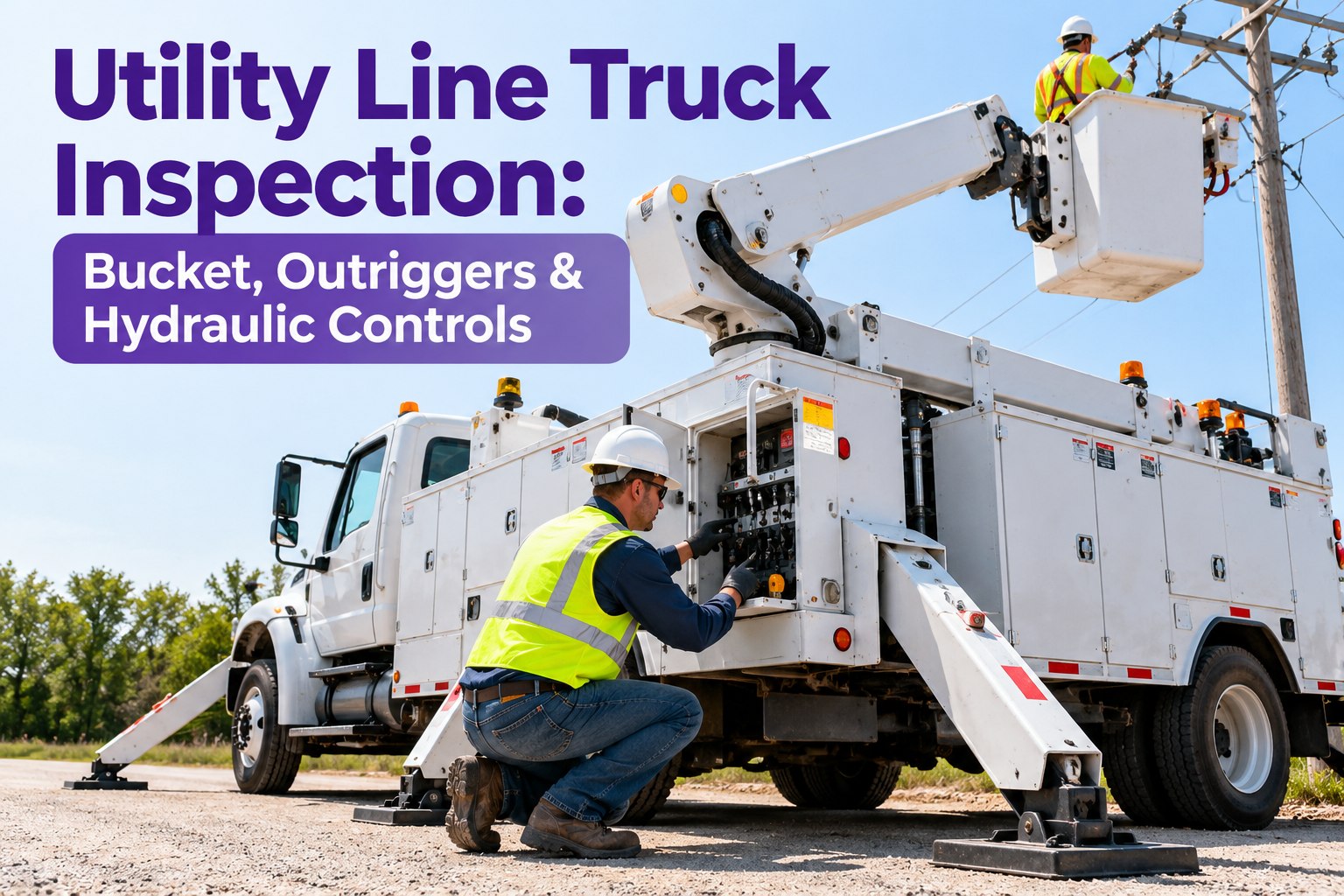
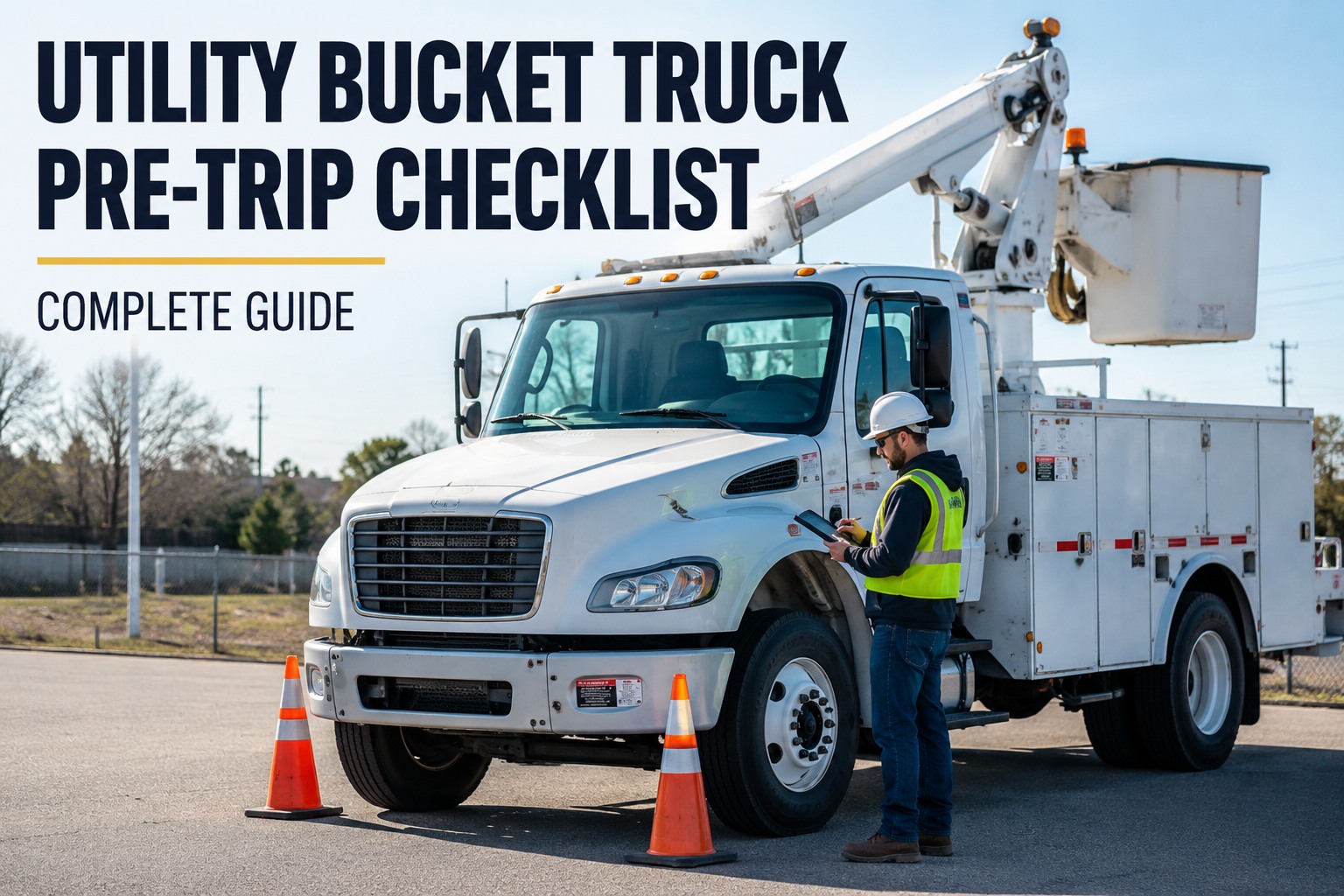
Utility Line Truck Inspection Checklist: Bucket, Outriggers & Hydraulics
By William Jerry on October 9, 2026
A lineworker trusts a utility truck with their life — forty feet up, often over an energized conductor. A soft outrigger pad, a hose chafed through at a boom joint, a hairline crack at a weld, or a boom past due on its dielectric test isn't a maintenance defect; it's a fall or a flashover waiting to happen. This checklist walks the whole chain that holds a worker up — base to bucket — and lets Truck Inspection & Maintenance Management Software (TIM) turn any defect into a tracked repair. Start free and run line truck inspections on one record with TIM.
TIM · Bucket · Outriggers · Hydraulics · Dielectric
Utility Line Truck Inspection Checklist: Bucket, Outriggers & Hydraulics.
A utility line truck is a chain of systems carrying a person at height over live power — outriggers, hydraulics, boom, bucket, and insulation, each depending on the one before it. One weak link isn't downtime; it's a fall or an electrical contact. This pre-use checklist walks every link, and TIM turns each failed item into a graded work order before anyone goes up.
Our promise: every flagged defect gets a 4-hour first response — acknowledged, graded, and assigned.
This isn't a vehicle check with a lift bolted on. The aerial device changes what failure means — three ways.
☗
The worker is the loadA structural or hydraulic failure isn't a sidelined truck — it's a person falling from height. The margin for a missed defect is zero.
⚡
It works energized linesOn an insulated device the boom is the barrier between the worker and the conductor, so dielectric integrity is life-safety, not a spec.
⊿
It stands on outriggersLifted, the truck's stability comes from its stabilizers and the ground under them — not its wheels. A soft pad is a tip-over.
Think of the truck as a load path from the ground to the person in the bucket. Each link carries the one above it — and the checklist that follows walks them in exactly this order.
Walk these five systems before every use, ground up. Items marked CRITICAL are life-safety checks — a fail takes the truck out of service until corrected. Tick each as you go, and always follow the maker's manual, ANSI A92.2, and OSHA.
The insulated boom is the worker's barrier — and it's on a clock. An insulated aerial device has to pass a dielectric ("hi-pot") test at least every 12 months under ANSI A92.2, and only the insulated boom is tested, not the bucket. Between tests, the insulation is only as good as its condition: any "tracking" on the fiberglass means immediate removal from service, and the boom has to be kept clean, dry, and waxed to hold its rating. Keep the test certificate on file — the proof is part of the protection.
The Failures That Put a Worker at Risk
When a line truck incident happens, it usually traces to one of these — and every one is a checklist item above.
✕
Outrigger not set or soft groundA leg that didn't seat or sank into soft ground is the classic aerial tip-over.
✕
Hose failure at a boom jointA hose chafed through where it crosses a moving joint lets the boom lose control under load.
✕
Tracking on the fiberglassCarbon tracking on an insulated section destroys its dielectric rating — a flashover path to the worker.
✕
Overdue dielectric testAn expired hi-pot test means the boom's insulation is unverified the next time it's near a live line.
Pre-Use Checks, Dielectric Dates, and Repairs on One Record
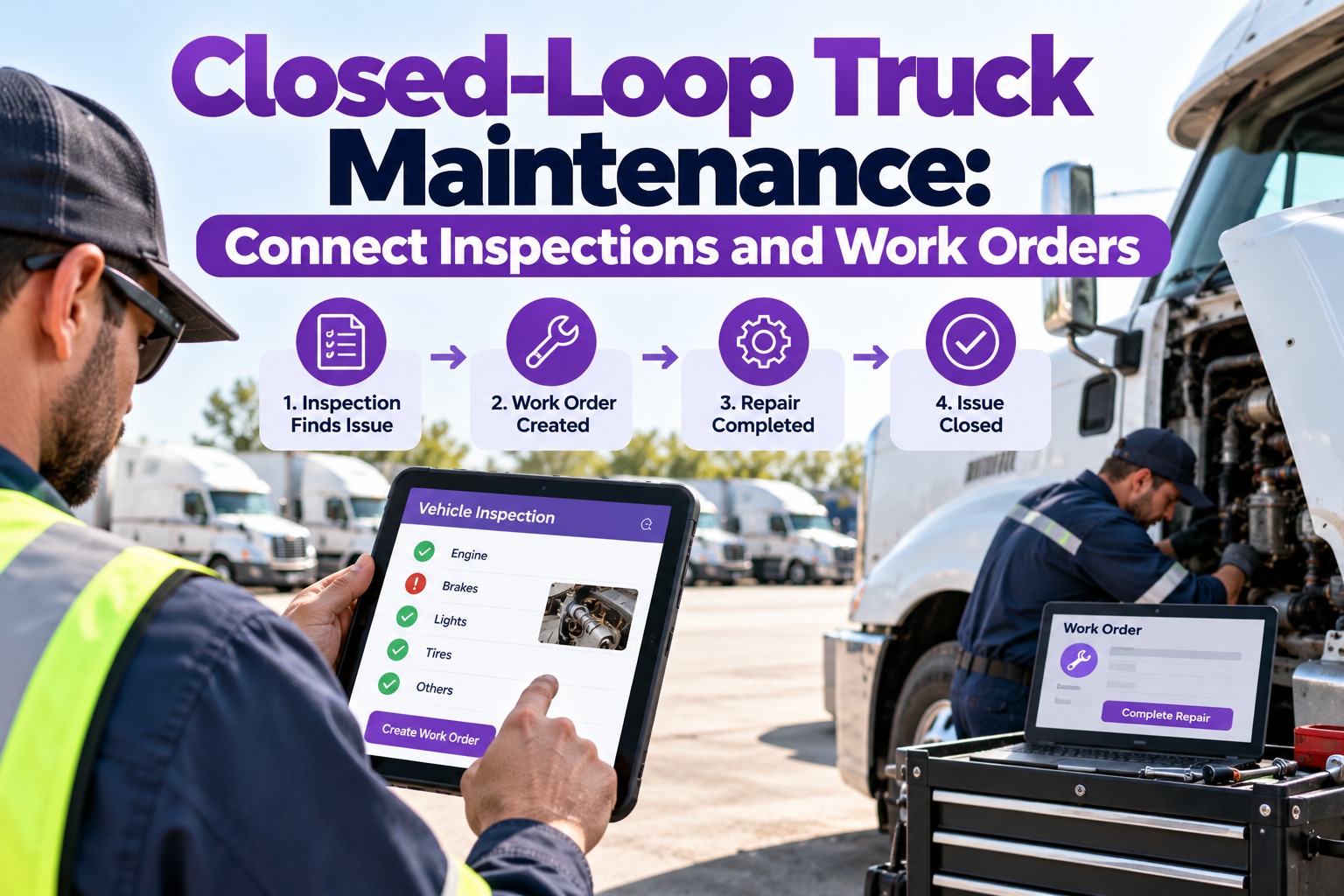
A line truck has two things that can't slip: the daily pre-use check and the dielectric test interval. TIM handles both — it puts the five-system checklist on every operator's phone, tracks the dielectric and service due dates so none lapses, and turns any failed item into a graded work order, with the certificates kept on the unit record.
1Pre-use check, ground up
→
2Defect graded
→
3Work order routed
→
4Records retained
Five-system checklistOutriggers, hydraulics, boom, dielectric, and emergency systems in one guided inspection.
Dielectric interval trackedThe 12-month test due date held and counted down so it never lapses.
Critical-item flagsA tracking mark, unset outrigger, or overdue test marks the truck out of service.
Finding becomes a work orderA flagged defect routes to the shop the moment it's filed — no re-keying.
Certificates on the unitDielectric and inspection records kept on the truck's record and produced on demand.
Per-unit historyEvery test, defect, and repair logged against that aerial device for its service life.
A pre-use inspection before each shift, covering outriggers, hydraulics, boom and bucket, dielectric condition, and the emergency systems, plus more detailed periodic inspections and the annual structural and dielectric checks the standards require. The daily check is the operator's responsibility and catches the fast-moving items; the deeper inspections catch structural wear and verify the insulation. Following the maker's manual, ANSI A92.2, and OSHA together is what keeps the schedule complete. Start free and run every pre-use check with TIM.
What is a dielectric test and how often is it required?
It's a high-voltage ("hi-pot") test that verifies the insulated boom can still resist current — the barrier that protects a worker near an energized line. Under ANSI A92.2 it's required at least every 12 months on insulated aerial devices, and only the insulated boom is tested, not the bucket. Between tests, the insulation depends on condition: any tracking on the fiberglass means immediate removal from service, and the test certificate showing the voltage applied and the result has to be retained.
Why are the outriggers so important on a line truck?
Because once the boom is up, the truck's stability comes from its outriggers and the ground beneath them, not its wheels and suspension. A leg that didn't fully set, or one that sank into soft ground, shifts the load off the stable base and is the classic cause of an aerial tip-over. That's why the pre-use check confirms each leg deploys and seats on firm footing with pads, that the interlocks stop boom use until the legs are set, and that the level indicator reads within limits.
What is fiberglass "tracking" and why does it matter?
Tracking is a carbon path that forms across a contaminated or damaged fiberglass surface, and on an insulated boom it's serious: it forms a conductive route that destroys the section's dielectric rating and can carry current toward the worker. Any tracking found on an insulated section means the device comes out of service immediately — it can't be cleaned off and trusted. Keeping the boom clean, dry, and waxed is what prevents it from forming in the first place.
Why does the emergency lowering system need checking?
Because it's the worker's way down if the primary hydraulics fail while they're at height. The auxiliary lowering system, and a full set of lower controls that can do everything the upper controls do, mean a worker in the bucket is never stranded by a single failure. Confirming the emergency stop works at both stations and that the auxiliary system brings the boom down is a daily check for exactly that reason — it's only useful if it works when everything else hasn't.
Check Every Link Before Anyone Trusts It With Their Life
A utility line truck carries a person into the most dangerous place on the job — at height, beside live power — and asks a chain of systems to hold the whole time. A soft outrigger, a chafed hose, a crack at a weld, or an overdue dielectric test quietly weakens that chain. A ground-up pre-use check catches it, and TIM turns every finding into a tracked repair while watching the test dates — so the truck that goes up is one a worker can trust.