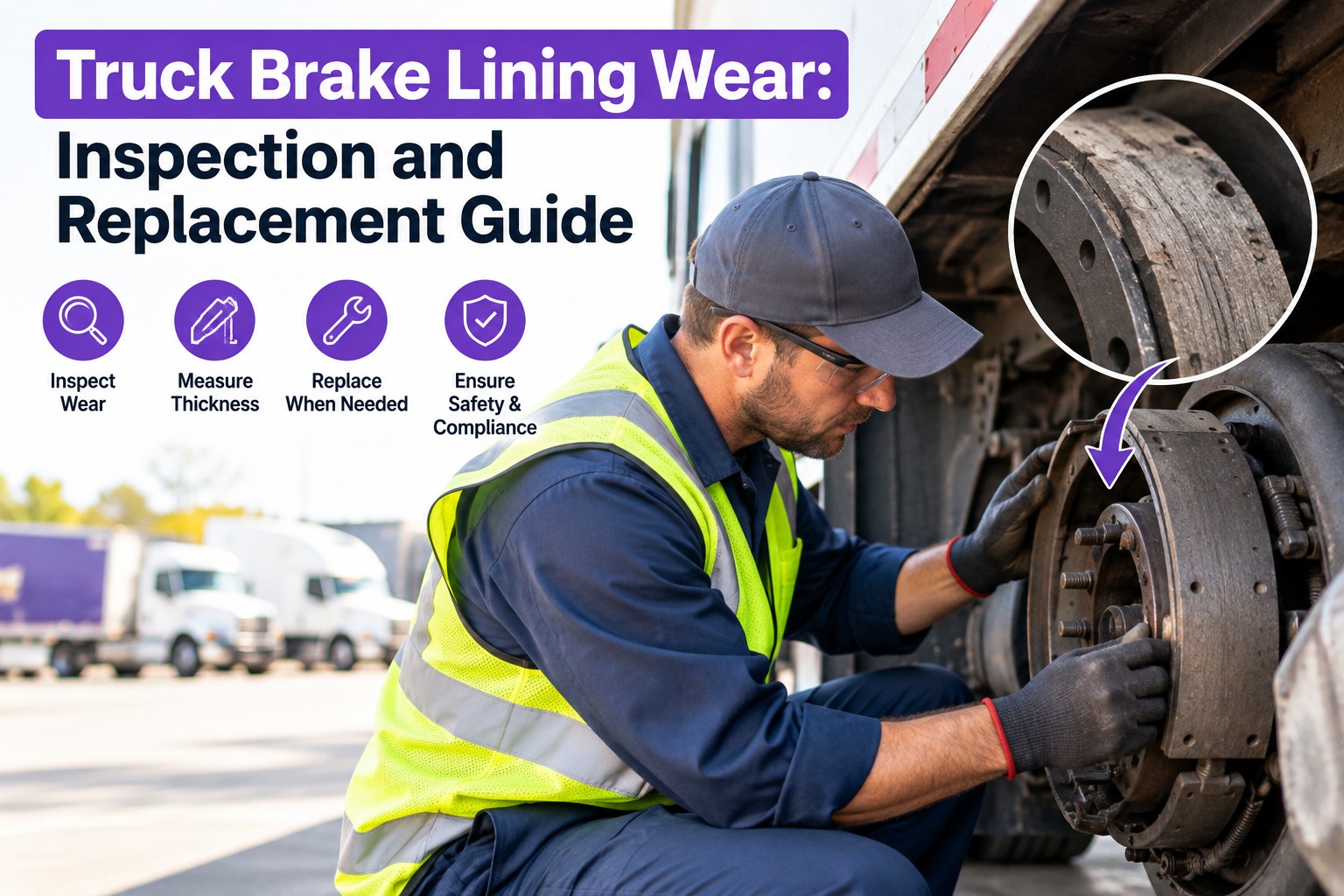
Brake lining doesn't fail all at once. It thins a little every mile, and nobody notices until a roadside inspector measures it. Lining wear is one of the easiest brake problems to predict and one of the costliest to ignore. This guide covers how to measure truck brake lining wear, what a worn shoe or pad looks like, when to replace it, and how to schedule the work before it becomes a violation. Brake condition falls under 49 CFR 393.47, and the driver's duty to confirm the truck is safe sits in 392.7 and 396.13. Measuring once is not enough, though. The real savings come from recording each wheel end and watching the trend, which is what Truck Inspection & Maintenance Management Software is built to do.
Truck Brake Lining Wear: Inspection and Replacement Guide
Most fleets measure lining only when a truck is already in the shop. Truck Inspection & Maintenance Management Software records thickness for every wheel end during inspections, flags the ones nearing your limit, opens a work order, and schedules the next check. You replace linings on your schedule, not at the roadside.
The Wear Gauge: From New Lining to Out of Service
Think of lining thickness as a fuel gauge that only drains. The legal limit is the empty line, and good fleets decide well before it where they will start planning the replacement. The bar below shows the idea for air drum brakes.
Set your plan-ahead trigger by fleet policy. Many fleets choose a value comfortably above the limit, based on route type and shop lead time. The legal limit is a floor, not a target.
Drum or Disc: What You're Actually Measuring
The measuring point depends on the brake type. Always confirm limits against the current out-of-service criteria and the brake manufacturer's specifications.
- Measure at the thinnest point of the lining, typically the center of the shoe
- Air drum brakes: ¼" or less is the common out-of-service threshold
- Check the lining is firmly attached, with no loose rivets or lining separating from the shoe
- Check the drum for cracks, heat checking and the discard dimension cast on it
- Look for oil or grease contamination on the lining face
- Measure friction material only, not the steel backing plate
- Air disc brakes: ⅛" or less is the common threshold, and many pads have a wear indicator
- Check pads wear evenly across the face and between inboard and outboard
- Check the rotor for cracks, deep scoring and minimum thickness
- Check the caliper moves freely and the boots are intact
The 5-Step Lining Inspection
Do this with the wheels chocked and the brakes released. Use a flashlight, and a lining gauge or ruler for any reading near the limit.
What the Wear Pattern Is Telling You
Fast or uneven wear is rarely random. Find the cause before you install new linings, or the new set will wear out the same way.
| What You Find | Likely Cause | Check First |
|---|---|---|
| One wheel end much thinner than the rest | Dragging brake, seized cam or a stuck chamber | Free movement, return springs, pushrod |
| Both ends of the lining worn unevenly | Worn cam bushings or a bent spider | Camshaft play and bushings |
| Lining oily or glazed | Leaking wheel seal or grease over-application | Hub seal and wheel bearing |
| Cracks or heat checking on drum | Overheating from long downgrades or dragging | Drum condition and adjustment |
| One axle wearing faster than the others | Mismatched components or poor brake balance | Lining type, chamber size, adjusters |
| Frequent relines on a short route | Stop-and-go duty or heavy loads | Wear history by truck and route |
Replace, Plan or Monitor?
Use these triggers to turn a reading into a decision. Replace linings in axle sets, so both wheel ends on an axle get the same treatment.
- Thickness is well above your plan-ahead trigger
- Wear is even left to right
- No contamination or cracking
- Thickness has reached your plan-ahead trigger
- Wear is faster than the fleet average
- Drum or rotor is near its discard limit
- Lining at or below the legal limit
- Lining loose, cracked through or contaminated
- Cracked drum or rotor
- Pushrod stroke over limit on the same axle
See Wear by Wheel End, Not by Guesswork
This is the kind of view fleet managers want: every wheel position, its latest reading, and which ones are heading toward the limit. The example below is illustrative. In Truck Inspection & Maintenance Management Software, the readings come straight from your drivers' and technicians' inspections.
From Reading to Repair in One Record
Technicians and drivers enter thickness and pushrod stroke by wheel position. The software grades each reading against the limits you set, turns a failing brake into a work order, and schedules the next brake inspection in your PM plan. Your wear history stays with the truck, so you can see which units, routes or components are eating linings fastest.
Where Brake Maintenance Gets Expensive, and How the Software Helps
Frequently Asked Questions
Replace Linings on Your Schedule, Not the Inspector's
Start free and record lining thickness on one truck, or talk to our team about setting wear limits and reline triggers that fit your fleet.