A government fleet isn't one fleet — it's a police cruiser, a snow plow, an ambulance, a refuse truck, and a pool sedan, all on one budget, all answerable to a council and, through public-records law, to any taxpayer who asks. The maintenance record isn't just an operations document; it's the evidence that public money was spent safely and well. When it lives in a filing cabinet, a records request takes weeks and an audit becomes a scramble. Start free and put every public vehicle's inspection record in one place.
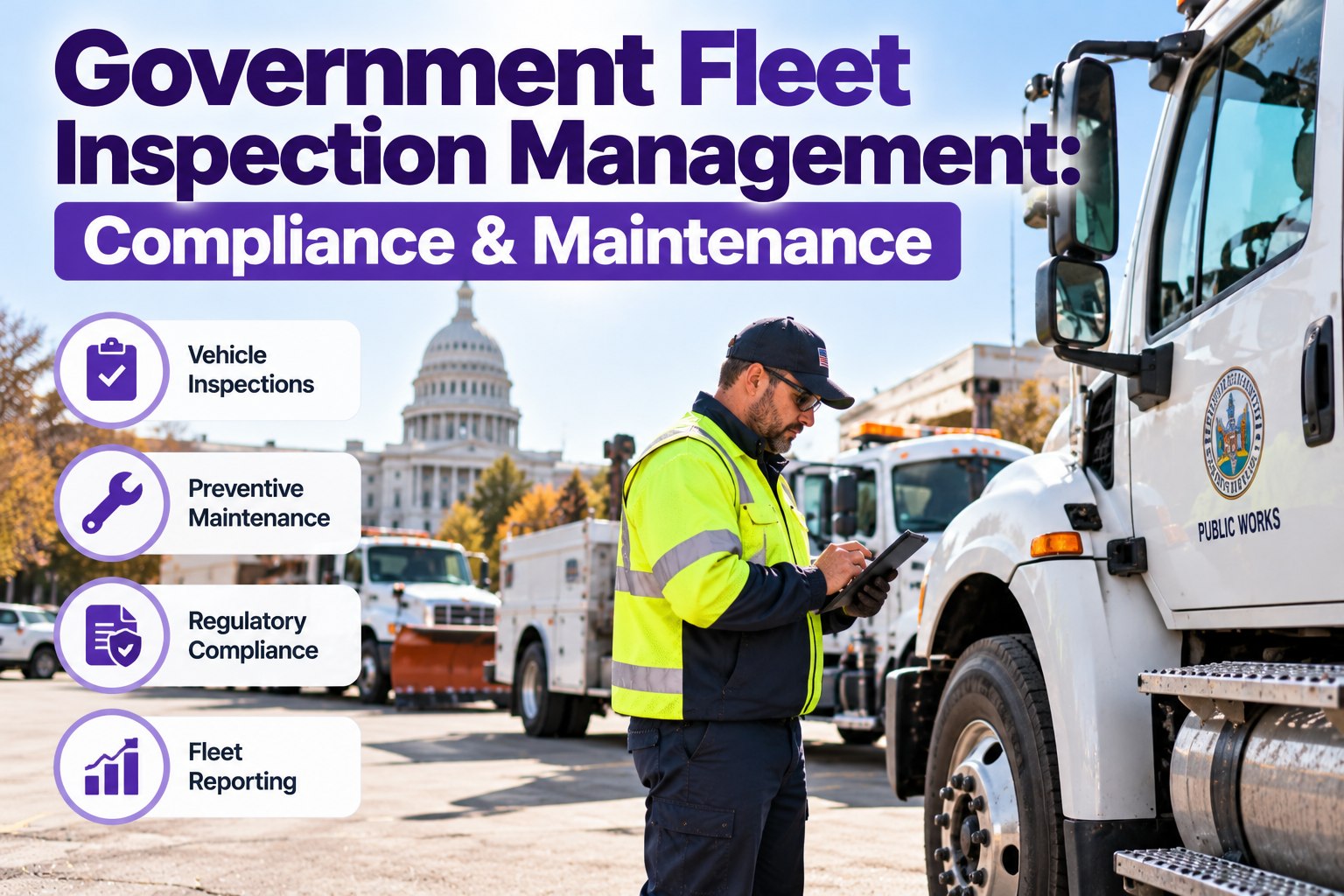
Government Fleet Inspection Management: Compliance & Maintenance
Public fleets carry a weight commercial ones don't: every inspection and repair is a public record, every dollar faces a council review, and a dozen asset classes share one shop. Truck Inspection & Maintenance Management Software gives each vehicle a digital inspection, turns defects into tracked work orders, and keeps a complete, timestamped compliance trail — so a records request takes minutes, an audit is already prepared, and readiness is a number you can report, not a hope.
One Shop, Many Missions — the Asset-Class Problem
A commercial fleet is usually one kind of truck. A public fleet is a dozen, each with its own inspection form, duty cycle, and compliance clock — and all of them have to be ready when the call comes. The first job is a system that holds every class on its own schedule.
The Three Pressures a Public Fleet Answers To
Private fleets answer to a P&L. Government fleets answer to three masters at once, and the inspection record is what satisfies all three.
Annual DOT and state inspections across the fleet, pre-trip DVIRs with timestamps, and documentation ready for any incident or liability review. The record has to exist before it's needed.
Maintenance records are open to public-records law. A council or auditor can ask what was done to a vehicle and when — and "we think we did it" is not an answer that survives a review.
Every repair and replacement competes for appropriated dollars on a fiscal calendar. Lifecycle cost data is what turns a replacement request into an approved line item.
When the Records Request Comes — Minutes, Not Weeks
This is where paper fails a public fleet hardest. A maintenance history that lives in binders and spreadsheets turns a routine records request or an audit into a multi-week hunt. A digital trail turns the same request into a search.
- A records request means digging through binders across departments
- Audit prep is a scramble to reconstruct what happened
- Gaps in the record become a safety and a political problem
- No single view of which units are actually ready
- A records request is a filtered search, answered in minutes
- The audit trail is built as the work happens — always current
- Every inspection, defect, and repair is timestamped per unit
- A live readiness view across every class and department
One System for Every Class, Every Record, Every Department
Truck Inspection & Maintenance Management Software is built for exactly this mix. Each asset class — cruiser, plow, ambulance, pool car — runs its own digital inspection on a phone; every defect becomes a tracked work order routed by severity; and all of it rolls into one timestamped record per vehicle that satisfies DOT inspections, public-records requests, and council budget reviews alike. Every safety defect is acknowledged, graded, and assigned within 4 hours, and the compliance trail is ready the moment anyone asks for it.
Aging Fleets and the Case for the Record
Public fleets run old. A government vehicle averages 7.4 years against 3.9 in the private sector, because replacement waits on budgets and long procurement lead times — standard vehicles take 18 to 24 months to acquire, specialized emergency units 24 to 36. An older fleet needs more inspection, not less, and it needs the cost history to prove when a repair stops being worth it.
The Numbers a Public Fleet Manager Reports Up
A council doesn't want the maintenance weeds — it wants four numbers that show the fleet is safe, ready, and spending well. A single system makes all four reportable without a spreadsheet marathon.
Frequently Asked Questions
Make Every Public Vehicle Ready — and Every Record Ready Too
Truck Inspection & Maintenance Management Software runs a digital inspection on every class in the fleet, turns defects into tracked work orders, and keeps one timestamped compliance trail per vehicle — so a records request takes minutes, an audit is already prepared, and the readiness and cost numbers are there when the council asks. Every safety defect acknowledged, graded, and assigned within 4 hours.