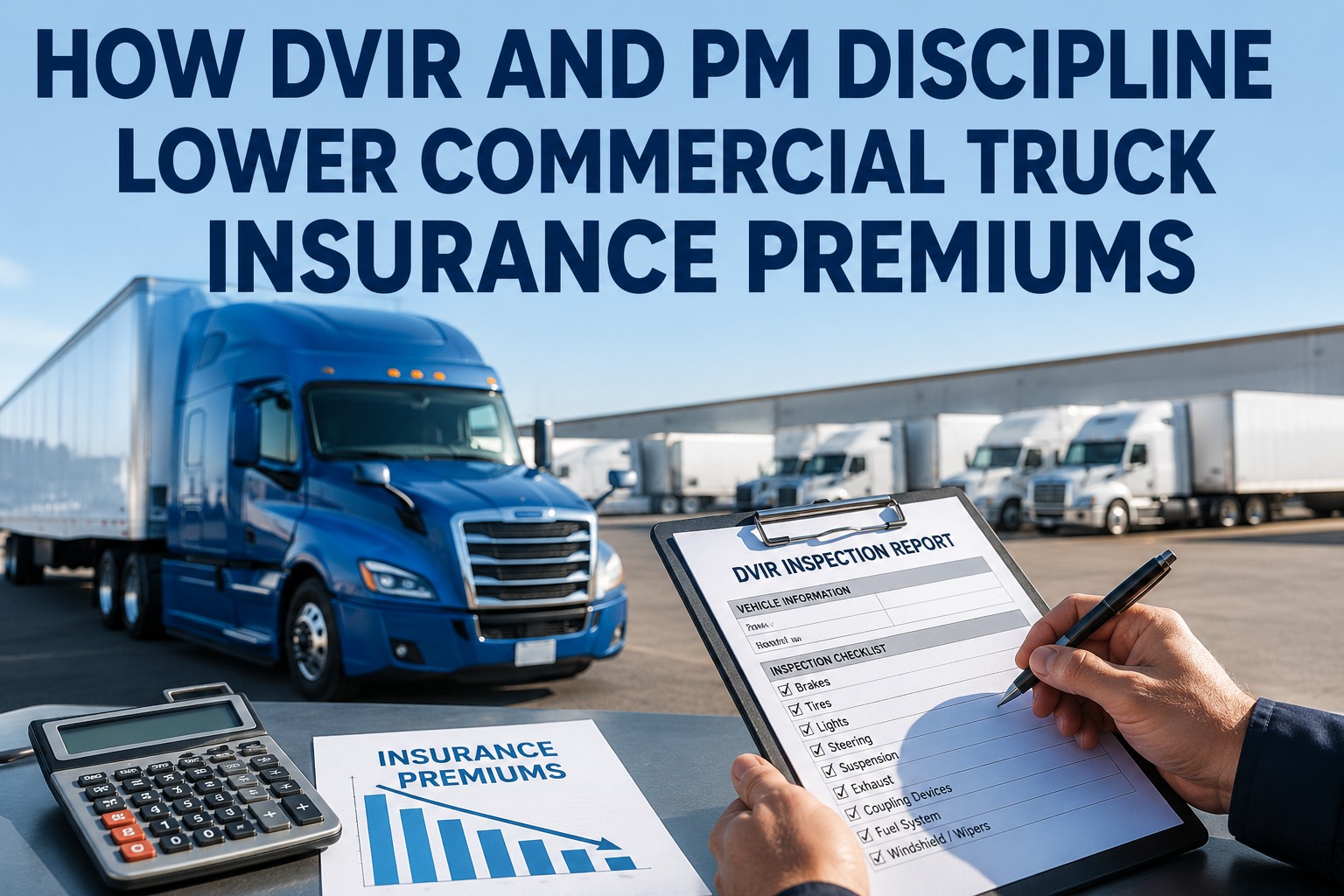
Most fleet managers treat truck insurance as a fixed cost — something to budget for, not something to negotiate. That mindset costs the average 30-truck fleet $40,000-$120,000 in unnecessary premiums every year. The reality: 60-70% of your insurance premium formula is directly controllable through documented maintenance and inspection practices. Fleets that present underwriters with digital maintenance records, clean CSA scores, and verifiable PM compliance routinely cut premiums 20-35% at the next renewal. One Progressive policyholder dropped from $13,000 to $8,500 in four months — just from two clean roadside inspections and documented maintenance. That's the leverage Truck Inspection & Maintenance gives you: every DVIR, every PM, every defect-to-repair cycle is digitally captured and ready to hand to underwriters at renewal. No more "trust me, we maintain our trucks" — actual data that moves your file from standard risk to preferred risk. This guide breaks down exactly how maintenance affects insurance rates and how our platform delivers the documentation that lowers them. Talk to our team for an insurance-readiness assessment.
How Fleet Maintenance Affects Your Truck Insurance Rates
Documented PM. Clean CSA. Lower premium. Our platform delivers the paper trail.
How Insurers Actually Calculate Your Premium
Underwriters use a formula that weighs multiple risk factors. Knowing which ones you can control is step one — Truck Inspection & Maintenance gives you data to influence almost all of them:
The Real Cost Math — Premium Stacking
Insurance discounts compound, but not multiplicatively. A 30% telematics discount plus a 30% clean-record discount doesn't equal 60% — it works out to roughly 51%. Here's what the math actually looks like for a typical 10-truck fleet:
Realistic combined savings: Most well-run fleets achieve 30-40% combined reduction with verifiable digital documentation. On a $250K annual premium, that's $75,000-$100,000 in annual savings — recovered every single year.
The CSA Score Problem Maintenance Solves
CSA scores are the #1 thing underwriters check. The Vehicle Maintenance BASIC is one of the easiest to improve — and the most directly tied to your maintenance program. Truck Inspection & Maintenance attacks this at every level:
What Underwriters Actually Want at Renewal
Renewal isn't a price negotiation — it's a documentation review. The fleets paying lowest premiums hand underwriters specific reports. Truck Inspection & Maintenance generates all six on-demand:
Pre-Trip Inspection Completion Rate
What underwriters want: 95%+ DVIR completion across all drivers. What we provide: real-time dashboard showing per-driver, per-vehicle completion with timestamps and GPS verification.
PM Schedule Adherence Report
What underwriters want: Proof PMs are completed within 10% of scheduled interval. What we provide: every PM tracked against trigger thresholds with on-time / late / overdue counts.
Defect-to-Repair Cycle Times
What underwriters want: How fast you fix what drivers report. What we provide: average cycle time per defect severity — typically 4 hours on our platform vs 3 days on paper.
Driver Training & Certification Log
What underwriters want: Verifiable driver training completion. What we provide: per-driver training records, expiration tracking, and certification timestamps.
Roadside Inspection History
What underwriters want: Clean inspections, no out-of-service orders. What we provide: every inspection logged with outcome, citations addressed, and trend analysis.
Annual Maintenance Spend Report
What underwriters want: Evidence you're investing in maintenance, not deferring. What we provide: spend per vehicle, per PM tier, year-over-year trends — proves you're not running iron into the ground.
Turn maintenance into insurance savings
Truck Inspection & Maintenance generates every report underwriters request — DVIR compliance, PM adherence, defect cycle times. Documented safety = lower premium. Sign up free to start building your insurance-ready file today.
The Risk Tier Shift — From Standard to Preferred
Insurance carriers segment fleets into risk tiers. Most fleets sit in "Standard." A handful break into "Preferred" — and pay 25-40% less. Truck Inspection & Maintenance is the documentation engine that makes the shift possible:
Non-Standard / Surplus Lines
CSA above 80% threshold. Paper-based DVIRs. No PM documentation. Multiple at-fault claims. Result: 50-100% above market rate, limited coverage options, often E&S placement.
Standard Risk
CSA below 80%. Some inspection records but inconsistent. Mileage-based PM only. Occasional claims. Result: market average rate, standard carrier acceptance.
Preferred Risk
CSA below 50%. Digital DVIR 99%+ completion. Structured PM tracked in CMMS. Loss-free 3+ years. Result: 25-40% below market rate, carrier competition for your business.
How Truck Inspection & Maintenance Directly Lowers Premiums
Our platform isn't insurance software — but it produces exactly the documentation that lowers your insurance. Here's the mechanism:
The Renewal Strategy That Actually Works
Stop accepting your first renewal quote. Fleets that systematically negotiate save 15-25% beyond the documentation savings. Truck Inspection & Maintenance provides the data foundation:
Frequently Asked Questions
Industry data shows 20-35% premium reduction is achievable when fleets present verifiable digital maintenance records vs paper logs. One Progressive policyholder dropped from $13,000 to $8,500 in four months — a 35% reduction tied directly to documented inspection compliance. Truck Inspection & Maintenance generates exactly the records underwriters credit for these discounts. Contact our specialists to estimate your fleet's savings potential.
Yes — heavily. The Vehicle Maintenance BASIC, Unsafe Driving BASIC, and Crash Indicator are the three CSA factors underwriters weight most. Above 80% threshold on any BASIC typically triggers decline from standard markets, forcing you into expensive surplus lines coverage. The Vehicle Maintenance BASIC is the easiest to improve — pre-trip DVIRs in Truck Inspection & Maintenance catch defects before they become roadside violations.
Some fleets see results at their very next renewal cycle — typically 6-12 months from implementation. Faster results are possible after 2-3 clean roadside inspections demonstrate the documentation translates to real-world performance. Most fleets recover the cost of Truck Inspection & Maintenance multiple times over through insurance savings in year one alone.
Standard risk = market average rates. Preferred risk = 25-40% below market. The gap is documentation: CSA below 50%, digital DVIR 99%+ completion, structured PM tracked in CMMS, loss-free 3+ years. Truck Inspection & Maintenance generates the documentation underwriters need to flip your file from Standard to Preferred. Sign up free to start building your Preferred Risk file.
Yes, but not multiplicatively. A 30% telematics discount plus a 30% clean-record discount works out to roughly 51% off baseline — not 60%. Most well-run fleets stack 4-6 discounts (telematics, documented PM, DVIR compliance, clean loss run, safety tech, preferred risk) and land at 30-40% combined reduction. Documentation through our platform is what unlocks the stacking.
Yes — and increasingly require them. As of 2026, major carriers (Progressive, Great West, Sentry, Nationwide) actively request digital DVIR completion rates, PM adherence reports, and defect cycle times during underwriting. Paper records are now a negative signal because they suggest you can't produce data on demand. Truck Inspection & Maintenance exports all required reports in formats carriers accept. Talk to our team for carrier-specific documentation requirements.
The fleets paying least share one thing: documented digital maintenance.
Truck Inspection & Maintenance generates every report underwriters request — DVIR compliance, PM adherence, defect cycle times, CSA improvement, loss prevention. Free for up to 3 vehicles. Start building your Preferred Risk file today.