Idle is the fuel you pay for while the truck goes nowhere. A long-haul tractor idles roughly 1,800 hours a year — burning close to a gallon an hour, running up $4,000 to $6,000 per truck in fuel alone, and adding about 25 miles of engine wear for every idle hour. The catch is you can't cut what you can't see, so the first move is measuring the idle, then going after the biggest slice of it. This guide covers the cost, where the hours hide, and the levers that bring them down. Start free and put a number on your fleet's idle.
Idle Cost · Telematics · APU · Coaching
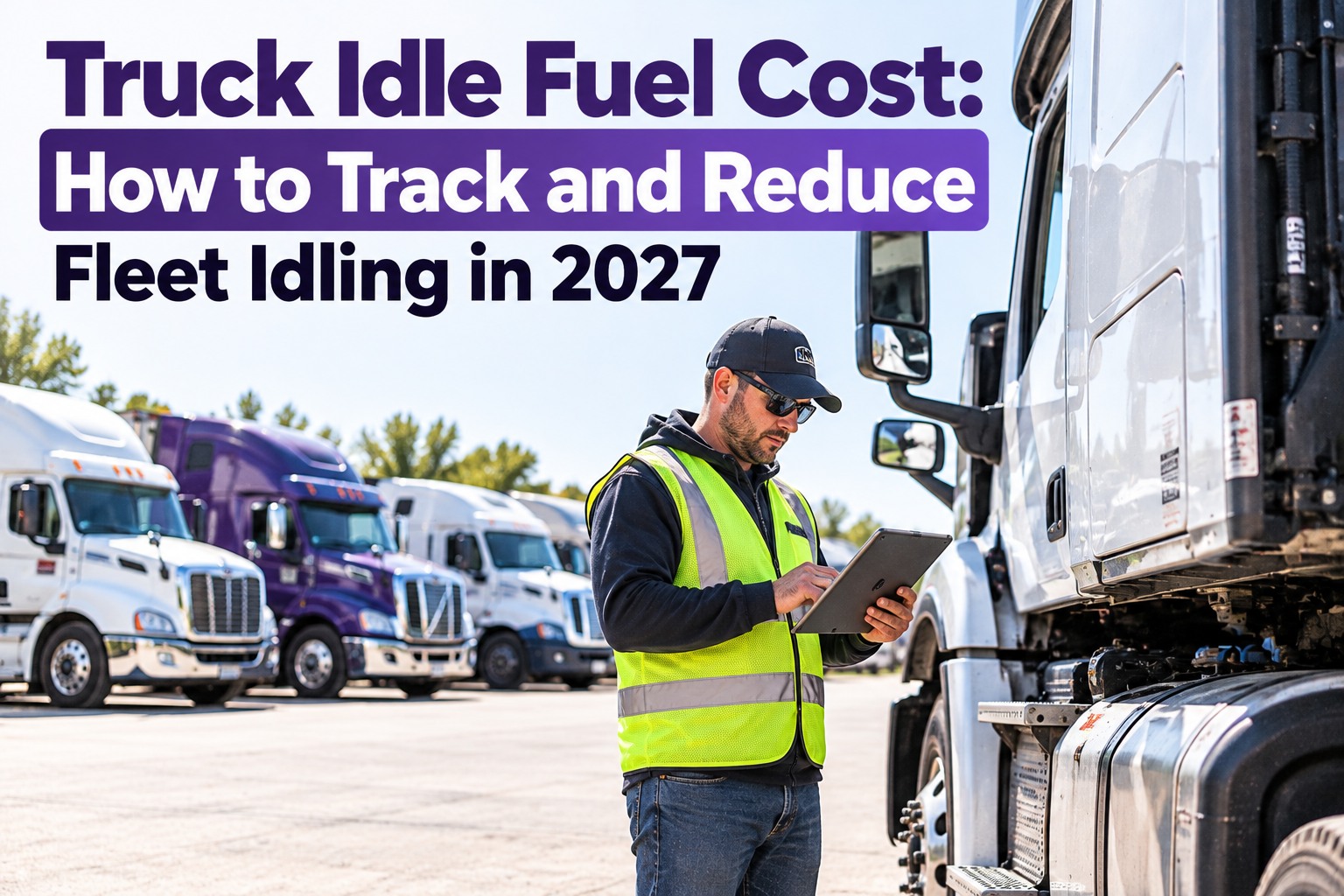
Truck Idle Fuel Cost: How to Track and Reduce Fleet Idling in 2027
~0.8–1gallons / hour
→
$3–6per idle hour
→
$4K–6Kper truck / year
Plus about 25 miles of engine wear for every hour the engine runs parked
What an Idle Hour Really Costs
The fuel is only the visible part of the bill. Every hour the engine runs parked, it's spending in three places at once — and the second two don't show up on a fuel card.
⛽Fuel burnedClose to a gallon an hour at idle — $3 to $6 depending on diesel price.
⚙Engine wearAbout 25 miles of wear per idle hour, pulling services forward.
◷Aftertreatment loadLow-temp idling fouls DPF regeneration and raises emissions maintenance.
Idle hours are measured in engine run time, not distance — so a truck can rack up thousands of dollars of idle cost without a single mile on the odometer to show for it.
Where the Idle Hours Actually Go
You can't cut idle evenly — you cut the biggest slice first. Across typical fleets, the hours break down into four buckets, and one dwarfs the rest.
Share of idle time by cause
Traffic, dock & yard wait
The lesson is in the top row: most idle is a driver keeping the cab warm or cool overnight. That's the slice an APU or bunk heater targets — and the PTO slice at the bottom isn't waste at all, so it shouldn't be counted against the driver.
The Overnight Fix: APU vs. Idling the Engine
Since rest-comfort idling is the biggest bucket, the highest-value move is to stop running a 15-liter engine just to power a heater and an air conditioner. An auxiliary power unit does the same job on a fraction of the fuel.
Idling the main engine
~0.8–1.5 gph
The whole engine runs to heat or cool one cab. Full fuel burn, full engine wear, full emissions.
APU for cab comfort
~0.15–0.25 gph
A small dedicated unit runs the HVAC — a 75 to 85% fuel cut for overnight comfort loads.
An APU is a capital item, so it pays back over time; a bunk heater is a cheaper middle path. But neither helps unless you first know which trucks are idling overnight — that's what tracking tells you.
The Levers That Bring Idle Down
No single tool fixes idle; the fleets that win stack several. Each lever has its own reduction, cost and lead time — start with the free one.
Free · 1 weekAnti-idle policyA 5-minute shutoff rule — roughly a 3 to 5% cut, no spend.
2 weeksTelematics visibilityYou can't manage what you don't measure — 5 to 8% once idle is reported per truck.
30 daysDriver coachingFeedback on idle habits — a 4 to 6% cut, and it compounds with policy.
CapitalAPU / bunk heaterTargets the overnight comfort slice — a further 3 to 8% off the baseline.
Stacked together, a fleet starting above 30% idle can reach under 10% within a year. The order matters: policy and tracking first, because they cost little and tell you where to spend on hardware.
Know Your Number: Idle Benchmarks
Before you can improve idle, you need to know where you stand. These are the bands fleets measure against — and the duty cycle shifts the target.
Under 10%Best-in-class — tightly managed
10–20%Well-managed to watch — room to improve
Over 20%Missing policy or tracking — act now
By duty cycle: long-haul OTR lands around 6 to 10%, regional day-cab 8 to 12%, and heavy vocational 15 to 25% because PTO work is legitimately part of the job. Set the target to the duty, not one fleet-wide line.
Turn Idle Hours Into a Number You Can Act On
Truck Inspection & Maintenance Management Software ties each truck's idle to its fuel and maintenance record, flags the trucks burning the most parked, and turns a high-idle unit into a coaching note or a work order — so idle stops being an invisible line on the fuel bill and becomes something you manage per truck.
When Idling Is Actually Justified
Not all idle is waste, and a good policy says so. Counting legitimate idle against a driver kills trust in the whole program, so build the exceptions in at the start.
✓PTO & auxiliary workReefers, lift gates and hydraulic equipment need the engine running.
✓Extreme temperaturesIdle thresholds widen below about 32°F or above 80°F for driver safety.
✓DPF regenerationAn active regen cycle needs the engine running to complete.
✓Short warm-upModern diesels need only 3 to 5 minutes before driving, not twenty.
Many states cap idling at 5 minutes — some cities at 3, and near schools as little as 1 — with fines that make a policy worth having regardless of the fuel math.
Book a demo to build idle exceptions into the record.
You Can't Reduce What You Don't Measure
Every idle-reduction program starts the same way — with a true number per truck. Truck Inspection & Maintenance Management Software keeps idle alongside the fuel and maintenance history, so the fleet manager can see which trucks are burning money parked and act on the ones that matter.
Why Fleets Track Idle Alongside Maintenance
Idle isn't just a fuel number — it's a maintenance one, pulling services forward and loading the aftertreatment system. Tracking it next to the truck's record connects the burn to the wear. Start free and connect idle to the maintenance it causes.
▦Idle per truckEach unit's idle tracked against its fuel and hours.
⚑High-idle flagsThe trucks burning most parked surfaced for action.
◷Wear pulled forwardIdle hours added to the service clock, not just miles.
✎Coaching notesA high-idle driver gets a logged, trackable follow-up.
✓Exceptions respectedPTO and weather idle kept off the waste count.
⌕Trend over timeFleet idle percentage tracked as it comes down.
Frequently Asked Questions
01
How much does truck idling cost per year?
A long-haul tractor idles around 1,800 hours a year, burning close to a gallon an hour, which adds up to roughly $4,000 to $6,000 per truck in fuel alone — before the engine wear and aftertreatment load that idling also drives. Across a fleet it's one of the largest controllable fuel costs.
Book a demo to size your idle cost.
02
Does idling really wear the engine?
Yes — about 25 miles of engine wear for every hour at idle, because the engine runs cool and under-loaded, which is harder on it than driving. That wear pulls oil changes and services forward and fouls DPF regeneration, so idle shows up as a maintenance cost as well as a fuel one.
Book a demo to tie idle to maintenance.
03
Is an APU worth it versus idling?
For overnight cab comfort, usually yes. An APU burns about 0.15 to 0.25 gallons an hour against the 0.8 to 1.5 of a main engine — a 75 to 85% fuel cut — plus it spares the engine the wear. It's a capital cost, so the payback depends on how much a given truck idles overnight, which is exactly what tracking reveals.
Book a demo to find your overnight idlers.
04
What's a good fleet idle percentage?
Under 10% is best-in-class, 10 to 20% is manageable, and over 20% signals a missing policy or no tracking. The target shifts with duty cycle — long-haul 6 to 10%, vocational 15 to 25% because of legitimate PTO work — so set it to the job rather than one line fleet-wide.
Book a demo to benchmark your idle.
Measured · Benchmarked · Reduced
Stop Paying to Go Nowhere
Put a number on your fleet's idle, attack the overnight-comfort slice first, stack policy and coaching on top, and track it per truck — so the fuel you were burning parked turns back into margin.
No credit card required. Free for up to 3 trucks. Built for fleet maintenance teams.