Renewable diesel is the biggest change in commercial fuel supply in a generation — and for fleets deciding whether to switch, the marketing hype makes clean answers hard to find. It's not biodiesel (which has real cold-weather and blending problems), it's not synthetic diesel (which is different again), and it's not ULSD with an environmental label slapped on. Renewable diesel — sold as R99 (99% renewable content) or R100 (100%) — is a molecular twin of petroleum diesel produced from plant oils, animal fats, and waste greases through a hydrogen-catalyzed refining process that makes finished fuel chemically identical to conventional ULSD. That "molecular twin" claim actually holds up in practice: renewable diesel meets ASTM D975 (the same spec as petroleum ULSD), works in any diesel engine without modification, blends with ULSD at any ratio, and doesn't have the gelling, storage, or seal-compatibility issues that made biodiesel a headache. Where it differs from ULSD is worth understanding: better cold-flow properties, higher cetane, 60–80% lower lifecycle CO2, cleaner emissions, and — depending on your region — price competitive or slightly premium versus petroleum ULSD. This guide walks through the complete comparison: what renewable diesel actually is at the molecular level, side-by-side performance and cost analysis vs ULSD, cold-weather behavior, OEM compatibility, adoption checklist, and how fleet software tracks fuel type usage across mixed-fuel operations. Ready to track ULSD vs renewable diesel usage across the fleet? Start a free trial of our fleet maintenance software, or reach out to our support team for a walkthrough.
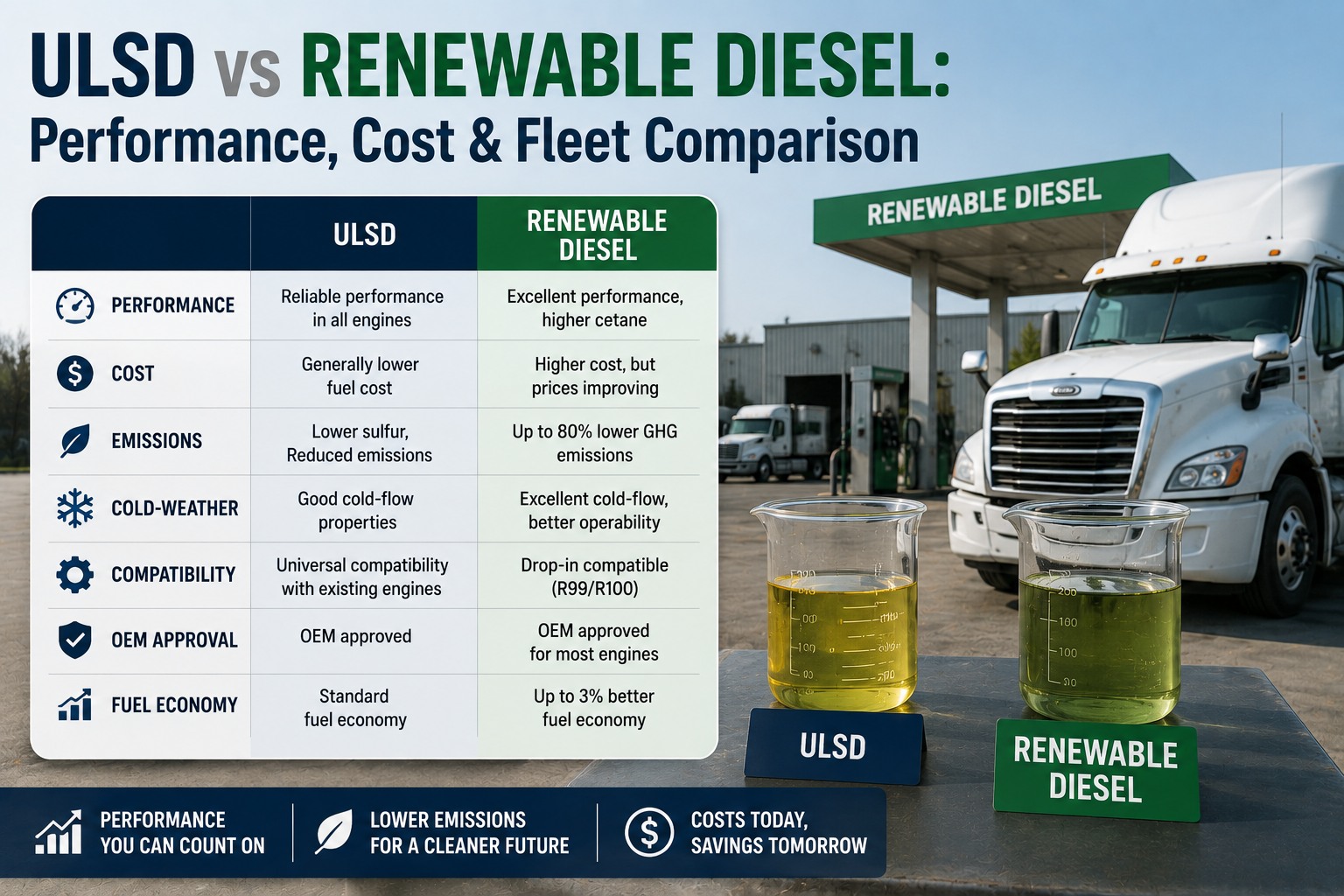
ULSD vs Renewable Diesel: Performance, Cost & Fleet Comparison
The molecular twin comparison — R99 and R100 renewable diesel head-to-head with petroleum ULSD on performance, cost, cold-weather behavior, and OEM compatibility. Cut through the marketing.
What Renewable Diesel Actually Is (And Isn't)
Confusion about renewable diesel starts with the name. It's not biodiesel, it's not synthetic fuel, and it's not a blend — it's a distinct fuel product made from renewable feedstocks through a specific refining process.
Head-to-Head Performance Comparison
The fair comparison is fuel-to-fuel on the specs that actually matter for fleet operations. Here's the head-to-head across ten measurable attributes.
The Advantages Renewable Diesel Actually Delivers
Beyond the specs, six real operational advantages show up when fleets switch to renewable diesel — verified across fleet trials at major carriers and public agencies.
The Trade-Offs to Know Before Switching
Renewable diesel is not a magic bullet. Four trade-offs matter for the switch-decision math — and understanding them prevents unrealistic expectations.
OEM Compatibility: What Manufacturers Say
Renewable diesel meeting ASTM D975 is approved by every major diesel engine manufacturer. Here's the current position from each — and why this is the most fleet-friendly alternative fuel available.
Track fuel type usage across the fleet
Log which trucks run ULSD vs R99/R100. Track MPG and maintenance outcomes by fuel type. Generate sustainability reporting data automatically.
Total Cost Analysis: Real Fleet Math
The real switch-decision math depends on region, incentive programs, and how you value emissions reduction. Here's the honest comparison for a typical 25-truck fleet.
The Adoption Decision: Should Your Fleet Switch?
Six factors determine whether renewable diesel makes sense for your specific fleet operation. Here's the framework for making the call.
Are You in an LCFS Credit State?
California, Oregon, and Washington have Low Carbon Fuel Standard programs that create price parity or discount for renewable diesel. Outside these states, expect $0.30–$0.80/gal premium.
Do You Have Sustainability Commitments?
Fleets with Scope 1 emissions goals, ESG reporting requirements, or urban delivery contracts that reward low emissions have direct payback beyond fuel cost.
Do You Operate in Emission Zones?
Increasing urban low-emission zones (LEZ) in North America and Europe favor renewable diesel. Some zones now require reduced-emissions fuel for commercial vehicles.
Is Supply Reliable in Your Region?
West Coast and select East Coast markets have reliable bulk supply. Midwest and Southeast may require long-distance sourcing that adds logistics cost and complexity.
Would DPF Savings Meaningfully Matter?
Older trucks with high DPF replacement risk benefit more from renewable diesel's cleaner burn. Newer fleets with warranty coverage capture less DPF savings.
Can You Pilot Before Committing?
Best approach: run R99 on 3–5 trucks for 6 months before fleet-wide adoption. Measure MPG, maintenance costs, and driver feedback. Decision confidence increases dramatically with real data.
Frequently Asked Questions
Renewable diesel is a hydrocarbon fuel chemically identical to petroleum diesel but made from renewable feedstocks — vegetable oils, animal fats, and used cooking oil — through hydrotreating (a hydrogen-catalyzed refining process). It meets ASTM D975 (the same spec as petroleum ULSD), works in any diesel engine without modification, and blends with petroleum ULSD at any ratio. R99 is 99% renewable content, R100 is pure renewable. Both perform identically. Track fuel type usage per truck in our fleet software.
No — completely different products despite the similar names. Biodiesel is a fatty-acid methyl ester (FAME) made through transesterification, regulated under ASTM D6751, and requires blending limits (B5, B20 typical) due to cold-weather gelling and material compatibility issues. Renewable diesel is a true hydrocarbon fuel identical to petroleum diesel, meeting ASTM D975, with no blending limits or compatibility concerns. Don't confuse them — the operational differences are enormous.
No — every major diesel engine manufacturer (Cummins, Detroit Diesel, PACCAR, Volvo, Mack, Ford, GM, Ram, International) has approved renewable diesel that meets ASTM D975 for use without warranty impact. This is because the fuel is chemically identical to petroleum diesel — it just came from a different source. This is the biggest OEM-compatibility difference between renewable diesel and biodiesel, which has warranty restrictions on many engines.
Depends heavily on region. In California, Oregon, and Washington — states with Low Carbon Fuel Standard credit programs — renewable diesel is often at price parity or slightly discounted vs petroleum ULSD. Outside these states, expect a premium of $0.30–$0.80 per gallon. Some of the premium is offset by DPF service savings, reduced winter additive needs, and (for regulated fleets) LCFS credit revenue. Contact our team for fleet-level cost analysis.
Yes, but only 1–3%. Renewable diesel has slightly lower energy density than petroleum ULSD (~122,000 BTU/gal vs ~129,500) which translates to a small MPG penalty in real-world use. The penalty is usually offset by pump-price parity in incentive states or by DPF service savings elsewhere. Higher cetane (70–80 vs 40–45) can improve combustion efficiency slightly, partially offsetting the energy-density penalty.
Six factors decide it: whether you're in an LCFS credit state (California/Oregon/Washington), whether you have sustainability commitments or ESG reporting requirements, whether you operate in low-emission zones, whether supply is reliable in your region, whether you'd benefit meaningfully from DPF service reduction, and whether you can pilot before committing. Best practice: run R99 on 3–5 trucks for 6 months and measure MPG, maintenance costs, and driver feedback before fleet-wide adoption. Try tracking free: sign up here.
Fuel strategy tracked across every truck
Log which trucks run ULSD vs R99/R100. Track MPG by fuel type. Correlate DPF service intervals with fuel choice. Generate sustainability reporting data automatically. Compare maintenance outcomes between fuel programs. Everything a fleet needs to make evidence-based fuel decisions instead of guessing whether the switch is worth it.