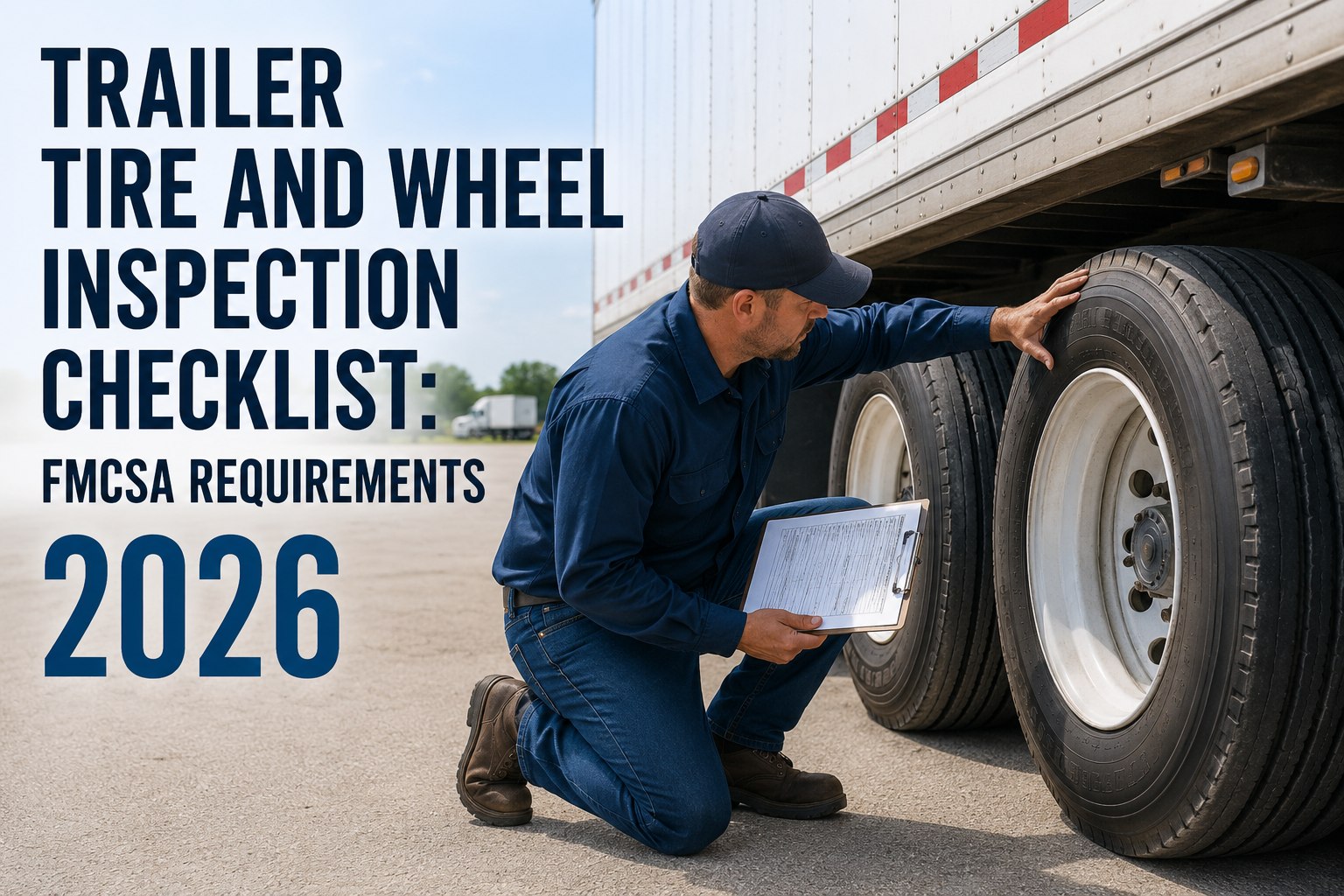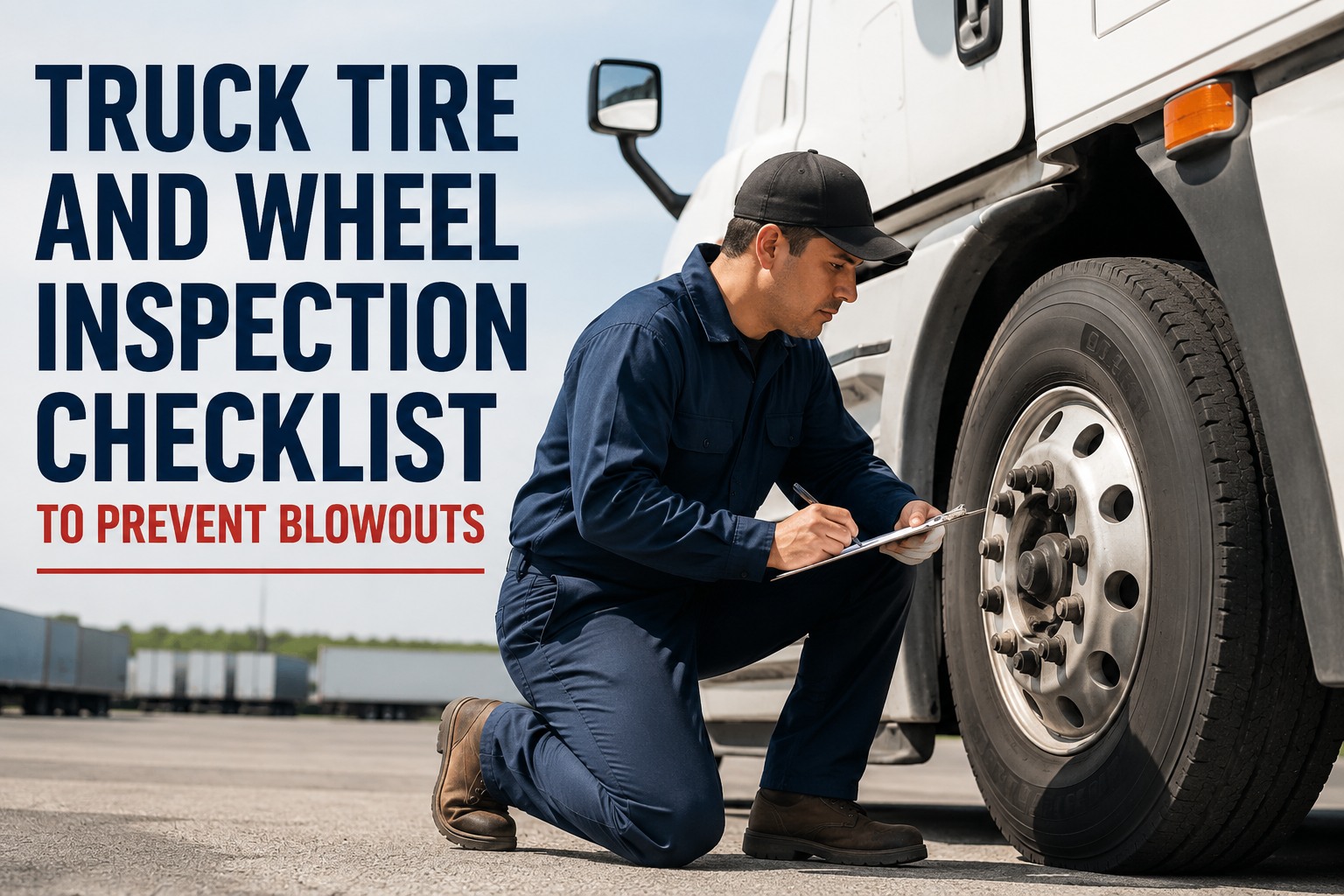
A tire blowout at highway speed is one of the most violent failures a truck can suffer — and one of the most preventable. Tire-related problems account for roughly 21–30% of all out-of-service violations at roadside and an estimated 53.5% of all roadside breakdowns, yet nearly every one traces back to something a two-minute walk-around with a gauge would have caught: low pressure, worn tread, a sidewall bulge, or a loose lug nut. The trap is that tires fail silently. A tire can sit 15% underinflated — the most dangerous blowout range — and look completely normal, and a steer tire at 3/32" looks "fine" to the eye while sitting below the out-of-service threshold. That's why a real inspection measures rather than glances: a calibrated tread gauge, a pressure gauge on every position, and a deliberate look at the wheel end. This checklist walks the tread limits, the pressure discipline, the sidewall and wheel checks, and the out-of-service conditions that park a truck — so a defect gets caught in the yard, not at 65 mph. Truck Inspection & Maintenance puts pressure, tread, and lug checks into every pre-trip. Talk to our team to deploy it.
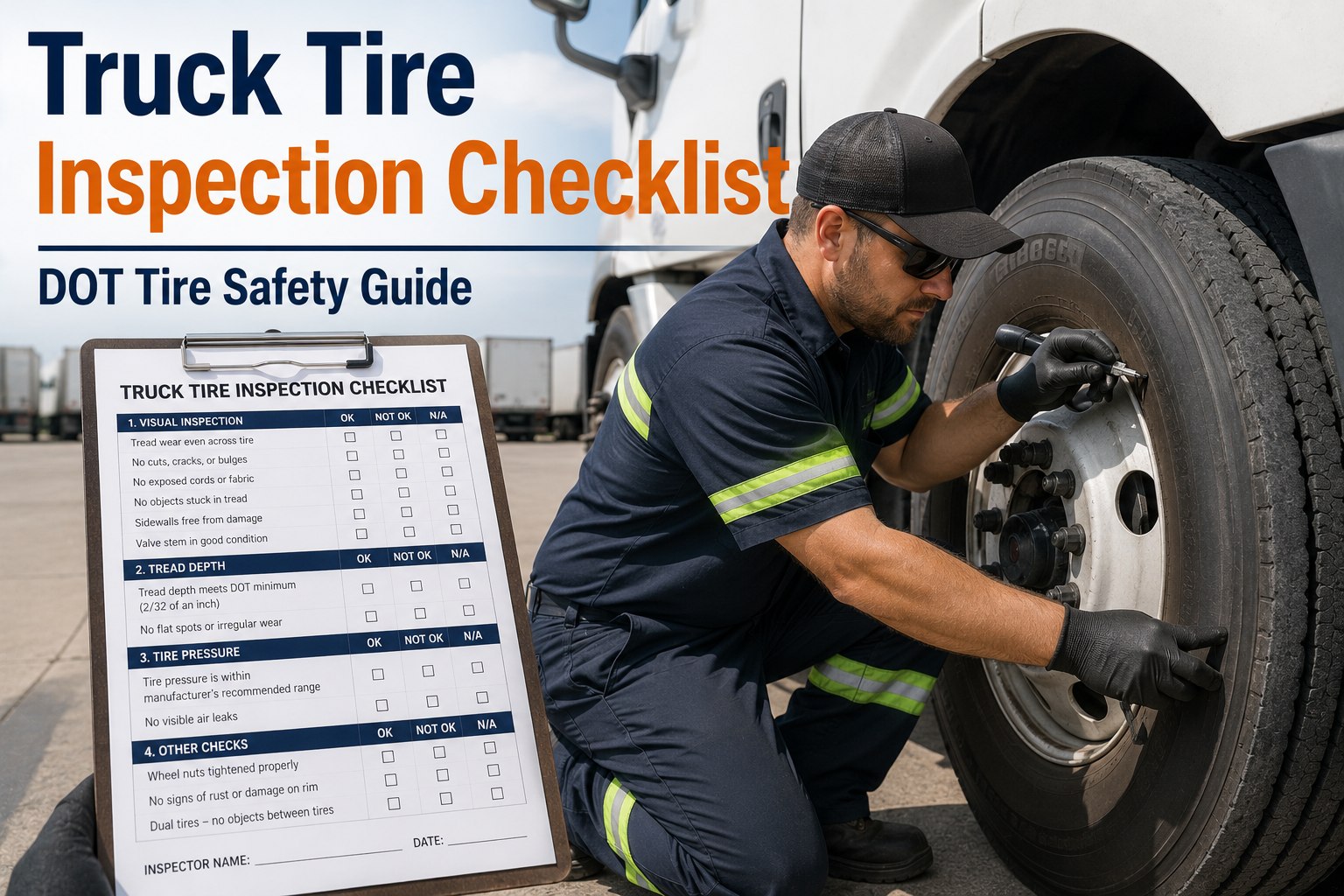
Truck Tire & Wheel Inspection Checklist
Catch pressure, tread & lug issues before a truck rolls onto the highway.
The Tread Depth Rule
Tread is the fastest way a truck gets flagged — and the rules leave no wiggle room. Under 49 CFR 393.75, the depth is measured at the shallowest point in a major groove (never at tie bars, humps, or fillets), and there's no grace period: below the limit at any single groove means non-compliant. Note that CVSA's out-of-service thresholds are even stricter than the DOT operating minimums. Start a free account to record measured tread per position.
Part 1 — The Tire Walk-Around
Work every tire position — all 18 on a standard tractor-trailer — starting at the left steer and moving systematically around the rig. Measure, don't estimate. Reach our team to put a per-position tire check on every driver's phone.
Tread & Wear
- Tread ≥ limit at shallowest groove
- No irregular wear, cupping, or flat spots
- Wear pattern even across the tread
- Retreads: no lifting or peeling cap
Pressure (Cold)
- Gauge every tire — no thump test
- Check cold, per load & manufacturer spec
- Inner duals reached with long-hose gauge
- Investigate any slow-leak history
Sidewall & Damage
- No cuts, cracks, or weather-checking
- No bulges (internal/cord separation)
- No exposed ply or belt material
- Remove embedded nails, glass, stones
Valve Stems & Duals
- Every valve stem capped & intact
- No cracks or leaks at the stem base
- Duals matched & properly spaced
- No debris lodged between duals
Part 2 — The Wheel-End Check
Most checklists stop at the tire — and miss the wheel end, where a loose-nut or rim failure can drop a wheel on the highway. Slow down and read the clues at every hub. Open a free account to capture wheel-end condition with photos.
Two minutes per side catches every OOS condition
Truck Inspection & Maintenance puts a required PSI field, tread-depth entry, and photo capture on every tire and wheel position — with OOS-threshold alerts and auto work-order routing the moment a tire is flagged. Catch it in the yard, not on the shoulder. No hardware, no contracts. Sign up free and make tire checks measurable.
Out-of-Service Conditions — Tag It Out
Certain tire conditions park a truck on the spot, no measurement debate required. If you see any of these in the yard, the tire comes off before the truck moves. Talk to our team about auto-tagging OOS defects.
Reading Wear Patterns
The way a tire wears is a diagnostic readout of the truck. Catch the pattern and you fix the root cause before it eats another set of tires — or causes a failure.
Over-inflation — reduce to spec & check the gauge.
Under-inflation — the #1 blowout precursor. Re-inflate & find the leak.
Alignment issue — schedule an alignment immediately.
Worn shocks or suspension — inspect & replace before rotating.
Toe misalignment — rough one way, smooth the other. Align.
Brake lockup or parking-brake drag — check ABS & adjustment.
Frequently Asked Questions
What's the minimum legal tread depth?
Under 49 CFR 393.75, steer tires need at least 4/32" and all other tires (drive and trailer) at least 2/32", measured at the shallowest point in a major groove — never at tie bars, humps, or fillets. There's no grace period: below the limit at any single groove makes the vehicle non-compliant regardless of how the rest of the tire looks. CVSA out-of-service thresholds are stricter still (2/32" steer, 1/32" other). Start a free account to log measured tread.
Why can't I just thump the tires to check pressure?
Because a thump test can identify a completely flat tire but cannot detect under-inflation of 10–20% — which is the single most dangerous range for blowout risk. The only reliable way to verify pressure is a calibrated gauge on every tire, checked cold (before driving or after sitting 3+ hours), including the inner duals with a long-hose gauge. With 55% of commercial vehicles running at least one tire 10+ PSI low, daily gauge checks are the highest-ROI tire activity. Talk to our team about pressure tracking.
What tire conditions cause an automatic out-of-service?
Any flat tire or audible leak, tread below 4/32" steer or 2/32" other, exposed ply or belt material, tread or sidewall separation, a cut exposing ply or belt, a sidewall bulge, inflation below 50% of maximum, or a tire labeled "Not for Highway Use." Any of these removes the vehicle from service until corrected and adds points to your CSA Vehicle Maintenance BASIC. Catch them in the walk-around. Sign up free to flag OOS conditions instantly.
How do I read tire wear patterns?
Wear tells you the root cause. Center wear means over-inflation; edge or shoulder wear means under-inflation; wear on one side points to alignment; cupping indicates worn shocks or suspension; feathering (rough one direction, smooth the other) signals toe misalignment; and flat spots come from brake lockup or parking-brake drag. Fixing the cause — not just replacing the tire — stops the same pattern from destroying the next set. Contact us about tracking wear over time.
What should I check on the wheel, not just the tire?
Confirm all lug nuts are present and torqued, and watch for rust trails or shiny worn metal around them — the classic loose-nut warning. Inspect rims for cracks, bends, or breaks, especially at the bolt holes; an unauthorized weld on a rim is an immediate out-of-service violation. Check hub and axle seals for oil leaks, verify multi-piece rims are matched and seated, and clear any debris lodged between duals. Start free to standardize wheel-end checks.
How does tire age affect safety?
Tires degrade with time even with good tread. The DOT doesn't mandate a specific age limit, but NHTSA and tire manufacturers recommend replacement at 6–10 years regardless of tread depth, because rubber hardens and the casing weakens. You can read manufacturing date from the last four digits of the DOT Tire Identification Number on the sidewall — the first two are the week, the last two the year. Factor age into replacement planning, not just tread. Contact us about age tracking.
Catch every tire defect before it becomes a road gator.
Truck Inspection & Maintenance puts required PSI and tread-depth fields, photo capture, and OOS-threshold alerts on every tire and wheel position — auto-routing a work order the moment a defect is flagged. Two minutes per side, fully documented. Free for up to 3 vehicles, no hardware, no contracts.