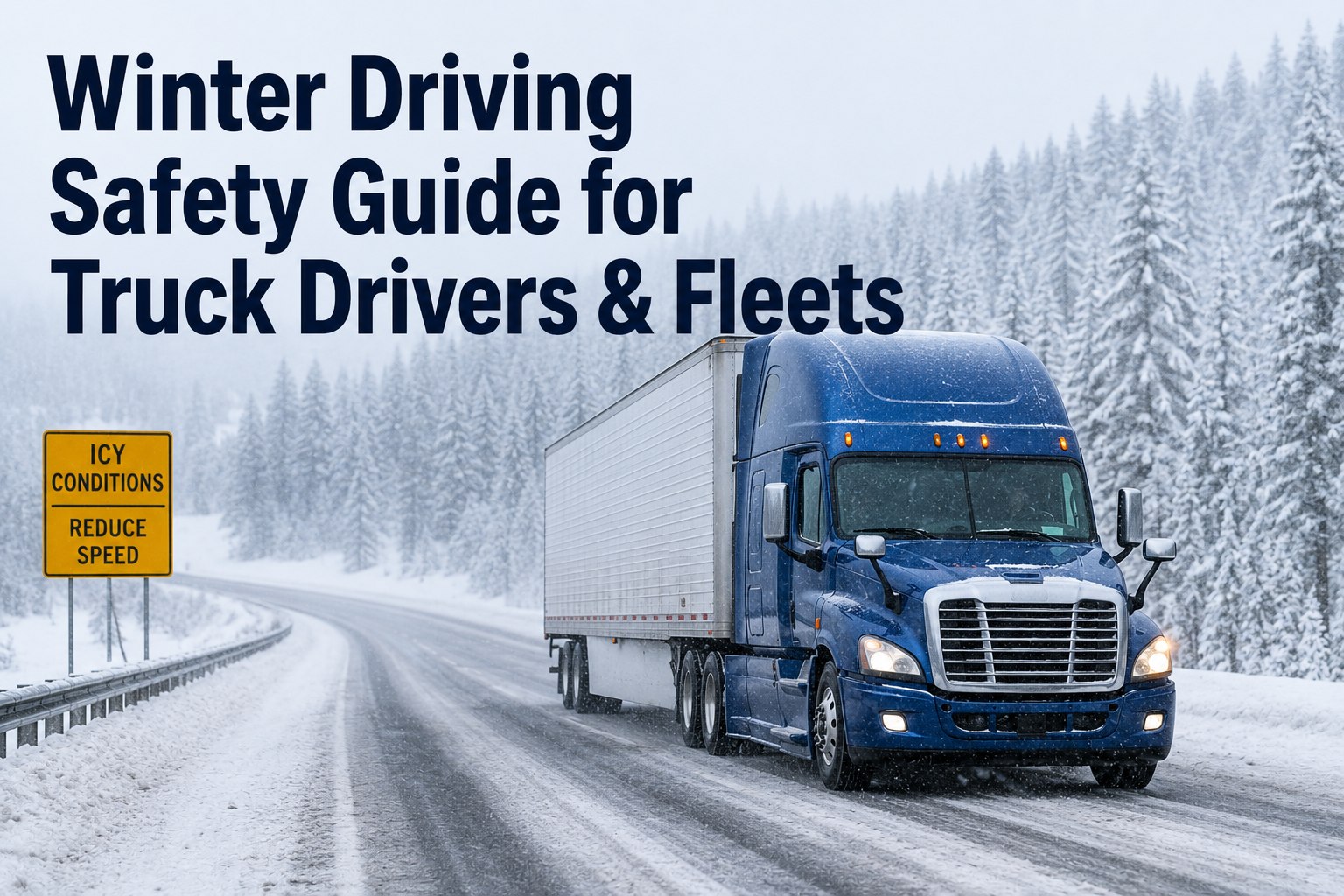
Every winter, the same pattern repeats on American highways — the first hard freeze hits, black ice appears on bridges before the main road, and crashes spike overnight. FMCSA data shows snow conditions alone cause roughly 84 fatal crashes, 2,000 injury crashes, and 11,000 property-damage crashes involving large trucks in a typical year, and the Federal Highway Administration reports 24% of all weather-related vehicle crashes occur on snowy, slushy, or icy pavement. What separates drivers who arrive safely from those who end up in a ditch isn't luck — it's a system, and that system runs on documented inspections, not memory. This guide breaks winter driving into the four zones that actually matter: the pre-trip that catches cold-weather failures, the driving techniques that keep 80,000 lbs under control, the emergency kit that saves lives when things go wrong, and the fleet-level playbook that turns safety from a hope into a habit. Talk to our team to see how Truck Inspection & Maintenance software turns every one of these zones into a repeatable, auditable process across your entire fleet.
The Complete Winter Driving Safety Guide for Truck Drivers & Fleets
Because slow is professional. Smooth is professional. And prepared is what gets you home.
The 4 Zones of Winter Driving Safety
Winter safety isn't one skill — it's four interlocking systems. Miss any one and the others can't compensate. Here's the framework professional drivers and safety managers use to think through cold-weather operations:
Pre-Trip Prep
Catch cold-weather failures before you leave the yard — belts, air lines, tires, fluids, chains.
Driving Technique
Smooth inputs, extreme following distance, no cruise, no engine brake — control every input.
Emergency Kit
Because breakdowns in a snowstorm aren't inconvenient — they're survival scenarios.
Fleet Playbook
Route intelligence, dispatcher discipline, digital inspection records — the operational layer.
Zone 1: The Winter Pre-Trip That Catches What Summer Misses
Cold weather changes how every component behaves. Belts get brittle. Air lines collect moisture that freezes. Tire pressure drops one PSI for every 10°F temperature drop. A standard summer pre-trip template is not enough in freezing weather — winter demands a heightened checklist that specifically hunts for cold-related failures before they strand you on I-80 in a blizzard. Truck Inspection & Maintenance lets you build a dedicated winter DVIR template with these cold-weather items pre-loaded, enforce photo evidence on high-risk checks, and route any defect straight to the shop as a work order — no paper, no missed items, no post-storm surprises:
Cold-Weather Systems
Traction & Fluids
Zone 2: Driving Techniques That Actually Work at 80,000 lbs
The physics of a loaded semi don't forgive winter mistakes. Large trucks need up to two football fields to stop safely under ideal conditions — and stopping distance grows dramatically on rain, snow, and ice. FMCSA regulations require truck drivers to exercise "extreme caution" and reduce speed when hazardous conditions affect visibility or traction. Technique lives with the driver, but Truck Inspection & Maintenance makes sure the truck is ready to support it — verified brakes, chains logged as on-board, tire pressures documented cold, and every DVIR timestamped as evidence if a winter incident ever gets investigated. Here's what "extreme caution" actually looks like in practice:
Reduce Speed by Conditions
1/3 slower on wet, 1/2 slower on snow, and drop way below limits on ice. 25% of speed-related CMV fatalities happen in adverse weather. Curve warning signs are calibrated for passenger cars — they're too fast for a loaded rig.
Extreme Following Distance
On dry pavement the rule is 7 seconds. In winter, double it. On suspected ice, push to 10+ seconds. On black ice, 80,000 lbs of momentum makes stopping distance essentially meaningless — the only defense is not needing to stop.
Turn Off Cruise & Engine Brake
Cruise control on ice causes wheel spin, which triggers a skid before you can react. Engine brakes force drive-axle deceleration that jackknifes trailers on slick pavement. Manual throttle and light service-brake application only.
Bridges & Overpasses First
Bridges, overpasses, and shaded road sections freeze first and stay frozen longest — cold air circulates below the deck. The main road can be dry and the bridge can be a skating rink. Slow before the bridge, not on it.
Smooth Every Input
No sudden steering. No hard braking. No throttle stabs. Every input to the truck should feel like you're carrying an open cup of coffee. Friction is already gone in winter — abrupt inputs finish what the ice started.
Skid Recovery
If the trailer starts to overtake the tractor (jackknife) — feet off all pedals, steer gently into the skid, keep wheels pointed where you want to go. Recovery means small corrections. After a recovery, pull over safely and take 10 minutes to reset before continuing.
Winter safety starts with a documented pre-trip
Paper inspections don't survive freezing rain, work gloves, or a DOT audit six months later. Truck Inspection & Maintenance runs winterized digital DVIRs on any phone — cold-weather templates, GPS-tagged photo evidence, offline sync for dead zones, defect-to-work-order routing, and audit-ready records exported in one click. Sign up free for up to 3 vehicles with no hardware, no contracts, and no credit card required.
Zone 3: The Emergency Kit That Turns Crisis into Inconvenience
Every winter, drivers get stranded on closed interstates for 6, 12, sometimes 24 hours. The truck may not start. Cell service may not work. Help may not come until the plows clear the highway. The kit isn't optional gear — it's the difference between waiting out a storm and becoming a news story. Add a "winter kit verification" section to your Truck Inspection & Maintenance DVIR template so every driver confirms the kit is on-board and complete before each cold-weather run — the software timestamps the confirmation and flags any missing category to dispatch. Organize the kit itself by function so drivers can find what they need in the dark:
Zone 4: The Fleet-Level Winter Playbook
Individual drivers can only do so much. The single biggest predictor of winter incident rates is not driver skill — it's fleet-level operational discipline. Dispatchers who push drivers into storms, dispatchers who reward speed over safety, dispatchers who don't verify routes are open — those decisions cause more winter crashes than black ice does. Truck Inspection & Maintenance gives fleet managers the operational layer that makes discipline enforceable — winter templates by vehicle type, real-time DVIR dashboards, defect-to-work-order routing, and audit-ready record retention exported in one click. Here's what a mature winter safety program looks like at the fleet level:
Weather-Aware Route Planning
Every dispatch decision starts with a 72-hour forecast. Avoid mountain passes during active storms. Reroute around closed corridors. Give drivers written authority to delay departure without penalty when NOAA issues winter storm warnings.
Digital Winter DVIR Templates
Standard pre-trip templates miss cold-weather items. Truck Inspection & Maintenance lets you build a dedicated winter template that adds air-dryer drain, chain check, anti-gel confirmation, and battery load-test — with photo evidence enforced on high-risk items, GPS-tagged, timestamped, and audit-ready for FMCSA at any moment.
Rushing = Root Cause
SambaSafety identifies rushing as the primary cause of most winter crashes. Build extra time into every winter schedule for defrost, snow removal, chain installation. Dispatchers should never tell a driver to "make up time" in winter weather.
"Stop Driving" Authority
Every driver needs written authority to pull over when conditions exceed safe operation — no dispatcher second-guessing, no HOS pressure, no dispatch retaliation. FMCSA already requires this: the driver's judgment on hazardous conditions is legally binding.
Post-Trip Debrief Loop
Every winter incident — near-miss, minor slide, delayed arrival — gets logged with cause, location, and countermeasure. Build a fleet-wide map of freeze-first bridges, chain-required corridors, and dead-zone stretches. Share it with every driver every October.
Winter Driving Do's & Don'ts — The Quick Reference
When a decision has to be made in seconds, drivers don't have time to consult a manual. This side-by-side reference is the mental model to internalize before winter starts — print it, laminate it, keep it on the sun visor:
Habits that keep you safe
Habits that end runs badly
Frequently Asked Questions
What does FMCSA legally require for winter driving?
Under 49 CFR 392.14, truck drivers must exercise "extreme caution" when snow, ice, sleet, fog, mist, rain, dust, or smoke adversely affects visibility or traction — and speed must be reduced. If conditions become "sufficiently dangerous," operation must be discontinued until conditions improve. This isn't a suggestion — it's a federal regulation with real consequences after a crash.
How much should I reduce speed in winter conditions?
FMCSA guidance: reduce speed by 1/3 on wet roads, by 1/2 on packed snow, and slow way below posted limits on ice. Remember that 25% of speed-related CMV fatalities occur in adverse weather. Curve warning signs are calibrated for passenger cars — a loaded semi needs to enter curves significantly slower.
What's the safe following distance on winter roads?
On dry pavement, 7 seconds is the standard for large trucks. In rain or light snow, double it. On packed snow or suspected ice, push to 10+ seconds minimum. On confirmed black ice, following distance essentially doesn't matter — 80,000 lbs of momentum can't be stopped. The only defense is avoiding the need to brake at all.
Should I use tire chains and when are they required?
Chain laws vary by state and elevation — Colorado, California, Oregon, Washington, and other mountain states have strict requirements during winter months, and violations can result in fines plus liability exposure after a crash. Carry the correct quantity and size for your truck, know how to install them before you need them, and check state DOT websites for real-time chain-law status. Add a "chains on-board" check to your Truck Inspection & Maintenance winter template so every driver logs chain readiness with a photo before each cold-weather run. Talk to our team to set it up.
Can I refuse to drive if conditions are unsafe?
Yes — and FMCSA regulations legally protect that judgment. If a driver reasonably believes conditions are hazardous enough to threaten safe operation, dispatchers cannot compel driving. Document the conditions (photos, forecast screenshots, road-closure notices) and log the delay. Retaliation for a safety-based refusal violates federal whistleblower protections.
How does Truck Inspection & Maintenance software help with winter safety?
Winter-specific templates in Truck Inspection & Maintenance catch cold-weather failures that standard summer pre-trips miss — air-dryer condensation, chain readiness, anti-gel confirmation, battery load-test. GPS-tagged photo evidence documents defects in real conditions. Defect-to-work-order routing means the shop knows about the frozen air line before the truck rolls out of the yard. And offline mobile sync means inspections still work at rural yards and mountain truck stops where cell signal disappears. Sign up free to run winter templates on your fleet.
Winter safety runs on documented inspections — not hope.
Truck Inspection & Maintenance is the software that ties all four winter safety zones together — a winterized pre-trip template your drivers actually finish, offline mobile inspections that work in dead zones, GPS-tagged photo evidence for every defect, and audit-ready records ready to export the moment a DOT officer asks. Free for up to 3 vehicles, no hardware, no contracts. Set it up in 10 minutes and be ready before the first freeze.