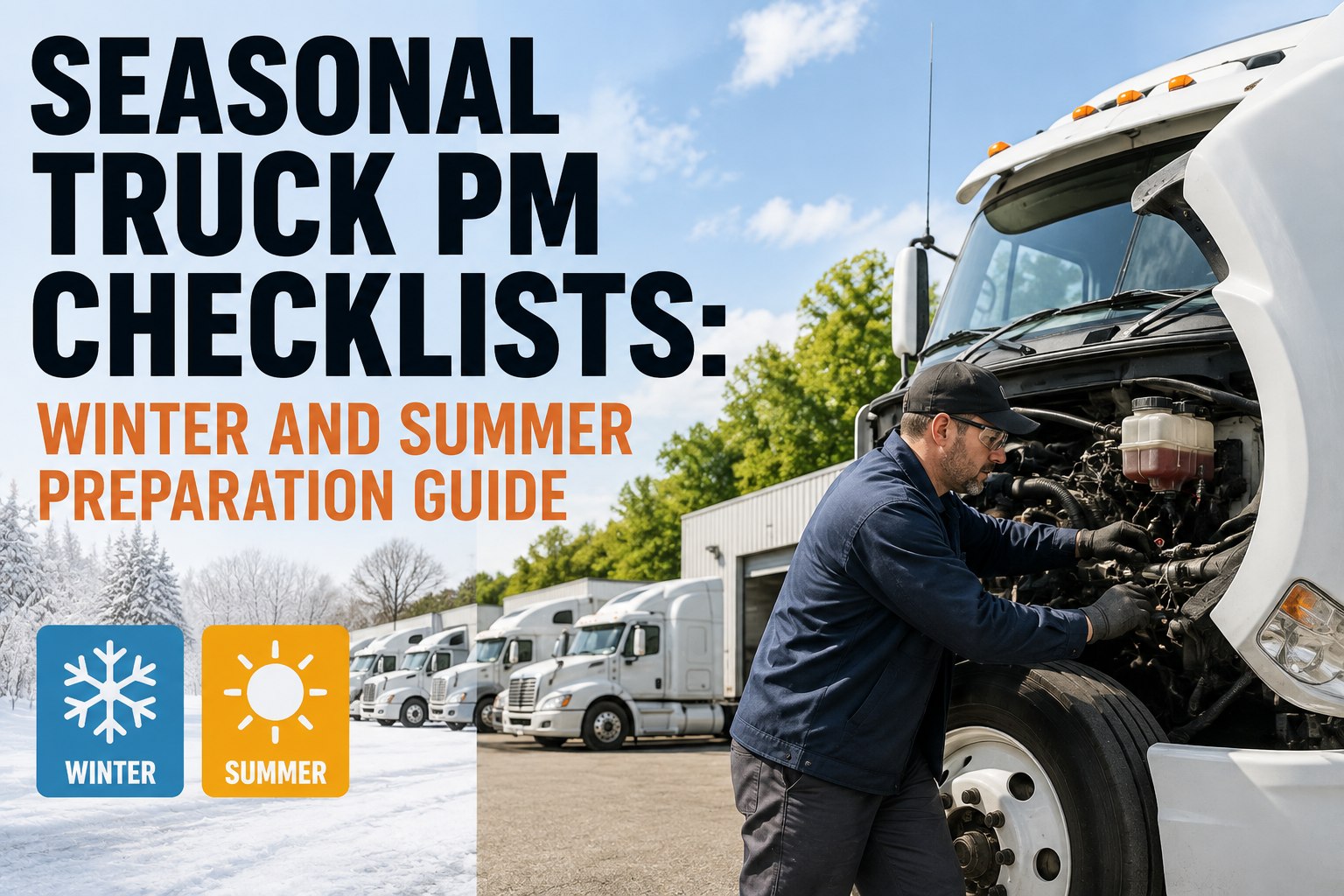
The base PM schedule handles what breaks year-round. Winter and summer each add tasks the base schedule doesn't cover — a truck that passed PM-B in September will still no-start at -15°F in January without the winter prep pack, and a truck that ran fine in April will overheat in July without the summer prep pack. This checklist covers both — the 10-point Winter Preparation Pack (October before first freeze) and the 10-point Summer Preparation Pack (April before first heat wave) — with what to check, why it matters, and how it plugs into your existing PM tiers. Truck Inspection & Maintenance runs both packs as scheduled PM overlays on driver phones — sign up free or contact our team.
Seasonal Truck PM Checklists — Winter & Summer Preparation Guide
Base PM misses what only winter or summer breaks. Add the season-specific overlay before the weather turns.
Why Seasonal PM Packs Pay for Themselves
Fleets that skip seasonal prep run higher no-start rates, more roadside calls, and more preventable breakdowns in the first 30 days of each weather turn. Three numbers show the shape of the cost:
Fleets without winter prep run roughly 4× more no-starts in the first cold snap. Dead batteries, gelled fuel, frozen DEF — all preventable with October prep, all guaranteed to hit unprepared trucks.
A single winter roadside call for a no-start, jump, or fuel gelling averages $675 including truck-stop mechanic labor. October prep costs $85–$120 per truck to prevent.
Fleets that skip April A/C service see roughly 3× spike in A/C service tickets in the first heat wave. Driver comfort translates directly to DOT hours-of-service compliance risk.
Skip prep and pay $675 per no-start all winter — start a free account and auto-fire both seasonal packs across your fleet this year.
Winter Preparation Pack — 10 Points (Complete by Oct 15)
The 10-point winter overlay runs on top of the standard PM tier the truck is due for in October. Each item has a specific check, a specific threshold, and a specific consequence if skipped:
Want a printable 10-point winter prep card for the shop wall? Contact our team and we'll ship one per truck, free.
Summer Preparation Pack — 10 Points (Complete by Apr 15)
The 10-point summer overlay covers what only shows up in heat — A/C system, cooling capacity, and heat-related component stress:
Both packs auto-fire as annual PM overlays with region-specific tuning — sign up free and configure both packs in under 20 minutes.
The One Rule That Makes Seasonal PM Actually Happen — Anchor Both Packs to Fixed Dates, Not First Freeze/First Heat
Fleets that wait for "when it gets cold" or "when it warms up" always run late. By the time the first freeze hits in mid-November, the entire fleet needs winter prep the same week and the shop is swamped. The rule: Winter Prep completes by October 15, Summer Prep by April 15 — regardless of what the weather looks like that year. Both dates fall inside the seasonal buffer window, both leave the shop enough runway to spread the work across 4 weeks instead of 4 days. Auto-schedule both packs in your CMMS to fire in September and March. Start a free account and configure both packs as annual PM overlays today.
The Rollout Timing — Both Packs on One Calendar
A standing seasonal PM schedule keeps both packs from colliding with regular PM tiers and each other. Recommended pattern:
CMMS auto-fires W1–W10 work orders across the fleet. Shop starts booking slots for driver-booked scheduling. Parts pre-pull: coolant test kits, batteries, dryer cartridges, winter blades, block heater cords.
All 10 winter points complete on every truck. Any truck not through winter prep by Oct 15 gets flagged red on the dashboard — high-priority scheduling exception.
CMMS auto-fires S1–S10 work orders. Parts pre-pull: A/C refrigerant, radiator/condenser cleaning supplies, belts, hoses, reefer service kits, coolant flush.
All 10 summer points complete on every truck. Any truck not through summer prep by Apr 15 = flagged red. Same discipline as winter.
Need help sequencing seasonal packs against your existing PM tiers? Get in touch for a free 15-minute PM calendar review.
Auto-fire both packs on Sept 1 and Mar 1 — 20 seasonal points across every truck without spreadsheet chasing.
Winter and Summer overlays scheduled as annual PM tiers, per-truck completion tracking, red-flag exception dashboard. Free forever for up to 3 vehicles — create your free account or talk to our team.
The KPI Dashboard — 6 Seasonal PM Metrics
Six numbers to track through each seasonal transition. All six directly predict winter no-start and summer overheating rates:
Every truck through W1–W10 before the deadline. Below 100% = the un-prepped trucks predict the first no-start.
Every truck through S1–S10 before the deadline. Below 100% = the un-prepped trucks predict the first overheat.
No-starts as % of fleet on first sub-freezing morning. Above 1% = winter pack incomplete or executed poorly.
Overheating warnings triggered per fleet per month during heat wave. Above 2% = summer pack cooling items skipped.
Zero tolerance. Every gel event traces to either wrong fuel blend or skipped water separator drain — both preventable.
Trucks with vent temp in 38–48°F range at post-summer prep verification. Below 95% = A/C service quality gap.
Track all 6 seasonal KPIs and hit 100% completion on both packs by deadline — create your free account in 10 minutes.
Frequently Asked Questions
When should winter and summer PM prep be completed?
Winter Prep Pack (10 points) should complete by October 15; Summer Prep Pack (10 points) should complete by April 15. Both deadlines are set before the seasonal weather typically hits, giving the shop 4 weeks of runway to spread the work. Fleets that wait for "when it gets cold" or "when it warms up" always run late — by the time the first freeze hits in November, the whole fleet needs winter prep the same week and the shop is swamped. Fixed calendar dates beat weather-triggered scheduling every time.
What's in the Winter Preparation Pack?
10 points: coolant freeze point test to -34°F protection, battery load test with sub-75% replacement, block heater function and cord check, winter diesel blend confirmation, fuel water separator drain, DEF freeze protection verification (heater cycle), winter washer fluid + wiper blades, tire pressure reset to cold OEM target, air brake dryer cartridge replacement, and emergency winter kit in cab. All 10 complete by October 15.
What's in the Summer Preparation Pack?
10 points: cooling system pressure test to spec (14–16 PSI), radiator and A/C condenser cleaning from engine side, A/C system service and recharge (R-1234yf or R-134a) to 38–48°F vent temp, fan clutch engagement test under load, coolant condition and pH check (8.5–11 range), belts and hoses heat inspection, tire pressure reset to summer baseline, battery terminal recheck for heat corrosion, reefer refrigeration unit service if equipped, and emergency summer kit in cab. All 10 complete by April 15.
Do seasonal PM packs replace or supplement regular PM tiers?
Supplement. Seasonal packs are annual overlays that run in addition to the existing PM-A / PM-B / PM-C cycles, not instead of them. A truck due for PM-B in October gets PM-B plus the Winter Pack — usually scheduled together to minimize down-truck time. Trucks not otherwise due for a PM tier in October still get scheduled for the Winter Pack alone. Same pattern in April with the Summer Pack.
How much does a winter no-start event actually cost?
A single winter roadside call for a no-start averages $675 including truck-stop mechanic labor, plus the load delay and any customer credit for late delivery. Fleets that skip winter prep run roughly 4× more no-starts in the first cold snap than fleets that complete the 10-point pack. The pack itself costs $85–$120 per truck to execute. The math favors prep aggressively — one prevented no-start covers the cost of prepping 6–8 trucks.
How does Truck Inspection & Maintenance handle seasonal PM packs?
Truck Inspection & Maintenance ships with both packs pre-configured as annual PM overlays. Winter Pack auto-fires September 1 with an October 15 deadline; Summer Pack auto-fires March 1 with an April 15 deadline. Each of the 10 points per pack tracks per-truck with photo verification available. Red-flag exception dashboard highlights any truck not through the pack by deadline. Both packs configure per fleet region — northern routes get stricter coolant freeze thresholds, southern routes get softer winter requirements. Free forever for up to 3 vehicles. Sign up in 10 minutes or contact our team for larger fleets.
The base PM handles what breaks year-round. The 20-point seasonal pack handles what only winter and summer break.
Both packs pre-configured as annual PM overlays with fleet-region tuning, red-flag exception tracking, photo verification. Free forever for up to 3 vehicles — no hardware, no contract, no credit card.