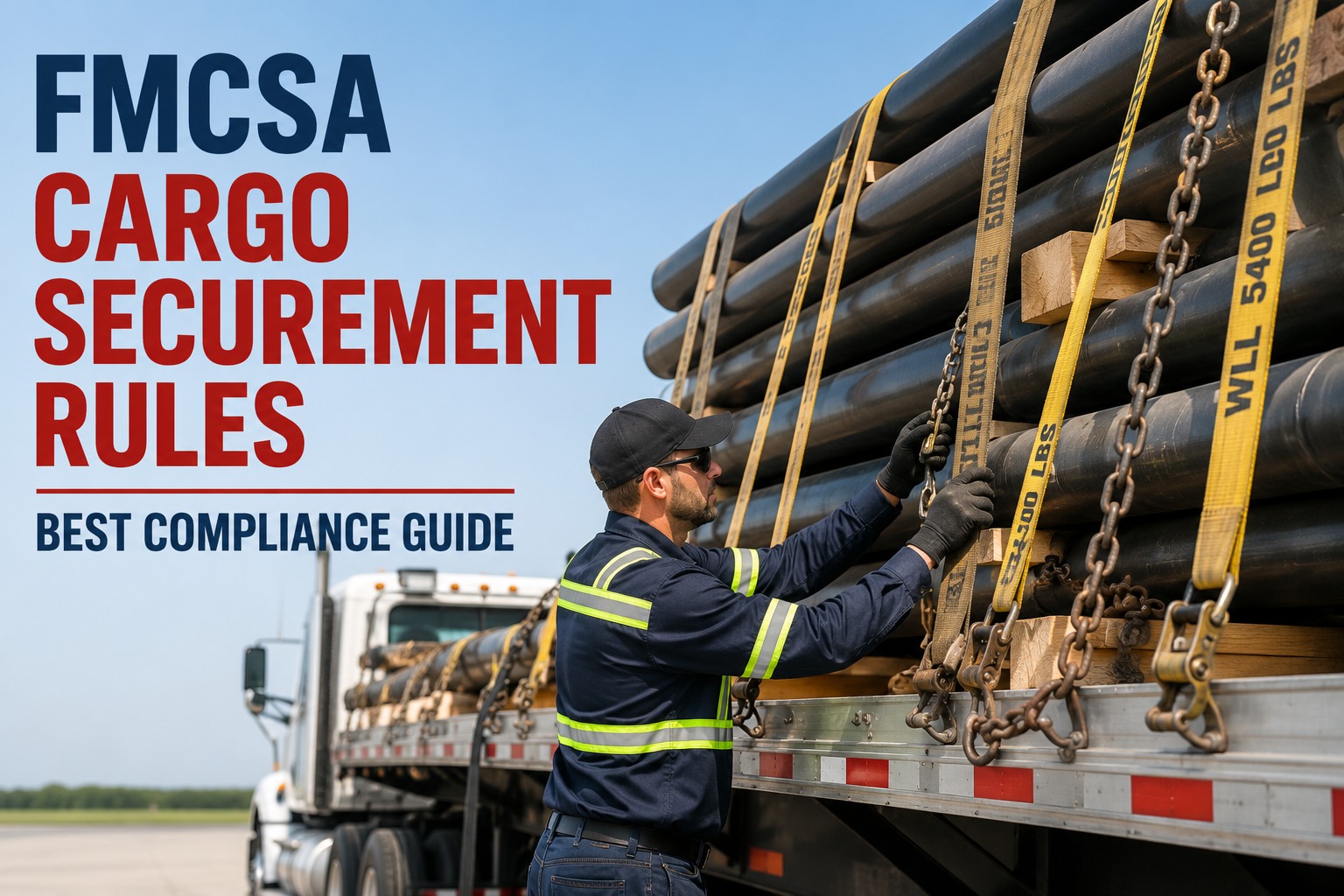
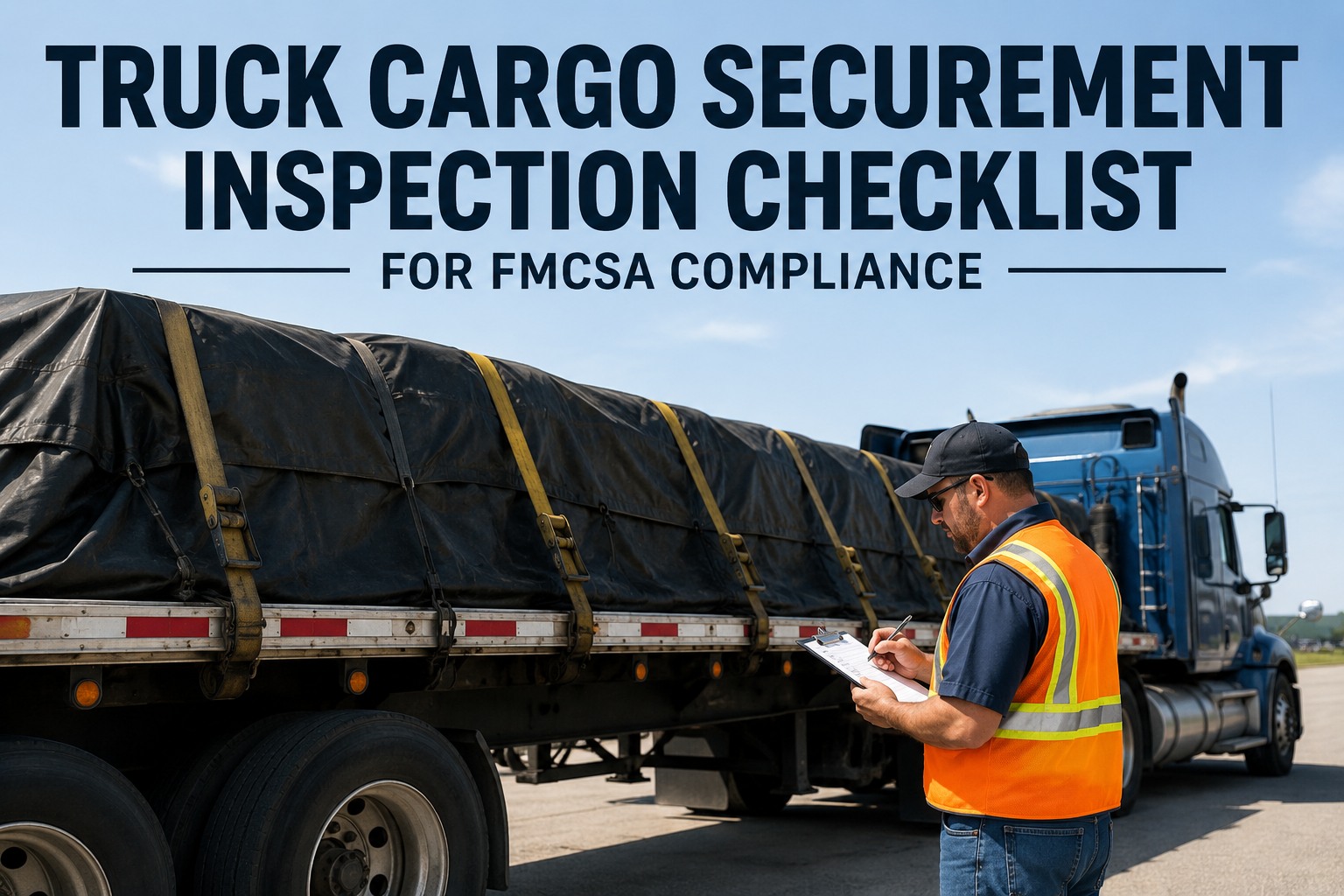
The pipe load looks tight at the yard. By mile 40, a strap has loosened, the bottom row has shifted and the stack is working against the tiedowns. Round, heavy cargo does not give you a second chance, because once it starts rolling, tightening a strap will not stop it. This guide explains how FMCSA cargo securement rules apply to concrete pipe on flatbeds: block it, tie it, check it. It also shows how Truck Inspection & Maintenance Management Software keeps securement gear inspected, defects logged and replacements closed out as work orders. Start free and put your securement gear on a checklist.
Flatbed · Cargo Securement · Pipe & Cylinders
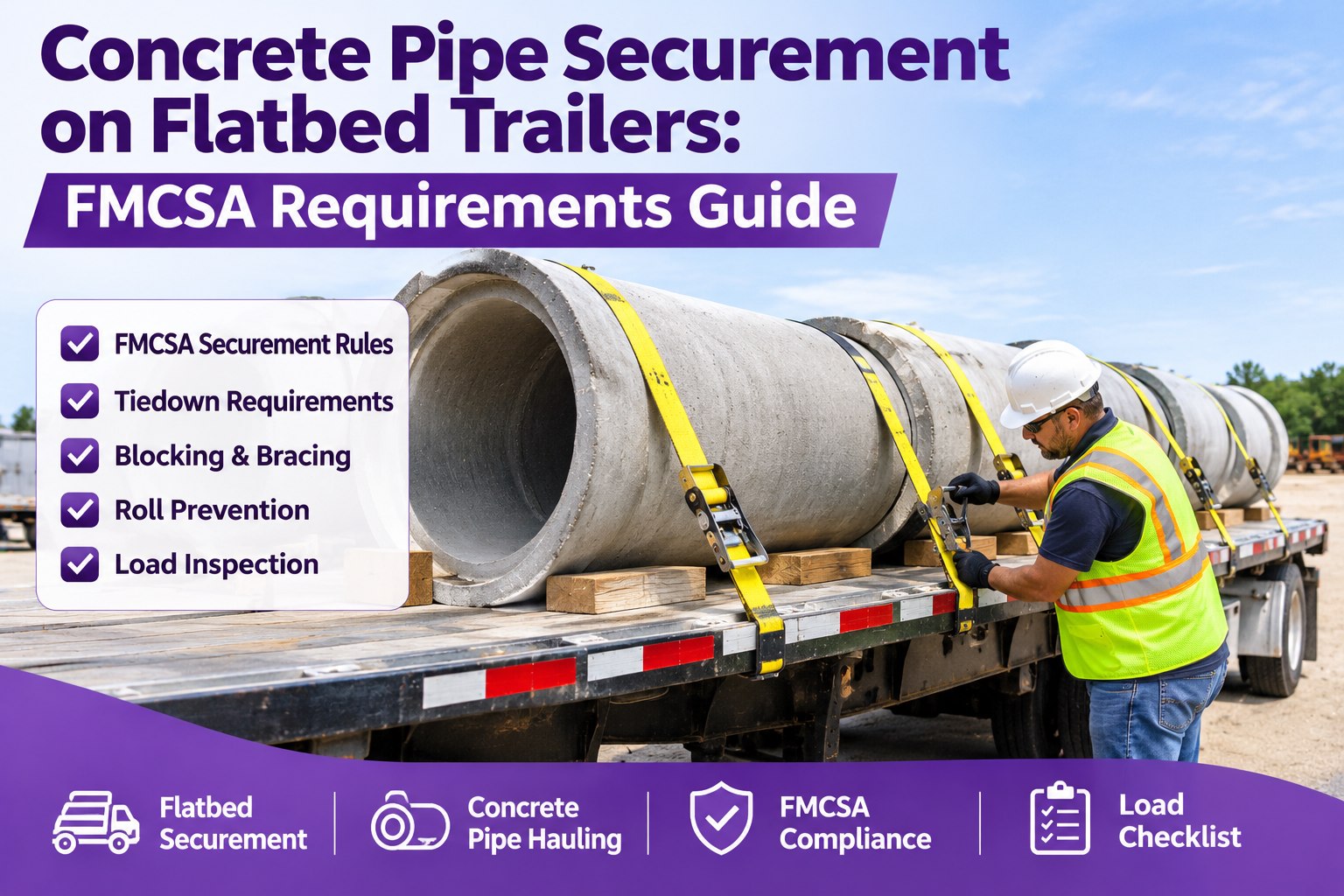
Concrete Pipe Securement on Flatbed Trailers: FMCSA Requirements Guide
Worn straps, bent binders and missing wedges rarely get noticed until the load is already moving.
With Truck Inspection & Maintenance Management Software, securement gear is part of every inspection. A frayed strap or damaged chain is logged against the trailer, becomes a work order, and is closed on record before the next pipe load goes out.
1InspectTrailer and securement gear checked before loading
2Log defectsWorn straps, chains and binders recorded on the unit
3Work ordersReplace or repair, then close on record
4PM trackingFlatbed PM and inspection dates in view
No credit card required. Free for up to 3 trucks.
0.8 gforward deceleration the securement system must withstand
0.5 grearward and sideways acceleration it must withstand
50%of cargo weight: minimum combined working load limit of tiedowns
Why Concrete Pipe Is Not Like Other Flatbed Cargo
A pallet of blocks wants to slide. A concrete pipe wants to roll, slide and shift, often all at once. Cargo securement rules in 49 CFR Part 393, Subpart I set the performance standard for every load. Concrete pipe also has its own section (393.124), because tiedowns alone cannot hold a round load that has nothing underneath to stop it.
↻RollRound shape lets pipe turn the moment friction or blocking fails.
⇄SlideSmooth concrete on a wet deck moves under braking and sharp turns.
⇅ShiftA stack moves as a group, loosening the tiedowns on top of it.
Anatomy of a Secured Pipe Load
Think in layers. The bottom row is held by blocking, the stack is held by tiedowns, and the whole load is held by checks along the route. This view shows a simple stacked load, end-on.
End view: stacked pipe on a flatbed (illustrative, not to scale)
Tiedown across the top of the stack
Wedge / blockFlatbed deckWedge / block
Simplified diagram. Pipe size, stacking pattern and the exact blocking and tiedown requirements are set out in 49 CFR 393.124 and depend on diameter and how the load is arranged.
Block It, Tie It, Check It
1Block It
Immobilize the bottom row with blocking, chocks or wedges
Block against both ends of the row so it cannot walk
Use blocks in sound condition, sized for the pipe
2Tie It
Place tiedowns over the stack, not only over the top row
Use gear with a legible working load limit
Protect straps from sharp edges with edge protectors
3Check It
Inspect before leaving, then again early in the trip
Re-tighten after the load settles
Note any damaged gear for repair or replacement
Blocking and tiedowns do different jobs. Blocking stops the bottom row from rolling, and tiedowns keep the stack together. If either one is missing, the other cannot make up for it. Book a demo to see how securement checks fit into your inspection routine.
The Tiedown Math, Step by Step
Two general rules set the minimum. Concrete pipe has its own section and may call for more, so treat these numbers as a starting point, not the full requirement.
ACount the tiedownsFor cargo longer than 5 feet, use at least one tiedown for the first 10 feet, plus one for each additional 10 feet or fraction of it (393.110).
BAdd up the strengthThe combined working load limit of all tiedowns must be at least half the weight of the cargo (393.106).
CCompare to the loadIf the combined limit falls short, add tiedowns. Use the lowest-rated part of each assembly (strap, hook or winch).
Illustrative example
Pipe load weight40,000 lb
Minimum combined working load limit (50%)20,000 lb
Example: tiedowns rated 5,000 lb eachAt least 4 needed
20-foot load: general minimum by lengthAt least 2
Both rules must be met, so the higher number applies. Always confirm against the current text of Part 393 and the pipe section.
The Re-Check Clock: When to Look Again
Securement is not a one-time job. Under 49 CFR 392.9, the driver has to re-examine the load at set points. Pipe settles and straps stretch, and that is when most loosening happens.
BeforeDepartureCheck blocking, tiedowns, edge protection and gear condition.
50 miFirst stopRe-examine the load within the first 50 miles and adjust.
3 hrOn the roadCheck again after 3 hours of driving or 150 miles, whichever comes first.
DutyStatus changeRe-examine whenever you change duty status.
Securement Gear: Keep It or Retire It?
Part 393 does not allow tiedowns with knots, cuts or other damage that reduces their strength. Use this as a quick screen during pre-trip and gear checks.
GearRetire or repair when
Webbing strapsCuts, frays, burns, knots, UV damage, or an unreadable working load limit tag
ChainsStretched or twisted links, nicks, gouges, welded repairs, or bent hooks
Binders and winchesBent handles, cracked housings, worn ratchets or pawls that do not hold
Blocks and wedgesCracked, split, crushed or too small for the pipe diameter
Edge protectorsMissing, split or flattened, so straps rub on concrete edges
Weak Load vs. Solid Load
WEAKWhat drivers get caught with
Bottom row sitting on friction alone
Straps over the top row only
Frayed webbing "good for one more trip"
No re-check until the destination
SOLIDWhat a secured load looks like
Bottom row blocked at both ends
Tiedowns spaced along the whole load
Gear inspected, rated and in good condition
Re-checks at 50 miles, then every 3 hours or 150 miles
How Truck Inspection & Maintenance Management Software Supports Pipe Hauling
The load is only as secure as the gear and the trailer under it. The software puts securement into the same loop as the rest of your maintenance.
1Securement on the ChecklistAdd strap, chain, binder and edge-protector checks to flatbed inspections so they are done every time.
2Defects on the UnitA frayed strap or cracked winch is logged against the trailer and driver, not left as a verbal note.
3Work Orders to CloseTurn the defect into a work order, assign the replacement and close it on the same record.
4Flatbed PM and DatesTrack preventive maintenance and annual inspection dates for the trailer that carries the load.
Check the Gear Before the Pipe Goes On
Keep securement checks, defects, repairs and trailer due dates in one system, so the next load leaves with gear you have already inspected.
Frequently Asked Questions
Does FMCSA have specific rules for securing concrete pipe?
Yes. Concrete pipe is covered by its own section of the cargo securement rules (49 CFR 393.124), in addition to the general requirements in 393.100 through 393.114. The pipe section deals with blocking, stacking and tiedowns for round loads.
Start free and add a pipe securement checklist.
How many tiedowns do I need for a pipe load?
The general rule is at least one tiedown for the first 10 feet of cargo and one more for each additional 10 feet or fraction, and the combined working load limit must be at least 50% of the cargo weight. The pipe section may require more, so check it for your load arrangement.
When must the driver re-check the load?
Can I use a strap with a few frayed edges?
No. Tiedowns with cuts, knots or other damage that reduces their strength must not be used. Remove the strap from service, and in the software log it as a defect and create a work order to replace it.
Are tiedown ratings important?
Yes. The working load limit is what counts toward the 50% requirement, and a tiedown assembly is only as strong as its weakest part. A strap with an unreadable tag should be treated as unrated and replaced.
Gear inspected · Defects closed · Flatbeds on schedule
Make Load Securement a Routine, Not a Roadside Surprise
Inspect securement gear, log defects, assign replacements and track trailer PM in Truck Inspection & Maintenance Management Software.
No credit card required. Free for up to 3 trucks.