A loaded dump truck starting down a long grade is asking its brakes to absorb a lot of energy. The engine brake, exhaust brake or retarder is supposed to take most of that load so the service brakes stay cool and ready. When the auxiliary system is weak, the driver finds out halfway down the hill. This guide covers how each system works, how to diagnose weak retarding, and what to check at every service, plus how Truck Inspection & Maintenance Management Software (TIM) schedules the checks and turns every finding into a work order. Start free and schedule your first engine brake PM.
Engine Brake · Exhaust Brake · Retarder · Downhill Safety
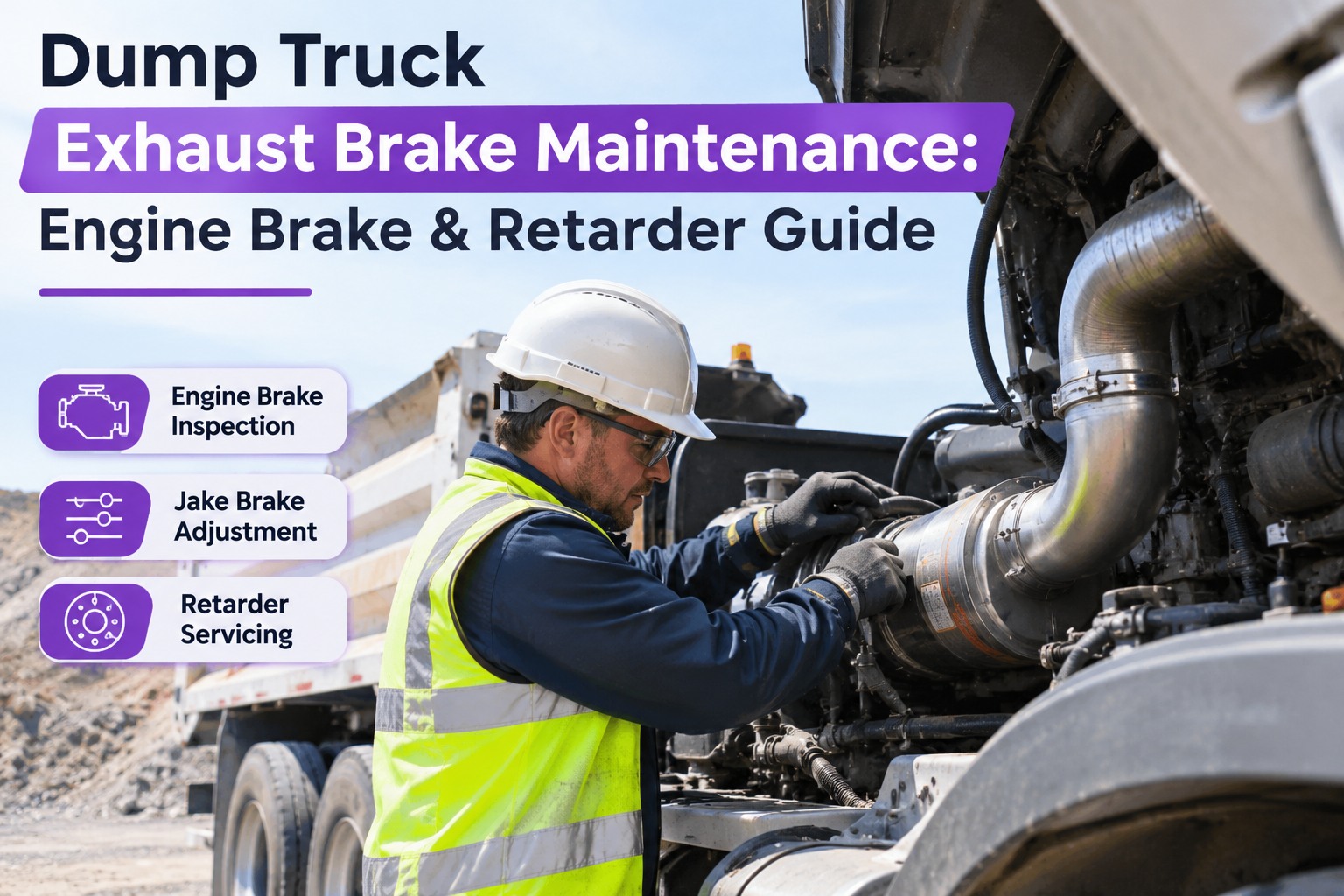
Dump Truck Exhaust Brake Maintenance: Engine Brake & Retarder Guide
If the engine brake fades on a loaded grade, the service brakes carry everything.
TIM runs the loop that keeps it from happening: drivers report weak retarding on inspection, the defect is graded, a work order is created, and recurring PMs bring the next check.
1. InspectDriver and tech checks on a digital inspection.
2. Log the defectWeak or no retarding recorded against the truck.
3. Work orderGraded, prioritized and sent to the shop.
4. Repeat as PMValve, lash and oil checks on a schedule.
ReportedWeak retarding logged by the driver, not discovered on the hill
PrioritizedBrake defects graded so safety items rise to the top
On recordEvery adjustment and repair kept in truck history
Three Auxiliary Brakes, Three Different Failure Patterns
"Engine brake" gets used for several systems. Knowing which one your truck has tells you what to inspect first.
🔧Exhaust brake
How it worksA valve in the exhaust restricts flow, creating back pressure that slows the engine.
Typical troubleA butterfly valve stuck closed causes constant power loss. A sticking or leaking actuator weakens braking.
Check firstValve movement, actuator and air or control connections, exhaust leaks.
⚙️Compression-release (Jake-style) brake
How it worksEngine oil pressure, directed by solenoids, drives slave pistons that open the exhaust valves near the top of the compression stroke.
Typical troubleLow or diluted oil, restricted oil feed, solenoid or control faults, and incorrect slave piston lash.
Check firstOil level, pressure and condition, enable switches, lash to OEM spec.
🛞Retarder
How it worksA driveline or transmission-mounted device that adds braking torque independent of the service brakes.
Typical troubleControl or wiring faults, low fluid, cooling problems and wear, depending on the design.
Check firstFluid level and condition, controls, connections, and the OEM's service schedule.
Auxiliary brakes help control speed but never replace the service brakes. Follow your engine and retarder manufacturer's manual for specifications and procedures.
The Loaded Downhill Plan
Auxiliary brake maintenance matters most on grades, so build the driver's plan around it.
1
Before the gradeSlow down, select a suitable lower gear and set the engine brake level before the descent starts, not after speed builds.
2
On the gradeLet the engine brake or retarder hold the speed. Use the service brakes for small adjustments instead of dragging them the whole way down.
3
If retarding feels weakReduce speed, use the service brakes as needed and stop in a safe place. Do not keep going on a truck that is not slowing as expected.
4
After the tripReport it the same day. In TIM, that report becomes a defect and a work order instead of a verbal comment that gets lost.
Also watch local rules: some areas restrict engine brake noise. A properly maintained system is quieter and more predictable than a neglected one. Book a demo to see driver reports turn into work orders.
Troubleshooting Weak or No Engine Braking
Work from the easiest checks to the most involved. Many "weak brake" complaints are controls, oil or lash problems, not a failed brake housing.
If you noticeNo engine braking at all
Common causesMaster or intensity switch off, clutch or throttle switch not enabling, ECM lockout, blown fuse or wiring fault.
Check firstSwitch inputs and enable signals, fault codes, solenoid power and connectors.
If you noticeWeak retarding
Common causesLow or diluted oil, wrong viscosity, restricted oil feed, loose slave piston lash, leaking solenoid seals.
Check firstOil level, pressure and condition, then lash to spec. Rule out worn service brakes, which can feel like a weak engine brake.
If you noticePower loss with brake off
Common causesExhaust brake valve stuck closed, or an exhaust restriction.
Check firstValve movement, actuator and exhaust restriction. Do not run the truck loaded until it is resolved.
If you noticeBrake shuts off by itself
Common causesECM locking it out because of oil pressure, coolant temperature or actuator faults.
Check firstStored fault codes and the underlying engine problem before touching brake hardware.
Lash Adjustment: Where Shops Make Costly Mistakes
Slave piston lash sets how far and when the exhaust valves open during braking. Too loose gives delayed, shallow opening and weak retarding. Wrong adjustment can damage the engine or brake housing, and settings differ between models, so use the OEM manual for your engine.
Do
Set valve and injector adjustments first, as the OEM procedure requires.
Use the exact lash spec and gauge for your engine and brake model.
Purge oil from the adjusting screw for the specified time, longer when the oil is cold.
Recheck the setting before closing up and record the values.
Don't
Reuse a spec from a different engine or brake model.
Rush the oil purge. Trapped oil gives a wrong reading.
Trust a lash check after the brake has run. Oil in the screw makes it unreliable, so repeat the full procedure if unsure.
Replace brake housings before ruling out oil pressure and controls.
Who Checks What
Split the work so drivers catch symptoms and technicians check the system. Both lists become scheduled tasks in TIM.
Driver, every inspection
✓Brake switches and indicator work normally
✓Engine brake sounds and feels normal when tested
✓No oil leaks near the brake housings
✓Report any fade, noise or power loss the same day
Technician, at PM
✓Oil level, condition and pressure
✓Slave piston lash to OEM spec, with values recorded
✓Solenoids, seals, wiring and connectors
✓Exhaust brake valve and actuator; retarder fluid and controls
✓Service brakes, as the cross-check
How TIM Runs the Engine Brake Loop
Inspect, log, repair, repeat. TIM keeps the loop moving so a weak-brake report becomes a scheduled job the same day.
1Defect loggedA driver or technician records weak retarding on a digital inspection.
2Severity gradedBrake-related defects are graded and placed in a priority lane.
3Work order createdThe repair is queued, with parts checked so the shop knows if it can start.
4Closed on recordLash values and repairs close against the truck's history, and the next PM is set.
Example dump truck brake work queue (illustrative)
P1Truck 21 — No retarding on grade, driver reportOut of service · bay now
P2Truck 14 — Exhaust brake valve stickingSame shift
P3Truck 09 — Weak retarding, check oil and lashNext open bay
P4Truck 33 — Engine brake PM dueNormal queue
Keep Your Auxiliary Brakes Ready for the Next Grade
TIM connects driver reports, defects, work orders and PM schedules, so engine brake and retarder checks happen on time and are documented on every dump truck.
Frequently Asked Questions
How often should a dump truck's engine brake be serviced?
Follow the engine and brake manufacturer's schedule, and inspect at every PM. Lash is typically checked together with valve and injector adjustments. TIM can attach those checks to each truck's PM schedule.
Start free and set it up.
Why is my engine brake weak?
Common causes are low or diluted oil, restricted oil feed, loose slave piston lash, control or switch faults, and leaking solenoid seals. Worn service brakes can also make the truck feel like it has weak engine braking, so check both systems.
What is the difference between an exhaust brake and a Jake brake?
An exhaust brake restricts exhaust flow to create back pressure. A Jake-style compression-release brake uses oil-driven slave pistons to open the exhaust valves near the top of the compression stroke, so the engine absorbs more energy. Their failure patterns and checks differ.
Can I rely on the engine brake instead of the service brakes?
No. It is an auxiliary system that reduces the load on the service brakes. Keep the service brakes in good condition and ready to stop the truck.
How does TIM help with engine brake maintenance?
It runs the full loop: digital inspections capture weak retarding, defects are graded into priority lanes, work orders are created for the repair, and recurring PMs bring the next check. Everything closes on the truck's history.
Book a demo to see it in action.
Inspect · Log · Repair · Repeat
Don't Find Out Your Brake Is Weak on the Hill
Start a free trial and schedule your first engine brake inspection, or book a demo and we'll walk through the loop with your dump trucks in mind.
No credit card required. Free for up to 3 trucks.