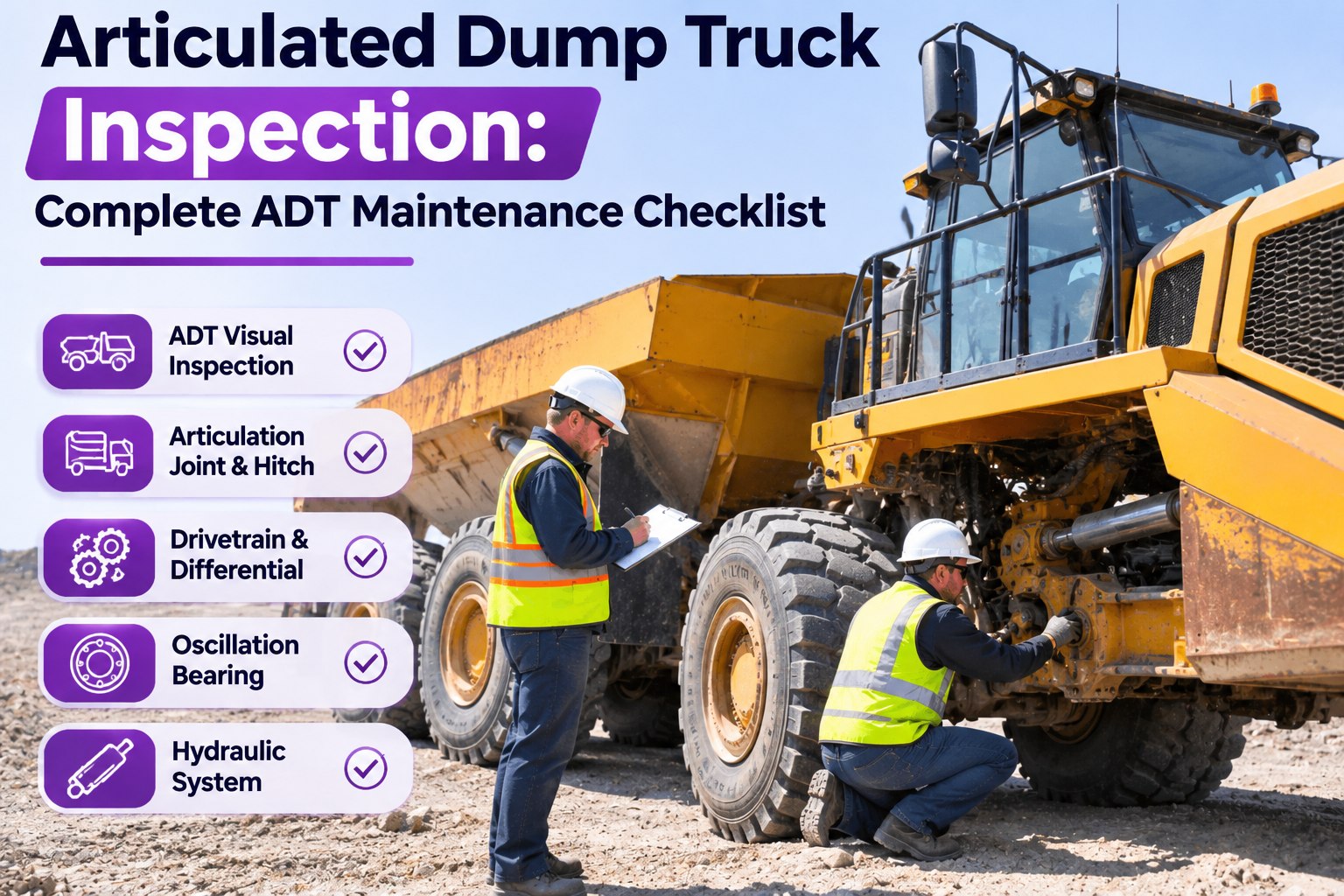
An articulated dump truck is built to go where rigid trucks cannot: soft ground, steep haul roads, and sites where the surface changes every week. That ability comes from a hitch that bends in the middle, an oscillating rear frame, and a drivetrain that sends power to every wheel. It also means an ADT has more moving joints, more hydraulic lines under stress, and more places for wear to hide than most trucks in your yard. A solid articulated dump truck inspection routine focuses on those places first. This guide shows where to look, how to organize daily and periodic checks, what hitch, oscillation, and drivetrain wear looks like, and how to keep records that make ADT maintenance predictable. Start free and put an ADT walkaround checklist on every operator's phone.
Articulated Dump Truck Inspection: Complete ADT Maintenance Checklist Guide
Off-highway work hides small problems until they become big repairs. Truck Inspection & Maintenance Management Software gives operators a guided walkaround for the hitch, oscillation joint, and drivetrain, grades what they report with photos, and sends each finding to the shop as a work order with PMs scheduled around your manufacturer's plan.
Map the Machine: Front Unit, Hitch, Rear Unit
Think of an ADT as two machines joined by one critical joint. Walk it the same way every time so nothing is skipped.
- Cab, mirrors, cameras, and alarms
- Engine bay, belts, hoses, and leaks
- Front axle, wheel ends, and tires
- Steering cylinders and their pins
- Articulation joint bearings and pins
- Oscillation joint and its bearings
- Hoses and wiring crossing the joint
- Grease points and frame lock
- Body, tailgate, and hoist cylinders
- Body pivots and wear surfaces
- Rear axles, brakes, and tires
- Driveshafts and differential locks
Three Layers of Inspection
Different checks belong to different people at different times. Layering them keeps the daily walkaround quick and the deeper work thorough.
The Joints That Decide ADT Life
The articulation and oscillation joints carry steering forces, load, and twisting from uneven ground. They deserve extra attention.
- Grease at every joint point, with fresh grease visible
- Play or movement at the hitch when the machine is stopped and supported
- Steering cylinder pins and bushings for looseness
- Hoses and wires crossing the joint for chafing or tight bends
- Seals and covers for damage or contamination
- Cracks in the frame around the joint
Use the manufacturer's service manual for bearing preload, wear limits, and the correct way to measure play.
Drivetrain and Differential Locks: Four Questions
Look for play, missing grease, vibration, or damaged guards. A failing U-joint can tear up a shaft and surrounding lines.
Test them as the manufacturer directs. Operators should know when not to use them, and report any lock that sticks or will not release.
Check levels and look for leaks at seals, plugs, and housings. Milky or metallic fluid needs attention.
Check for leaks, overheating, noise, and weak braking. Brake systems on these machines differ, so follow your manual.
Catch Hitch and Drivetrain Wear Before It Parks the Machine
Operators report it with a photo, the shop gets a work order, and each machine's history shows how wear is trending. Start free or book a demo.
Site Conditions Change the Schedule
Two ADTs of the same model can wear very differently. Use the manufacturer's schedule as the baseline, then adjust for where and how the machine works.
A Shift in Three Checks
Frequently Asked Questions
Put Your ADT Inspections and PMs in One Workflow
Guided inspections, photo defects, traffic-light grading, work orders, and PM scheduling in one system built for trucking and heavy-equipment fleets. Start free to build your ADT walkaround, or book a demo and we will walk through it with your fleet in mind.