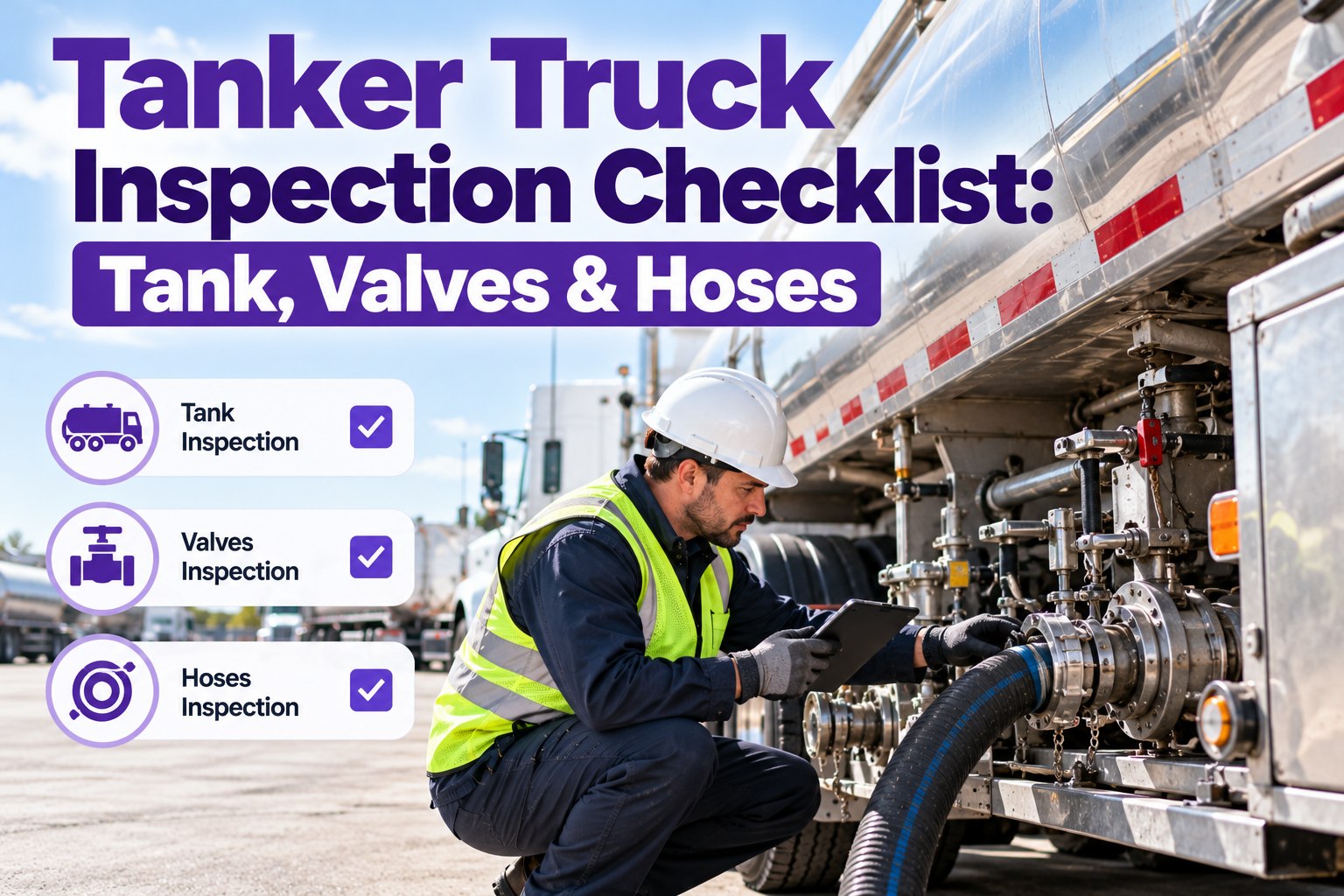
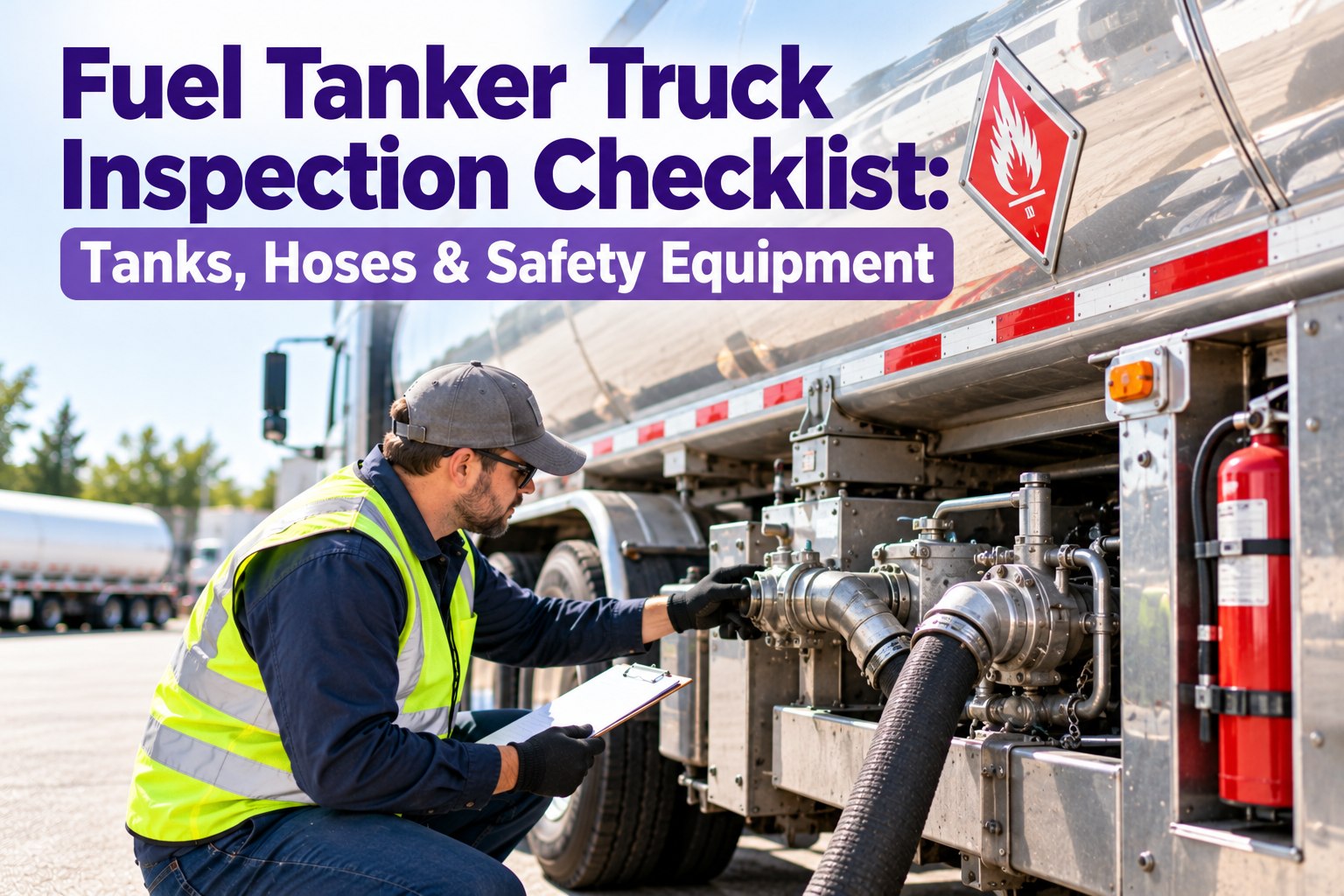
On a tanker, a valve does not have to fail to cost you the day — it only has to weep. A drip at the bottom outlet or a seat that won't seal gets the load refused at the rack, sends the trailer back empty, and puts the repair on the terminal's schedule instead of yours. Worse, a valve that lets go on the road is a cargo spill. Every discharge valve, every gasket, every flange is a potential leak path, and each one has a specific place to look. This checklist walks them valve by valve, the way a leak-tight tanker demands. Start free and run this checklist on every tanker.
Tanker Checklist · Valves, Fittings & Leak Testing
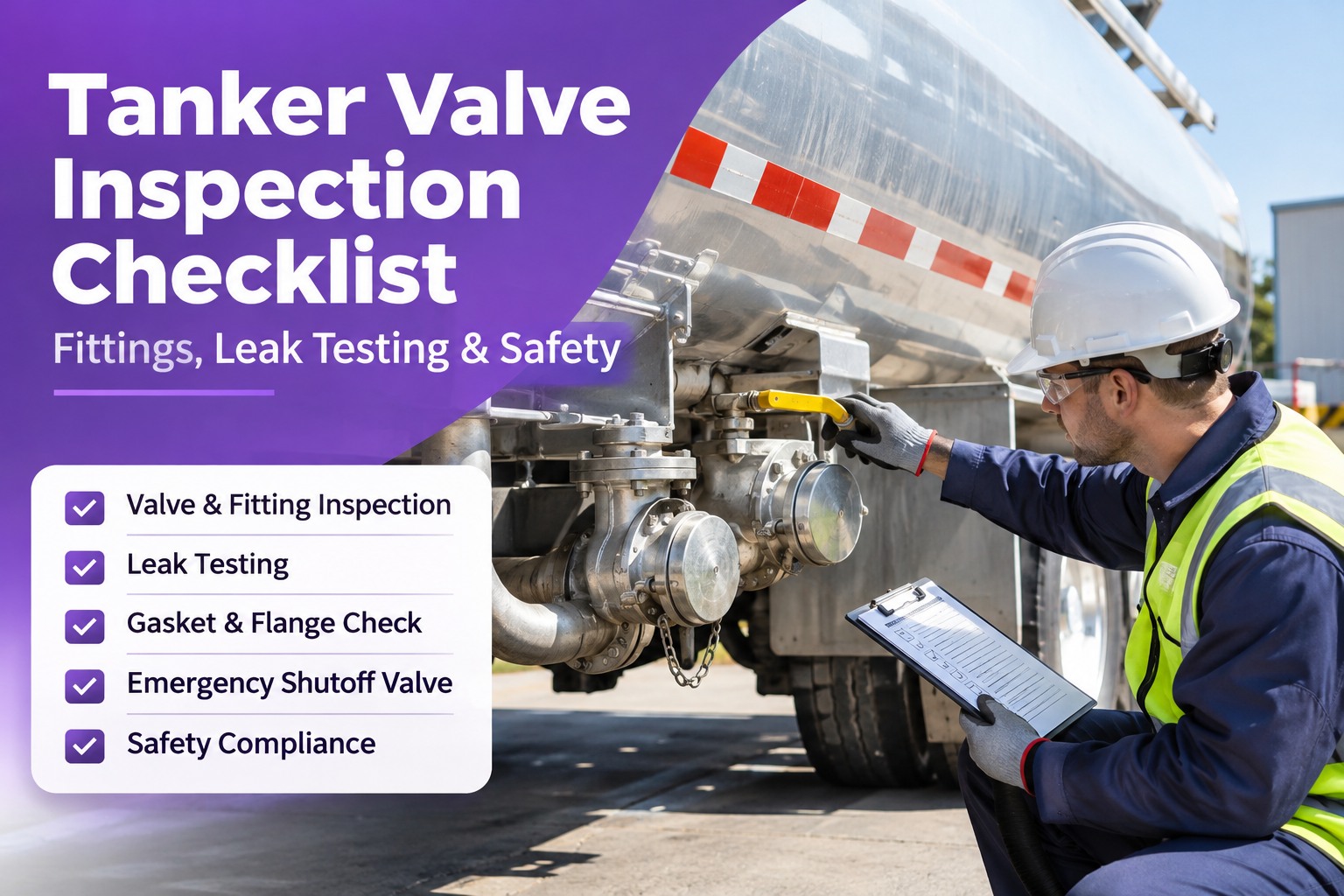
Tanker Valve Inspection Checklist: Fittings, Leak Testing & Safety
A weeping seat or a loose flange refuses the load at the rack and can become a spill on the road. Truck Inspection & Maintenance Management Software runs the loop that catches it first: a valve-and-fitting walkaround on every digital inspection, each seep or damaged seal logged to the tanker's DVIR, any defect turned into an assigned work order, and the next leakage test scheduled — so every closure is verified leak-tight and on the record before the trailer leaves the yard.
The four leak paths on a discharge valve
Valve seat
Packing gland
Flange connection
Side-port area
§180.407the cargo-tank test & inspection standard, including leakage
12 monthstypical interval for the annual leakage (K) test
Monthlyinternal self-closing stop valve leakage & shutoff actuation check
Leak-tightthe pass/fail bar for every self-closing stop valve
Before You Start: Three Checks, Three Clocks
Valve work on a tanker lives on three separate schedules. Know which one you are doing so nothing falls through the gap between them.
Daily walkaround
The driver or tech check before and after every load — closures seated, caps secure, no seepage around any valve.Shop maintenance
Gasket replacement, valve service, seat and packing work on a time or usage cadence set by your shop.Federal testing
The §180.407 leakage, visual and pressure tests on their fixed intervals — a lapse alone puts the tank out of service.
The Tanker Valve Inspection Checklist
Work it valve by valve before dispatch and after any valve service. Each box is a leak path or a function an inspector will check too.
A Weeping Valve Caught in the Yard Is Free
Found at the rack, it costs you the load. Found on the road, it is a spill. Truck Inspection & Maintenance Management Software logs each valve and seal on the walkaround, turns a seep into a work order, and keeps the dated leak-test history — so a weeping seat is caught on your schedule, not the terminal's.
Where Tanker Valves Actually Leak
Valve seat
→Worn or scored seat won't seal closed — the classic "weeping valve" that refuses a load
Packing gland
→Dried or loose stem packing lets product seep up the stem under pressure
Flange gasket
→Wrong, reused, or under-torqued gasket weeps at the bolted joint
Closure cap missing
→A missing or loose cap fails leak-tightness outright — hold the truck until fixed
Every one of these is visible on a careful walkaround before it becomes a spill. Book a demo to flag seeps the moment a driver spots them.
This is an overview of the standing 49 CFR Part 180 cargo-tank test, inspection and valve requirements. Intervals and criteria vary by tank specification and service — confirm current requirements against official PHMSA / FMCSA sources and your tank's specification before setting policy.
Frequently Asked Questions
1Where do tanker discharge valves most commonly leak?
Four places: the valve seat (won't seal when closed), the packing gland around the stem, the flange connection between the cover plate and the valve body, and the side-port area. On a daily walkaround you are looking for product residue or wetness at any of them; on a leak test you apply detection solution to each path and watch for bubbles. Knowing the four paths is what turns a vague "it's wet down there" into a found fault.
Book a demo to log leak paths per valve.
2How often does a cargo tank need a leakage test?
Under 49 CFR 180.407, a leakage test is generally required at least once every 12 months, and it checks the internal and external self-closing stop valves along with the product piping and delivery hoses. A back-flow check valve isn't held to the same leak-tight standard. Separately, the internal self-closing stop valve is checked for leakage monthly. Let the annual test lapse and the tank is out of service on paperwork alone.
Book a demo to schedule leakage tests automatically.
3How do I leak test a tanker valve?
With the valve closed and a flange or plug applied, pressurize to the test pressure, hold for the soak time, then apply leak-detection solution to each potential leak path and inspect for the full dwell time. If the valve won't hold pressure, the solution shows you exactly where it is escaping. For a metered internal valve, the meter-creep method rejects any detectable creep in the first five seconds after the meter stops.
Book a demo to record every leak-test result.
4When should a tanker valve gasket be replaced?
Any time it is cut, weeping, or no longer seating, and as a rule you don't reuse a gasket in a bolted joint — if one is reused, inspect its contact face first. The gasket also has to be chemically, thermally and mechanically compatible with the product, the flange face must be free of gouges, and the fasteners torqued to the gasket maker's spec. A wrong or under-torqued gasket is a weep waiting to happen.
Book a demo to track gasket service by valve.
Seated · Leak-tight · Torqued · On record
Keep Every Tanker Valve Leak-Tight and Provable
Truck Inspection & Maintenance Management Software walks every valve, gasket and flange as one check, opens a work order on any seep, and keeps the dated leak-test record that proves the tanker was tight when it rolled — load after load.
No credit card required. Free for up to 3 trucks. Built for tanker and bulk-liquid fleets.