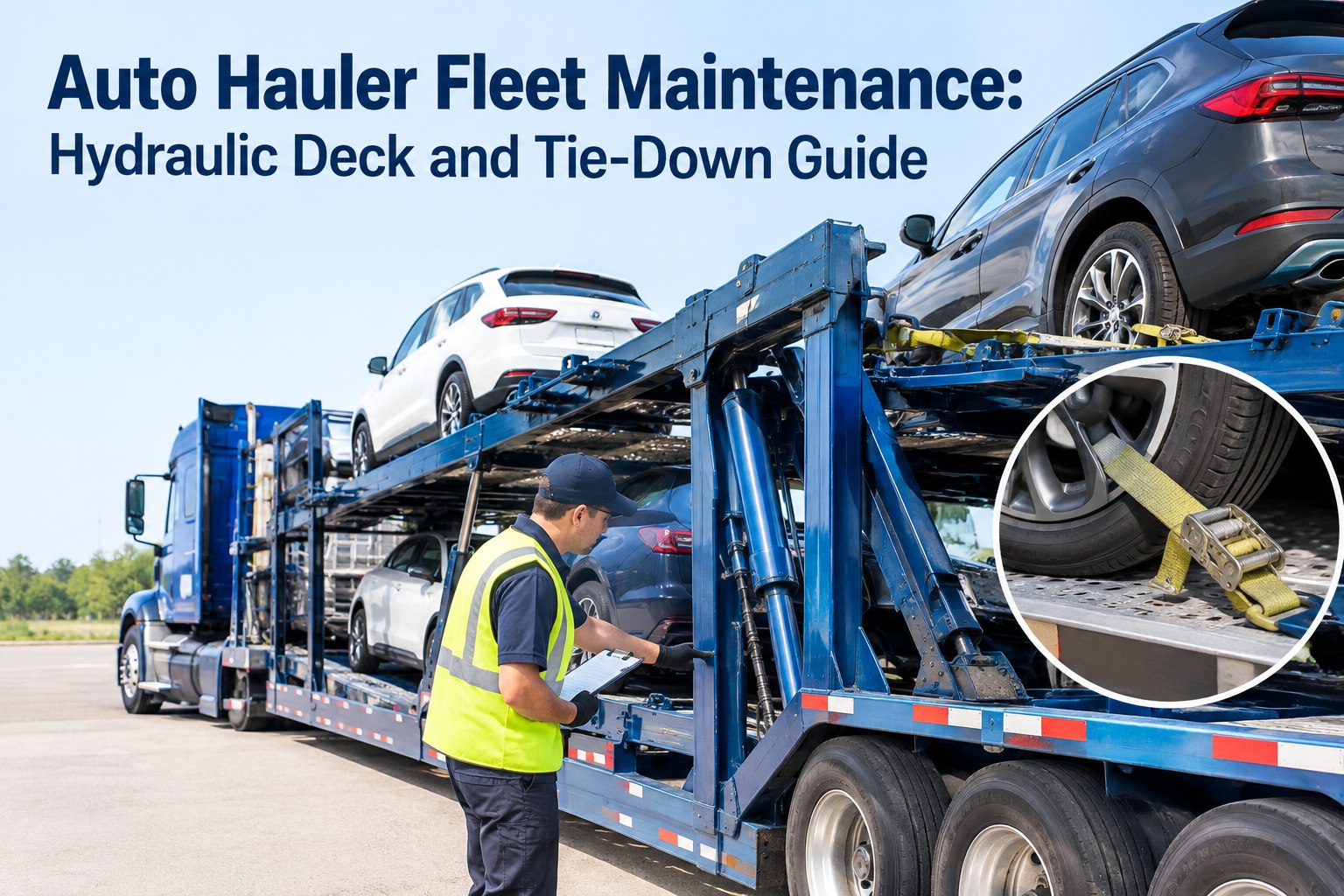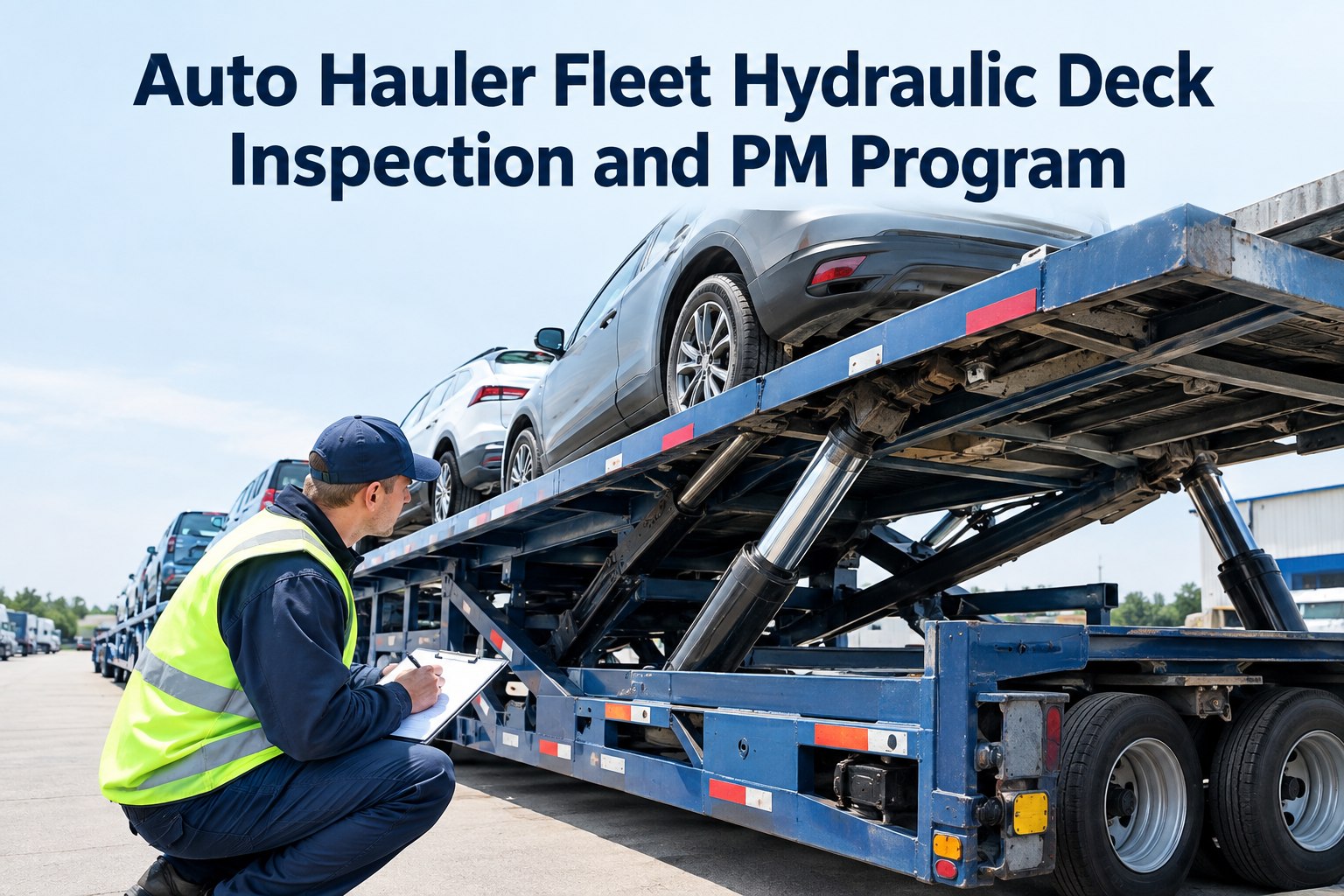
An auto hauler's hydraulic deck fails on a clock a mileage schedule can't see: it raises, lowers, tilts, and locks dozens of times a day under load, so wear tracks cycle count, not odometer miles. And the biggest killer is contaminated fluid — behind roughly 85% of hydraulic failures — quietly scoring cylinder rods until a deck drifts down with $200K of cars on it. This guide is the hydraulic-deck-specific program: the components, the failure modes, and the cycle-based cadence that keeps the deck holding. Truck Inspection & Maintenance runs deck PM on cycle counts and routes any weep or drift straight to a work order — start a free trial or contact our team.
Auto Hauler Fleet Hydraulic Deck Inspection & PM Program
The deck wears on cycles, not miles — and 85% of its failures start with dirty fluid. Here's the component-by-component program that keeps $200K of cars from drifting down.
Why the Deck Breaks a Mileage Schedule
A car carrier can sit in traffic all day and barely move the odometer while cycling its deck a hundred times. Three realities make the hydraulic deck its own maintenance discipline:
The Hydraulic Deck — Component by Component
The deck system is six inspection zones, each with its own failure mode and check cadence. This is the core of the program:
The One Reading That Predicts a Deck Drop — Hold-Drift Under Load
A hydraulic deck should lock at position and stay dead still with cars on it. The moment it sags even an inch after locking, a cylinder seal is already failing — and seal failure doesn't degrade slowly, it lets go under load and the deck drops with whatever's on it. So "the deck settles a little" is never a note-and-continue item; it's an immediate work order. Caught at the fluid-and-rod stage it's a seal kit; caught as drift it's a cylinder; missed entirely it's a deck of damaged vehicles. Start a free trial and make hold-drift a logged, trended reading on every unit.
Building the PM Cadence — By Cycle, Not by Mile
Because the deck wears on use, its PM triggers on cycle count and calendar together — layered over the standard chassis schedule:
Run fluid analysis on a quarterly cadence and replace filters on schedule — since contamination drives 85% of failures, clean fluid is the highest-leverage deck PM there is. Sample the oil, don't just top it off.
Put the six deck zones on the driver's phone, fire PM on cycle count, and route any drift or weep straight to the shop.
Replace paper DVIRs and PM spreadsheets with mobile deck inspections, cycle-based PM triggers, automated work orders on any hold-drift or fluid flag, and audit-ready records — lifting PM compliance above 95% and keeping every deck holding under load. Start a free trial or talk to our team.
Frequently Asked Questions
Why can't auto hauler decks run on a mileage-based PM schedule?
Because the hydraulic deck wears on cycle count, not distance. A car carrier can log low miles in city traffic while cycling its deck dozens of times a day — each raise, lower, and lock stressing the cylinders, pump, and locks. Cycle-based PM (layered with calendar triggers) matches service to actual deck use.
What causes most auto hauler hydraulic failures?
Contaminated fluid — roughly 85% of hydraulic failures. Dirt and moisture in the oil score the chrome cylinder rods, which destroys the seals and lets the deck drift under load. That's why quarterly fluid analysis and on-schedule filter changes are the highest-leverage deck maintenance.
What does "hold-drift under load" mean and why does it matter?
It's the deck sagging from its locked position while loaded. Any drift means a cylinder seal is already failing, and seal failure doesn't degrade gradually — it lets go under load and the deck drops with cars on it. Drift is never a note-and-continue item; it's an immediate work order.
How often should the hydraulic deck be inspected?
Layer the cadence: pins/locks/straps and a hold-drift check every load, headramp and skids weekly, cylinders/pump/tank/filter monthly, and anchor points plus fluid analysis quarterly. Each tier catches a different failure mode — skipping one leaves that mode exposed.
What are the highest-risk deck components to watch?
The cylinders (rod scoring and seal weep leading to drift), the PTO pump (seal failure is the most common hydraulic issue), and the deck position locks and pins (the every-load safety check). Tie-down anchors and securement hardware round out the securement side of the system.
How does Truck Inspection & Maintenance handle deck PM?
It puts the six-zone deck inspection on driver and tech phones, schedules PM on cycle counts plus calendar, and auto-generates a work order on any logged hold-drift, seal weep, or fluid flag — with per-unit records kept audit-ready. The deck's cycle-based wear becomes a tracked, scheduled program instead of a surprise. Start a free trial or contact us.
The deck wears on cycles and dies on dirty fluid — so run its PM on cycle counts, sample the oil, and treat any drift as a stop-now repair.
Six-zone deck inspection on the driver's phone, cycle-based PM triggers, automated work orders on drift or weep, and quarterly fluid analysis — one platform that keeps the deck locked, the fluid clean, and the cars on it undamaged.