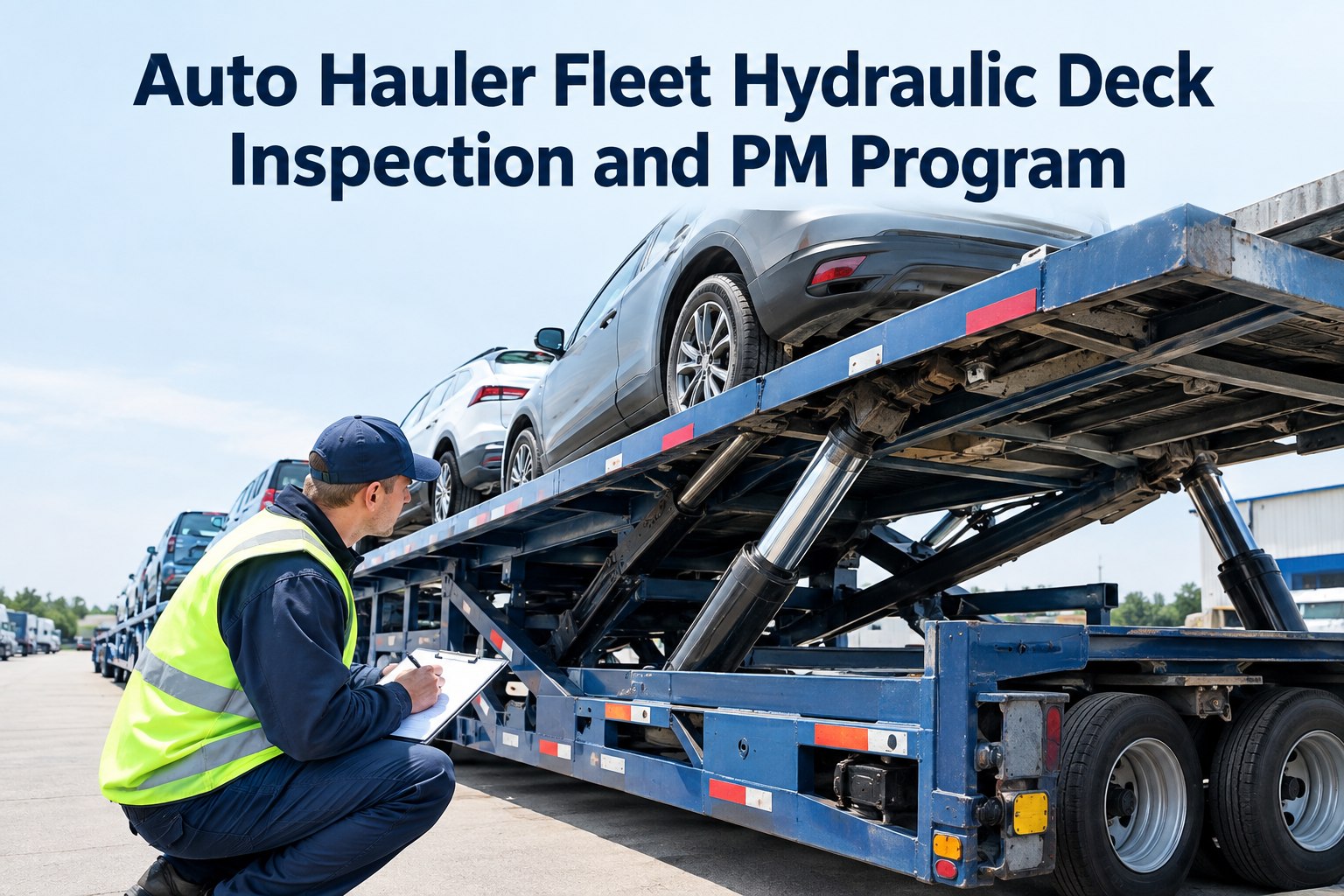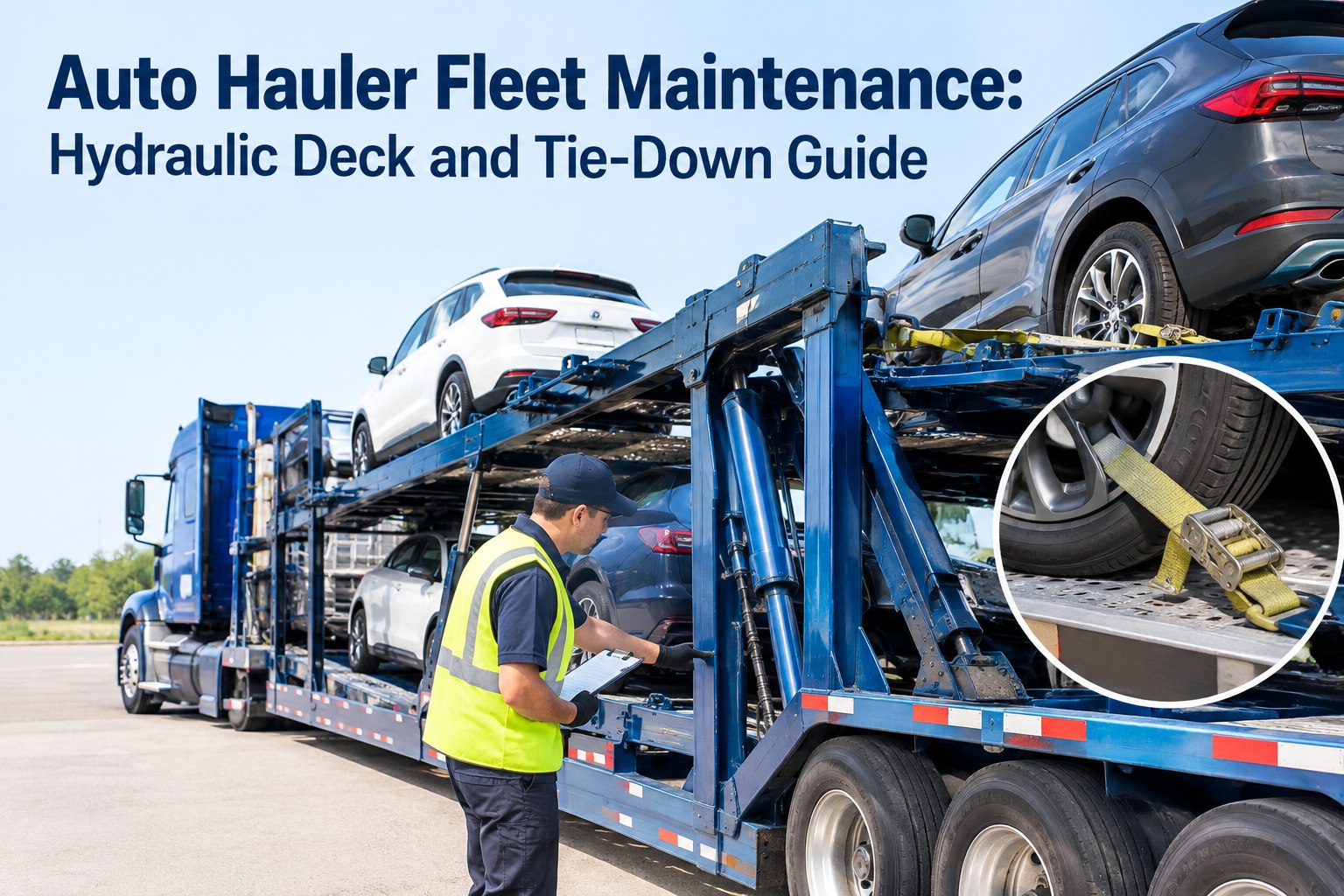
Auto haulers carry the highest per-load cargo value in trucking outside of specialized couriers — a fully loaded 8-9 car carrier moves $200K-$600K of finished vehicles per trip. A single tie-down failure or hydraulic deck drop doesn't just cost the freight, it costs the car — plus the dealer credit, plus the transport claim, plus the reputation damage on a lane. Standard truck PM covers half the equation. The other half — hydraulic deck cylinders, ramps, chains, wheel straps, ratchet mechanisms, tie-down anchor points — has its own failure modes, its own cadence, and its own inspection discipline. This guide breaks down both domains and the shared KPIs that predict a cargo-damage event before it happens. Truck Inspection & Maintenance runs auto-hauler-specific PM overlays on driver phones with photo-verified tie-down checks — sign up free or contact our team.
Auto Hauler Fleet Maintenance — Hydraulic Deck & Tie-Down Guide
$200K-$600K of cargo per trip. Two PM domains, one failure = one destroyed car.
The Auto Hauler Cost Profile — Why Two-Domain Discipline Matters
Three numbers frame the cargo exposure that makes auto hauling economically distinct:
Fully loaded 8-9 car carrier moves $200K-$600K of finished vehicles per trip. Mix of compact sedans, SUVs, luxury, and commercial vehicles — average vehicle value $32K-$75K depending on lane.
Range for damage claim per vehicle from cosmetic (chip, scratch) to structural (deck drop, tie-down failure with body contact). Full write-off of a luxury vehicle from a hydraulic collapse: $85K+.
Chassis PM runs on OTR mileage triggers. Deck/tie-down PM runs on cycle counts + calendar. Two independent cadences, both tracked, both auto-fired — one deferred is one high-value load exposed.
$200K-$600K rolls on the deck every trip. Start a free account and run both PM domains from one system today.
Domain 1 — Chassis PM Highlights (What's Different vs Standard OTR)
The chassis PM baseline is standard OTR (see the 4-tier mileage-anchored model). Auto haulers layer specific items on top because of the load profile:
Rear Axle Loading & Suspension Wear
Fully loaded auto hauler runs near GVWR with heavy concentrated deck loading. Air bag failure, shock wear, and leaf spring cracking hit harder and faster than standard OTR. Add rear suspension detailed inspection to every PM-B — not just PM-C.
Trailer Tire PSI Under Peak Load
Trailer tires spec at max cold PSI when loaded to capacity. 5 PSI under target on 4 trailer positions under full load = accelerated shoulder wear + heat build-up. Verify at every enroute fuel stop with load on.
Brake Adjustment Under Cargo Load
Slack adjuster stroke under full load is different than empty. Verify stroke measurement at PM-B with representative loaded weight — an in-spec empty reading can go OOS loaded. Auto haulers get flagged on Level 1 brake inspections more often for this reason.
Trailer Lighting Circuit Continuity
Multi-deck lighting harnesses have more connectors, more flex points, more corrosion exposure than standard vans. Full lighting circuit check at every PM-A. §393.11 rules apply the same but the risk points are amplified.
Want a printable auto-hauler-specific chassis PM overlay for the shop wall? Contact our team and we'll send one, free.
Domain 2 — Hydraulic Deck System PM
The hydraulic deck is the piece of equipment that separates auto hauling from other trucking. It has its own PM cadence and its own failure modes:
Auto-fire deck PM on cycle counts AND calendar in one flow — sign up free and configure both triggers in under 20 minutes.
Domain 2 — Vehicle Tie-Down & Securement PM
Tie-down failure is the highest-frequency cargo damage source on auto haulers. Every strap, chain, and anchor point is a wear item on its own cadence:
Need help mapping the 3-tier tie-down cadence to your current strap and chain inventory? Get in touch for a free 15-minute setup review.
The One Rule That Prevents Most Cargo Damage — Recheck Every Tie-Down at 50 Miles + Every Fuel Stop
Straps and chains loosen. Fabric webbing takes an initial stretch under load. Vehicle suspension settles as the tractor accelerates and hits its first freeway curves. Every single tie-down loses 5-15% of initial tension within the first 50 highway miles. FMCSA §392.9 requires inspection of cargo securement within the first 50 miles after loading and every 3 hours or 150 miles after that. Missing that first 50-mile recheck is the root cause of a huge share of tie-down failures — the strap that was tight at the shipper is loose enough to allow shift by mile 60. Build the 50-mile recheck into driver dispatch instructions and every fuel stop after. Photo evidence at each check makes it defensible on a claim. Start a free account and put the FMCSA §392.9 tie-down recheck sequence on every driver's phone with photo verification.
The Auto Hauler Pre-Trip & Pre-Load — 8-Item Sequence
Auto hauler pre-trip is longer than standard OTR because both domains have to be checked and both have to pass before the first vehicle rolls onto the deck:
Standard DVIR Chassis Pre-Trip
Full §392.7 pre-trip on tractor + trailer chassis — brakes, tires, lights, coupling, all standard items. Must clear before any deck operation.
Hydraulic Reservoir Level + Sight Glass
Check reservoir at operating temp; verify fluid at proper level, clear color, no milky appearance. Any darkening or contamination = don't load, WO immediately.
Deck Full Cycle Test — Empty
Operate deck through full up-and-down cycle empty. Verify all positions lock, all pins seat, no unusual noise, no fluid weep, cycle time within baseline. 60-second test.
Ramp Deploy + Retract
Fully deploy and retract each ramp. Verify hinges move freely, non-skid surface intact, ramp sits flush at deck. Any ramp not seating = don't load until repaired.
Strap & Chain Inspection — Every Piece
Every wheel strap, every chain, every hook, every ratchet inspected before deployment. Fraying beyond 10%, chain elongation beyond 5%, missing latches, bent hardware = pulled from service.
Anchor Point Visual Walk
Walk both decks, visually check every anchor point. Weld cracks, plate deformation, corrosion bloom, or missing hardware = don't use that position, WO.
Load Verification — Weight + Balance
Actual load matches manifest. Weight distribution front/rear verified within GVWR limits. Vehicle placement matches OEM guidance for that deck position (heavy over axles, light on ramps).
Final Securement Photo — Every Vehicle, Every Corner
Photo of each tie-down point on each loaded vehicle. Photo of deck locks. Photo of ramp retracted. These photos are the claim defense on cargo damage disputes.
Both PM domains, the full 8-item pre-load sequence, and the §392.9 recheck cadence — with photo evidence on every step.
Auto-hauler-specific PM overlays, 8-item pre-load on driver phone with photo evidence, 50-mile + 150-mile tie-down recheck alerts. Free forever for up to 3 vehicles — create your free account or talk to our team.
KPI Dashboard — 6 Auto Hauler Metrics
Six numbers that surface auto hauler program health — six numbers most standard OTR fleets don't track:
Vehicles delivered with new damage attributable to hauler. Every claim exposes $15K-$85K per vehicle.
Every load has documented tie-down recheck within first 50 miles per §392.9. Below 100% = defensibility gap on any claim.
Every loaded vehicle has photo evidence at each tie-down point. Photo trail is the claim defense — no photos, no defense.
Hours deck operational ÷ fleet hours. Below 99% = 1+ trip cancellations per 100 dispatches due to deck fault.
Percentage of tie-downs replaced per quarter as % of fleet inventory. Below 5% + no failures = healthy. Above 5% = premature wear pattern to investigate.
Hydraulic or deck defect logged to shop close-out. Above 24 hours = deck sits unloadable, revenue exposed.
Track all 6 auto hauler KPIs and drop successful cargo claims 40-60% in year one — create your free account in 10 minutes.
The 5 Auto-Hauler-Specific Failure Patterns
Five patterns that hit auto haulers constantly and rarely show up on other fleet types:
Skipping the 50-Mile Tie-Down Recheck
Pattern: Driver loaded at shipper, all straps tight. Hit the freeway, ran 4 hours to first fuel stop without stopping at 50 miles. Straps loosened during initial stretch and suspension settle. Vehicle shifted, contact between two vehicles = paint damage claim on both.
Hydraulic Deck Drift Not Investigated
Pattern: Driver notes deck sagging 1-2 inches at position after locking. Continues to use it. Cylinder seal failing. Two weeks later, cylinder blows under load with vehicles on the deck — controlled drop damages 2 vehicles + deck structure.
Frayed Strap Used "One More Trip"
Pattern: Wheel strap shows fraying beyond 10% of width at pre-load. Driver notes it, dispatches anyway to make schedule. Strap fails mid-trip, vehicle slides during braking, wheel well damage on adjacent vehicle. Strap cost: $28. Damage claim: $18K.
No Photo Evidence on Delivery Dispute
Pattern: Receiver claims vehicle arrived with damage. Fleet has no pre-load photo of that tie-down position, no photo of the vehicle at loading, no timestamps. Claim goes to hauler by default. Photo evidence at pre-load is the entire defense.
Chain with Missing Grade Tag Used
Pattern: §393.104 requires Grade 70 or higher chain for cargo securement, with grade tag visible on inspection. Chain in use has tag worn off. Roadside inspection cites the load out of compliance — placed OOS regardless of actual chain quality.
Frequently Asked Questions
What makes auto hauler maintenance different from standard OTR?
Two independent PM domains sharing one fleet — standard OTR chassis PM on mileage triggers, plus hydraulic deck + tie-down hardware on cycle counts and calendar. Both must pass before dispatch or $200K-$600K of cargo per trip sits exposed.
What does the FMCSA require for tie-down inspection?
§392.9 requires a first inspection within 50 miles of loading, then every 3 hours or 150 miles after. §393.104 additionally requires Grade 70+ chain with visible grade tag, under 5% elongation, and functional hook safety latches.
How often should the hydraulic deck system be inspected?
Layered cadence: locks and pins every load, ramps and surfaces weekly, cylinders monthly, pump/reservoir/anchors quarterly. Each tier catches a different failure mode — skipping one leaves that mode exposed.
What's the ROI of photo evidence on tie-down and pre-load checks?
Without photo evidence at pre-load, disputed claims go to the hauler by default. Fleets that implement mandatory pre-load photos plus §392.9 recheck evidence typically drop successful cargo claims 40-60% in the first year.
Why does hydraulic deck drift matter if it's only an inch or two?
Drift means a cylinder seal is already failing. Once integrity is lost, the seal doesn't degrade gradually — it lets go under load, and the deck drops with whatever's on it. Drift = immediate WO, not deferred.
How does Truck Inspection & Maintenance handle auto hauler fleets?
Chassis PM auto-fires on OTR mileage; deck/tie-down PM auto-fires on cycle counts + calendar. 8-item pre-load runs on driver phones with mandatory photos, and §392.9 recheck alerts fire at 50 miles and every 150 miles after. Free forever for up to 3 vehicles — sign up in 10 minutes or contact us.
$200K-$600K rolls on the deck every trip. One tie-down = one destroyed car. Both PM domains earn the discipline.
Chassis + deck/tie-down PM auto-fired independently, 8-item pre-load with photo evidence per vehicle per corner, 50-mile + 150-mile recheck sequence, full audit-defensible photo trail. Free forever for up to 3 vehicles — no hardware, no contract, no credit card.