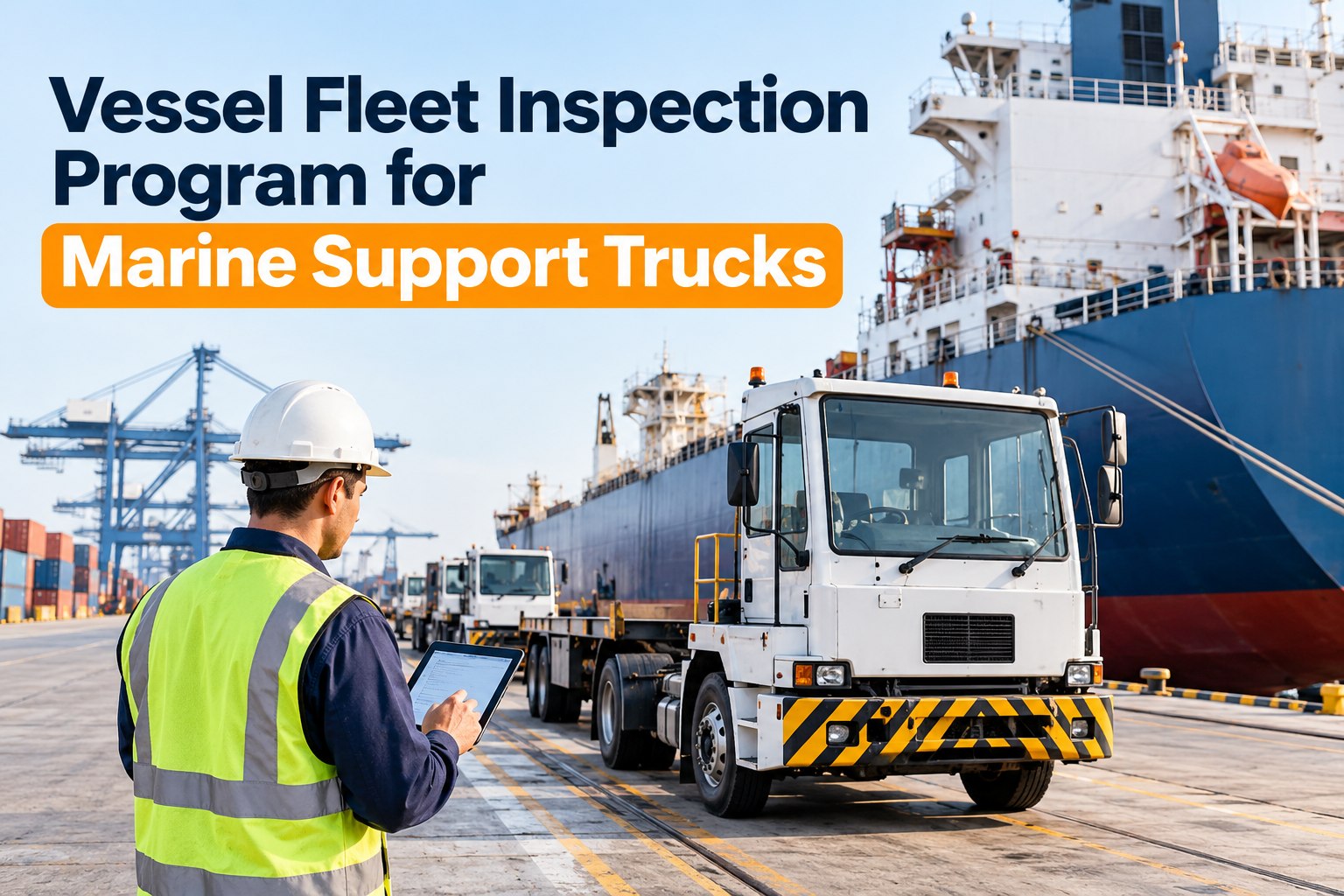
A marine support truck lives two lives every shift. One at the dock — salt air, standing water, crane loads, container interchange — and one on the public highway, where a corroded brake line or a cracked chassis rail is an out-of-service order and a CSA hit. Most fleets inspect for the highway life and ignore the one that's actually eating the equipment: the marine environment. And when a defect shows up at roadside on an interchanged chassis, the question "whose fault is that?" has a specific federal answer that decides who pays. A vessel fleet inspection program has to cover both worlds in one workflow — dockside corrosion and interchange condition on one side, FMCSA roadability on the other. Here's how to build it. Start free and run one program across dock and highway with TIM.
Your Trucks Cross From Dock to Highway Every Shift — Your Inspection Program Should Too
Marine support fleets run tractors, chassis, and specialized haulage through salt, standing water, and container interchange, then straight onto public roads under full FMCSA scrutiny. Truck Inspection & Maintenance Management Software runs one program across both — corrosion and interchange checks dockside, roadability and DVIR compliance for the highway — with photo proof and defect-to-work-order routing on every unit.
The Two Environments — and Why One Program Has to Span Both
A highway-only inspection misses what the dock does to the equipment; a dockside-only check misses what a roadside inspector will cite. The trucks move between the two continuously, so the inspection program can't be split into separate checklists that never talk to each other. It has to be one workflow that covers both stressors on the same unit, in the same pass.
- Salt-air and standing-water corrosion on brake lines, air tanks, and frame
- Chassis and container interchange condition — accept it defective, you own it
- Crane and loading impact damage to rails, crossmembers, and coupling
- Electrical and lighting connectors corroding at the harness
- Brake, tire, lighting, and structural defects under FMCSA Part 393
- Roadability of the chassis under the Intermodal Safe Container Act
- DVIR compliance and defect-correction records (396.11)
- Out-of-service conditions that strand the load and add CSA points
One unit, two sets of failure modes — the program has to catch both before the truck leaves the yard. Contact our team to map both environments into one TIM workflow.
Who's Responsible at Interchange — The Rule That Decides Who Pays
Intermodal equipment is the only category on the road where three federally defined parties share responsibility, under 49 CFR 390.40–42. Get the boundaries wrong and your carrier absorbs costs that legally belong to the equipment provider. The program has to document exactly what condition the equipment was in at the moment of interchange.
Must systematically inspect, repair, and maintain interchange equipment (§390.40); provide it in safe operating condition; run a DVIR system (396.11) and records (396.3); inspect periodically (396.17); give drivers space to pre-trip and fix reported defects before departure.
Operates the equipment on the road and carries the roadside consequence. Must report known damage, defects, or deficiencies back to the IEP when the equipment is returned — and can dispute misattributed violations through DataQs.
Must inspect the §392.7(b) components at interchange and be satisfied they're in good working order before operating over the road. Accepting the equipment is deemed confirmation those components were sound — so the record matters.
The Driver Pre-Trip — 8 Component Categories at Interchange
Before an interchanged chassis moves over the road, the driver must be satisfied these eight component categories from 49 CFR 392.7(b) are in good working order. There's no federal paperwork mandate for this pre-trip — which is exactly why a documented one is your protection when responsibility is questioned later.
TIM turns these eight into a guided, photo-verified interchange check so "in good working order" is a record, not a memory. Start free and document every interchange pre-trip with TIM.
The Marine Corrosion Layer — What Highway Checklists Skip
Standard DVIRs weren't written for salt exposure. A marine support program adds a corrosion layer on top of the federal scope — the slow damage that turns into a roadside defect months later if no one's tracking it.
One Program, Every Unit — Dockside Corrosion, Interchange Condition, Highway Roadability
Truck Inspection & Maintenance Management Software runs your whole marine fleet — tractors, chassis, and specialized haulage — through one program. Corrosion and interchange checks capture the dockside damage; the §392.7 and Part 393 scope covers the highway; every defect is photographed against the unit, timestamped, and routed to a work order with the interchange record intact. Responsibility questions get answered by the file, not by argument.
Building the Program — Four Steps to Coverage
A vessel fleet program isn't a single form — it's a repeatable cycle that spans both environments and produces a defensible record every time. Here's the shape TIM runs.
Frequently Asked Questions
Inspect for Both Lives Your Trucks Actually Live
The dock is corroding your equipment while the highway is waiting to cite it. A vessel fleet inspection program that spans both — with a documented interchange boundary and a corrosion layer the standard checklist skips — is what keeps marine support trucks rolling and the liability where it belongs. TIM runs that program on every unit, every shift.