Brakes put more commercial vehicles out of service than any other system, year after year — and the reason isn't that fleets don't care about brakes. It's that brake compliance is decided by measurements, not by looking. A driver can charge the system to 120 psi, hold the pedal, listen for leaks, and drive away confident, while two wheel ends sit a quarter inch past their adjustment limit. At roadside, an inspector puts a stroke indicator against the chamber and that truck is grounded — not for one bad brake, but because two out of ten crosses the 20% threshold that takes the entire vehicle out of service. The numbers that decide pass or fail are specific, published, and non-negotiable. This guide covers the 20% rule and how defective brakes are actually counted, the pushrod stroke measurement that trips more trucks than anything else, the limits by component, the standalone violations that ground a vehicle on their own, and how truck maintenance software catches a brake drifting toward its limit before an inspector does.
Fleet Safety Guide · CMV Brake Inspection · 2026
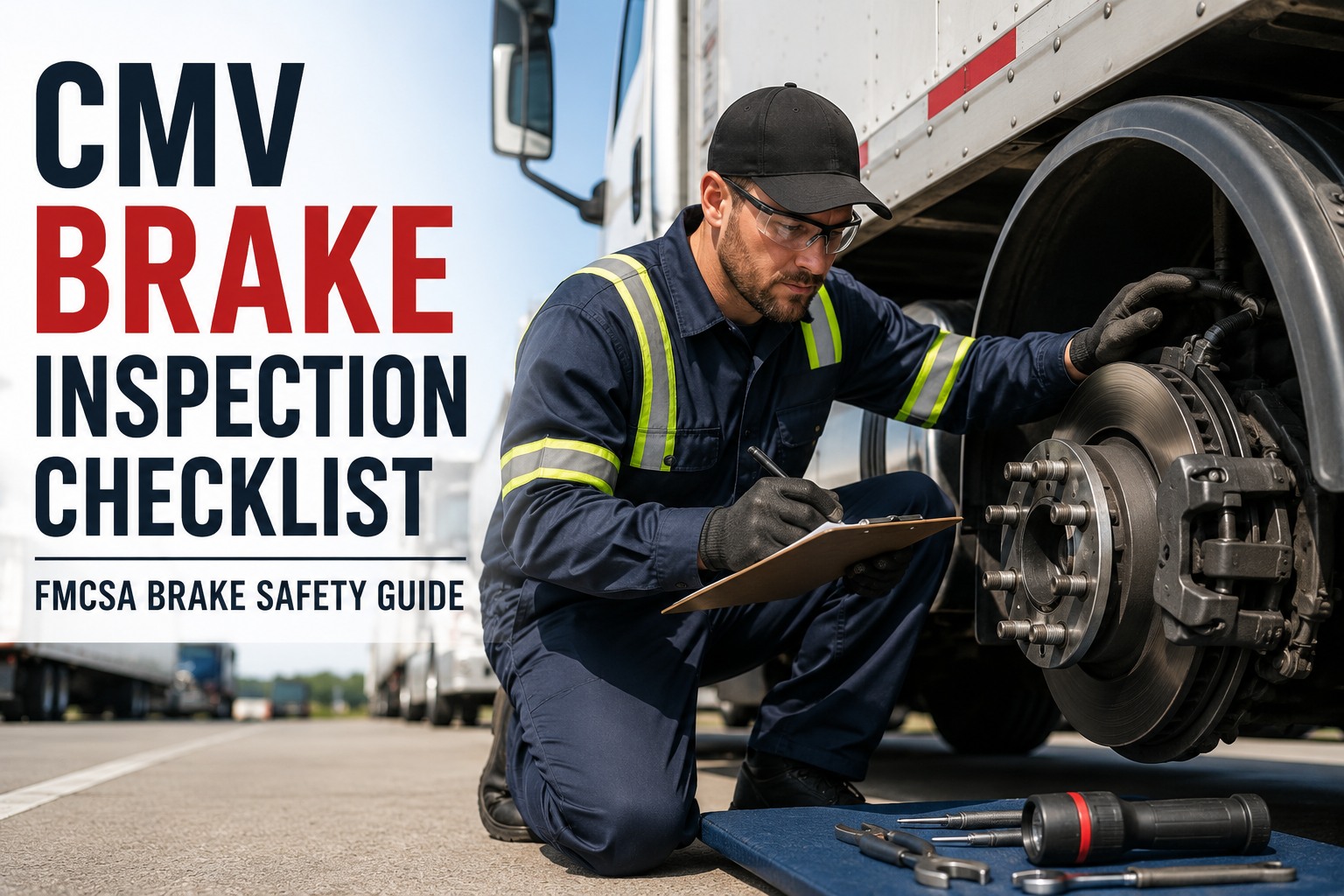
CMV Brake Inspection Checklist
The measurements that decide out-of-service, how the 20% rule is really calculated, and the preventive approach that keeps trucks off the OOS list.
#1
Brakes lead all out-of-service violation categories
20%
Defective brakes and the whole vehicle is grounded
90-100 psi
The only valid range for measuring pushrod stroke
Aug 23-29
Brake Safety Week 2026 enforcement window
Why Brakes Dominate Out-of-Service Numbers
The enforcement data is remarkably consistent. Brake defects aren't just common — they're the single largest source of roadside groundings, and they show up across every inspection program:
Roughly a quarter of all OOS violations
At recent CVSA International Roadchecks, brake-related violations have accounted for close to a quarter of every out-of-service violation issued across all systems.
Six of the top twenty violations
Six of FMCSA's top 20 reported vehicle violations in 2025 involved defective, worn, or out-of-adjustment brakes — the most of any component group.
15.1% OOS in Brake Safety Week
Of more than 15,000 vehicles inspected during Brake Safety Week 2025, 15.1% were placed out of service for brake violations alone.
Mark the calendar, then ignore it: Brake Safety Week 2026 runs August 23-29, with inspectors again focusing on brake drums and air disc rotors, plus an unannounced one-day Brake Safety Day. But a vehicle can be selected for inspection anywhere, at any time — so the only reliable preparation is a maintenance program that would pass in any random week, not a scramble in August.
The 20% rule: how a vehicle actually gets grounded
If 20% or more of the service brakes on a vehicle or combination are defective or out of adjustment, the entire vehicle goes out of service — no matter how good any individual brake looks. On a five-axle tractor-trailer with ten wheel ends, that means just two defective brakes grounds the whole rig. This single criterion accounted for the majority of all out-of-service vehicles in a recent Brake Safety Week.
An eighth of an inch over
A brake measuring 1/8 inch or more beyond its adjustment limit is counted as a half-defective brake against your total.
A quarter inch or more over
At 1/4 inch or more beyond the limit, the brake counts as one full defective brake toward the 20% threshold.
Exactly at the limit
A brake found right at its adjustment limit is not counted as defective for the purposes of the 20% rule.
Fractions round down
If your defective total lands on a fraction, it rounds down to the next whole number — 1.5 defective brakes counts as 1.
Pushrod Stroke: The Violation That Catches Most Trucks
Excessive pushrod stroke — how far the pushrod travels when the brakes are applied — is the most common brake violation found at roadside. Inspectors don't estimate it; they place a standardized stroke indicator against the chamber. The measurement procedure matters as much as the result:
Park safely and block the wheels
Find level ground, chock the wheels, and make sure nobody is near the vehicle before releasing anything.
Release the spring brakes
With the parking brakes released, the service brakes can travel their full applied stroke for a valid reading.
Build to 90-100 psi, engine off
This range is mandatory. Below it, brakes read falsely compliant; above it, falsely non-compliant.
Mark the pushrods
Mark each pushrod at the chamber face with the brakes released, giving a fixed reference to measure from.
Fully apply, hold, and measure
With the brakes fully applied and held, measure the travel from the mark and compare it against the limit for that chamber type.
Why the pressure range is non-negotiable: stroke readings shift roughly a tenth of an inch for every 10 psi of variation. A 20-psi error swings the measurement by nearly a quarter inch — more than enough to turn a passing brake into a failing one, or worse, to certify a failing brake as good. Measuring outside 90-100 psi doesn't give you a rough answer; it gives you an unreliable one.
The Limits That Decide Pass or Fail
These are the published thresholds inspectors measure against. Note that stroke limits differ by brake chamber type and design, so knowing the chamber fitted to every axle isn't optional:
Pushrod stroke
Maximum allowable stroke is set by chamber type and design — commonly around 2 to 2.5 inches across the standard clamp-type chambers, with long-stroke chambers held to tighter figures than standard ones of the same nominal size.
Verify the exact limit against the chamber stamped on each axle before measuring.
Lining and pad thickness
FMCSA sets a minimum friction material thickness of 1/4 inch at the center of the lining, while the out-of-service threshold is reached at 1/16 inch or less at the shoe center for drum or disc brakes.
Replace at the maintenance minimum, not the OOS floor — waiting damages drums and rotors.
Braking efficiency
Where a performance-based brake tester is used, a vehicle measuring below 43.5% braking efficiency goes out of service immediately. Passenger-carrying commercial vehicles are held to a substantially higher standard.
A pass on visual inspection does not guarantee a pass on measured performance.
Violations That Ground You on Their Own
The 20% rule isn't the only path to an out-of-service order. Each of these is a standalone violation — one occurrence and the vehicle is grounded regardless of how every other brake measures:
Steering axle brake failure
Any inoperative or missing brake on either wheel of a steering axle is an immediate out-of-service condition on its own.
Cracked spring brake housing
Cracks or non-manufactured holes in the parking brake section of a spring brake chamber are a standalone violation.
Breakaway system faults
Trailers and dollies must have a working breakaway braking system, correctly mounted and connected to the towing vehicle.
Cracked drums or damaged rotors
A crack through a brake drum, or a rotor with severe rusting or metal-to-metal contact across the friction surface, grounds the vehicle.
Contaminated friction surfaces
Oil, grease, or brake fluid on the friction material or rotor surface destroys braking capability and is treated accordingly.
Excessive caliper movement
Caliper movement within the anchor plate in the direction of wheel rotation beyond 1/8 inch is an out-of-service condition.
Free · Up to 3 Vehicles
Flag the brake before it crosses the limit
Truck maintenance software turns every brake PM into a guided inspection with required measurement fields — stroke per wheel end, lining thickness, air loss rate — so readings are recorded rather than eyeballed. Values approaching an adjustment limit surface as a warning and generate a work order, instead of becoming an out-of-service order at a scale house. Sign up free for up to 3 vehicles and put real numbers behind your brake program.
The Component Checklist
A complete brake inspection works through the system component by component. Each of these has its own failure modes and its own inspection points:
Brake chambers & pushrods
Chambers free of cracks, dents, and damage
Clamp bands secure, no air leaks at the chamber
Pushrod stroke measured at each wheel end
Mounting hardware tight and complete
Slack adjusters
No broken, missing, or loose components
Automatic adjusters functioning as designed
Consistent stroke across paired wheel ends
Clevis pins and retainers secure
Linings, drums & rotors
Lining thickness checked through the inspection slot
Linings not loose, cracked, or contaminated
Drums free of cracks, deep scoring, or out-of-round wear
Rotors free of severe rust or metal-to-metal contact
Hoses, tubing & lines
No chafing, abrasion, cuts, or cover damage
No bulges or soft spots indicating internal failure
Routed with clearance from heat and moving parts
No leaks at fittings or connections
Air system & leak tests
Governor cut-in and cut-out within specification
Static and applied leak-down rates within limits
Low-pressure warning activates at the correct point
Air dryer functioning; tanks drained of moisture
Parking brake & ABS
Spring brakes apply and hold the vehicle on a grade
Spring brake chambers free of cracks or holes
ABS warning lamp cycles correctly and extinguishes
Trailer breakaway system present and functional
The Preventive Approach
Every brake violation found at roadside was measurable in the shop first. These four habits are what separate fleets that pass from fleets that get grounded:
Measure at every PM
Record actual stroke and lining numbers on every service — not a pedal tap and a glance. A number you can trend is a defect you can predict.
Act before the limit
Adjust or replace when a reading approaches the threshold, not when it crosses it. Brakes at the limit today are over it next week.
Never fake an adjustment
Manually adjusting an automatic slack adjuster to hide excessive stroke masks the real fault — the adjuster, the foundation brake, or the installation — and leaves the truck just as unsafe.
Know your chambers
Limits vary by chamber type and design. Keep the chamber specification for every axle position on record so nobody has to guess at the wheel end.
Frequently Asked Questions
How many bad brakes put a truck out of service?
Under CVSA criteria, if 20% or more of the service brakes on a vehicle or combination are defective or out of adjustment, the entire vehicle is placed out of service. On a five-axle tractor-trailer with ten wheel ends, that means just two defective brakes grounds the whole rig — regardless of how well the other eight measure. It's the most common route to a brake-related out-of-service order.
At what air pressure is pushrod stroke measured?
Between 90 and 100 psi with the engine off — this range is specified in the standard inspection procedure and isn't optional. Readings shift about a tenth of an inch per 10 psi of variation, so a 20-psi error can swing the measurement nearly a quarter inch. That's enough to flip a pass into a fail, or to certify a genuinely out-of-adjustment brake as compliant. Contact our team about digitizing brake measurements.
How is a "half defective" brake counted?
Inspectors measure adjustment in eighth-inch increments. A brake 1/8 inch or more beyond its limit counts as 0.5 defective; at 1/4 inch or more beyond, it counts as a full 1.0. A brake sitting exactly at the adjustment limit isn't counted as defective at all. If your total lands on a fraction, it rounds down — so 1.5 defective brakes counts as 1 for the 20% calculation.
What's the minimum brake lining thickness?
FMCSA sets a minimum friction material thickness of 1/4 inch measured at the center of the lining, while the out-of-service threshold is 1/16 inch or less at the shoe center for both drum and disc brakes. Linings must also be free of cracks, looseness, and oil or grease contamination. Practically, replace at the maintenance minimum rather than the OOS floor — running linings down damages drums and rotors and turns a routine job into an expensive one.
Can one brake problem ground a truck by itself?
Yes. Several conditions are standalone out-of-service violations regardless of the 20% calculation: an inoperative or missing brake on a steering axle, cracks or non-manufactured holes in a spring brake housing, a missing or non-functional trailer breakaway system, a crack through a brake drum, a rotor with metal-to-metal contact, contamination of friction surfaces, and caliper movement beyond an eighth of an inch. Any one of these grounds the vehicle on its own.
When is Brake Safety Week 2026?
August 23-29, 2026, with inspectors placing particular focus on brake drums and air disc brake rotors, alongside an unannounced one-day Brake Safety Day. That said, treating enforcement weeks as the deadline is the wrong approach — a vehicle can be selected for inspection anywhere and at any time, so the goal is a brake program that would pass in a random week in February just as easily. Sign up free to keep brake measurements on schedule year-round.
Measured, Recorded, Compliant
Catch the brake before the inspector does.
Truck maintenance software records stroke, lining thickness, and air loss as real measurements on every PM, flags any wheel end approaching its adjustment limit, and routes it straight to a work order with full history per axle position. The defect gets fixed in your shop instead of grounding a load at a scale house. Free for up to 3 vehicles. Works with your existing fleet, no contracts.