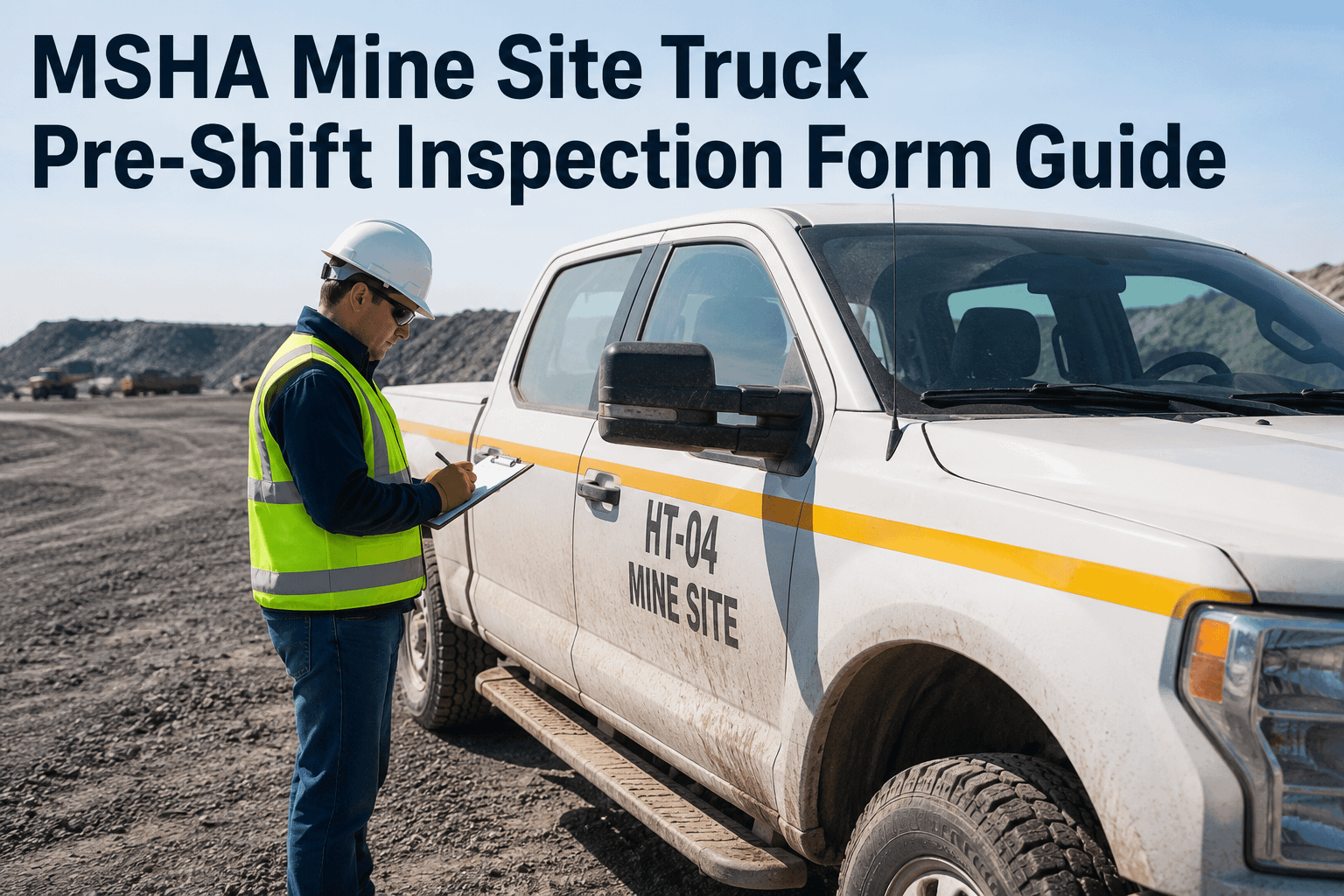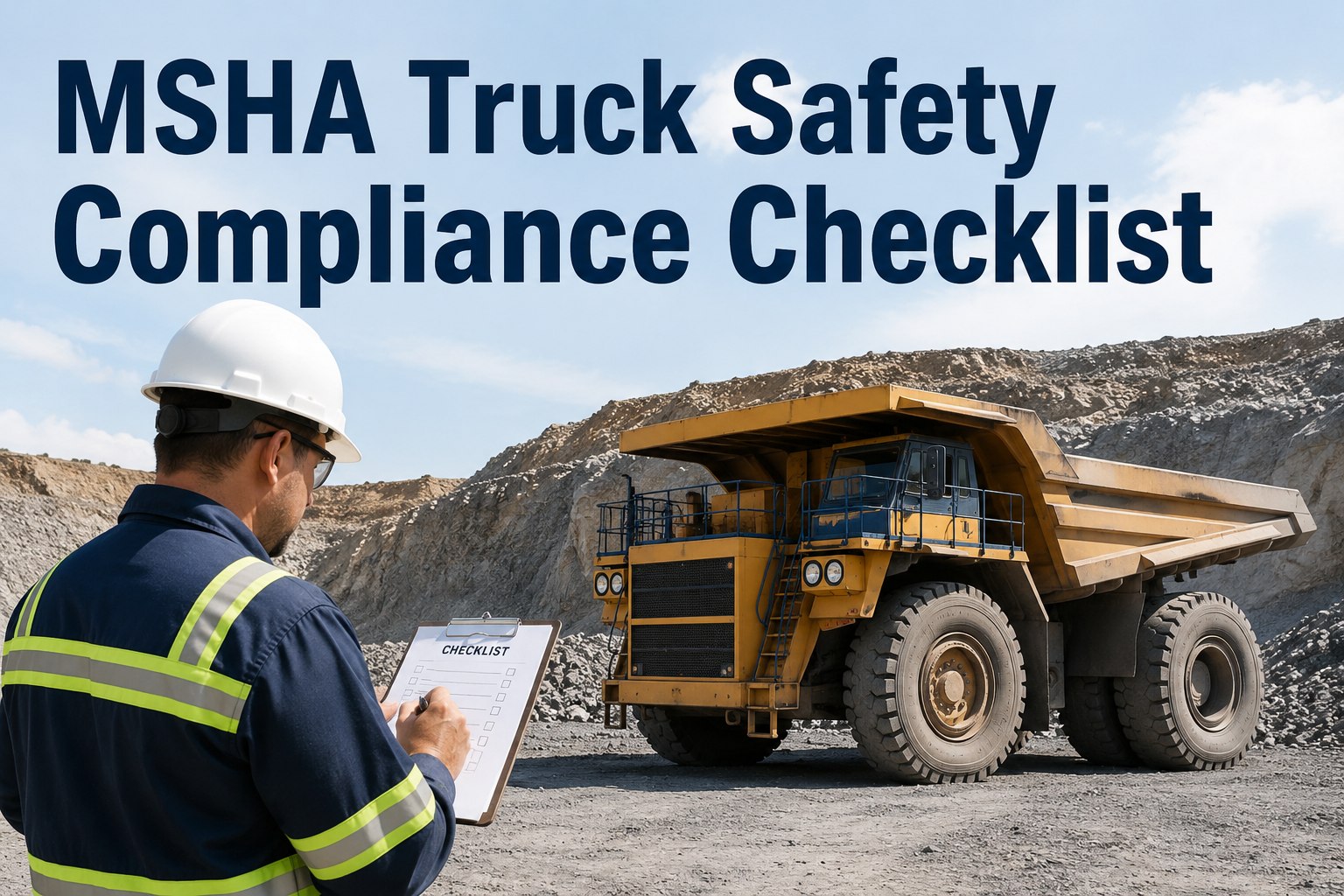
Mine haul roads do not forgive paperwork gaps. In 2025, powered haulage became the deadliest category of mining fatalities since 2006 — and MSHA inspectors now treat a missed pre-shift defect record the same way they treat a defective brake. The fix is not more clipboards. It is Truck Inspection & Maintenance — software that proves every truck was checked, every defect was logged, and every record is ready the moment an inspector walks the yard. This guide breaks down the exact MSHA truck safety compliance checklist your mine fleet needs, the federal standards behind each item, and how Truck Inspection & Maintenance keeps your records audit-ready without chasing drivers. Build your digital MSHA checklist in minutes.
MSHA Truck Safety Compliance Checklist: The Complete Guide
Site orientation, pre-shift defect exams, incident reporting, and audit-ready records — mapped to 30 CFR Parts 46, 48, and 56. Everything your mine truck fleet needs to pass inspection and protect operators.
Why MSHA Truck Compliance Is Under the Microscope
Mine trucks are not ordinary vehicles. A loaded haul truck can stand several stories tall, weigh hundreds of tons, and carry blind spots large enough to hide an entire pickup. When something goes wrong, the consequences are rarely minor. MSHA's enforcement data tells the story plainly — and it explains why inspectors are scrutinizing pre-shift records harder than ever.
The pattern in MSHA's accident reviews is consistent: a meaningful share of fatalities involve improper maintenance or unsafe operation of equipment. Inspectors know this, which is why the daily pre-operational exam record — required under 30 CFR 56.14100 — is one of the first documents they ask to see during an E01 inspection.
The Four Pillars of Mine Truck Compliance
MSHA truck safety is not a single checklist — it is four interlocking obligations. Miss any one of them and a clean inspection record falls apart. Here is how they fit together across the federal standards that govern your fleet.
Every operator — including customer and contract truck drivers — must receive hazard training before performing tasks at the mine. MSHA's enhanced enforcement program specifically targets untrained contract drivers.
Self-propelled mobile equipment must be inspected by the operator before being placed in service that shift. No exceptions, every shift, on record.
Defects affecting safety must be corrected in a timely manner. Hazardous units must be taken out of service and tagged until repaired.
Uncorrected safety defects must be reported to and recorded by the operator, and records kept at the mine until the defect is fixed.
Turn These Four Pillars Into One Digital Workflow
Training records, daily exams, tag-outs, and defect logs — unified in Truck Inspection & Maintenance, which flags gaps before MSHA does. See it on your own fleet.
The Pre-Shift Mine Truck Inspection Checklist
This is the core of daily compliance. Under 30 CFR 56.14100(a), the equipment operator must examine the unit before placing it in service. Each item below ties to a recognized hazard category. Truck Inspection & Maintenance puts this exact checklist on the operator's phone, so every truck gets walked the same way every shift — with a timestamped record the moment it is submitted.
What Happens When You Find a Defect
The checklist is only half the job. MSHA's standard is built around what you do after a defect is found. Following this decision path correctly is the difference between a clean record and an unwarrantable-failure citation. Truck Inspection & Maintenance enforces this exact sequence automatically — a flagged defect spins up a work order and tag-out status, and the record stays open until the repair is verified. Here is the sequence the standard requires.
Manual Records vs. Digital Compliance
Most citations under 56.14100 are not about a truck with no brakes — they are about a defect that was known and not corrected or recorded in time. That is a documentation failure, and it is exactly where whiteboards and glovebox paper logs break down. Truck Inspection & Maintenance closes that gap. Here is how paper stacks up against running compliance in our software under real inspection pressure.
| Compliance Task | Paper / Whiteboard | Truck Inspection & Maintenance |
|---|---|---|
| Pre-shift exam proof | Loose forms, often missing | Timestamped, per-operator log |
| Defect logged & tracked | Handwritten, easily lost | Auto work order + tag-out status |
| Records kept until corrected | No close-out trail | Open until repair verified |
| Training records linked | Separate binder | Tied to operator profile |
| Audit retrieval time | Hours of searching | Instant export by truck/date |
| Contract driver coverage | Often skipped | Mobile access, any device |
Your Audit-Readiness Scorecard
Before an inspector arrives, run your own walk. If you cannot answer "yes" to each of these in under a minute, your records are not audit-ready — and that gap is what turns a routine inspection into a citation. With Truck Inspection & Maintenance, every answer is one tap away.
Score Your Fleet's Compliance — Free in 15 Minutes
We'll walk your current MSHA records, show you exactly where the documentation gaps are, and set up a digital pre-shift checklist on your real trucks. No commitment.
Frequently Asked Questions
30 CFR 56.14100(a) for surface metal/nonmetal mines requires that self-propelled mobile equipment used during a shift be inspected by the equipment operator before it is placed in operation that shift. Parallel standards apply underground (57.14100) and for surface coal (77.1606). The exam must happen every shift, every unit.
Yes. Mine operators must provide appropriate hazard training to customer and contract truck drivers under 30 CFR 46.11, 48.11, or 48.31 depending on mine type. MSHA's enhanced enforcement program specifically flags untrained contract drivers as a focus area after recent fatalities.
If the defect affects safety and makes operation hazardous, the truck must be taken out of service and tagged or moved to a designated posted area until repaired. The defect must be reported to and recorded by the operator, and that record kept at the mine until the defect is corrected (56.14100 c and d).
Regular assessed penalties run up to roughly $55,000 per violation under 30 CFR Part 100, based on factors like negligence, gravity, and history. Flagrant violations can reach $242,000 under the MINER Act. A documented good-faith compliance effort is one factor that reduces the penalty formula.
Yes. MSHA requires that records exist, be accurate, and be retained until defects are corrected — it does not mandate paper. Truck Inspection & Maintenance keeps timestamped, per-operator exam logs and a full defect close-out trail that satisfies the recordkeeping requirement and is far faster to produce during an inspection than any binder.
Make Every Mine Truck Audit-Ready, Every Shift
Truck Inspection & Maintenance gives you digital pre-shift exams mapped to 30 CFR 56.14100, automatic defect tracking and tag-out status, and training records linked to every operator — one system that proves compliance the moment an inspector arrives.