Every year, brake system defects put more trucks out of service than any other maintenance category — and the single biggest culprit isn't a blown chamber or a snapped pushrod. It's a slack adjuster that has drifted a quarter inch past its legal stroke limit, unnoticed between PM intervals. During CVSA's 2025 Brake Safety Week, 15.1% of inspected vehicles were placed out of service for brake violations, and brake system defects accounted for roughly 25–30% of all vehicle out-of-service citations across International Roadcheck. If you run commercial trucks, catching drift early isn't a "nice to have" — it's the difference between a 15-minute pre-trip and a grounded rig at the weigh station. That's exactly what our Truck Inspection & Maintenance software was built for: chamber-type stored per wheel-end, stroke measurement logged on every inspection, and auto-flagging the moment a reading trends toward the OOS limit. This guide walks through the exact procedure inspectors use, the numbers that decide pass or fail, and how our software turns that entire workflow into a two-tap job for your drivers and technicians. Talk to our team to see it running on a fleet like yours.
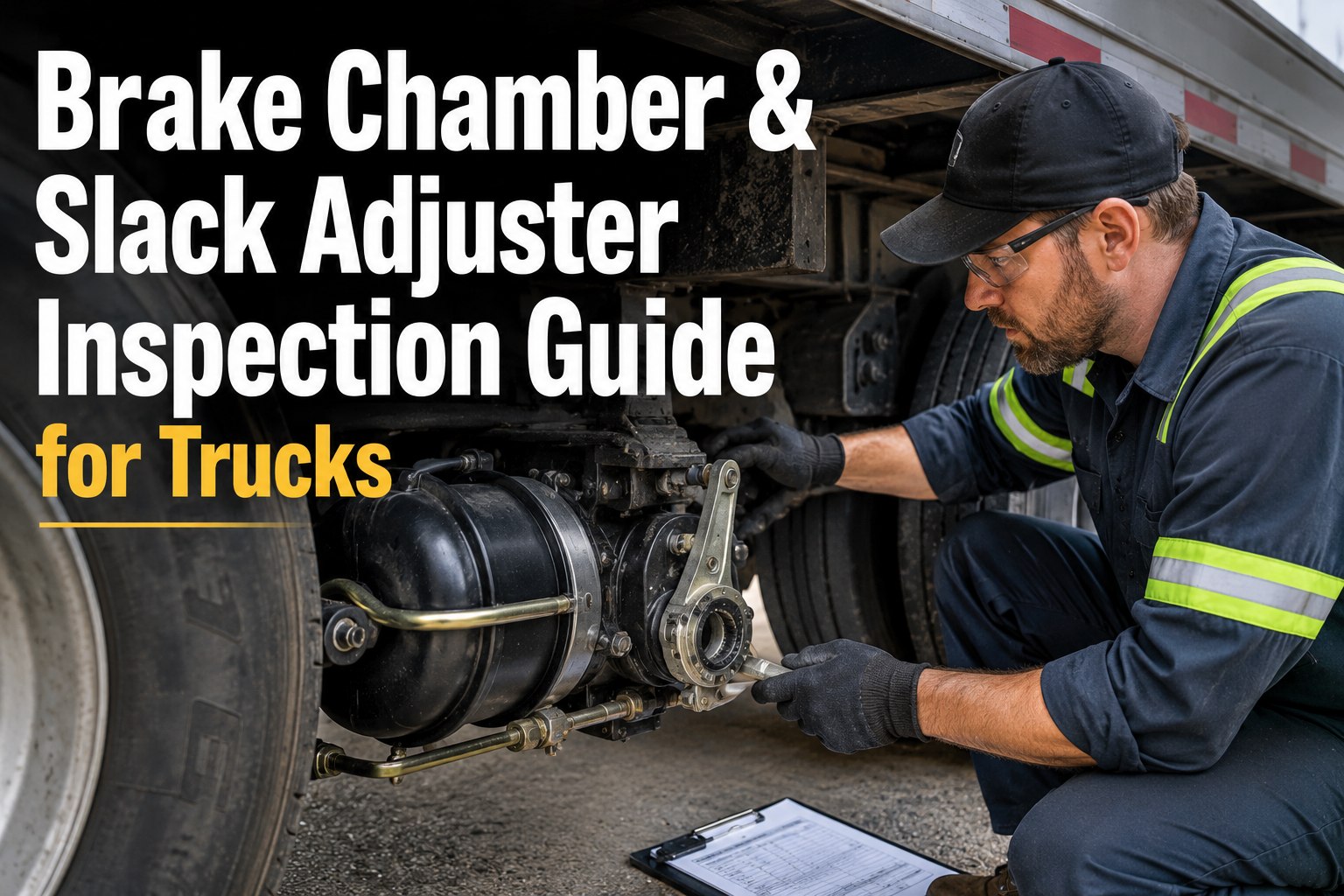
Brake Chamber & Slack Adjuster Inspection: The Complete Guide for Commercial Trucks
The single most common reason a truck fails a roadside inspection is pushrod stroke exceeding the legal limit for its chamber type. Miss the measurement — or measure at the wrong pressure — and a perfectly good rig gets parked. Here's how our software helps you get it right on every wheel, every day.
Why This Inspection Matters More Than Any Other
Brake violations carry the highest severity weighting of any maintenance category in FMCSA's Safety Measurement System. Under CVSA's out-of-service criteria, if 20% or more of a vehicle's brakes are defective or out of adjustment, the entire truck is grounded on the spot. On a standard 10-brake tractor-trailer, that's just two bad brakes. On a straight truck with four brakes, one bad brake hits the threshold. Get it wrong and you eat downtime, tow charges, CSA points, and insurance premium hikes for the next 24 months. Our Truck Inspection & Maintenance software was built to keep you on the right side of that math — every brake, every wheel, every inspection tracked and trended in one place. Start your free trial and see it running on your first vehicle in under 10 minutes.
Anatomy: What Each Component Actually Does
Brake Chamber
A sealed air-powered actuator bolted near each wheel. When you press the brake pedal, compressed air (90–120 psi) fills the chamber and pushes a diaphragm — which extends the pushrod outward. This is what converts stored air into mechanical force at the wheel.
Slack Adjuster
An arm connected to the pushrod on one end and the brake camshaft (S-cam) on the other. As the pushrod moves, the slack adjuster rotates the camshaft, which spreads the brake shoes against the drum. It also maintains proper clearance as linings wear.
Both components must work together. A weak chamber can't push hard enough; a drifted slack adjuster can't translate that push into stopping force. Our software stores the chamber type per wheel-end so technicians always know which limit applies — no guessing, no manual lookups, no missed identification. Not sure which chamber types are on your fleet? Reach out to our support team and we'll help you get your vehicle records set up.
The 6-Step Inspection Procedure (CVSA Method)
This is the same procedure a roadside inspector uses. Do it exactly this way — deviations produce false readings that either fail compliant brakes or pass unsafe ones. Our mobile inspection app walks technicians through each step in order, with a measurement entry field at step 6.
FMCSA Brake Adjustment Limits by Chamber Type
Every chamber has a legal maximum applied stroke. Exceed it and the wheel is out of adjustment — no exceptions, no roadside repair allowed by the driver. Our software carries this entire reference table built-in, so the moment a technician enters a stroke value, it's automatically checked against the correct chamber-type limit for that specific wheel.
| Chamber Type | Outside Diameter | Standard Limit | Long-Stroke Limit |
|---|---|---|---|
| Type 12 | 5-11/16 in (145 mm) | 1-3/8 in (35 mm) | 1-3/4 in (44 mm) |
| Type 16 | 6-3/8 in (162 mm) | 1-3/4 in (44 mm) | 2 in (51 mm) |
| Type 20 | 6-25/32 in (172 mm) | 1-3/4 in (44 mm) | 2 in (51 mm) |
| Type 24 | 7-7/32 in (184 mm) | 1-3/4 in (44 mm) | 2 in (51 mm) |
| Type 30 | 8-3/32 in (206 mm) | 2 in (51 mm) | 2-1/2 in (64 mm) |
| Type 36 | 9 in (229 mm) | 2-1/4 in (57 mm) | 2-3/4 in (70 mm) |
What to Look For: Chamber & Slack Adjuster Checklist
Every item below appears as a required photo-verified checkpoint in our daily inspection template. Skip a checkpoint and the inspection can't be submitted — so nothing gets missed on a rushed pre-trip.
Instant Fail Signs — Auto-Flagged in Our Software
When any of these are logged in the inspection app, our software auto-triggers a defect work order, notifies the maintenance manager, and locks the vehicle from dispatch until the defect is signed off as corrected — closing the loop between driver, technician, and fleet manager without a single email or phone call.
Stop tracking brake strokes on paper
Our Truck Inspection & Maintenance software logs every wheel-end measurement, flags drift before it hits OOS, and pulls DOT audit records in under 30 seconds.
Automatic vs Manual Slack Adjusters
Under CFR 393.53(b), every commercial vehicle built on or after October 20, 1994 must be equipped with automatic slack adjusters (ASAs). Manual adjusters are only legal on pre-1994 units. Our software tags each vehicle by adjuster type so the correct maintenance workflow gets triggered every time.
- Mandatory on all US-built trucks since Oct 1994
- Self-adjusts as brake linings wear
- Excessive stroke = ASA has failed or is drifting — do NOT manually adjust in service
- Manually adjusting an ASA to pass inspection is itself an FMCSA violation
- Our software flags out-of-stroke ASAs for diagnosis, never for readjustment
- Only legal on pre-1994 vehicles
- Requires periodic manual adjustment as linings wear
- Turned with a wrench at the adjusting nut
- Requires qualified brake inspector under CFR 396.25
- Our software stores inspector qualifications alongside every adjustment record
Top 5 Causes of Drifted Stroke
Even a properly installed automatic slack adjuster can drift out of adjustment. When it does, one of these is almost always why — and our maintenance module tracks each of them as a diagnosable root cause on the linked work order.
Recommended Inspection Schedule
Not everything needs to be checked daily, but skipping the longer-interval checks is how brakes drift into OOS territory between PMs. Our software auto-generates each of these on the right interval — no calendar-watching required.
Documentation: What DOT Wants to See
Under CFR 396.17 and 396.25, motor carriers must retain brake inspection and maintenance records for at least 14 months, and evidence of brake inspector qualifications for as long as that person performs the work. If a DOT auditor asks for the last 12 months of stroke measurements on a specific VIN, you should be able to produce them in minutes — not days. Our software stores every measurement, photo, defect, work order, and inspector qualification against the vehicle record. When audit day comes, you export a signed PDF for that VIN in a single click. This is exactly where paper binders and spreadsheets fail: the records exist, but nobody can find the right page under audit pressure. Sign up free today and stop worrying about audit day ever again.
Frequently Asked Questions
A standard Type 30 clamp-type chamber has a legal maximum applied stroke of 2 inches (50.8 mm). A Type 30 long-stroke chamber ("L" marked or stroke-tagged) allows 2-1/2 inches (63.5 mm). Measurement must be taken between 90 and 100 psi with the engine off and brakes fully applied. Our software auto-compares each reading against the correct limit for the chamber type stored on that wheel.
No. Manually adjusting an automatic slack adjuster is prohibited under FMCSA rules — it masks the underlying failure and is a violation on its own. If stroke is out of spec, our software opens a defect work order and routes the vehicle to a qualified brake inspector for diagnosis and repair.
Under CVSA out-of-service criteria, if 20% or more of a vehicle's brakes are defective or out of adjustment, the entire vehicle is grounded. That's 2 brakes on a standard 10-brake tractor-trailer, or 1 brake on a 4-brake straight truck. Our software calculates this ratio in real time as inspection findings are logged.
Any air leak that can be heard by an inspector standing near the vehicle. If it's heard at a brake chamber during full application, it's an automatic out-of-service violation — no measurement or judgment call required.
The next announced enforcement window is August 23–29, 2026. An unannounced Brake Safety Day is also scheduled at some point during spring 2026, with location and date undisclosed. Our software keeps you audit-ready year-round, not just during announced windows.
Yes. Any person who inspects, adjusts, or repairs brakes on a commercial motor vehicle must meet CFR 396.25 qualifications. Our software stores each technician's qualification records alongside every brake job they sign off — so evidence of qualification is always attached to the work.
Track every brake chamber and slack adjuster with Truck Inspection & Maintenance software
Chamber type stored per wheel-end. Stroke measurement fields on every inspection. Auto-flagging when readings approach OOS limits. Defect-to-work-order routing without a single email. Audit-ready records in one click. Built for fleets that don't want to be part of the 15.1%.