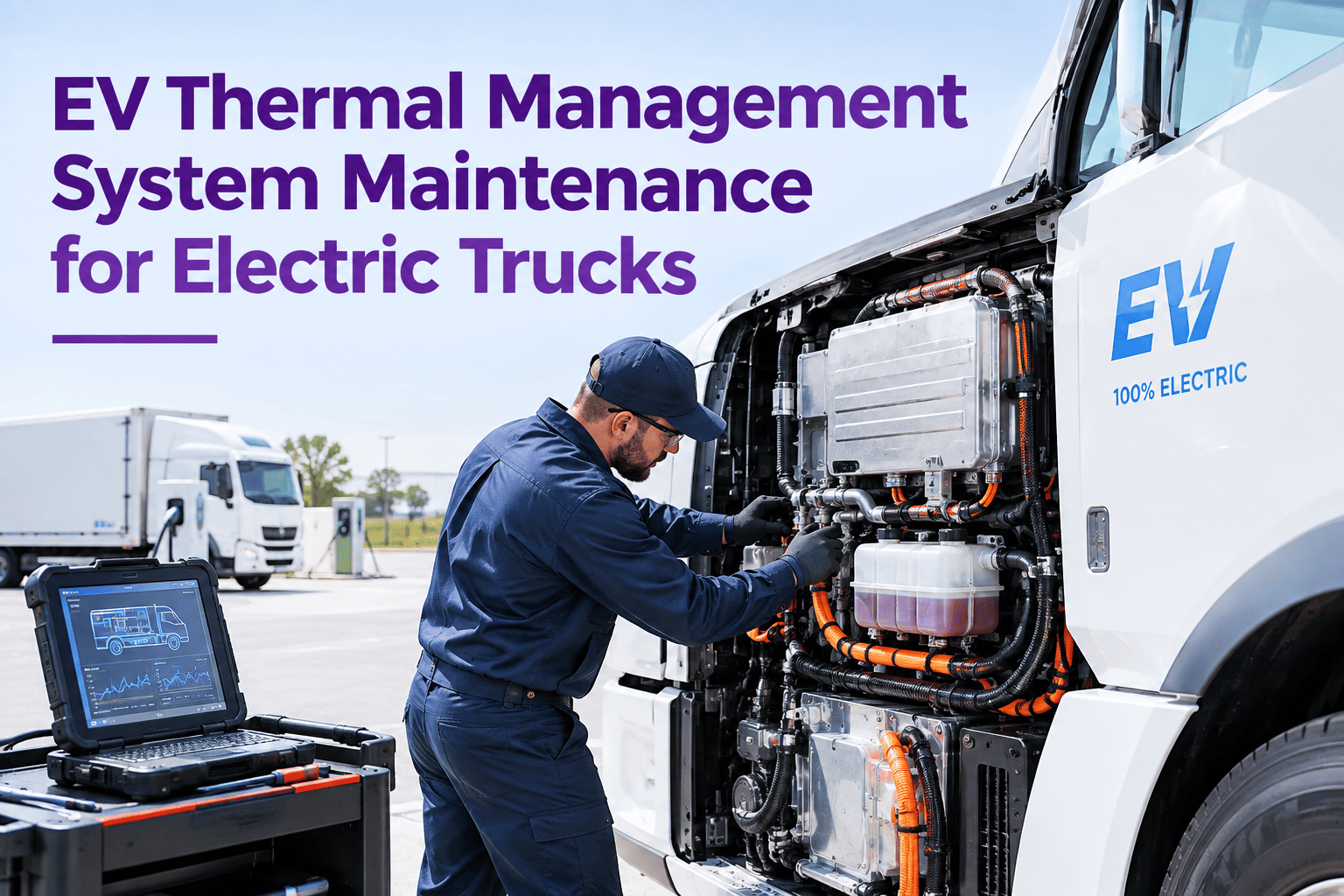
An electric truck lives or dies by one number: the temperature of its battery pack. Lithium-ion cells hold full power, fast charging, and range only inside a narrow window — roughly 25–35°C (77–95°F). Push past ~95°F and cells degrade permanently; drop near freezing and range collapses. Yet the coolant loop that governs it all is quiet and sealed — easy to ignore until a pump fails or a leak corrodes a cold plate. This guide covers the checks that keep an EV's thermal system honest, and how Truck Inspection & Maintenance Management Software (TIM) turns each one into a scheduled, trend-able record. Start free and build your EV thermal PM program in minutes.
A Coolant Leak Found at Pre-Trip Is a Work Order. Found on the Road, It's a Dead Battery.
Catch thermal problems the moment a driver spots them — not a slow leak that corrodes a cold plate for weeks. TIM runs the loop for your EVs: inspections capture the reading, a flagged leak or fault becomes a graded defect, and the defect opens a work order with the pack's full history attached. Every thermal defect gets a first response within 4 hours — acknowledged, graded, and assigned.
The Temperature Window — Why a Few Degrees Decide Range, Charge Speed, and Pack Life
Lithium-ion cells have a comfort zone, and both edges of it are expensive. The gauge below shows what happens as pack temperature drifts out of the ideal band. The thermal system holds the needle in the green in both directions — cooling when it runs hot, and heating the coolant in cold weather so the pack reaches its ideal temperature before the truck asks for power.
Anatomy of the Loop — The Six Components That Keep the Pack in the Window
A liquid-cooled thermal system is a closed circuit, each part with its own failure mode. Uneven cooling is the quiet killer: even small cell-to-cell temperature differences significantly shorten pack life, so a weak pump or blocked passage doesn't just run hot — it runs unevenly, creating hot spots. TIM tracks each of these as an inspectable asset on the unit record, so a flagged pump, hose, or cold-plate issue is logged against the exact truck and its full service history.
Circulates fluid through battery, motor, and inverter loops. A weakening pump creates uneven flow and hot spots long before it fails outright.
Transfer heat from cells into the coolant. Aging glycol corrodes cold plates — the exact surfaces the pack depends on for heat transfer.
The working fluid. Degrades over time, drops in level through slow leaks, and loses corrosion protection — all silently.
The most common leak points. Connections loosen and age; a small leak left unchecked degrades the battery it was meant to protect.
Rejects heat to ambient air. Debris on the exterior and clogging inside both cut its capacity on the hottest days.
Warms coolant in cold weather to bring the pack to its ideal window before load. A cold-climate wear item that's easy to forget.
The EV Thermal PM Cadence — What to Check, and How Often
There's no universal coolant interval — it depends on the make, coolant chemistry, and cooling design, so the OEM schedule always wins. But the rhythm below reflects where fleet practice converges: quick visual and level checks happen constantly; the full flush is a long-interval, OEM-specified event. TIM lets you set each of these intervals per unit — by mileage or by date — so the right check auto-schedules and the full flush never slips. Severe-duty fleets should tighten every interval by 20–30%.
| Interval | Thermal System Task | Why It Matters |
|---|---|---|
| Daily / Pre-Trip | Visual check for coolant leaks; confirm no thermal fault/warning lights; listen for pump operation | A slow leak or a logged fault caught at the yard never becomes a roadside limp-home event |
| Routine PM | Coolant level & reservoir check; inspect radiators, fans, and hoses for damage or corrosion; verify pump operation | Level and flow problems are the most common cooling failures — they show up early to anyone looking |
| ~25,000 mi | Battery thermal management coolant check — condition, contamination, pH, freeze point | Fluid can look fine while its corrosion protection is spent; only a test tells you |
| Seasonal | Cooling-system pressure test & coolant-condition verification (summer); coolant freeze-point verification (winter) | Each season stresses a different edge of the temperature window; prep for the one that's coming |
| OEM Interval | Full coolant flush & fill with the exact specified fluid, plus air-purge — done by an EV-trained tech | Ranges widely by OEM (commonly ~150,000 mi or several years); the number that matters is in your manual |
Intervals shown are representative of published fleet-maintenance guidance, not a substitute for your OEM schedule. Always use the exact coolant specification the manufacturer requires — the wrong fluid undermines the whole system.
The Five Diagnostic Checks That Catch Thermal Trouble Early
A small leak, a loose connection, or a developing hot spot doesn't produce the obvious symptoms a failing diesel part does — it takes the right tools and disciplined procedure. These are the checks that move a fleet from reactive to predictive. Capture each result in TIM — a thermal-image note, a freeze-point value, a scanned fault code — and an invisible problem becomes a number you can trend across the pack's life.
Thermal imaging finds hot connections, blocked coolant flow, or uneven battery-module temperatures before they become expensive failures. The single highest-value predictive check on an EV.
Test at every major service. Degraded glycol corrodes cold plates; a wrong freeze point risks the pack in winter. Record actual measured values — not "OK."
BTMS controllers generate specific codes for pump failures, temperature-sensor faults, and flow restriction. Verify them with the OEM diagnostic tool, not guesswork.
A pressure test surfaces slow leaks and confirms the circuit is sealed. Pair with a visual on hoses, connectors, and the reservoir for the full picture.
Packs run at 600–900V. Treat every HV circuit as energized until disconnected, locked out, and verified de-energized. EV-rated PPE and procedure are non-negotiable.
Every Thermal Reading, Scheduled and Trended — Not Scribbled and Lost
TIM turns EV thermal care into a system: OEM coolant intervals scheduled per unit, pre-trip checks captured with photos, freeze-point and pH logged as trend-able data, and BTMS fault codes pulled from the ELD/telematics feed to open work orders automatically. When thermal maintenance shifts from preventive to predictive, the platform is what makes the trend visible.
Cold Snap vs. Heat Wave — The Two Climates That Test the System Hardest
The temperature window has two edges, and each season attacks a different one. Prep for the edge that's coming — fleets that complete seasonal thermal PM before the first hard freeze or heat wave avoid the breakdowns everyone else discovers the hard way. In TIM you can build a winter and a summer thermal-PM template once and trigger it fleet-wide when the season turns.
- Verify coolant freeze point to the required low temperature
- Confirm the coolant heater / heat pump brings the pack up before load
- Expect and plan for reduced range and longer charge times in the cold
- Watch for cells resisting current until the pack reaches its window
- Pressure-test the cooling system and verify coolant condition
- Clean radiator/heat-exchanger exteriors of road debris
- Thermal-image packs after long grades to catch hot spots
- Guard against sustained operation above 95°F on long hauls
Frequently Asked Questions
Keep Every Pack in the Green Band — and Keep the Proof
OEM coolant intervals per unit, pre-trip thermal checks with photos, freeze-point and pH logged as trends, and BTMS fault codes routed straight into work orders. That's how a fleet stops guessing about battery health and starts managing it.