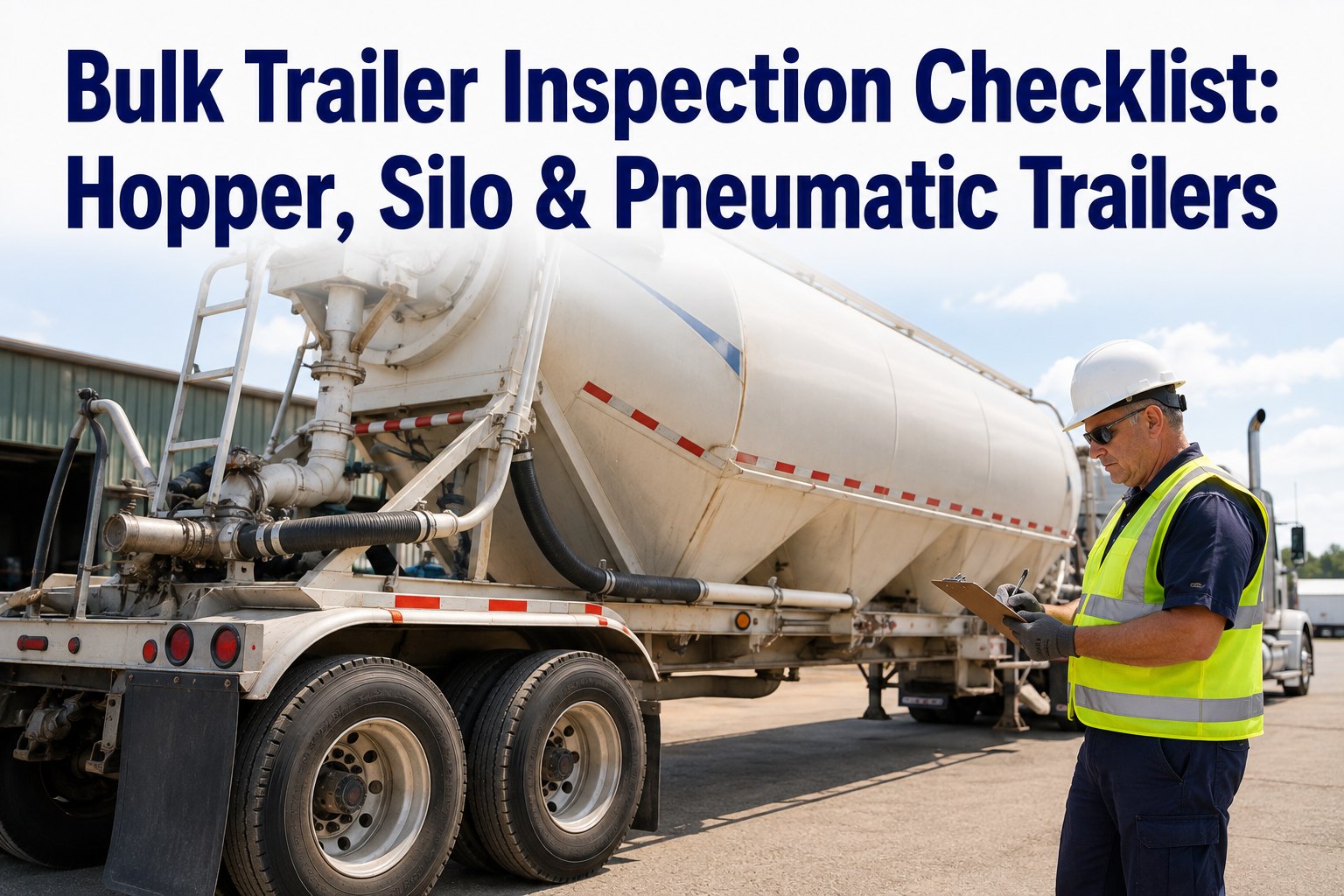
A bulk trailer isn't just a container on wheels — it's a pressure vessel with a discharge system that moves 40,000+ pounds of cement, flour, plastic pellets, or grain out of the tank in 30 to 90 minutes using compressed air and gravity. Every one of those pounds has to leave through the same discharge valves, hoses, and outlet points, and every one of those pressure system components has its own failure mode that can catastrophically fail if it's not caught at pre-trip. Bulk trailers fall into three distinct categories with fundamentally different failure signatures. Hopper trailers use gravity discharge through bottom gates, common in agriculture for grain and feed. Silo trailers are vertical-storage bulk containers, often stationary or specialized haul. Pneumatic trailers are the workhorses of dry bulk hauling — pressurized 15 to 30 PSI operating range with dedicated blower-driven discharge, aerators, and 3 to 5 PSI line pressure targets during unloading. And unlike a dry van where a defect quietly stays in the trailer, a bulk trailer defect becomes a $50,000 environmental cleanup, a manhole cover flying off from residual pressure, or a batch of contaminated food-grade product. The DANGER label on every pneumatic manhole isn't decorative: even slight residual pressure can cause the cover to violently fly open when unlatched. This guide covers exactly how to inspect all three bulk trailer types — the trailer-type identification, the pressure and vacuum system inspection points, the discharge valve and hose zones, the safety devices under 49 CFR 393, the 6 most common OOS defects, and how Truck Inspection & Maintenance software builds bulk-trailer pre-trips that catch pressure system defects before someone opens a manhole with residual PSI still in the tank. Ready to keep every bulk trailer running compliant and safe? Start a free trial of Truck Inspection & Maintenance, or contact our support team for a walkthrough.
Bulk Trailer Inspection Checklist: Hopper, Silo & Pneumatic Trailers
Three bulk trailer types. Two pressure ranges. One pre-trip that stands between routine unloading and a manhole cover going airborne. Here's exactly what to inspect.
The 3 Bulk Trailer Types — Know Which You're Inspecting
Every bulk trailer inspection starts with identifying the trailer type. Each type has its own primary components, failure modes, and inspection priorities.
The Pneumatic Pressure System — Every Component Mapped
Pneumatic bulk trailers have a dedicated pressure and vacuum system with 9 critical components. Every one has an inspection point, and every one can produce a citation or a safety event when it fails.
Pressure Reference Card — Critical PSI Values to Memorize
Every pneumatic operator should know these numbers by heart. Getting any of them wrong at unloading time is what turns a routine job into an incident.
The 8-Zone Bulk Trailer Pre-Trip Inspection
Every bulk trailer needs a systematic pre-trip covering both the general trailer components and the bulk-specific pressure and discharge systems. Here are the 8 zones.
Never open a manhole without confirming zero PSI
Bulk trailer DVIRs with pressure gauge photo verification. Blow-down valve status logged. PRV inspection dates tracked per unit. Truck Inspection & Maintenance software makes the safety-critical checks a documented event — because a residual-pressure manhole is one of the leading causes of serious injury in dry bulk operations.
Discharge Sequence — Why the Order Matters
Pneumatic trailers are unloaded in a specific hopper order. Get the sequence wrong and you plug the line, over-pressurize a hopper, or fail to fully empty a compartment.
The 6 Most Common Bulk Trailer OOS Failures
These six patterns dominate bulk trailer citations and safety events. Every one is preventable with a systematic pre-trip.
Frequently Asked Questions
Hopper trailers discharge by gravity through bottom gates and haul agricultural or aggregate cargo like grain, feed, coal, and sand — no pressurization, atmospheric pressure only. Silo trailers are vertical-storage bulk containers typically used for cement, flour, and powdered materials, often with pneumatic assist for discharge. Pneumatic trailers are the primary workhorses of dry bulk hauling — they use compressed air at 15–30 PSI to move product like cement, plastic pellets, flour, and fine sand from 2–4 hoppers through a dedicated discharge line into a receiving silo. Pneumatic trailers include a pressure relief valve, vacuum relief valve, tank and line pressure gauges, aerators, blow-down line, and cam-and-groove hose connections that hopper and silo trailers may not have. Truck Inspection & Maintenance software tracks trailer type per unit with type-specific inspection checklists.
Pneumatic bulk trailers operate at 15–30 PSI tank pressure during discharge. Startup pressurization is typically 5–10 PSI before opening the product valve — this confirms the system is sealed. Once discharge begins, the ideal line pressure is 3–5 PSI, and the line pressure should stay within 1–5 PSI of the tank pressure for smooth product flow. The pressure relief valve is typically set at 15 PSI on the blow-down line to prevent over-pressurization. Loading operations via vacuum should not exceed 13" Hg, with the filter canister staying below 5 PSI. Exceeding any of these limits risks blowing the PRV, damaging equipment, or in the worst case causing a manhole cover to fail catastrophically.
The blow-down line valve must be OPEN at all times except during active unloading. When parked, especially overnight, three things can build residual pressure inside a sealed tank: thermal expansion from ambient temperature swings, product expansion from moisture absorption, and internal friction as material settles. Even a few PSI of residual pressure is enough to make a manhole cover violently fly open when unlatched — this is one of the leading causes of serious injury in dry bulk operations. Keeping the blow-down valve open lets any pressure buildup vent harmlessly instead of accumulating. Verify blow-down valve status at every pre-trip and every post-trip.
Every pneumatic bulk trailer requires several dedicated safety devices. A pressure relief valve (PRV) — typically 15 PSI setpoint on the blow-down line — protects against over-pressurization. A vacuum relief valve — typically 15" Hg setpoint — protects against internal collapse during vacuum loading. Tank and line pressure gauges (typically glycerin-filled 0–30 PSI) provide operator visibility into the system state. A blow-down line valve allows residual pressure release. Manhole safety chains prevent cover loss during pressure events. Standard § 393 requirements still apply: DOT lighting and reflectors, brakes within adjustment, current annual DOT inspection. Never plug, bypass, or disable any safety device — it defeats the entire protection system. Contact our team to see how the software captures safety device inspection per PM.
The industry-standard hopper discharge sequence for a 4-hopper pneumatic trailer is: second hopper first, then first (front) hopper, then third and fourth (rear) hoppers last. The reason is fluid dynamics — starting with the mid-section establishes even product flow through the discharge line without overloading either end. Once flow is established and the line is pressurized evenly, the front hopper can discharge into the moving stream, and the rear hoppers finish the load without plugging the now fully-purged line. Reversing the sequence (starting with a rear hopper into an empty line) commonly causes plugging, uneven pressure, or incomplete discharge. Follow the manufacturer's specific recommendations — some 3-hopper designs have their own optimal sequence.
Bulk trailers need three layers of inspection. Pre-trip and post-trip (every trip): visual check of pressure relief devices, gauges, discharge valves, hoses, blow-down valve position, manholes, and the standard trailer OOS items (brakes, tires, lights, reflectors). PM interval (typically 90 days or by mileage): pressure relief valve testing, gauge calibration verification, hose condition assessment, aerator function check, gasket condition, and torque verification on all fittings. Annual DOT inspection: full § 396.17 inspection plus any commodity-specific requirements. Trailers hauling hazmat (some grades of chemicals or fuels in bulk) also fall under 49 CFR Part 180 cargo tank inspection intervals — V/K annually, I/P/PRV every 5 years. Try free: sign up here.
Truck Inspection & Maintenance software makes bulk trailer pre-trips a documented safety event
Trailer type flagged per unit (hopper vs silo vs pneumatic). Pressure relief valve inspection dates tracked. Gauge photos captured at every pre-trip. Blow-down valve status verified. Hose condition history per unit. Aerator function logged. Discharge sequence documentation. Every element of bulk trailer compliance managed in one platform — because a $200 PRV inspection is orders of magnitude cheaper than a residual-pressure manhole failure event.