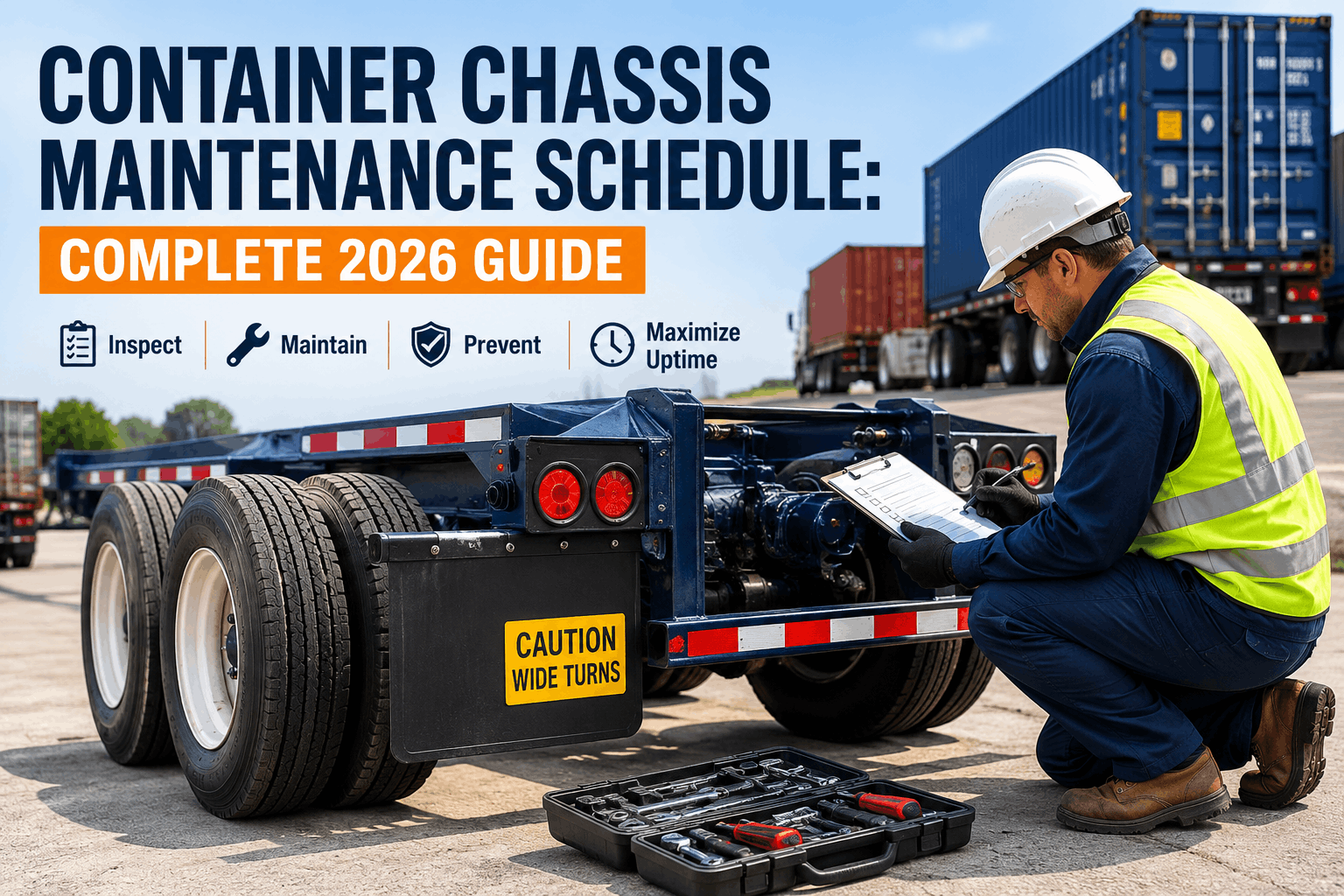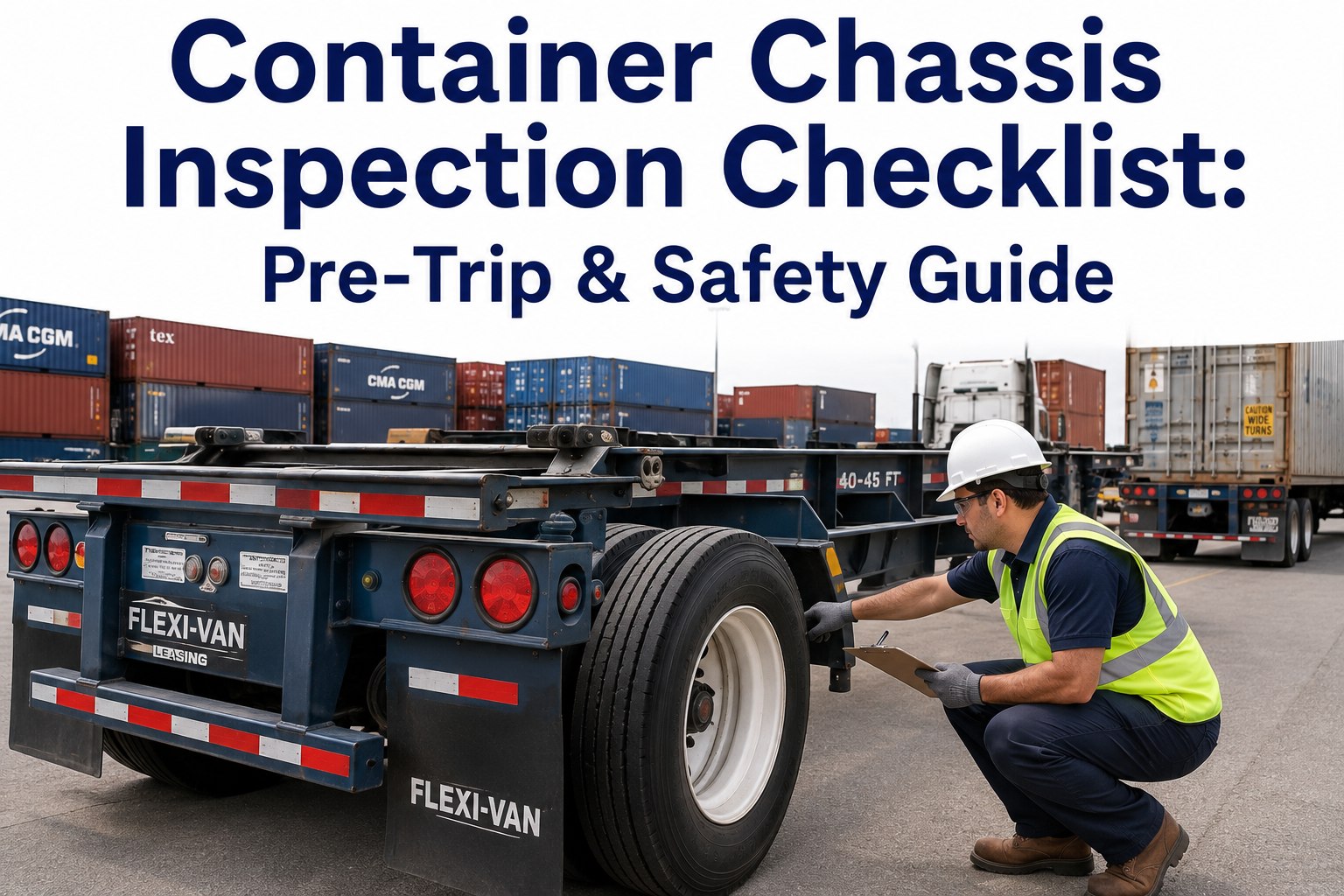
An intermodal container chassis is one of the strangest pieces of equipment in commercial trucking — legally, mechanically, and operationally. It's a trailer without a body, whose entire purpose is to carry a piece of cargo (the container) that clicks onto four twist locks and gets driven off a port or rail yard by a motor carrier that almost certainly doesn't own the chassis itself. Under the FMCSA Intermodal Equipment Provider (IEP) rule, chassis owners are responsible for maintaining roadworthy equipment and are subject to roadability reviews for compliance with Parts 390, 393, and 396. But the motor carrier is separately responsible for the pre-trip inspection of that chassis before every drayage move, and any defect the driver misses — a cracked twist lock, a bent slider stop, an inoperative marker light, worn brake shoes — becomes a citation against the motor carrier's CSA record even if the chassis showed up from the IEP that way. This is why intermodal drayage has the highest per-inspection violation rate of any trucking segment: two responsible parties, thousands of shared chassis moving through pool systems, and a single unified pre-trip that has to catch everything before departure. This guide covers exactly what a compliant container chassis inspection looks like — the split responsibility between the IEP and the motor carrier, the twist locks and corner casting connection that defines intermodal, the 8 inspection zones specific to chassis (main rails, bolsters, slider mechanisms, twist locks, tires and brakes, lights and reflectors, air lines, landing gear), how to defect-report at receipt, the top OOS violations, and how Truck Inspection & Maintenance software builds photo-verified chassis pre-trips that document what was received in what condition so citations don't stick to the wrong party. Ready to inspect every chassis with a repeatable, documented pre-trip? Start a free trial of Truck Inspection & Maintenance, or contact our support team for a walkthrough.
Container Chassis Inspection Checklist: Pre-Trip & Safety Guide
Two responsible parties. Four twist locks. Eight inspection zones. One pre-trip that determines whether your CSA record survives the drayage lane.
The Split-Responsibility Model — IEP vs Motor Carrier
Unlike a fleet-owned dry van, an intermodal chassis has two separate responsible parties under federal law. Understanding who owns what obligation prevents citations from sticking to the wrong side.
The 8 Inspection Zones for a Container Chassis
A container chassis has its own hardware layer beyond what a standard trailer requires. These eight zones are what every driver has to walk before hooking up and rolling out.
Twist Lock Deep Dive — The 4-Corner Connection
Twist locks are the mechanism that makes intermodal work. Four locking devices engage the container's four bottom corner castings, converting a loose 40,000+ pound container into a secure part of the chassis. Every one has to be inspected before every move.
Slider Chassis vs. Fixed Chassis
Two main chassis configurations dominate North American drayage — sliders that adjust axle position for different container sizes, and fixed chassis built for one length. Inspection points differ.
Defect reporting at receipt shifts citations upstream
Photo-verified interchange inspection. Timestamped defect reports to the IEP. DVIR generation at hook-up. Truck Inspection & Maintenance software creates the paper trail that keeps citations off the motor carrier's CSA record when the chassis arrived defective.
The Interchange Defect-Report Workflow
The moment a driver takes possession of a chassis is the single most important compliance moment in intermodal drayage. Here's the exact sequence that protects both parties.
Top 6 Chassis OOS Violations
The same six patterns dominate chassis out-of-service violations across every drayage lane. Each is preventable at pre-trip.
The IEP Roadability Review — What It Is
Beyond individual roadside inspections, FMCSA conducts on-site roadability reviews of IEPs themselves — checking whether the equipment provider is meeting its Part 390/393/396 obligations.
Frequently Asked Questions
A complete container chassis pre-trip covers 8 zones. Twist locks and push pins (all 4 corners engaging smoothly, no cracked welds, safety devices intact). Slider mechanism if equipped (moves freely, stops undamaged, no elongated apertures). Main rails and bolsters (no cracked welds, no bent members, kingpin area intact). Tires, wheels, and axles (2/32" minimum tread, no sidewall damage, wheel bearings tight). Brake system (push rod within adjustment, no air leaks, ABS operational). Air lines and glad hands (no cracks, seals intact, no leaks). Lights, reflectors, and marking (all lights operational, conspicuity tape intact, USDOT/IEP identification legible). Landing gear and kingpin (operates both directions, no cracked welds). Truck Inspection & Maintenance software builds photo-verified chassis pre-trips zone by zone.
Two parties share separate responsibilities. The Intermodal Equipment Provider (IEP) — typically a shipping line, chassis pool operator, or leasing company — is responsible for systematic chassis maintenance, compliance with FMCSRs Parts 390, 393, and 396, annual DOT inspection certification, and repair of driver-reported defects. IEPs are subject to on-site roadability reviews. The motor carrier is separately responsible for pre-trip inspection before every drayage move, defect reporting at receipt, refusing to operate defective chassis, DVIR documentation per § 396.11, and roadside inspection cooperation. Any defect that a driver misses becomes the motor carrier's citation regardless of who caused it — which is why documented defect reporting at receipt is critical.
Twist locks are the four mechanical fasteners at the corners of a container chassis that secure a container to the chassis frame. Each twist lock's bayonet inserts through the oval hole in the container's bottom corner casting, then rotates 90 degrees to lock. When all four are engaged, the container becomes structurally part of the chassis — sharing loads through the corner castings and providing the rigidity that makes the whole unit stable at highway speed. Pre-trip inspection must verify all 4 twist locks engage smoothly, are free of rust and mechanical wear, have no cracked welds, and have functional handles with safety devices intact. A single defective twist lock is an out-of-service condition.
A roadability review is an on-site FMCSA examination of an Intermodal Equipment Provider's compliance with Parts 390, 393, and 396 of the Federal Motor Carrier Safety Regulations. The FMCSA auditor visits the IEP's maintenance facility, verifies systematic maintenance program records, reviews annual DOT inspection certificates per chassis, checks driver-reported defect resolution documentation, and physically inspects a sample of chassis in the pool. IEPs are not currently rated in FMCSA's Safety Measurement System (SMS), but non-compliant IEPs face civil penalties and mandatory corrective action following a roadability review. Roadability reviews are triggered by patterns of chassis violations at roadside, complaint patterns, or random selection. Contact our team to see how the software supports IEP maintenance programs.
Five-step workflow. First, walk and photograph the chassis before touching it — document the USDOT/IEP identification plate and any visible damage. Second, complete the 8-zone systematic inspection, photographing every defect found. Third, document defects on the Equipment Interchange Report (EIR) before signing — the EIR is the legal record and signing clean means the defects become yours. Fourth, refuse the chassis if defects are at OOS level — you have both the right and the obligation to refuse an unroadworthy chassis. Fifth, complete a DVIR per § 396.11 with all defects noted and deliver to the IEP for repair. Retain photos and the DVIR as evidence — a documented defect-report at receipt protects the motor carrier's CSA record if the chassis is later inspected at roadside.
Six patterns dominate chassis out-of-service violations. Inoperative or missing lights — brake lights, turn signals, marker lights, or reflectors non-functional (the single most preventable category). Brake adjustment out of spec — push rod stroke exceeding limits, easily verified with a chalk mark and stopwatch. Tire tread below 2/32" — chassis see high-mile use across many carriers, so tread depth degrades fast. Cracked or ineffective twist locks — cracked welds, worn bayonets, non-locking mechanisms. Air leaks and damaged glad hands — audible leaks, cracked lines, torn seals. Damaged slider stops or elongated apertures on slider chassis — bent stops mean the axle can shift under load, an extreme rollover risk. Every one is preventable at pre-trip. Try free: sign up here.
Truck Inspection & Maintenance software builds the defect-report trail that keeps citations off the motor carrier
Photo-verified 8-zone chassis pre-trips. USDOT/IEP identification capture per interchange. Timestamped defect reports at receipt with automatic IEP notification. DVIR generation per § 396.11. Twist lock condition history per chassis unit. Slider mechanism inspection tracking. Air brake stroke logs. Landing gear operation verification. Every element of intermodal chassis compliance managed in one platform — because in a shared-pool system, documentation is the only thing standing between your CSA record and someone else's defect.