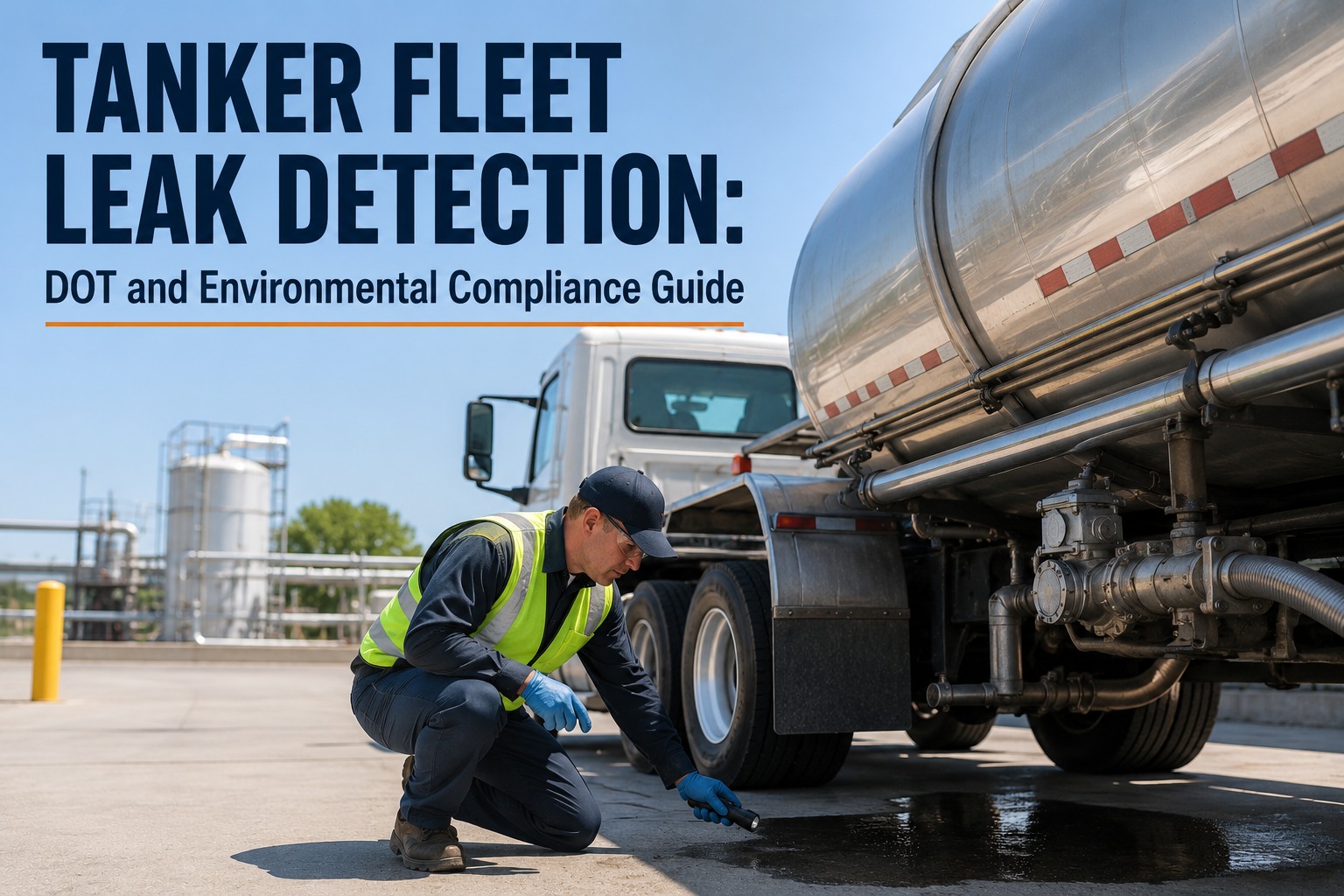
A cargo tank hauling gasoline, sulfuric acid, or liquid asphalt is not a trailer with regulations bolted on top — it's a pressure vessel that has to be built, inspected, and re-tested to a specific DOT specification for the material it's authorized to carry. Under 49 CFR Part 180, the three most common highway cargo tanks are DOT 406 (petroleum fuels and flammable liquids at 2.65–4 psig MAWP), DOT 407 (higher-pressure liquids and chemicals at up to 35–40 psig), and DOT 412 (corrosive materials like sulfuric acid, requiring stainless steel or lined carbon steel construction). Each spec has its own design pressure limits, construction materials, and periodic testing schedule enforced by PHMSA — and 49 CFR 180.407 is explicit: a tank with an overdue test may not be filled or transported. The consequences of getting this wrong compound quickly. Approximately 30% of fatal hazmat crashes result in material release, and rollovers account for 29% of hazmat tanker accidents. A tank found overdue at roadside receives an immediate out-of-service order and cannot be loaded or moved until testing is completed — plus every PHMSA hazmat incident tracked through Form 5800.1 can trigger a facility audit if patterns of non-compliance emerge. This guide covers exactly what DOT 406, 407, and 412 tanks are; the six periodic tests required under 180.407 (external visual V, internal visual I, leakage K, pressure P, thickness T, and pressure relief valve testing); the interval rules by specification; the qualifications required for the inspector; the daily driver inspection points; and how Truck Inspection & Maintenance software tracks tank-by-tank test due dates so no unit gets loaded past its interval. Ready to keep every tank in your fleet compliant and rolling? Start a free trial of Truck Inspection & Maintenance, or contact our support team for a walkthrough.
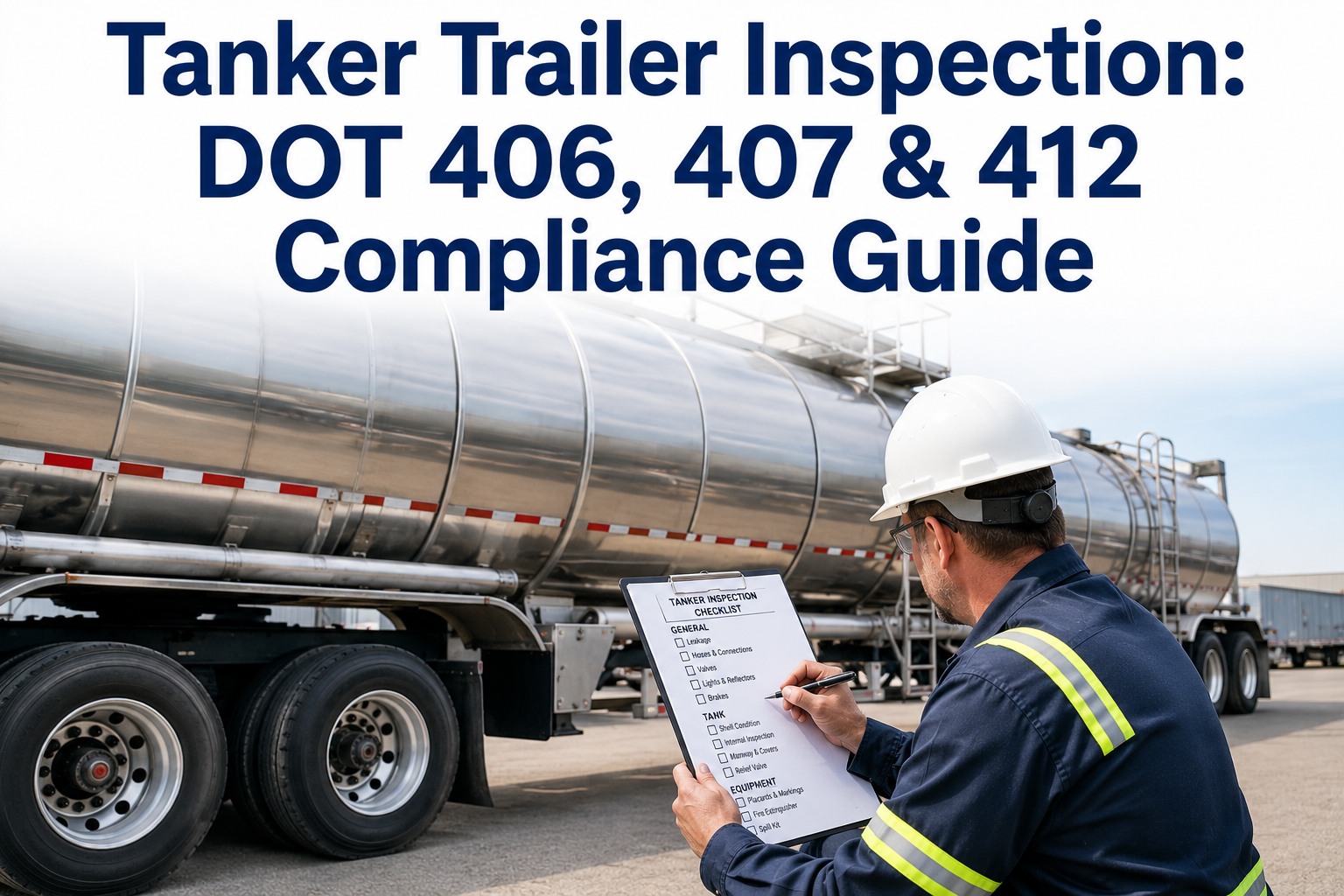
Tanker Trailer Inspection: DOT 406, 407 & 412 Compliance Guide
A tank with an overdue test may not be filled. Full stop. Here's every specification, every required test, every interval — and how to keep every unit rolling.
The 3 DOT Cargo Tank Specifications
Each cargo tank is built to one of the DOT 400-series specifications, and the spec on the manufacturer's plate determines what the tank can legally carry. Here's how the three most common highway tanks compare.
The 6 Periodic Tests Required Under 49 CFR 180.407
Every specification cargo tank must pass six specific test types on a mandated schedule. Each test has a code letter that appears on the tank's inspection markings — V, K, P, I, T, and pressure relief.
Testing Intervals by Test Type
Each test has its own interval, and the schedule is set by 49 CFR 180.407. The most common intervals for standard DOT 406/407/412 tanks in non-corrosive service:
Who Can Perform Each Test — Inspector Qualifications
Not just anyone can sign off on cargo tank tests. 49 CFR 180.409 sets minimum qualifications for the person witnessing or performing each test. Skipping qualifications is a violation itself.
Never let a tank load past its due date
Tank-by-tank inspection tracking. V/K/P/I/T/R dates per unit. Automatic alerts before intervals expire. Truck Inspection & Maintenance software makes sure no tank leaves the yard with an overdue test — because "we forgot to schedule the P" is an OOS finding waiting to happen.
Daily Driver Pre-Trip Inspection Points
Beyond the periodic 180.407 tests, drivers perform a daily pre-trip on the tank. These are the specific points that catch issues before loading — and prevent 29% of tanker rollovers that trace back to unsecured or improperly maintained components.
Top 5 Tanker Compliance Failures
The vast majority of cargo tank citations trace back to these five patterns. Every one is preventable with proper tracking and daily driver discipline.
Frequently Asked Questions
These are three cargo tank specifications defined in 49 CFR Part 178, each built for a different category of commodity. DOT 406 (formerly MC 306) tanks carry flammable liquids like gasoline, diesel, jet fuel, and ethanol at 2.65–4 psig MAWP — typically aluminum, elliptical cross-section, multi-compartment. DOT 407 (formerly MC 307) tanks carry mid-pressure chemicals and certain higher-pressure liquids at up to 35–40 psig MAWP — typically stainless or carbon steel, circular cross-section. DOT 412 (formerly MC 312) tanks carry corrosive liquids like sulfuric acid — stainless steel or lined carbon steel construction required. The DOT spec plate on the tank identifies which specification applies and what commodities it can legally carry. Truck Inspection & Maintenance software tracks each tank's specification and test dates per unit.
Under 49 CFR 180.407, six periodic tests are required. External Visual Inspection (V) — walk-around inspection of shell, heads, piping, and mountings. Leakage Test (K) — pressurize to 80% MAWP and verify no leakage for 5 minutes minimum. Pressure Test (P) — hydrostatic or pneumatic test to 1.5 × MAWP. Internal Visual Inspection (I) — confined-space entry to inspect internal shell, baffles, and lining. Thickness Test (T) — ultrasonic wall measurement. Pressure Relief Valve Bench Test — removal and bench testing of PRVs. Each test has its own interval and its own qualified-inspector requirement under § 180.409.
For standard DOT 406 petroleum fuel tankers, the intervals are: annually for External Visual (V) and Leakage Test (K), every 2 years for Thickness Test (T) on unlined tanks carrying liquids that thin the shell, and every 5 years for Internal Visual (I), Pressure Test (P), and Pressure Relief Valve Bench Test. All three 5-year tests typically happen together on the same service visit. A tank with any overdue test may not be filled or transported under § 180.407(a)(1). The test dates are stamped on the tank's spec plate as V-YYMM, K-YYMM, P-YYMM, I-YYMM, and T-YYMM — inspectors check these first at roadside.
49 CFR 180.409 sets minimum qualifications by test type. External Visual, Leakage Test, and Internal Visual can be performed by a Registered Inspector with training, experience, and knowledge of applicable specifications — employer-designated is acceptable if properly qualified. Pressure Test and Thickness Test require a Registered Design Certifying Engineer with registration number appearing on the certificate, and are typically performed at a certified cargo tank facility. Pressure Relief Valve bench tests are performed at a facility with calibrated test equipment by a Registered Inspector. Every test certificate must document the inspector's qualification level and registration number where required. Contact our team to see how the software captures inspector credentials with each test record.
Under 49 CFR 180.407(a)(1), a cargo tank with any overdue test may not be filled and offered for transportation. Consequences are immediate and severe. At the loading rack: the terminal legally cannot load the tank until testing is completed. At roadside: an immediate out-of-service order that keeps the tank from being moved until the overdue test is completed. On a compliance review: an automatic-failure finding that can result in unsatisfactory rating and revocation of hazmat authority. Civil penalties for operating on an overdue tank can reach into five figures per violation, and each shipment on an overdue tank is a separate violation. Track test dates by unit, not by memory or paper spreadsheet.
The differences are commodity type, design pressure, and construction. DOT 406 is the low-pressure standard for flammable liquids — 2.65–4 psig MAWP, typically aluminum, elliptical, no vacuum loading, multi-compartment fuel deliveries. DOT 407 handles mid-pressure liquids and chemicals — up to 35–40 psig MAWP, stainless or carbon steel, circular cross-section, some variants support vacuum loading. DOT 412 is built for corrosive materials — variable MAWP depending on lading, stainless steel or lined carbon steel required, often with full-opening rear head options for aggressive commodities like sulfuric acid. Classification is set at manufacture and cannot be changed in the field. The spec plate is the authoritative source for what a specific tank can legally carry. Try free: sign up here.
Truck Inspection & Maintenance software tracks every tank's V, K, P, I, T, and R dates so nothing loads overdue
Tank specification plate captured per unit. Test date tracking with automatic alerts before intervals expire. Inspector credential verification. Certificate storage with instant retrieval for roadside verification. Daily driver pre-trip capture of tank-specific inspection points. PRV bench-test scheduling. Placarding verification against lading. Every element of § 180.407 compliance managed in one platform — because "the P was due last week" isn't a valid answer at a loading rack.