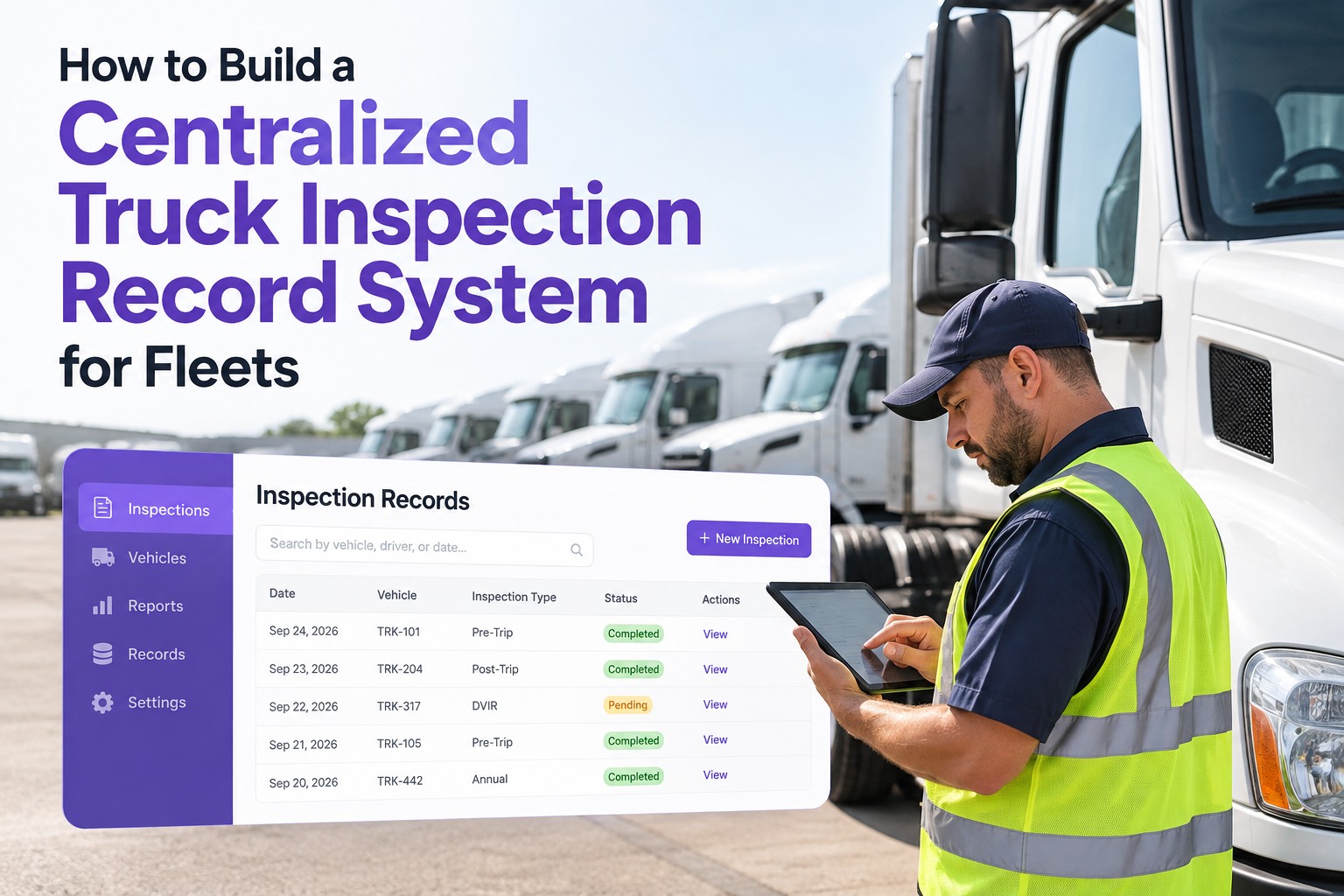
An auditor calls with 48 hours' notice and asks for one specific DVIR truck 4407, 74 days ago. Either it comes up in seconds from any phone or workstation, or it doesn't, and "we probably have it in the file room at HQ" is not compliance. That's the moment scattered records fail a fleet: paper in a cab, a defect noted on one app, repairs logged in a different spreadsheet, annual reports in a binder at a yard three states away. During a DOT audit a missing record is treated exactly like a missing repair — no matter how well the truck was actually maintained. A centralized inspection record system fixes that by putting every DVIR, defect, repair certification, and inspection report for every truck in one searchable place. Here's how to build one. Start free and centralize every inspection record with TIM.
TIM · Centralized Inspection Records
Scattered Records Don't Fail Because the Work Wasn't Done — They Fail Because You Can't Find the Proof
A DVIR in the cab, a defect in one tool, a repair in a spreadsheet, an annual report in a binder — that's four places to search and four places to lose an audit. Truck Inspection & Maintenance Management Software puts every inspection, defect, repair, and signature for every unit in one system, retrievable in seconds with the full chain intact.
48-hour noticeoffsite audits demand records fast
4 retention clockseach record type on its own timer
eDVIR officialelectronic records authorized in 2026
Why Scattered Records Fail
The problem isn't that fleets don't inspect — it's that the evidence ends up in silos that don't talk to each other. When the record lives in four places, three things go wrong: you can't retrieve on demand, the signature chain breaks, and records get purged before their retention clock runs out. Any one of them turns a routine audit into a finding.
⊘
Can't retrieve on demand
Records must be produced at the location where the vehicle is housed. A binder at HQ doesn't help when the auditor wants a specific DVIR from a yard three states over.
⚯
Broken signature chain
The driver report, the repair certification, and the next driver's review have to connect. Split across systems, the chain of custody snaps — and that's what auditors look for.
⏳
Early-purged records
Four record types, four different retention periods. Mix them up and you toss a document while its clock is still running — a recordkeeping violation on its own.
Know Your Retention Clocks
The foundation of any record system is knowing what to keep and for how long. FMCSA runs four separate clocks under 49 CFR Part 396, and mixing them up is one of the most common compliance failures. A centralized system enforces each one automatically instead of leaving it to memory.
| Record type |
Regulation |
Retention period |
| DVIR + repair & review certifications |
§396.11 |
3 months from report date |
| Roadside inspection reports |
§396.9 |
12 months |
| Annual periodic inspection reports |
§396.21 |
14 months from inspection date |
| General maintenance / repair files |
§396.3 |
1 year in service + 6 months after |
Retention periods per 49 CFR Part 396. Records must be produced on demand and, for maintenance files, kept at the location where the vehicle is housed. Verify current figures against the regulation for your operation.
TIM tags every record with its type and applies the right retention clock automatically — nothing purged early, nothing lost. Contact our team to map your retention rules into TIM.
Protect the Chain of Custody
A DVIR isn't one signature — it's three, and they have to connect. This chain is what proves a defect was found, fixed, and confirmed before the truck rolled again. Break any link and the record can't do its job in an audit. A centralized system keeps all three together on the same record.
1
Driver's ReportThe driver documents defects found on the post-trip inspection — the record that starts the chain.
→
2
Repair CertificationThe carrier certifies the reported defect was repaired — or that no repair was needed.
→
3
Next-Driver ReviewThe following driver reviews the prior DVIR and confirms before operating — closing the loop between drivers (§396.13).
TIM captures all three signatures digitally with timestamps on one linked record, so the chain never breaks across shifts or systems. Start free and keep the signature chain intact with TIM.
The Four Standards a Digital Record System Must Meet
FMCSA permits electronic recordkeeping as long as digital files meet the same standards as paper. The best systems make these four properties structural — built in from day one, not bolted on as compliance chores.
◆
Integrity
Records can't be altered after the fact without a trace. The signature chain and timestamps stay intact and tamper-evident.
◈
Accuracy
Every record reflects what actually happened — correct unit, date, defect, and repair — with no gaps or guesswork.
◉
Accessibility
Retrievable from any workstation or phone, at any yard the fleet operates from — not locked in one file room.
◎
Retrievability
The specific record an auditor names comes up in seconds, complete with its full signature chain — on demand, every time.
One System, Every Record, Retrievable in Seconds
Truck Inspection & Maintenance Management Software runs the whole recordkeeping system alongside your fleet maintenance. Digital DVIRs with photo capture and timestamps, the full three-signature chain, an unbroken defect-to-repair trail, and automatic retention by record type — all searchable by unit, date, or defect. A 48-hour audit notice stops being a fire drill because every document is one search away.
How to Build It — Five Steps to a Centralized System
Centralizing records isn't a one-time data dump — it's a system you stand up once and run continuously. Here's the path from scattered paper to a single audit-ready archive.
1
Digitize CaptureMove inspections to electronic DVIRs with photos and timestamps — the record is born digital, not scanned later.
→
2
One Record Per UnitTie every inspection, defect, and repair to the vehicle, so each truck has one continuous history.
→
3
Link the ChainConnect report, repair certification, and next-driver review on the same record automatically.
→
4
Automate RetentionApply the right clock to each record type so nothing is purged early or lost.
→
5
Search & TrendQuery any record on demand — and read safety trends across the fleet the silos used to hide.
The Payoff — Beyond Passing the Audit
Centralized records do more than survive a compliance review. When every inspection lives in one place, the data starts working for you.
🛡
Audit-ready by default
Any record produced in seconds, chain intact — no fire drill, no early-purged gaps.
📈
Visible safety trends
Recurring defects across units surface instead of hiding in separate silos — so you fix patterns, not just incidents.
🔗
Unbroken defect-to-repair trail
Every defect traceable from discovery to certified fix, on one record, for every truck.
Frequently Asked Questions
Are electronic DVIRs actually compliant, or do I still need paper?
Electronic DVIRs are fully compliant. They've been permissible since 2018, and a federal rule effective March 23, 2026 explicitly added electronic-DVIR authorization to the regulations — removing any remaining ambiguity. Digital signatures, mobile submission, and cloud storage all satisfy the rules, provided the records contain the required information, carry the proper signatures, and meet the retention periods. Paper is now the liability, not the safeguard.
Start free and go paperless with compliant eDVIRs in TIM.
How long do I actually have to keep each type of record?
Four different clocks: DVIRs and their repair and review certifications for 3 months from the report date; roadside inspection reports for 12 months; annual periodic inspection reports for 14 months; and general maintenance and repair files for 1 year while the vehicle is under your control, plus 6 months after it leaves. Many fleets keep DVIRs longer for litigation protection — digital storage makes that essentially free.
Contact us to automate retention by record type in TIM.
What happens in an audit if one record is missing?
A missing record is treated the same as a missing repair — it doesn't matter how well the truck was actually maintained. Recordkeeping violations carry civil penalties that accrue per day, so a gap found during an offsite review (often on 48-hour notice) becomes costly fast. The defense is simple: every record retrievable on demand with its signature chain intact, which is exactly what a centralized system delivers.
Start free and close the record gaps with TIM.
We already inspect well — why centralize if the work is getting done?
Because doing the work and proving it are two different things, and the audit only sees the proof. Scattered records also hide the bigger prize: safety trends. When every inspection lives in one place, a recurring defect across ten units becomes visible instead of buried in ten separate files — so you fix the pattern before it becomes a roadside failure. Centralizing turns compliance paperwork into a fleet-health signal.
Contact our team to surface fleet-wide trends with TIM.
Digital Capture · One Record Per Unit · Signature Chain · Auto-Retention · Instant Search
Build the System Once — Pass Every Audit After
A centralized inspection record system turns the scariest part of a DOT audit into a non-event: the auditor names a record, and it's on screen in seconds with the full chain intact. It also does what silos never could — show you the safety trends hiding across your fleet. Build it once, and every inspection from then on makes the fleet both more compliant and easier to run. TIM is that system.
No credit card required · Free for up to 3 trucks · Centralized DVIR + records system built in