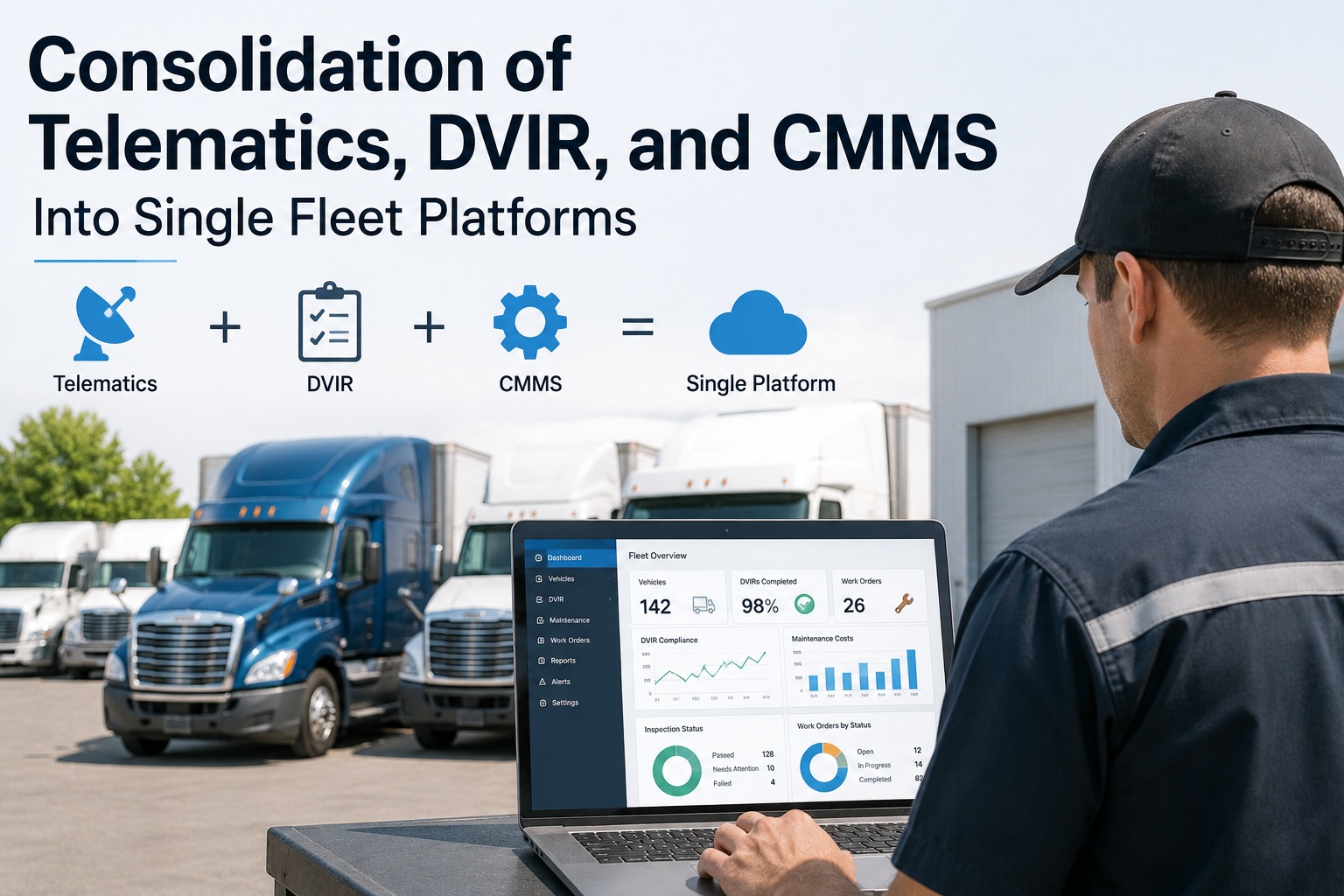
The classic fleet stack — telematics from one vendor, DVIR from a second, CMMS from a third, plus a spreadsheet on top — is quietly being replaced. 2026 is the year platform consolidation stops being a promise and becomes the default recommendation from every fleet consultant. The reasons are boring but decisive: three systems produce three data models, three logins, three audit trails, and the integration debt that connects them costs more than any of them individually. This article breaks down what's actually driving the consolidation, what to evaluate before switching, and where Truck Inspection & Maintenance sits in the new landscape. Start a free trial to see the consolidated model in action.
Consolidation of Telematics, DVIR, and CMMS Into Single Fleet Platforms
The three-vendor fleet stack is consolidating into unified platforms in 2026 — with real operational impact on integration cost, data quality, and workflow speed. Here's what's driving it, what to evaluate before switching, and what fleets should actually adopt this year.
Why the Classic Stack Is Breaking
The three-vendor model wasn't a design — it was a historical accident. Telematics companies grew out of GPS tracking. DVIR apps grew out of ELD mandates. CMMS platforms grew out of manufacturing. Each built for its own niche, then bolted on integrations to the others. Four structural problems are forcing consolidation now.
Each vendor pair needs a custom integration. Three vendors = three integration surfaces. Every API change, credential expiration, or version bump breaks something. IT spends more time maintaining integrations than the tools cost.
Vendor A calls a truck "Vehicle 47." Vendor B calls it "V-047." Vendor C uses the VIN. Merged datasets are lossy at best, broken at worst. The unified reporting layer becomes a data reconciliation project.
Fault code fires in telematics. Driver's DVIR doesn't reflect it. Shop's CMMS never gets the ticket. Truck rolls another 800 miles before someone notices. The gap between systems is where problems live.
Three subscriptions look cheaper than one enterprise license — until you add integration maintenance, training on three UIs, admin overhead, and the productivity tax of every workflow spanning multiple systems.
What "Unified" Actually Means
Not every "integrated platform" is unified. Some vendors bundle acquired products under one login and call it consolidation. True unification looks different across four specific dimensions.
The Consolidation Trade-Offs
Not every fleet should consolidate. The decision has real trade-offs that matter more for some operations than others.
The 7-Question Evaluation Checklist
Before switching to any consolidated platform, run every candidate through these seven questions. Vendors that dodge or hand-wave on any of them are selling bundles, not unification.
Test: create a new truck in one module, verify it appears everywhere else automatically with no sync delay.
Test: trigger a fault code in the demo environment; a work order should appear in the shop view within seconds, not manually.
Test: submit a DVIR with a defect photo; verify the same photo appears in the work order and the compliance record.
Test: ask for cost-per-mile by unit, PM compliance %, and open defects — all in one view. Multiple dashboards = bundle.
Test: ask for a written data migration plan from your specific vendors. "We'll figure it out" is a no.
Test: ask what data you can export, in what format, on what timeline. Trust vendors who answer plainly.
Test: expect days for simple fleets, weeks for complex. Anything beyond 90 days means implementation debt is built in.
The Consolidation Model, Live Today
Truck Inspection & Maintenance gives dispatch, drivers, and the shop a single system for inspections, preventive maintenance, and repair tracking — so no defect, PM, or DOT record ever slips. One asset ID across every workflow, native fault-code-to-work-order routing, one dashboard for the whole fleet.
Who Should Consolidate Now vs Wait
The decision framework depends on fleet size, current stack, and where you are in the existing vendor contracts. Three profiles emerge.
The Migration Reality: What to Expect
Moving from a 3-vendor stack to a unified platform is not a switch — it's a project. The honest month-by-month view.
Pull historical data from existing vendors. Reconcile asset IDs across all three. Clean up years of legacy inconsistencies before migration.
Configure unified platform to match existing workflows where possible. Import cleaned data. Set up user accounts and permissions.
Run new platform alongside old stack for 30 days. Verify data flows, catch edge cases, train users on new workflows without operational risk.
Switch primary system. Archive legacy data per retention requirements. Cancel legacy subscriptions once records confirmed intact.
The Three Consolidation Mistakes That Kill Programs
Frequently Asked Questions
Subscription costs are often comparable — the savings come from what you stop spending on. Integration maintenance, admin overhead, training on multiple UIs, and the productivity tax of workflows spanning systems typically add 30-50% to the visible subscription cost of a 3-vendor stack. Consolidation eliminates most of that. Fleet operators reporting the biggest savings aren't the ones with the cheapest platform — they're the ones who accurately measured what the legacy stack was actually costing. Start free and see the unified model for yourself.
Any credible consolidation platform provides an import path for historical DVIRs, PM records, work orders, and compliance documents. Data older than active retention windows is typically archived rather than imported — no benefit to loading 5 years of expired records into the new system. Retention obligations follow the record, not the platform, so archived data must remain accessible for the full retention period even if it lives outside the new system.
Ask upfront about data export. Any platform worth using will let you export your data in a standard format on a documented timeline — no fees, no delays, no "contact sales" barriers. Verify export works during evaluation, not after signing. Standard formats (CSV, JSON, PDF for records) mean your data stays portable regardless of vendor decisions. Vendors who won't discuss exit terms are betting you won't ask; the ones worth trusting answer plainly.
Real question. For most fleets, 80% of the value from any specialized module comes from features that are also present in unified platforms. The remaining 20% is where the trade-off lives. Evaluate honestly: if a specialized routing algorithm or advanced analytics module is providing quantifiable ROI, keep it and integrate. If it's a feature nobody uses regularly, unified functionality is likely sufficient. Best-of-breed is only worth the integration debt when it demonstrably drives operational value. Ask about hybrid architectures.
The Fleet Stack of 2026 Has One Login
Truck Inspection & Maintenance is the unified platform for DVIRs, PM scheduling, work orders, and DOT compliance records — no integration debt, no data reconciliation project, no gaps between systems where defects hide. One asset ID everywhere. One dashboard for the whole fleet. One system for drivers, mechanics, and managers.