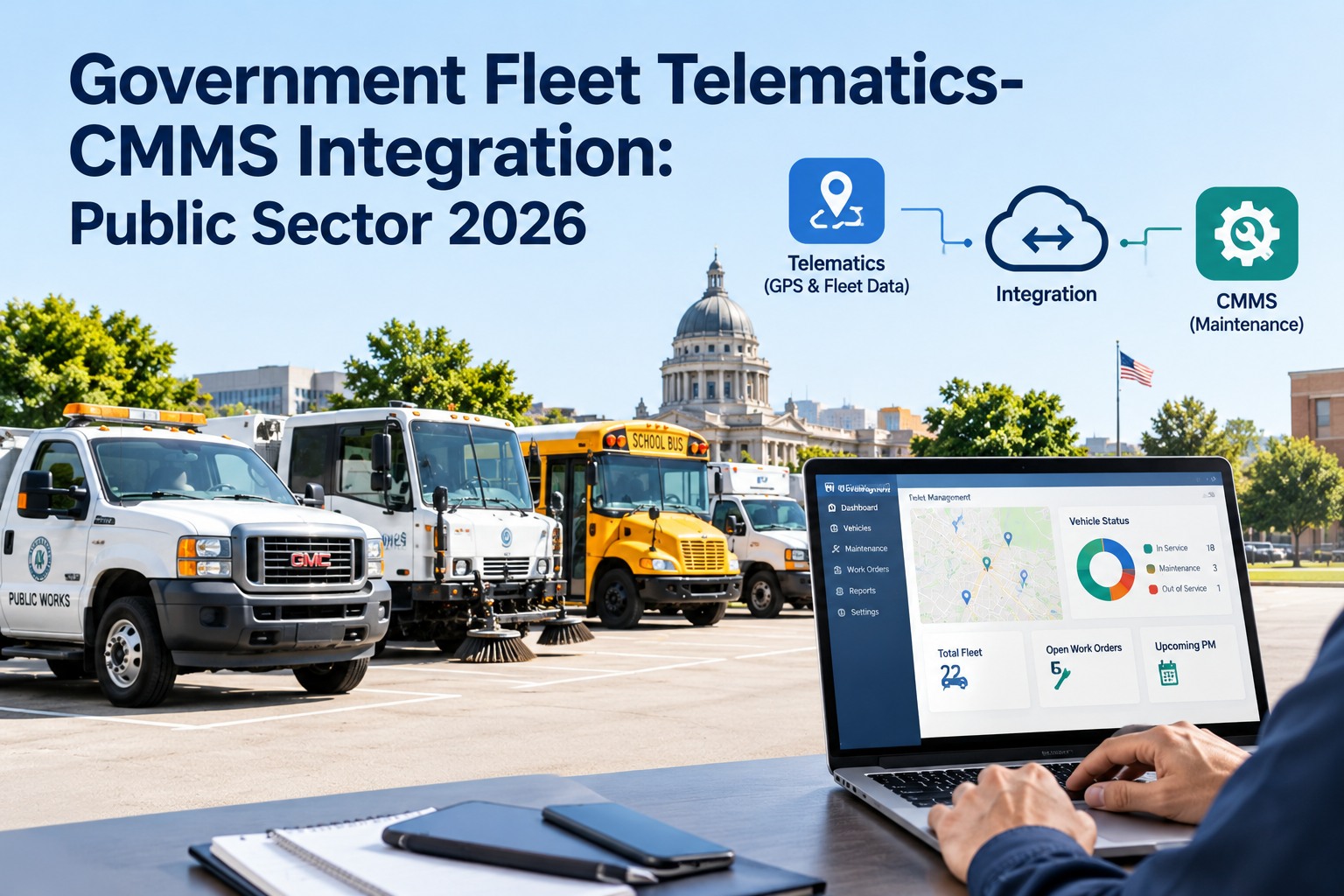
A private fleet that connects its telematics feed to its maintenance system gets fewer breakdowns and lower costs. A government fleet gets all of that — plus something a private fleet never has to think about: the ability to answer to a state auditor, a city council, and a public records request, all from the same data. When a resident files a request asking why a public works truck was running on a Sunday, telematics is both the question and the defense. When a council member asks how a $45,000 engine replacement was justified, the maintenance record is the answer. And when the fleet spans police cruisers, fire apparatus, snowplows, and refuse trucks — each under a different compliance regime — the integration between what a vehicle reports and what a vehicle gets serviced for is what keeps the whole operation defensible. This is the 2026 playbook for connecting telematics and CMMS in the public sector, where the stakes aren't just uptime — they're accountability. Truck Inspection & Maintenance connects driver DVIRs, telematics-driven PM triggers, digital work orders, and audit-ready reporting in one platform built for trucking — sign up free or contact our team.
Government Fleet Telematics–CMMS Integration: The Public Sector 2026 Playbook
Private fleets integrate for uptime. Government fleets integrate for uptime and for the auditor, the council, and the public records request. Same data — three times the accountability.
Why Public Sector Fleets Are a Different Problem
Everything a private fleet manages, a government fleet also manages — under constraints private operators never face. Four of them shape every integration decision:
You Can't Just Buy the Best Tool
Private fleets pick a vendor and sign. Public agencies buy through cooperative contracts — Sourcewell, NASPO ValuePoint, HGAC, GSA — or run a months-long RFP. The integration has to work with whatever the contract vehicle allows, not whatever's ideal.
Every Repair Has to Survive an Auditor
A $45,000 engine replacement needs a date-stamped work order, technician sign-off, parts receipts, and vendor invoice — all linked to the VIN and retrievable in minutes. State auditors and city councils don't accept "we're pretty sure we did the PM."
The Public Can See Everything
Operations are subject to public records requests, council presentations, and budget hearings. When a government vehicle shows up in a story about after-hours personal use, telematics data is both the evidence and the defense — but only if it's tied to the record.
One Fleet, Many Compliance Regimes
Police cars, fire apparatus, plows, refuse trucks, parks equipment — each with its own PM template and rules. Municipal fleets answer to GASB 34, NFPA 1900/1911, DOT/FMCSA, EPA and FTA at once, where a private fleet typically faces DOT and EPA only.
Integration built for the way public fleets actually buy and report. Start a free account and connect your telematics feed to maintenance today.
The Numbers Driving 2026 Adoption
Public-sector fleet technology isn't a slow-moving backwater anymore — the market and the pressure behind it are both accelerating:
Versus 3–5 years for commercial fleets, driven by 18–36 month procurement cycles. Predictive maintenance from connected data isn't optional — it's how you keep aging assets running until replacements finally arrive.
Fleets that unify GPS tracking, maintenance, and fuel into one platform report 30–40% faster reporting with fewer data errors — and cut administrative time on compliance by up to 40%.
Agencies are actively evaluating, buying, and renewing fleet systems right now — fueled by compliance mandates, EV transition planning, public accountability, and legacy systems hitting end-of-life.
The Integration in Four Layers
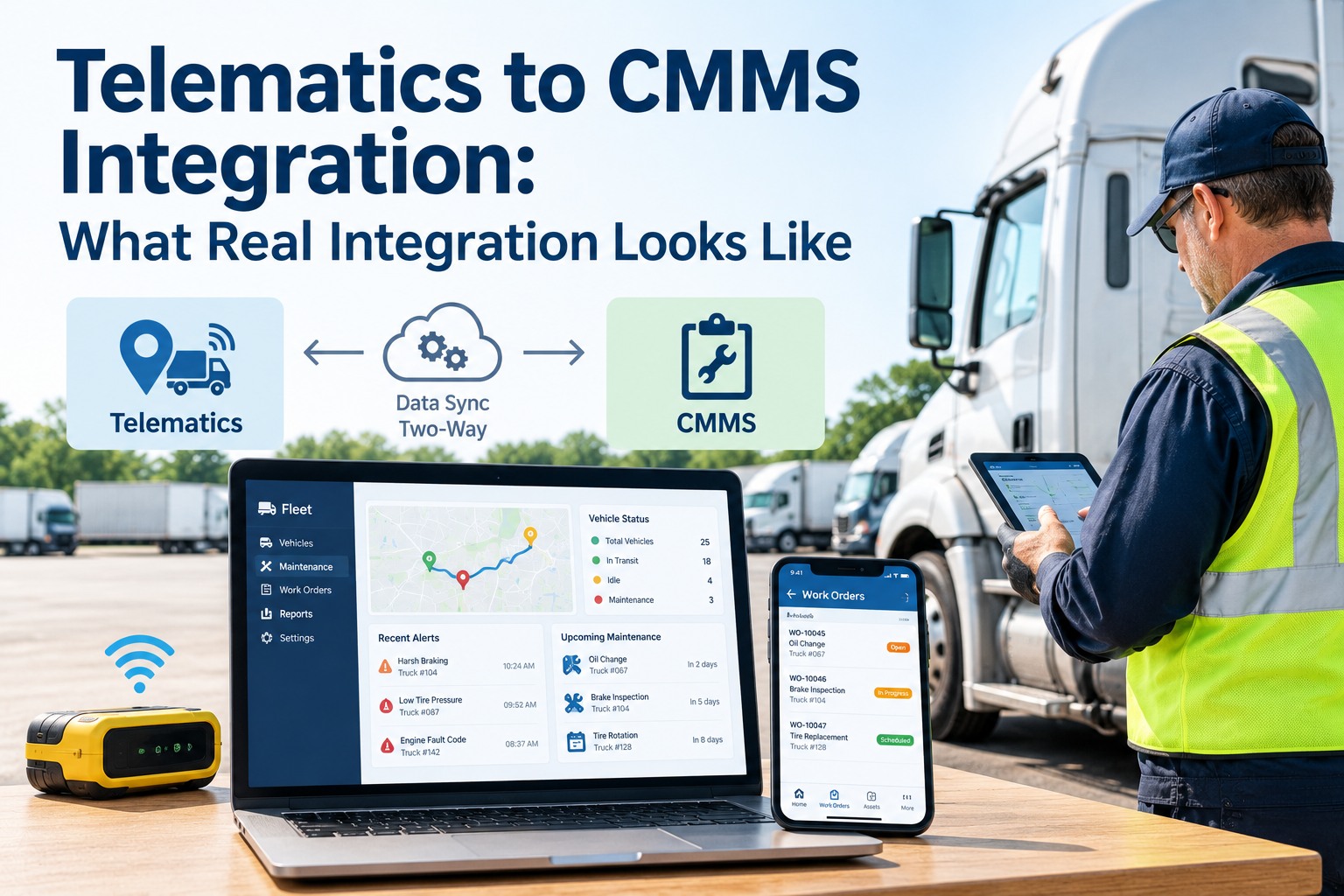
A working telematics–CMMS integration for a public fleet isn't one connection — it's four data flows, each solving a different accountability problem:
PM schedules fire on real usage, not a clipboard estimate. A plow that ran 300 hours in a storm week triggers service on schedule; an admin sedan that barely moved doesn't waste a bay. No manual odometer entry, no drift.
A telematics fault code (low oil life, coolant temp, tire pressure) becomes a work order assigned to the shop automatically — before it becomes a roadside breakdown. This is the link most fleets miss: data that never reaches maintenance is data that only documents the failure after it happens.
Mobile pre- and post-trip inspections carry photos and GPS timestamps, route defects straight to maintenance, and store every record digitally. Roughly 73% of paper DVIRs never reach the office; enforced digital DVIRs reach 100% completion — and that completion is the audit trail.
Cost-per-vehicle, cost-per-department, and total cost of ownership export in audit-ready format for city council, budget hearings, and GASB 34 condition reporting. Fleet managers who present data win budget battles; those without it lose them.
The One Gap That Undoes the Whole Investment — Telematics Data That Never Reaches Maintenance
Plenty of government fleets buy telematics and buy a maintenance system — and never connect them. The GPS platform shows a fault code on one screen; the work order gets written on another, days later, by someone who happened to hear about it. The data existed the whole time; it just never triggered anything. The fix isn't more dashboards — it's a live link where a fault code or a mileage threshold opens a work order on its own, and every action lands in one audit trail. Start a free account and turn telematics signals into scheduled maintenance instead of after-the-fact reports.
Choosing a Procurement Path — The Public Sector Reality
The fastest way to stall a fleet-tech project is to run a full RFP when a cooperative contract already covers it. Here's how the paths compare:
Sourcewell · NASPO · HGAC
Federal / leasing
Custom bid
Not sure which path fits your agency and current contracts? Get in touch for a free 15-minute procurement-fit review.
Turn every mile, engine hour, and fault code into scheduled maintenance — and every repair into a record your auditor and council can read.
Connect telematics to PM triggers, route defects straight to digital work orders, and export cost and condition data in audit-ready format. Free forever for up to 3 vehicles — create your free account or talk to our team.
KPI Dashboard — 5 Metrics That Prove the Integration Works
These five numbers tell you whether the telematics–CMMS link is doing its job — and give you the data to defend the program in a budget hearing:
Share of PM events fired by real usage data, not manual entry. Below 100% means schedules are still drifting on clipboard estimates.
Enforced digital DVIRs vs the ~73% of paper reports that never reach the office. Completion is the audit trail — anything less is a gap.
Telematics fault to open work order. Above 24 hours means signals are being logged, not acted on — the integration isn't live.
Work orders with date stamp, sign-off, parts receipt, and VIN link. This is what survives a state audit or a public records request.
From request to formatted cost/condition export. Days, not weeks — the difference between winning and losing a budget conversation.
Track all five automatically as work flows through the system — create your free account in 10 minutes.
The 5 Integration Mistakes Public Fleets Make Most
Five patterns show up again and again in agencies whose fleet tech never delivers what the budget promised:
Buying Telematics and CMMS Separately, Never Linking Them
Pattern: Two contracts, two dashboards, zero connection. Fault codes sit in one system while work orders get written in another. The data was there — it just never triggered a repair.
Running an RFP a Cooperative Contract Already Covers
Pattern: Months of bid documents for a system available through Sourcewell or NASPO at pre-negotiated rates. The project stalls in committee while aging vehicles keep breaking down.
One PM Template for a Mixed Fleet
Pattern: Fire apparatus, plows, and admin sedans all on the same generic schedule. NFPA-governed apparatus gets treated like a pool car, and a certification lapse surfaces during an audit.
Paper DVIRs in a Public-Records World
Pattern: Inspections on paper that never reach the office. When a records request or incident review arrives, there's no timestamped, photo-backed trail — just a binder with gaps.
Cost Data Trapped Outside the ERP
Pattern: Maintenance cost lives in the fleet system and gets hand-keyed into accounting at year-end. Errors creep in, GASB reporting suffers, and budget requests arrive without defensible numbers.
Frequently Asked Questions
Why do government fleets need telematics–CMMS integration more than private fleets?
Because public fleets answer to auditors, councils, and public records requests on top of uptime. The same connected data that prevents breakdowns also produces the defensible trail — who serviced what, when, and why — that a private fleet is never asked to provide.
How do agencies buy fleet software without a full RFP?
Through cooperative purchasing contracts — Sourcewell, NASPO ValuePoint, HGAC — or GSA schedules for federal fleets. These are competitively solicited, pre-negotiated contracts that let eligible agencies skip a months-long bid while keeping a documented, compliant process.
What does telematics data actually do inside a CMMS?
It drives PM schedules off real mileage and engine hours, turns fault codes into automatic work orders, and feeds cost and usage data into reports. The point is action: data that never reaches maintenance only documents failures instead of preventing them.
How does integration help with GASB and audit requirements?
It links every repair to a VIN with date stamps, sign-offs, and parts receipts, and exports cost and asset-condition data in audit-ready format for ERP and GASB 34 reporting — so a $45,000 repair or a year-end condition report is defensible in minutes, not reconstructed from paper.
Our fleet mixes police, fire, plows, and admin vehicles — can one system handle that?
Yes, if it supports per-asset PM templates and role-based, multi-department access. Each vehicle class carries its own schedule and compliance rules while cost and condition roll up to fleet-wide and department-level reports for leadership.
How does Truck Inspection & Maintenance fit a public-sector fleet?
It connects telematics-driven PM triggers, mobile DVIRs with GPS timestamps, digital work orders, and audit-ready cost and condition exports in one platform built for trucking — so drivers, mechanics, and managers work from the same defensible record. Free forever for up to 3 vehicles — sign up in 10 minutes or contact us.
Uptime for the fleet. Evidence for the auditor. One connected system that serves both — built for the way public agencies actually operate.
Connect telematics to maintenance, route defects to work orders automatically, and hand your council and auditor a defensible record every time. Free forever for up to 3 vehicles — no hardware, no contract, no credit card.