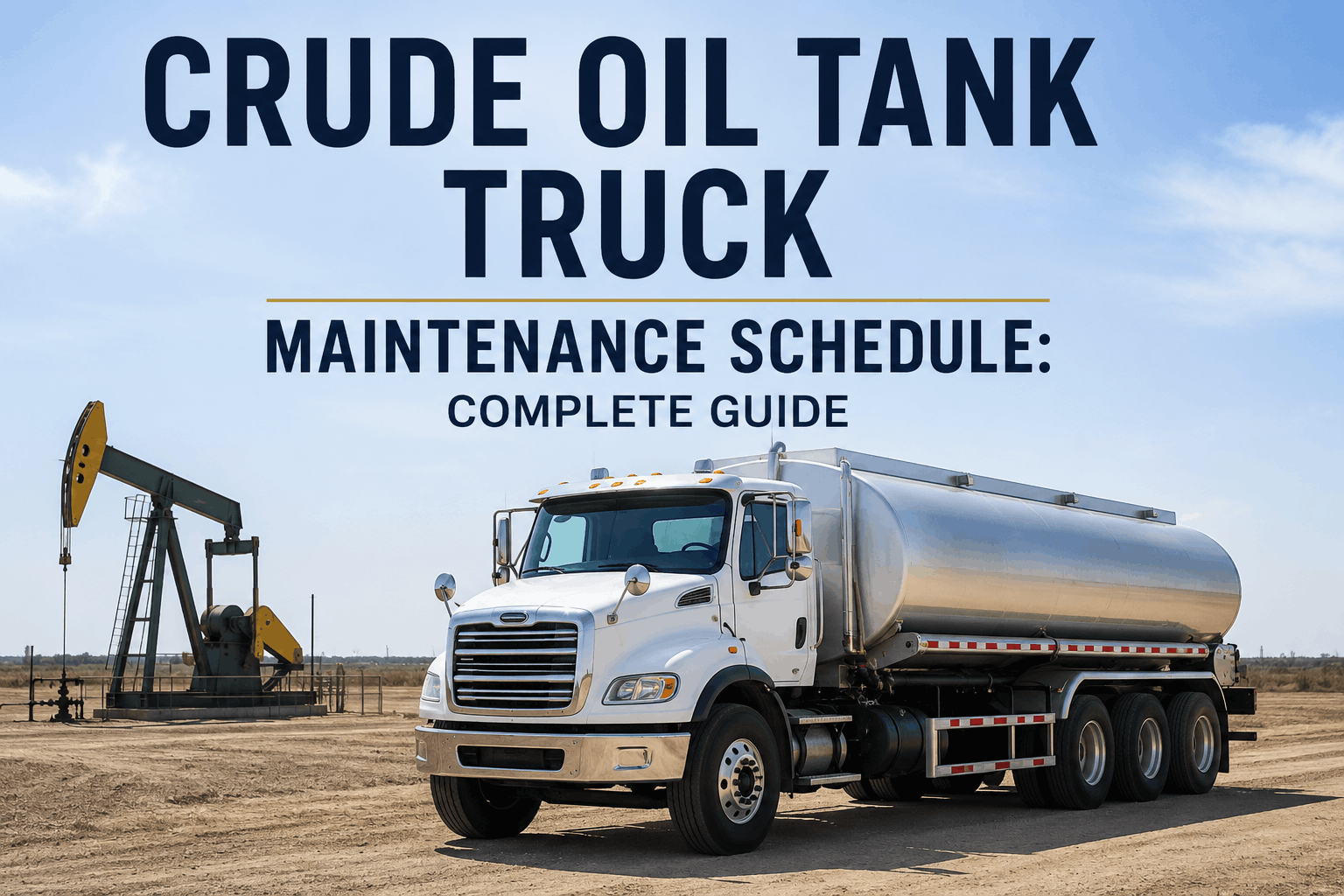
Crude oil tank truck preventive maintenance operates under a regulatory and operational framework distinct from any other commercial truck category. The combination of DOT 406/407 cargo tank specifications, hazardous materials transportation requirements under 49 CFR Parts 171-180, specialized pump systems (vacuum pumps or positive displacement pumps PTO-driven), vapor recovery requirements, static bonding for fire safety per NFPA 385, H2S exposure considerations, and chassis loaded at full GVW for sustained periods produces wear patterns and compliance obligations no generic truck PM template addresses. Major tank manufacturers include Heil, Polar Tank Trailer, Brenner, Stephens, Tremcar, and Dragon Products. Operations cycle 10-20 wellhead-to-station stops daily, accumulating PTO hours, pump cycles, and chassis miles in distinctive patterns. The maintenance economics: structured PM extends crude tank truck service life from 8-12 years to 12-18 years, maintains DOT certification status (single failure can produce 30-90 day operational restriction), prevents environmental incidents (single spill: $50,000-$500,000+ in cleanup and penalties), and protects $200,000-$400,000+ capital investment per unit. Start your free trial of our truck inspection and maintenance software to deploy crude oil tank truck-specific workflow — live in 10 minutes, free for up to 3 trucks.
Crude Oil Tank Truck Maintenance Schedule: Complete Guide
Why Crude Oil Tank Truck PM Is Different
Crude oil tank trucks face regulatory, mechanical, and safety challenges no generic truck PM template captures. Six factors make crude hauler maintenance operationally distinct.
DOT Hazmat Cargo Tank Requirements
Hazardous Materials Transportation
Specialized Pump Systems
Crude Oil-Specific Issues
Fire Safety Requirements
Heavy Loaded Chassis Operation
The 8-System Crude Oil Tank Truck PM Template
Every crude oil tank truck PM cycle covers these 8 systems. The depth varies by interval and crude type, but the categories don't. Contact our sales team for help deploying crude tank truck-specific templates.
01 Cargo Tank
02 Pump System
03 Valve System
04 PTO & Drive Shaft
05 Hose & Connections
06 Vapor Recovery System
07 Static Bonding & Grounding
08 Chassis & DOT Compliance
DOT Tank Inspection Requirements
Crude oil tank trucks operate under specific DOT inspection requirements beyond standard FMCSA compliance. Five inspection categories with regulated intervals must be maintained continuously.
| Inspection Type | Interval | Regulatory Citation | Documentation Required |
|---|---|---|---|
| External visual | Annual | §180.407(c) | Inspection certificate, qualified inspector signature |
| Internal visual | 5 years (DOT 406) / Annual (DOT 407) | §180.407(d) | Internal inspection report, photographs |
| Leakage test | Annual | §180.407(g) | Test results, qualified inspector |
| Pressure test | 5 years | §180.407(e) | Hydrostatic test results, calibration documentation |
| Thickness test | 5 years (DOT 406) / 2 years (lined) | §180.407(i) | Thickness measurements, qualified inspector |
| Annual periodic (chassis) | 12 months | §396.17 | Inspection record, qualified inspector per §396.19 |
DOT tank inspections must be performed by registered inspectors with appropriate qualifications under §180.409. Failed inspections produce immediate operational restriction until corrections are made and re-inspection completed. The economic impact: 30-90 day operational restriction for a single truck typically costs $50,000-$150,000 in lost revenue plus repair and re-certification costs. Compounding factor: certification failure history affects future inspection scrutiny. Operations with structured digital inspection records, advance scheduling of upcoming inspections, and disciplined corrective action workflow consistently pass inspections; operations with paper-based or reactive approaches accumulate certification issues over time. The 2026 environment: increased FMCSA enforcement focus on hazmat operations including crude haulers; CSA scoring overhaul weights out-of-service violations at 2× severity; eDVIR Final Rule (March 23, 2026) authorizes electronic DVIRs.
Common Crude Oil Tank Truck Failures
Six failure categories produce most crude oil tank truck unscheduled downtime. Structured PM addressing these patterns prevents the majority of expensive failures and regulatory issues.
Pump Seal Degradation
PTO Seal Leaks
Valve Failures
Tank Coating Failures
Vapor Recovery System Problems
Hose Damage & Connection Failures
Crude Oil-Specific Compliance Framework
Crude oil tank trucks operate under multiple regulatory frameworks beyond standard FMCSA. Five specific frameworks govern crude hauler operations.
Cargo Tank Specifications
Periodic Tank Inspection
Hazardous Materials Transportation
Tank Vehicle Fire Safety
Environmental Compliance
Frequently Asked Questions
What's the difference between DOT 406 and DOT 407 tank trucks?
DOT 406 and DOT 407 are different cargo tank specifications under 49 CFR Part 178 with different applications. DOT 406: typically used for crude oil, gasoline, fuel oils, and similar petroleum products with low vapor pressure. Operating pressure 3 PSIG. Suction loading typical. Non-pressurized tank with vacuum loading capability. Annual external inspection, 5-year internal inspection, 5-year pressure and thickness tests. DOT 407: used for higher vapor pressure products, hazardous chemicals, food products, and some specialized applications. Operating pressures up to 35 PSIG. Pressure loading and unloading. More frequent internal inspections (annual rather than 5-year). Higher construction standards for the higher pressure rating. Crude oil tank trucks predominantly use DOT 406 specification given low vapor pressure of crude oil. Some specialized applications including heated crude or specific chemical operations may use DOT 407. The selection drives inspection requirements, operational procedures, and capital cost. New crude tank purchases typically default to DOT 406 unless specific operational requirements justify DOT 407 specifications. Software platforms supporting crude tank operations must track specification status, inspection requirements per specification, and certification renewal scheduling. Start your free trial for DOT certification tracking workflow.
How often do crude oil tank trucks need PM service?
Crude oil tank truck PM cadence runs on multi-trigger logic combining chassis miles, PTO hours, pump cycles, and calendar. Daily pre-trip inspection: each operator, hazmat-compliant walkaround, pump operation test, hose visual, valve verification, bonding/grounding check. Sub-10-minute workflow typical. Weekly: detailed pump inspection, hose condition assessment, valve operation test, sub-frame mounting check. Monthly: PTO service and seal inspection (most common failure point), pump performance verification, comprehensive tank exterior inspection. Quarterly: hydraulic fluid analysis, comprehensive 8-system inspection, vapor recovery system function test. Semi-annual: hose pressure testing, valve functional testing, pump rebuild evaluation. Annual: external tank inspection per §180.407(c), leakage test per §180.407(g), pump major service, comprehensive 8-system service. 5-year: internal tank inspection per §180.407(d), pressure test per §180.407(e), thickness test per §180.407(i). Critical principles: DOT tank inspections cannot be delayed without operational restriction; annual external inspection is non-negotiable; pump and PTO service intervals based on operating hours rather than chassis mileage. Operations relying on mileage-based scheduling consistently under-service pump and PTO components.
What does crude oil tank truck PM cost?
Annual PM costs for crude oil tank trucks typically range $8,000-$18,000 per truck depending on operation intensity, age, and condition. Cost breakdown: routine PM service (oil changes, filters, lubrication) — $2,500-$5,000 annually based on hours and miles. Tank inspections: annual external $300-$800, 5-year internal $1,500-$4,000, pressure test $1,000-$3,000, thickness test $500-$1,500. DOT annual periodic inspection: $200-$500. Pump service: minor service $500-$1,500 annually, major rebuild every 3-5 years $3,000-$8,000. Hose replacement: $1,500-$5,000 annually depending on usage. Valve maintenance: $500-$2,000 annually. Hazmat compliance documentation and training: $500-$1,500. Vapor recovery system maintenance: $300-$1,200. Catastrophic repair avoidance is the key economic justification: single avoided spill incident ($50K-$500K+), single avoided pump catastrophic failure ($3K-$12K+), single avoided tank coating failure ($50K-$150K) each individually justifies years of structured PM service. Software platform cost typically $30-$80 per truck monthly is trivial compared to single avoided major incident. Contact our sales team for crude tank PM cost analysis.
What happens if my crude tank truck fails a DOT inspection?
DOT inspection failure consequences vary by inspection type and severity of findings. Annual external inspection failure (§180.407(c)): cargo tank cannot be used for hazmat transport until deficiencies corrected and re-inspection completed. Typical impact: 7-30 day operational restriction. Re-inspection cost typically $300-$800 plus repair costs. Leakage test failure (§180.407(g)): same operational restriction; failures often indicate valve or seal issues requiring repair. Internal inspection failure (§180.407(d)): more substantial repairs typically required; 30-90 day operational restriction common; repair costs $2,000-$25,000+ depending on findings. Pressure test failure (§180.407(e)): indicates significant tank issues; often requires major repair or tank replacement; 60-180 day restriction. Thickness test failure (§180.407(i)): often indicates approaching end-of-life for tank; may require tank replacement; $50,000-$150,000+ capital expenditure for tank replacement. Annual periodic inspection failure (§396.17): chassis-related, typically simpler repairs, shorter restriction period. Economic impact of operational restriction: single truck producing $300-$500 per operating day typically loses $9,000-$45,000 in revenue during 30-90 day restriction plus repair costs. Beyond direct cost: future inspection scrutiny increases following failures; insurance premiums may increase; customer contracts may be affected. The defense pattern: structured digital tracking of all inspection due dates with 60-day advance alerts; disciplined corrective action workflow; preventive replacement of components approaching end-of-life rather than waiting for failure. Sign up free for DOT inspection tracking workflow.
Do crude oil tank trucks need special driver training?
Yes — multiple training requirements apply to crude oil tank truck operators beyond standard CDL training. CDL with Hazmat (H) and Tank (N) endorsements required for operating crude tank trucks. Hazmat endorsement requires: completion of TSA security background check, written knowledge test, recertification every 4-5 years per state regulations. Tank endorsement requires: written knowledge test, demonstrated competency. HM training under 49 CFR §172.704: required every 3 years, covers general awareness/familiarization, function-specific training, safety training, security training, and in-depth security training where applicable. Documentation of training must be maintained for 3 years after training. H2S awareness training: industry-specific training for hydrogen sulfide exposure prevention and response. Often included in petroleum industry training programs. NFPA 385 training: bonding/grounding procedures, fire safety, vapor recovery, emergency response. Some operations require additional specialized training: site-specific safety orientation at customer locations, defensive driving for tanker operations (rollover prevention), emergency response training (ERT). Driver qualifications must be maintained in DQF per Part 391 with hazmat-specific elements documented. Common compliance gaps: expired hazmat endorsements, missing HM training documentation, incomplete site-specific training records. Software platforms should track all training expirations with advance alerts. Talk to our sales team for hazmat driver compliance workflow.
How do I extend crude oil tank truck service life?
Three practices most effectively extend crude oil tank truck service life from typical 8-12 years to 12-18+ years. (1) Disciplined DOT certification maintenance: maintain all required inspections proactively rather than reactively; address minor findings before they become certification failures; replace components approaching end-of-life through preventive replacement rather than failure-driven replacement. Single avoided catastrophic certification failure ($50K-$150K for tank replacement) pays for years of structured maintenance discipline. (2) Pump and PTO service discipline: PTO seals and pump seals are the most common failure precursors. Monthly inspection, quarterly performance verification, and proactive seal replacement at first sign of weeping prevent the catastrophic failures that produce both equipment damage and operational disruption. Single avoided pump failure ($3K-$12K) typically pays for years of disciplined pump service. (3) Crude oil-specific maintenance: paraffin and wax management through regular tank cleaning, BS&W contamination handling per operating procedures, H2S exposure protection both for personnel and for equipment in sour service applications, sand abrasion mitigation through pump design and maintenance practices. Industry-specific knowledge applied consistently extends equipment life substantially. The economics overwhelmingly justify structured maintenance investment for crude oil operations: single avoided major incident (catastrophic failure, environmental spill, regulatory citation) pays for years of platform and maintenance investment. The 2026 environment increases the importance: heightened FMCSA enforcement focus on hazmat operations, increased environmental enforcement, and growing scrutiny from customers requiring documented safety compliance.