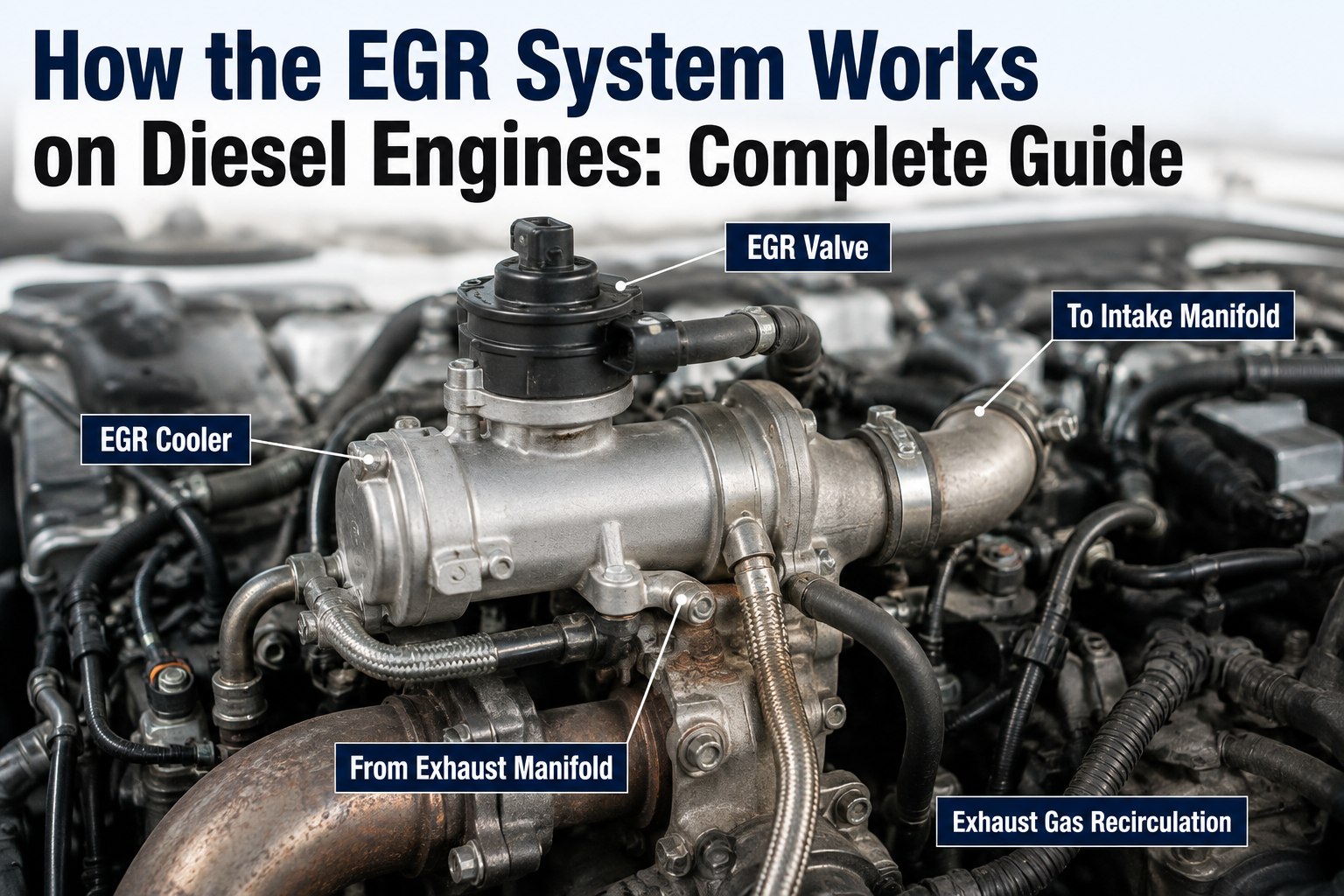
An EGR system does something that sounds backwards: it takes exhaust gas the engine just produced and feeds part of it back into the intake to be breathed in again. There's a precise reason for it. Nitrogen oxides — the regulated pollutant behind smog and acid rain — form in proportion to how hot the burn gets, and recirculated exhaust is inert. Mixing it back into the intake displaces some oxygen and cools the combustion, which cuts NOx at the source before it's ever created. It's an elegant trade-off, and it comes with a cost that hits diesels especially hard: the same exhaust that cools the burn carries soot, and on a diesel that soot builds into a sticky sludge that slowly chokes the whole system. This guide covers how the recirculation loop works, why the valve opens and closes when it does, why diesels clog far faster than gas engines, the failure modes and their codes, and how diesel fleet maintenance software keeps EGR problems from becoming derates and downtime.
Diesel Engine Guide · EGR System Explained · 2026
How the EGR System Works on Diesel Engines
Why an engine breathes its own exhaust, how the recirculation loop lowers NOx, and why soot makes the diesel EGR the component most likely to choke.
NOx
The pollutant EGR exists to reduce at the source
Cooler
Lower combustion temperature means less NOx
Soot
The number-one cause of diesel EGR problems
+ SCR
EGR and SCR share the NOx-reduction workload
What the EGR System Actually Does
The whole system exists to solve one chemistry problem. NOx forms when combustion gets very hot and oxygen is plentiful — exactly the conditions inside a hard-working diesel cylinder. EGR attacks both halves of that equation:
It cools the burn
Exhaust gas has already combusted, so it's inert — it absorbs heat without adding to the fire. Mixed back into the intake charge, it brings peak cylinder temperature down.
It displaces oxygen
The recirculated gas carries little oxygen, so it dilutes the fresh air charge. Less available oxygen at lower temperature means dramatically less NOx forms in the first place.
It works at the source
Rather than cleaning NOx out of the exhaust after the fact, EGR prevents much of it from ever forming — which is why it remains central to diesel emissions control.
A useful way to picture it: the engine is being made to inhale part of its own exhale. That sounds like it should hurt performance, and if it happened at the wrong moment it would — which is exactly why the valve is a precisely controlled gate rather than an open pipe. The whole art of the system is admitting just enough exhaust, only when the engine can spare the oxygen.
The Recirculation Loop
On a diesel, the recirculated gas takes a specific path — and the cooler in the middle is what separates a diesel system from a simpler gasoline one:
Exhaust manifold
A portion of hot exhaust gas is tapped from the exhaust stream as it leaves the cylinders.
EGR valve
The ECU-controlled valve meters exactly how much exhaust is allowed through, opening and closing based on engine conditions.
EGR cooler
On diesels, the hot gas passes through a coolant-fed heat exchanger that drops its temperature — a cooler charge reduces NOx even further.
Intake manifold
The cooled exhaust rejoins the fresh air charge in the intake, ready to be drawn into the cylinders on the next cycle.
Combustion
The diluted, cooler charge burns at a lower peak temperature, producing far less NOx than pure air would.
When the Valve Opens — and When It Closes
The valve is not simply on or off. The ECU commands it constantly based on what the engine is doing, because exhaust is helpful in some conditions and harmful in others:
Steady cruise & light-to-moderate throttle
When the engine is loafing along and doesn't need every bit of oxygen for power, the valve opens to admit exhaust and suppress NOx. This is where EGR does most of its work.
Idle, cold start & hard acceleration
At idle and cold start the engine needs stable combustion; under heavy acceleration or wide-open throttle it needs maximum oxygen for power. In all of these the valve closes so exhaust doesn't get in the way.
Why Diesels Clog Far Faster
Every EGR system deals with some carbon, but diesels face the problem on a different scale. It comes down to what diesel exhaust is carrying:
Heavy soot load
Diesel combustion produces far more particulate matter than gasoline. The recirculated exhaust carries that dry soot straight back into the intake.
Oil vapor
The intake also receives oil mist from the crankcase ventilation system, drifting in alongside the recirculated gas.
Sticky carbon sludge
Dry soot plus oil mist turns into a thick, tacky deposit that coats the valve, cooler, intake elbow, and manifold — slowly choking off flow.
Why the buildup accelerates for some trucks: where a gasoline engine might carbon up noticeably only after well over 100,000 miles, a diesel can clog far sooner — and frequent short trips, heavy towing, and stop-and-go city driving all speed it up. Those duty cycles keep the valve working while never letting the system run hot and clean the way sustained highway driving does. A diesel EGR problem often feels less like a sudden break and more like the engine slowly being strangled.
The Five Ways an EGR Valve Fails
Understanding which failure you're dealing with tells you what to expect and whether the valve can be saved:
Stuck closed
Too little exhaust gets through. Combustion temperature climbs, NOx rises, and the SCR and NOx sensor system sets fault codes. Cylinder temps can spike enough to cause knocking and, over time, internal damage.
Stuck open
Exhaust flows when it shouldn't — including at idle and acceleration. The result is rough idle, hesitation, stalling, weak low-end power, and smoke as the engine is starved of clean air at the wrong moments.
Sensor fault
The integrated position sensor stops reporting accurately, so the ECU can no longer tell where the valve actually is. That leads to incorrect control and logged fault entries.
Actuator fault
The valve stops responding to commands. It may deliver too much or too little EGR regardless of what the ECU asks, often dropping the engine into limp-home mode to protect itself.
Physical damage
The pintle or diaphragm becomes stuck, bent, or broken from heat and vibration. Once mechanically damaged, the valve almost always needs replacement rather than cleaning.
Symptoms and Trouble Codes
The system announces trouble through drivability changes and, if you scan it, a small family of related codes:
What you'll notice
Rough idle and a flat spot or hesitation on pull-away
Stalling and weak low-end power under load
Increased fuel consumption
Black smoke, or a knocking and pinging sound under load
Check-engine light and failed emissions testing
Insufficient EGR flow — typically a valve stuck closed or a passage clogged with carbon.
Excessive EGR flow — usually a valve stuck open or leaking exhaust into the intake.
Range or performance fault — the valve position or control circuit isn't behaving as commanded.
Free · Up to 3 Vehicles
Catch EGR trouble before it becomes a derate
Diesel fleet maintenance software logs fault codes, tracks recurring EGR symptoms per truck, and schedules preventive intake cleaning on the intervals that keep soot from winning — so a slow-clogging valve surfaces as a work order instead of a roadside limp-home event. Full service history stays attached to the engine, so patterns across the fleet become visible. Sign up free for up to 3 vehicles and get ahead of emissions-system faults.
Two things to get right before you spend money
White smoke can mean a cracked EGR cooler leaking coolant into the intake — but don't assume it. Check coolant level and pressure and inspect the valve and intake first, because not every white-smoke complaint is a failed cooler. And deleting or tampering with the EGR system is illegal on any on-road vehicle and carries real penalties. For a street-driven, emissions-certified truck the only correct path is diagnosis, cleaning, repair, or a compliant replacement that preserves the certified emissions system.
Clean It or Replace It?
Not every EGR fault means a new part. The deciding question is whether the valve is merely dirty or actually damaged:
Carboned but sound
If the valve is clogged with a moderate amount of carbon but remains mechanically and electronically healthy, a thorough clean with dedicated EGR cleaner and a brush can restore it. Cleaning the surrounding intake matters as much as the valve itself.
Cracked, failed, or worn
A cracked housing, failed electronics, a stuck or broken pintle, or severe wear all call for replacement — cleaning won't fix a valve that's mechanically or electrically gone. On heavy-duty diesels, parts and labor run well above light-vehicle figures.
EGR and SCR Work as a Team
On a modern diesel, EGR doesn't fight NOx alone — it splits the job with the selective catalytic reduction system, and the way they share the load has a direct maintenance benefit:
EGR handles the low end
Exhaust recirculation is most effective at low engine loads, where it suppresses NOx before it forms by keeping the burn cool.
SCR handles the high end
At higher loads and speeds, the SCR catalyst's conversion efficiency improves, so it takes over more of the NOx reduction downstream.
Together they clog less
Leaning on SCR at higher loads means the EGR valve doesn't have to open as far or as often — which slows carbon accumulation and extends the intervals between cleanings.
Driving habits are part of the maintenance plan: because sustained higher-temperature operation helps keep the system clear, regular highway running naturally fights buildup, while a life of short trips and idling encourages it. Routine intake inspection and periodic cleaning handle the rest — and catching a slow-clogging valve early is far cheaper than replacing a cooler, a valve, and cleaning a manifold full of sludge all at once.
Frequently Asked Questions
What does the EGR system do?
It recirculates a small, metered amount of exhaust gas back into the engine's intake to lower combustion temperature and cut nitrogen oxide (NOx) emissions. Because exhaust gas is inert and carries little oxygen, mixing it into the intake charge cools the burn and dilutes the oxygen — and since NOx forms in proportion to combustion heat, a cooler burn produces far less of it. On diesels the gas is routed through a cooler first to drop its temperature even further.
Why do diesel EGR systems clog so often?
Soot. Diesel combustion produces far more particulate matter than gasoline, and that dry soot mixes with oil vapor from the crankcase ventilation system to form a sticky carbon sludge that coats the valve, cooler, and intake. Where a gasoline engine might carbon up only after well over 100,000 miles, a diesel can clog much sooner — especially with frequent short trips, heavy towing, or city driving. Contact our team about scheduling preventive intake service.
What are the symptoms of a bad EGR valve?
Rough idle, hesitation or a flat spot on acceleration, stalling, weak low-end power, increased fuel consumption, and a check-engine light are the common ones. A valve stuck open tends to cause rough running and smoke, while one stuck closed raises combustion temperature and can cause knocking or pinging under load. Scanning usually reveals codes like P0401 for insufficient flow, P0402 for excessive flow, or P0404 for a range or performance fault.
Can an EGR valve be cleaned instead of replaced?
Often, yes — if the valve is clogged with carbon but still mechanically and electronically sound, a thorough cleaning with dedicated EGR cleaner can bring it back. But a valve with a cracked housing, failed electronics, a stuck or broken pintle, or severe wear needs replacement, because cleaning can't fix physical or electrical damage. Cleaning the surrounding intake elbow and manifold matters too, since the sludge isn't confined to the valve.
Does white smoke mean the EGR cooler failed?
It can — a cracked or internally leaking EGR cooler allows coolant into the intake or exhaust, which produces white smoke along with possible misfires. But don't assume it. Check coolant level and system pressure and inspect the valve and intake first, because not every white-smoke complaint is a failed cooler. Confirming the actual source before replacing an expensive part saves both money and downtime.
Can I just delete the EGR system?
No. Deleting or tampering with the EGR system is illegal on any vehicle operated on public roads and carries real legal penalties, and it will fail inspection. For a street-driven, emissions-certified truck the correct path is always diagnosis, cleaning, repair, or a compliant replacement that preserves the certified emissions system. Keeping the EGR healthy through preventive maintenance is both the legal route and the cheaper one over the life of the truck. Sign up free to track emissions-system maintenance.
Stay Ahead of the Soot
Keep the EGR clean and the truck out of limp mode.
Diesel fleet maintenance software tracks fault codes, flags recurring EGR symptoms per vehicle, and schedules the preventive intake cleaning that keeps carbon from choking the system into a derate. The full emissions-system history stays attached to each engine, so a slow-building problem gets caught as a planned job instead of a roadside failure. Free for up to 3 vehicles. Works with your existing fleet, no contracts.