The DVIR is the most-audited compliance document in commercial trucking — and the most-misunderstood. Federal Motor Carrier Safety Administration data shows that fewer than 7% of motor carriers pass a focused compliance review without at least one DVIR violation. The penalties stack quickly: $1,270 per day for missed DVIRs, $12,700 for falsifications, $15,420 per unrepaired defect, and up to $23,048 per out-of-service dispatch event. Yet most fleet managers cannot answer basic questions like "do I need a DVIR every day or only when defects exist?" or "what happens during a multi-day trip away from the home terminal?" or "can one DVIR cover a tractor-trailer combination?" The rulebook isn't actually complicated — it's just spread across §396.11, §396.13, §390.32, §392.7, and dozens of FMCSA interpretive Q&A documents that most fleets never read.
The 2026 regulatory landscape just simplified one thing while complicating another. FMCSA's final rule under docket FMCSA-2025-0115, effective March 23, 2026, explicitly authorizes fully electronic DVIRs in §396.11 and §396.13 — confirming what carriers practiced under §390.32 since 2018 and removing the last regulatory ambiguity about going paperless. At the same time, the CSA SMS update split Vehicle Maintenance into two BASIC compliance categories, meaning DVIR violations now show up in two red columns instead of one during your safety rating. The cost of getting DVIR rules wrong has roughly doubled in 2026 — even as the path to compliance got dramatically easier.
This guide is the visual rulebook fleet managers need: the complete DVIR lifecycle from creation to retention, the official FMCSA Q&A interpretations, the 11 mandatory inspection components, and the 2026 eDVIR final rule. Start your free trial to deploy DVIR compliance automatically across your fleet — live in 10 minutes.
Driver Vehicle Inspection Report Requirements: Complete Overview
The complete 2026 DVIR rulebook in plain English — every rule, every exemption, every official FMCSA Q&A interpretation, the new eDVIR final rule, and the visual lifecycle from creation to retention.
Quick Answer: DVIR Requirements at a Glance
DVIRs are required under 49 CFR §396.11 from drivers operating commercial motor vehicles ≥10,001 lbs GVWR, designed for ≥9 passengers, or hazmat-placarded — at the completion of every workday. Property-carrying CMVs require DVIRs only when defects are discovered (since the 2014 rule change); passenger-carrying CMVs require daily DVIRs regardless of defect status. The carrier must repair any reported defect before re-dispatching the vehicle, and the next driver must review and acknowledge the certification under §396.13. Records retained 3 months minimum. As of March 23, 2026, FMCSA's final rule (docket FMCSA-2025-0115) explicitly authorizes fully electronic DVIRs. Single-vehicle owner-operators running one tractor-semitrailer/full-trailer combination are exempt; multi-vehicle carriers must comply with the full chain of custody.
The DVIR Lifecycle — From Shift End to Audit-Ready Record
Every compliant DVIR follows the same five-stage lifecycle. Break the chain at any stage and the entire compliance framework collapses. Here's the visual journey from driver completion to permanent retention. Contact our sales team for a lifecycle audit against your current DVIR process.
The 11 Mandatory Component Categories
Every DVIR must cover exactly these 11 component categories — established by §396.11 and harmonized with the §392.7 pre-trip inspection list in the 2014 rulemaking. Any defect affecting safe operation in any of these areas must be documented.
Who Must Do DVIRs — Required vs Exempt
The DVIR requirement applies to specific vehicle classes and operations. Knowing where the line falls is critical — many fleets either over-burden drivers with unnecessary paperwork or exempt themselves from a requirement that legally applies. Sign up free to configure DVIR requirements by vehicle type automatically.
The Frequency Decision Tree
The "completion of each day's work" language in §396.11 generates more interpretation questions than any other phrase in the regulation. Use this decision tree to determine exactly how many DVIRs you need per shift, per trip, and per equipment combination.
Official FMCSA Q&A Interpretations
FMCSA publishes interpretive Q&A guidance to clarify §396.11 application in real-world scenarios. These are the eight most-cited interpretations every fleet manager should know. Contact our sales team for help applying these interpretations to your specific operation.
The 2026 eDVIR Final Rule — What Changed
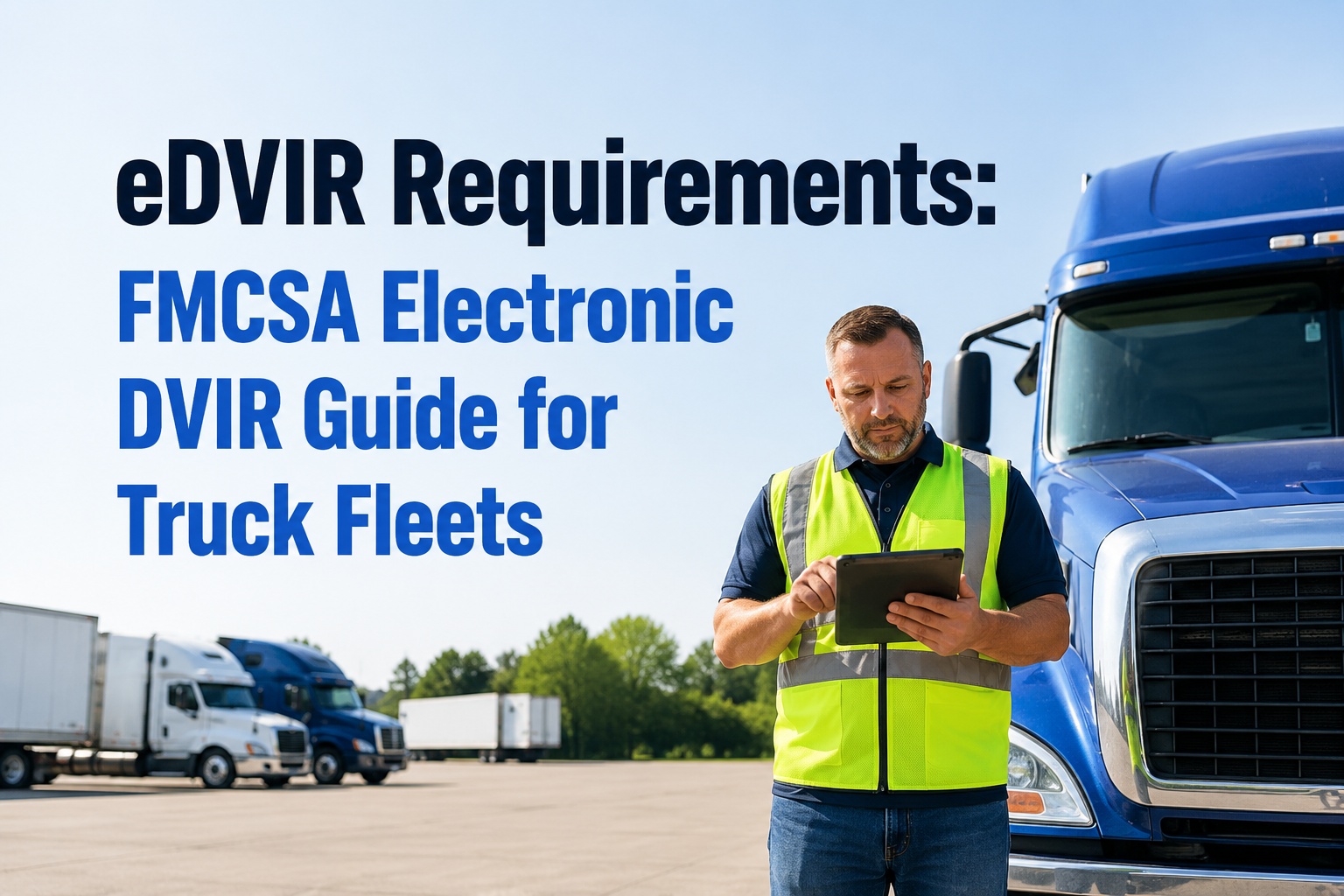
FMCSA's final rule under docket FMCSA-2025-0115, effective March 23, 2026, modernizes §396.11 and §396.13 by adding explicit electronic DVIR authorization. While eDVIRs have been compliant under §390.32's general electronic recordkeeping authority since 2018, this 2026 rule eliminates remaining regulatory ambiguity for carriers still running paper.
Penalty Math — The Cost of Non-Compliance
The cost of getting DVIR rules wrong has roughly doubled in 2026. Each violation type stacks separately during an audit — a fleet with paper gaps across 50 trucks can face cumulative penalties exceeding $100,000 in a single review.
Frequently Asked Questions
No — not since the 2014 FMCSA rule change. Property-carrying CMVs only require a DVIR when the driver discovers or is made aware of a safety-affecting defect during the day's work. If no defects exist, no DVIR is required (though many carriers still require daily DVIRs as company policy). Passenger-carrying CMVs still require daily DVIRs regardless of defect status. Start your free trial to track defect-triggered vs daily-required DVIRs by vehicle type.
§396.11 governs the post-trip DVIR — the written report drivers prepare at end of shift listing safety-affecting defects. §396.13 governs the pre-trip review — the next driver's responsibility to review the previous DVIR, verify repairs, and acknowledge before operating. Together they form the three-signature chain of custody: driver reports → carrier certifies repair → next driver acknowledges. Audit findings often involve breakdowns at the §396.13 review step.
No. FMCSA's interpretive Q&A guidance is explicit: any type of DVIR may be used as long as it contains required information and signatures. This includes paper forms (J.J. Keller, custom carrier forms), ELD-integrated DVIR modules, mobile apps, or even a blank sheet. The format is flexible; the required information and signatures are not. Contact our sales team for pre-loaded FMCSA-compliant digital templates.
The carrier must retain the original DVIR, repair certification, and driver acknowledgment for at least 3 months from report date — per §396.11(c)(2). FMCSA's Q&A clarified that retention applies only to the original copy retained by the motor carrier, not the legible copy carried on the vehicle. Best practice in 2026: digital retention permanently with cloud-based backup, exported instantly during any FMCSA review.
It depends on whether trailers stay coupled or get dropped. A single tractor-trailer combination can be covered by one DVIR (FMCSA Q&A 5). But if the driver pulls multiple trailers across the day — drop-and-hook operations — each dropped trailer requires its own DVIR. Same for multiple power units: each operated tractor needs its own DVIR (Q&A 3). Sign up free to track per-vehicle DVIRs across drop-and-hook fleets.
Yes — fully compliant. Electronic DVIRs have been permissible under §390.32 since 2018, and FMCSA's final rule FMCSA-2025-0115 (effective March 23, 2026) makes the authorization explicit in §396.11 and §396.13. Electronic creation, signatures, mobile submission, cloud retention, and roadside production via digital device are all explicitly compliant. The American Trucking Associations, OOIDA, and the National Tank Truck Carriers all supported the rulemaking.
Enforce Every §396.11 Rule Automatically
500+ fleets digitize §396.11 + §396.13 with full FMCSA Q&A compliance built in: home-terminal submission logic, per-vehicle DVIR enforcement, repair certification routing, next-driver acknowledgment, 3-month retention exceeded, and audit packets exported in seconds. The 2026 standard for DVIR compliance.