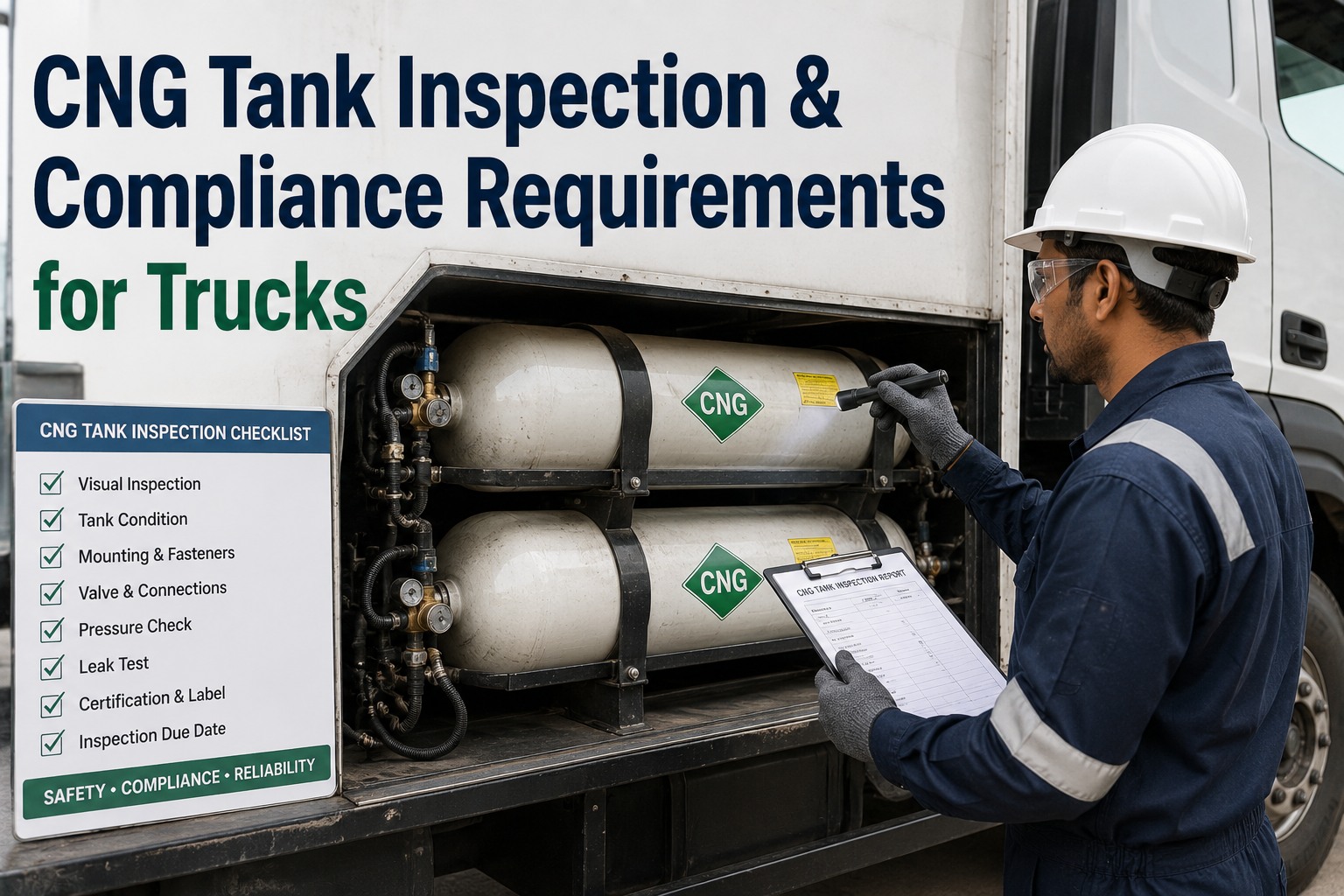
A CNG tank stores natural gas at 3,000–3,600 PSI — pressures that turn a hairline crack into a catastrophic rupture. That's why the Federal Motor Vehicle Safety Standard (FMVSS 304), NFPA 52, and CGA C-6.4 don't treat CNG cylinders like ordinary fuel tanks. They mandate a specific inspection cadence, qualified inspectors, and hard end-of-life dates that most conventional fleet maintenance programs simply aren't built to track. As of March 2023, FMVSS 304 requires every heavy-duty CNG vehicle (GVWR 10,000+ lbs) to have its cylinders inspected at least once every 12 months — a tightening from the previous 3-year/36,000-mile interval that had become impractical for fleets covering 100,000+ miles annually. This guide walks through the current inspection requirements, the visual defect criteria that pass and fail a tank, the end-of-life rules that ground vehicles, and how our Truck Inspection & Maintenance software keeps CNG cylinder compliance auditable across your fleet. Prefer a walkthrough? Reach out to our support team.
CNG Tank Inspection & Compliance Requirements for Commercial Trucks
3,600 PSI of stored energy. 12-month inspection windows. 15–20 year end-of-life caps. Miss any of these and a compliant fleet becomes a liability overnight — here's the complete regulatory picture.
The 4 Regulatory Standards You Must Know
CNG compliance sits on a stack of four interlocking standards. Understanding what each one covers — and which one governs your fleet — is the starting point for any inspection program.
Federal Vehicle Safety Standard
Sets the baseline federal requirement for CNG fuel container integrity. Governs cylinder labeling, inspection interval, and post-incident inspection triggers. Enforced by NHTSA.
Motor Carrier Safety Regulation
FMCSA regulation that directly requires commercial CNG containers to conform to FMVSS 304 labeling and inspection requirements. This is the rule DOT enforces at roadside.
Vehicular Fuel Systems Code
National Fire Protection Association code covering CNG fuel system installation, inspection, and maintenance. Adopted into law in 20+ states as the enforceable standard.
External Visual Inspection Methods
Compressed Gas Association's technical inspection methodology — the reference protocol for the detailed visual inspection procedure that qualified inspectors follow.
The 4 Levels of CNG Inspection
Not every "inspection" is the same. Four distinct levels exist, each with different scope, qualifications, and cadence. Missing any level breaks the compliance chain.
- Visible damage to fuel system components
- Dents, cuts, scrapes on accessible surfaces
- Leak indicators or fuel odor
- Bracket integrity from ground level
- Cylinder mounting brackets secure
- Shielding intact and undamaged
- Visible cylinder surface for damage
- Valve and fitting integrity
- 360-degree view of every cylinder
- Access panels removed if needed
- Per CGA C-6.4 protocol
- Documented pass/fail per cylinder
- Required regardless of visible damage
- Thermal event triggers PRD check
- Cylinder may require retirement
- Documented before return to service
The FMVSS 304 Inspection Interval — Post-2023
The 2023 update to FMVSS 304 substantially tightened the inspection cadence for heavy-duty vehicles. Here's the current requirement, plainly stated.
What a Detailed Visual Inspection Actually Checks
The Level 3 DVI is the inspection that keeps your fleet legal. Here's what a qualified inspector actually looks at during that annual sign-off.
End-of-Life: The Rule That Grounds Vehicles
Unlike diesel tanks, CNG cylinders have a hard expiration date. When they hit end-of-life, they must be removed from service. Period.
The EOL Rules That Matter
Track every CNG cylinder's clock automatically
Manufacture date, EOL date, inspection history, and next-due alert — logged per cylinder against the vehicle record.
Damage Classification: What Passes, What Fails
Not every scratch fails a cylinder. CGA C-6.4 defines specific damage categories with pass/fail thresholds. Here's how inspectors classify what they find.
Minor Cosmetic
Moderate Damage
Serious Damage
The Compliance Records DOT Wants to See
Under audit, a DOT inspector will ask specifically for these CNG-related records. Missing any of them is a compliance failure regardless of your actual tank condition.
What "Non-Compliant" Actually Costs
CNG cylinder violations are not typical fleet compliance issues. They carry higher penalties and higher liability exposure because of the safety consequences of failure.
Building a Compliant CNG Program
A compliant CNG program isn't complicated — it just has more moving parts than a diesel program. Here's the operating rhythm that keeps you audit-ready.
Frequently Asked Questions
For heavy-duty vehicles above 10,000 lbs GVWR, at least every 12 months — regardless of mileage, per the 2023 update to FMVSS 304. For light-duty CNG vehicles under 10,000 lbs, the legacy 3-year / 36,000-mile interval still applies. All cylinders require additional inspection after any accident, fire, or over-pressure event.
Four standards apply: FMVSS 304 (federal baseline), FMCSR 393.68 (FMCSA enforcement), NFPA 52 (state-adopted code in 20+ states), and CGA C-6.4 (technical inspection methodology). Manufacturer instructions take priority when they're more stringent than the standards.
CNG cylinder service life varies by type: Type 1 (all-steel) typically 20 years, Type 2 (metal-lined hoop-wrap) 15–20 years, Type 3 (metal-lined full-wrap) 15 years, Type 4 (full composite) 15–20 years. The exact end-of-life date is set by the manufacturer and stamped on the cylinder label.
No. Unlike some other pressure vessels, CNG vehicle cylinders past their manufacturer-defined end-of-life cannot be re-qualified and returned to service. They must be safely removed from the vehicle and destroyed per proper disposal procedures.
A CNG fuel system inspector qualified per CGA C-6.4 or manufacturer training program. Detailed Visual Inspections (Level 3) require this qualification. Driver-level daily checks and monthly intermediate inspections can be performed by trained maintenance personnel without the full DVI qualification.
The cylinder must be removed from service immediately. Depending on the failure category, it may be monitored under a reduced-interval re-inspection plan (Level 2 damage) or permanently retired (Level 3 damage or expired end-of-life). The vehicle cannot be returned to service with the failed cylinder still in place.
Make CNG compliance auditable across your fleet
Per-cylinder record tracking. Manufacture date and EOL date stored per tank. Inspection interval alerts fired automatically. DVI reports archived by VIN and cylinder serial. Post-incident inspection triggers built in. Everything a DOT auditor could ask for — one click away.