The Driver Vehicle Inspection Report under 49 CFR §396.11 is one of the most-violated and most-misunderstood compliance documents in commercial trucking. FMCSA estimates proper DVIRs prevent approximately 14,000 accidents every year — yet only 7% of motor carriers pass a focused compliance review without a single DVIR violation. The penalties are real and accumulating: up to $1,270 per day for failure to complete a required DVIR, up to $12,700 for falsifying a DVIR to hide a safety defect, and up to $15,420 for failing to repair a reported safety defect. And those numbers compound across multiple findings during a single audit.
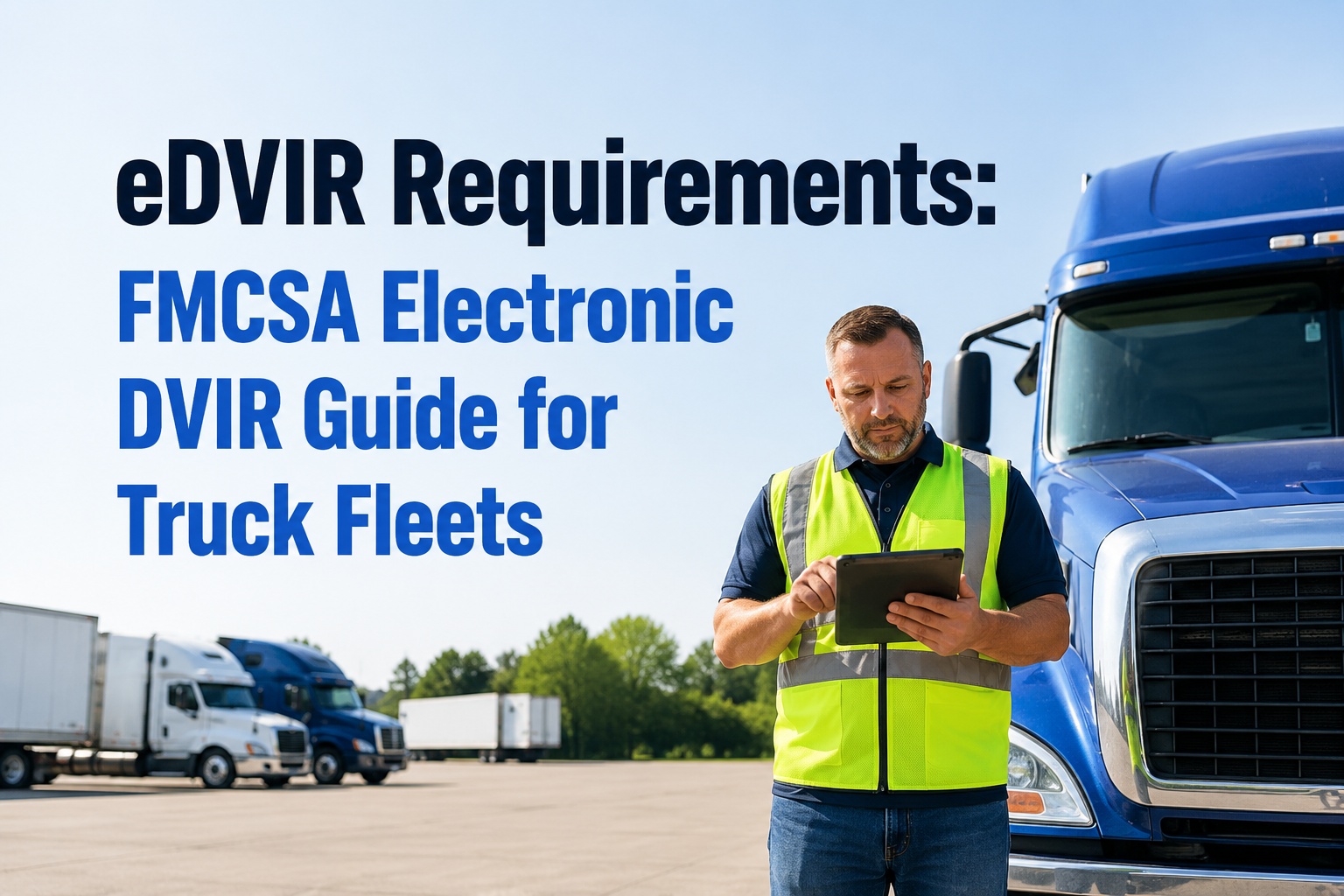
The 2026 regulatory landscape just shifted. On March 23, 2026, FMCSA's final rule (docket FMCSA-2025-0115) explicitly authorized fully electronic DVIRs in §396.11 and §396.13 — making eDVIRs not just permitted under the older §390.32 electronic recordkeeping rule, but officially endorsed. Carriers still running paper DVIRs in 2026 are working twice as hard for half the audit-readiness, with photo evidence, GPS timestamps, and three-signature chain-of-custody automation all available in modern eDVIR platforms. The shift from paper to digital isn't optional anymore — it's the new compliance baseline.
This guide gives you the complete §396.11 DVIR checklist library: all 11 mandatory federal categories, the 57-item expanded checklist (14 trailer + 43 truck/tractor), the three-signature chain of custody, retention requirements, and the 2026 eDVIR authorization update. Start your free trial to deploy fully-compliant eDVIRs across your fleet from drivers' phones in under 10 minutes.
Driver Vehicle Inspection Report Checklist Under § 396.11
Every component, every signature, every retention rule — the complete 2026 DVIR checklist library aligned to FMCSA §396.11 and the new eDVIR authorization. Plus the penalty math fleet managers need to know.
Quick Answer: What Is a DVIR Under §396.11?
A Driver Vehicle Inspection Report (DVIR) under 49 CFR §396.11 is a written report each commercial motor vehicle driver must prepare at the completion of every day's work, documenting the condition of 11 specified component categories: service brakes (including trailer brake connections), parking brake, steering, lighting and reflectors, tires, horn, windshield wipers, mirrors, coupling devices, wheels and rims, and emergency equipment. Any defect affecting safe operation or likely to cause breakdown must be documented. The carrier must repair the defect and certify the repair before next dispatch, the next driver must review and acknowledge the DVIR before operating, and all three signatures (driver report, repair certification, next-driver acknowledgment) must be retained for at least 3 months. As of March 23, 2026, FMCSA's final rule (FMCSA-2025-0115) explicitly authorizes fully electronic DVIRs.
The 11 Mandatory §396.11 Categories
FMCSA specifies exactly these 11 component categories that every DVIR must cover. The 2014 rulemaking harmonized these with the §392.7 pre-trip inspection list, so drivers cover the same components morning and evening. Any defect affecting safe operation in any of these areas must be documented. Contact our sales team to deploy these 11 categories as a digital workflow on your drivers' phones.
Truck/Tractor DVIR — 43 Inspection Items
Here's the expanded checklist drivers actually walk through during a thorough DVIR. These 43 items map back to the 11 federal categories but give technicians and drivers the granular component-level coverage that catches real defects.
Trailer DVIR — 14 Inspection Items
Trailers operate as separate equipment under §396.11. Drivers must report defects on every trailer operated during the day — even if hooked to the same tractor across multiple shifts. Brake connection issues at the trailer are among the most-cited DVIR violations during roadside inspections.
The 3-Signature Chain of Custody
The most-cited DVIR audit failure isn't missing the report — it's missing one of the three required signatures. §396.11 and §396.13 work together to create a continuous accountability chain: driver reports the defect, mechanic certifies the repair, next driver acknowledges before operating. Break any link and the carrier is in violation. Sign up free to enforce all three signatures automatically before vehicles can be re-dispatched.
Penalties: The Real Cost of DVIR Violations
FMCSA's DVIR-related penalties are tiered by severity. Each violation type stacks separately during an audit — a fleet with paper DVIR gaps across 50 trucks can face cumulative penalties exceeding $100,000 in a single review.
Retention Requirements & The 2026 eDVIR Update
The carrier must retain the original DVIR, the certification of repairs, and the certification of the driver's review for at least 3 months from the report date. Best practice in 2026: digital retention permanently, with audit-ready packets retrievable in seconds. Talk to our sales team for digital retention compliance built into the platform.
When DVIRs Are NOT Required (the 2014 Exception)
The 2014 FMCSA rulemaking removed the no-defect DVIR requirement for property-carrying CMVs — a major reduction in paperwork for the trucking industry. Here's exactly when DVIRs are and aren't required in 2026.
Important note: Many carriers require daily DVIRs as company policy regardless of defects. The §396.11 minimum is just that — a minimum. Best practice is daily DVIRs on every commercial vehicle, every shift, defects or not.
Frequently Asked Questions
A pre-trip inspection under §392.7 is the physical act of checking the vehicle before driving — no written report required by federal law. A DVIR under §396.11 is the written report submitted at the end of the workday documenting defects found. Pre-trip is the physical inspection; DVIR is the documentation. They cover the same 11 component categories but serve different regulatory purposes at different times of day. They work together: the previous driver's DVIR feeds into the next driver's pre-trip review under §396.13. Start your free trial to digitize both.
Yes — fully compliant. Electronic DVIRs have been permissible under 49 CFR §390.32 since 2018, and FMCSA's final rule FMCSA-2025-0115 (effective March 23, 2026) explicitly authorizes eDVIRs in §396.11 and §396.13. Digital signatures, cloud storage, mobile submission, and electronic retention are all compliant. eDVIRs are now preferred by carriers because they improve accuracy, capture rate, photo evidence, GPS verification, and produce audit packets in seconds that paper systems cannot match.
Three signatures form the §396.11 / §396.13 chain of custody: (1) the driver who prepared the report at end of shift, (2) the carrier official or qualified mechanic who certifies repairs are complete (or unnecessary), and (3) the next driver who reviews the previous DVIR and acknowledges before operating the vehicle. Missing any one of these three signatures during an audit is a violation. Contact our sales team to enforce 3-signature chain of custody automatically.
FMCSA requires carriers to retain DVIRs and the related repair certifications for at least 3 months from the report date. Best practice in 2026: digital retention permanently. Lost or unproduced DVIRs during an audit become automatic compliance findings — the inability to produce a DVIR is treated the same as not having created one. Cloud-based eDVIR platforms make permanent retention free and produce audit packets in seconds.
Yes — §396.11 requires a DVIR for each vehicle operated during the workday. If a driver pulls 3 different trailers across multiple shifts, that's 3 separate trailer DVIRs in addition to the tractor DVIR. Trailer brake connection issues are among the most-cited roadside violations, making per-trailer DVIRs critical for compliance. Sign up free to track per-trailer DVIRs across your entire fleet automatically.
The carrier must determine whether the defect affects safe operation. If yes: the vehicle cannot be dispatched until the defect is repaired and certified by a qualified mechanic OR carrier official, and the next driver reviews and acknowledges the certification before operating. If the defect doesn't affect safe operation: it must still be documented and addressed but does not block dispatch. Either way, the entire chain of documentation must be retained for 3 months and must reconcile cleanly during any audit.
Run §396.11 DVIRs from Drivers' Phones — Live in 10 Minutes
Photo-evidenced DVIRs, GPS-stamped submissions, automatic 3-signature chain of custody enforcement, defect-to-work-order auto-routing, and audit-ready packets exported in seconds. The 2026 standard for DVIR compliance — without paper, lost forms, or three-day audit prep marathons.