Every night, a fleet manager running electric trucks faces a question diesel never asked: will every vehicle have enough charge by dawn to cover its route — without the electricity bill exploding? Because with EVs, the hard part isn't plugging in. It's energy management. Plug forty trucks in at 5 PM and your facility's power demand spikes, dragging demand charges that can swallow the majority of your electricity bill. Charge them all overnight in the wrong window and you pay peak rates. Miss a charger fault and a truck isn't ready for dispatch — a missed route, not a maintenance ticket. The fleets that make EVs work treat charging as a scheduling and energy problem, shifting load into cheap off-peak hours, balancing demand across the depot, and guaranteeing every vehicle is ready at departure. This guide covers the demand-charge trap, the overnight charging window, the smart-charging capability stack, and why charger uptime is the new downtime — plus how fleet management software ties charging, energy, and vehicle readiness together.
Fleet Electrification Guide · EV Charging · 2026
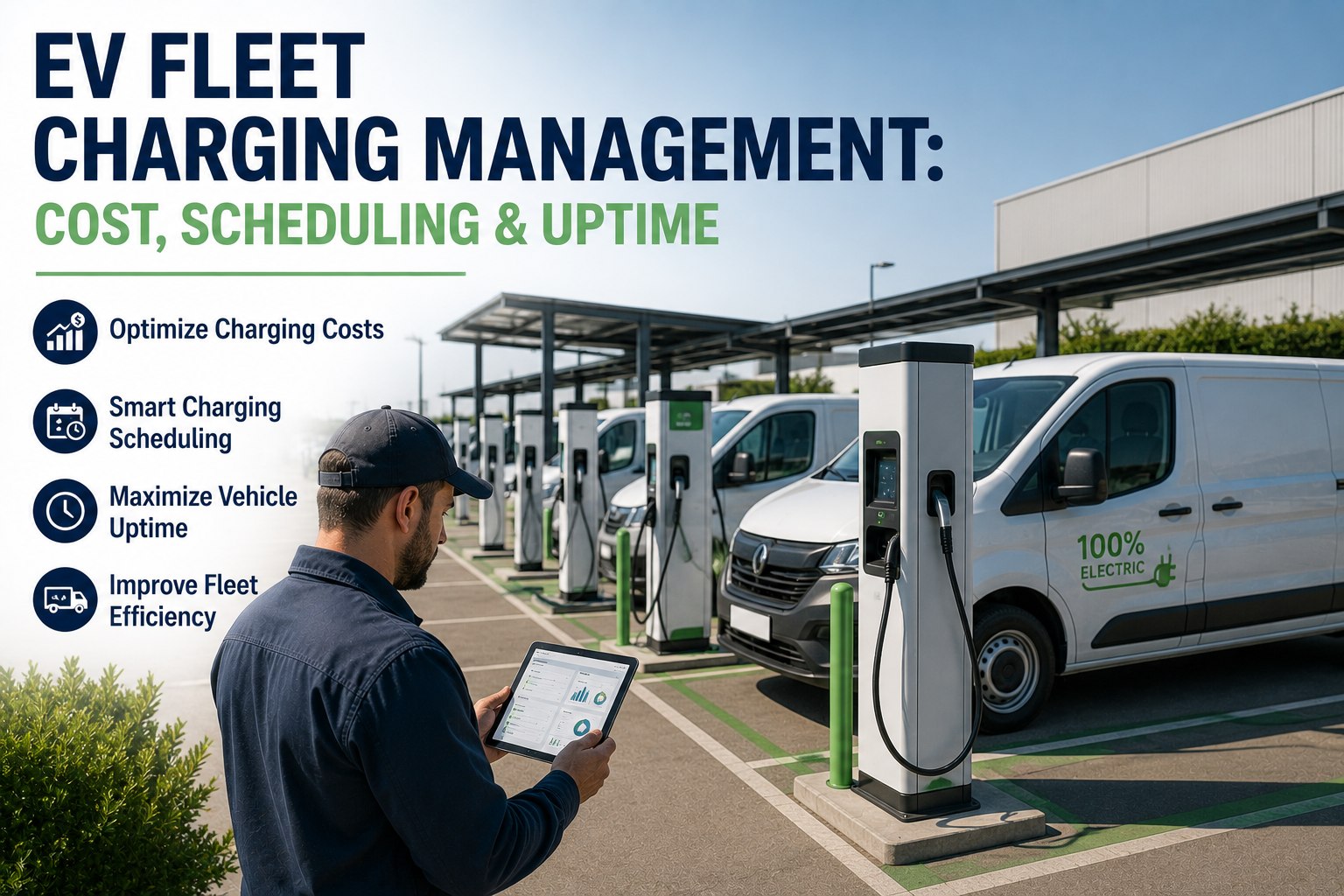
EV Fleet Charging Management: Cost, Scheduling & Uptime
Why running electric trucks is an energy-and-scheduling challenge, not a plug-and-forget one — and how smart charging turns overnight chaos into predictable cost and readiness.
200-900
kWh per heavy EV battery — a building's worth of power
68-81%
Of electricity cost demand charges can consume
Up to 40%
Electricity cost cut with smart charging
99%+
Departure-readiness rate managed charging targets
Why EV Charging Isn't Just Plugging In
The real challenge is making sure every vehicle has enough energy before its next route — while avoiding charger conflicts, demand spikes, and unnecessary cost. That takes coordinating three layers that a diesel fleet never had to think about together:
Vehicle operations
Routes, departure times, vehicle priority, and driver assignments — what each truck needs and when it has to leave.
Charging infrastructure
Charger status, connector availability, faults, and active sessions — which ports are working and free right now.
Energy management
Site capacity, load balancing, electricity tariffs, and peak-demand control — the power budget everything must fit inside.
The whole game is connecting these three: a total kWh number tells you almost nothing. Knowing that truck 12 leaves at 5 AM needing 80% charge, that only six ports are free, and that the site can't exceed its demand ceiling — and turning that into a schedule — is what separates a working EV depot from a runaway electricity bill.
The Demand Charge Problem
This is the cost trap that catches almost every new EV fleet. Electricity bills aren't just about kilowatt-hours consumed — they're heavily driven by your peak demand, the highest instantaneous power you pull. And nothing spikes peak demand like a whole fleet plugging in at once:
Everyone plugs in at 5 PM
Forty trucks hit the chargers simultaneously as drivers clock out. Site demand spikes to its daily maximum — during peak-rate hours — and demand charges balloon to consume the majority of the bill.
Charging spread through the night
The same trucks charge in a staggered schedule across off-peak hours, never exceeding a set site ceiling. Peak demand stays flat and low — and each vehicle is still full by departure.
The scale of the problem: a majority of fleet operators report demand charges consuming a huge share of their electricity costs — as much as 68-81% — when charging is left unmanaged. Flattening that peak with load balancing is where 40-60% demand-charge reductions come from, and it's the single biggest lever in EV charging economics.
The Overnight Charging Window
The foundation of affordable depot charging is simple in principle: fill the batteries during the cheapest hours, and finish exactly when each truck needs to leave. The window looks like this:
Peak rates
Highest electricity price. Avoid charging here unless a route demands a midday top-up.
Off-peak window
The cheap hours. Shifting the bulk of charging here cuts energy cost per mile dramatically.
Departure-ready
Charging completes timed to each truck's departure, at the target charge its route needs.
Why timing to departure matters: the goal isn't just "charge overnight" — it's to calculate the latest possible start time for each vehicle to reach its target charge exactly at departure. That keeps batteries fresh, maximizes off-peak usage, and shifting around 80% of charging load into off-peak windows can cut energy cost per mile by 35-55% versus unmanaged daytime charging.
Free · Up to 3 Vehicles
Make every truck ready by dawn — for less
Fleet management software connects departure times, charger availability, and your site's demand ceiling into one schedule — shifting charging into off-peak hours, balancing load across ports, and confirming every vehicle hits its target charge before it rolls out. One dashboard shows EV battery health beside the rest of your fleet. Sign up free for up to 3 vehicles and take control of your charging costs.
Smart Charging: The Capability Stack
Smart charging isn't one feature — it's a stack of capabilities, each building on the last. Together they turn a row of chargers into a managed energy system:
Time-of-use optimization
Automatically schedule charging into the lowest-cost electricity periods, avoiding peak-rate hours entirely where routes allow.
Departure scheduling
Coordinate each session to complete at the vehicle's planned departure time and required state of charge — no earlier, no later.
Load balancing
Distribute demand across available ports so no moment spikes the site's power draw, spreading the same energy over more time.
Demand-ceiling enforcement
A hard maximum site load the system never exceeds — no matter how many vehicles are plugged in at once. The guardrail on your bill.
The Power Scale Reality
It's worth being blunt about the numbers, because underestimating them is the most expensive EV-fleet mistake. Heavy vehicles draw serious power, and a depot full of them is an industrial electrical load:
A single truck battery
Heavy EV batteries run 200-600+ kWh, with Class 8 trucks reaching 600-900 kWh — a battery that draws as much power charging as an entire big-box store.
A fast charger
A DC fast charger at 150-350 kW pulls the same power as a commercial building. One Class 8 truck at 350 kW can draw more than a 30-van delivery depot combined.
A whole depot
Ten heavy machines charging at once can require 1-3.5 MW — a small industrial facility. A 20-bus depot overnight can hit 3 MW, needing a dedicated substation.
The costly modeling mistake: the common error is multiplying vehicle count by charger kilowatt rating and assuming that's your required service capacity. It usually isn't — but getting it wrong leads to an undersized transformer that can cost six figures to upgrade after installation. Smart scheduling reduces the peak you actually need to provision for, which is exactly why it saves on infrastructure, not just energy.
Charger Uptime Is the New Downtime
With a diesel truck, the vehicle is the asset you maintain. With an EV fleet, the chargers become critical infrastructure too — and a dead charger is a truck that can't roll:
Chargers are maintained assets
Each charging port needs its own PM: connector inspection, thermal checks, and firmware updates. Register them like any other asset with a schedule.
A fault is a missed route
An unnoticed charger fault overnight means a vehicle isn't ready at dawn. Charger status monitoring turns that from a morning surprise into an overnight alert.
Utilization is money
Idle or underused chargers are stranded capital. Smart scheduling has been shown to lift charger utilization by around 38% by keeping ports working through the night.
Avoid vendor lock-in
Using open, standards-based chargers keeps you free to switch management software over your infrastructure's 10-15 year life, rather than being trapped in one network.
EV Maintenance & the Incentive Landscape
The good news on the vehicle side: EVs shed a lot of diesel's maintenance burden. But the picture shifted on incentives in 2025, so plan on current reality, not last year's:
Lower vehicle maintenance
No oil changes, no DEF, no DPF, no complex emissions aftertreatment, and fewer moving parts mean electric trucks cut a large slice of routine diesel maintenance. The trade-off is that battery health and charging hardware become the things to monitor — and optimized charging can extend battery lifespan 20-30%.
Incentives shifted in 2025
Federal clean-vehicle tax credits ended in late 2025, but many state and utility programs remain active — California's heavy-duty voucher program offers up to $60,000 per truck, with New York, Colorado, Oregon, and Washington running fleet programs, plus utility make-ready rebates. Always verify current eligibility with your state energy office and a tax advisor.
Frequently Asked Questions
What is EV fleet charging management?
It's the practice of coordinating when and how a fleet of electric vehicles charges — connecting vehicle routes and departure times, charger availability, and your site's energy limits into a single schedule. The aim is to make sure every vehicle has enough charge for its next route while minimizing electricity cost and avoiding demand spikes. It's fundamentally an energy-and-scheduling discipline, not just plugging vehicles in.
What are demand charges and why do they matter?
Demand charges are utility fees based on the highest instantaneous power your site draws, not just total energy used. When a whole fleet plugs in at once, that peak spikes — and demand charges can consume a large majority of an unmanaged EV depot's electricity bill. Load balancing and staggered scheduling flatten that peak, which is where much of smart charging's savings come from. Contact our team to see your charging cost picture.
How much can smart charging actually save?
Consistently reported results are significant: up to a 40% reduction in total electricity costs, 40-60% lower demand charges through load balancing, and a 35-55% cut in energy cost per mile when roughly 80% of charging shifts into off-peak windows. On top of that, optimized charging can extend battery lifespan 20-30% and lift charger utilization. The savings compound as the fleet grows.
How much power does a depot actually need?
More than most expect, and the load calculation is where fleets go wrong. Heavy EV batteries are 200-900 kWh, a single DC fast charger can draw as much as a commercial building, and a depot charging ten-plus heavy vehicles can require multiple megawatts. The classic mistake is assuming required capacity equals vehicle count times charger rating — which leads to undersized, expensive-to-upgrade infrastructure. Smart scheduling lowers the peak you must provision for.
Do electric trucks need less maintenance?
On the vehicle itself, generally yes — no oil changes, no DEF or DPF systems, and far fewer moving parts than a diesel drivetrain remove a big chunk of routine maintenance. But the focus shifts: battery state of health becomes a key metric, and the charging hardware becomes critical infrastructure needing its own preventive maintenance — connector inspections, thermal checks, and firmware updates.
Why is charger uptime so important?
Because a charger that fails overnight means a vehicle that isn't ready for its route in the morning — an operational failure, not just a maintenance one. Treating chargers as monitored assets, with status alerts and scheduled PM, is what keeps a hardware fault from becoming a missed dispatch. In an EV fleet, charger reliability is as central to uptime as the trucks themselves. Sign up free to track chargers and vehicles together.
Charged, Ready, and Cost-Controlled
Turn overnight charging into a schedule you can trust.
Fleet management software coordinates departure times, charger status, and site demand limits into one plan — shifting charging off-peak, balancing load to kill demand spikes, monitoring battery health and charger uptime, and guaranteeing every truck is ready at dawn. One dashboard for EVs and the rest of your fleet. Free for up to 3 vehicles. Works with your existing chargers and telematics, no contracts.