The first question every FMCSA auditor asks: produce these specific records, right now. The 48-hour window between an audit notice and the deadline to deliver complete records is when fleets discover whether their compliance program actually works. And the answer for most is uncomfortable. Driver Qualification File violations alone account for nearly 17% of all FMCSA violations recorded — over 62,000 DQF-related citations in the past five years, with a single missing document averaging $7,000+ in fines. Operating a vehicle under an out-of-service order tied to documentation failure runs $23,048 per occurrence. Missing records by themselves are penalized at $1,584 per day, per record. The 2026 CSA scoring overhaul made this worse: the new methodology weights out-of-service violations at 2× severity, split Vehicle Maintenance into two BASIC categories, and uses a 24-month violation window — meaning the FMCSA-minimum 3-month DVIR retention period is dangerously short for CSA purposes alone.
This is where "7-year retention" became the industry-standard best practice — not because FMCSA explicitly mandates seven years for everything, but because no single retention period covers all the overlapping requirements that affect fleet operators. FMCSA itself requires different periods for different documents: DVIRs are 3 months minimum under §396.11, annual periodic inspections 14 months under §396.21, driver qualification files employment plus 3 years under §391.51(d), drug and alcohol testing records 1-5 years under §382.401, hours of service 6 months under §395.8, accident registers 3 years under §390.15. Layered on top: IRS tax records (typically 7 years), insurance claim documentation (often 7+ years for litigation defense), state workers' compensation requirements, and CSA's 24-month violation window. The fleets that get audited cleanly aren't tracking 11 different retention clocks — they're retaining everything digitally for 7 years (or permanently) and eliminating the question entirely.
This guide explains the actual FMCSA retention requirements record-by-record, why 7-year unified retention has become the operational standard, the penalty framework for compliance failures, and the digital workflow that makes the 48-hour audit production window a 48-second task. Start your free trial of our truck inspection and maintenance software to deploy cloud-based record retention with audit-ready exports — live in 10 minutes, free for up to 3 trucks.
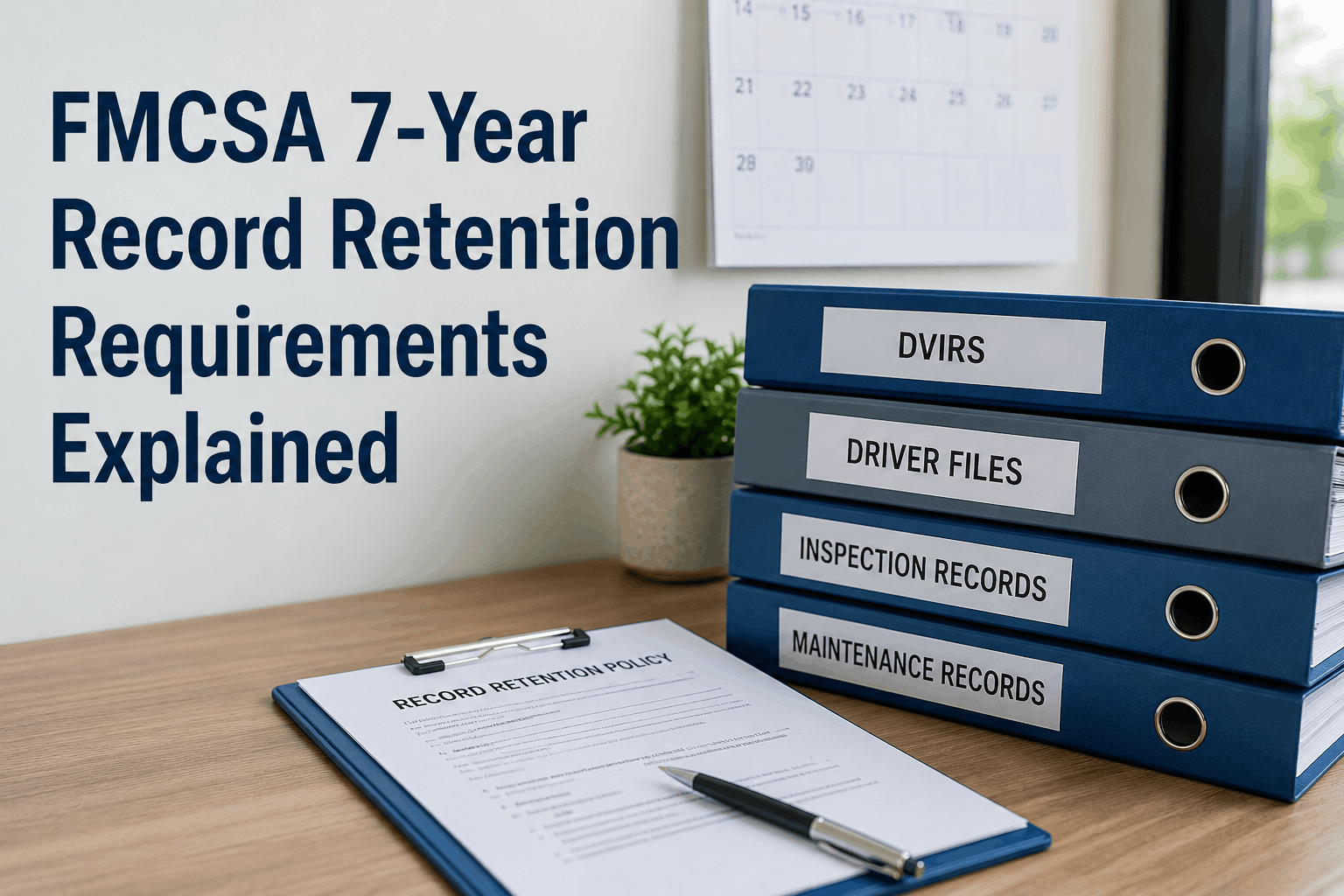
FMCSA 7-Year Record Retention Requirements Explained
The Actual FMCSA Retention Periods — Record by Record
FMCSA retention requirements vary dramatically by document type. Here's every major record category, the specific regulation, and the minimum retention period. Contact our sales team for help deploying audit-ready retention workflows.
| Record Type | Citation | Retention Period |
|---|---|---|
| DVIRs & repair certifications | 49 CFR §396.11 | 3 months minimum |
| Annual periodic inspections | 49 CFR §396.21 | 14 months |
| Roadside inspection reports | 49 CFR §396.9 | 12 months |
| Driver Qualification Files | 49 CFR §391.51(d) | Employment + 3 years |
| Drug & alcohol testing records | 49 CFR §382.401 | 1-5 years by type |
| Hours of Service / ELD records | 49 CFR §395.8 | 6 months |
| Accident register | 49 CFR §390.15 | 3 years |
| Maintenance records | 49 CFR §396.3 | Service life + 6 months |
| Inspector qualifications | 49 CFR §396.19 | Employment + 1 year |
| Safety Performance History | 49 CFR §391.23 | Employment + 3 years |
| Medical Examiner Certificate | 49 CFR §391.43 | Duration of employment |
Note the CSA gap: FMCSA requires 3-month DVIR retention under §396.11, but CSA scoring uses a 24-month violation window. Retaining DVIRs only for the FMCSA minimum leaves you unable to defend against CSA violations from months 4-24. Industry best practice: 12-24 month DVIR retention at minimum, permanent cloud retention as the safe default.
Why "7-Year Retention" Became the Operational Standard
The 7-year unified retention policy didn't come from FMCSA — it emerged because tracking 11 separate retention clocks against multiple overlapping authorities is operationally fragile. Here's the layered case for retaining everything 7+ years digitally.
Covers All Overlapping Authorities
Defends Against CSA 24-Month Window
Litigation Defense Window
Insurance Claim & Subrogation
Cloud Storage Cost Is Negligible
The Penalty Framework — What Records Failures Cost
FMCSA penalties for retention failures escalate quickly. Beyond per-violation fines, missing records can disable a CSA defense, suspend insurance coverage, and produce out-of-service orders that strand entire fleet operations.
| Violation | Penalty |
|---|---|
| Missing DQF document per driver | $1,000+ to $7,000+ avg |
| Failing to maintain required records | Up to $1,584/day per record |
| Operating under out-of-service order | Up to $23,048 |
| Falsifying inspection reports | Up to $12,700 |
| Failing to repair documented defects | Up to $15,420 |
| Records inadequate for compliance review | OOS order + CSA points |
Beyond direct fines: missing records typically trigger CSA Vehicle Maintenance BASIC points, raising your safety score and insurance premiums. Only about 7% of motor carriers pass focused compliance reviews without at least one records-related violation. Records failure isn't a paperwork problem — it's a compounding business cost.
Paper vs Cloud — Why Digital Is the 2026 Standard
The eDVIR Final Rule (effective March 23, 2026) explicitly authorized electronic records, removing the last regulatory ambiguity. Paper retention is still legal — but the operational gap between paper and cloud has widened to the point where paper-based fleets routinely fail audits even when records technically exist.
PAPER RETENTION
CLOUD RETENTION
Frequently Asked Questions
Does FMCSA actually require 7-year record retention?
Not as a single universal rule. FMCSA requires different retention periods for different record types: DVIRs 3 months (§396.11), annual inspections 14 months (§396.21), driver qualification files employment plus 3 years (§391.51(d)), drug and alcohol testing records 1-5 years depending on type (§382.401), HOS records 6 months (§395.8), accident registers 3 years (§390.15), maintenance records throughout vehicle service plus 6 months (§396.3). The "7-year retention" framing is industry-standard best practice — not FMCSA mandate — because tracking 11 separate retention clocks is operationally fragile. Retaining everything for 7 years digitally satisfies all FMCSA periods simultaneously while also covering IRS tax records, insurance claim documentation, litigation defense windows, and CSA's 24-month violation scoring window. Start your free trial to deploy cloud-based unified retention.
How long must I keep DVIRs specifically?
FMCSA requires a minimum of 3 months (90 days) under 49 CFR §396.11 — including the DVIR itself, the repair certification for any reported defects, and the next driver's review acknowledgment. However, the 3-month minimum is dangerously short for two reasons. First, CSA scoring uses a 24-month violation window — meaning CSA violations from months 4-24 cannot be defended without retained DVIRs. Second, personal injury and commercial litigation can be filed years after an incident, and maintenance records are critical defense evidence. Industry best practice: retain DVIRs for 24 months minimum, permanently in cloud storage as the safe default. Digital storage cost is negligible against the compounding risk of premature deletion.
What's the difference between FMCSA retention and IRS retention?
FMCSA retention exists for safety compliance, audit defense, and CSA scoring. IRS retention exists for tax purposes — typically 7 years for business expense documentation, payroll records, and asset depreciation schedules. Both regimes apply simultaneously to fleet operators. Maintenance and repair records that FMCSA requires for vehicle service life plus 6 months under §396.3 also serve as business expense documentation that IRS expects retained for 7 years for audit purposes. The simplest policy is unified 7-year (or permanent) retention that satisfies both regimes — eliminating the need to track which authority requires what period for which document type. Contact our sales team for help structuring unified retention.
Are digital records and electronic signatures legal for FMCSA?
Yes — fully. Electronic records and signatures have been authorized under 49 CFR §390.32 since 2018, and the FMCSA eDVIR Final Rule (Docket FMCSA-2025-0115, effective March 23, 2026) added explicit electronic DVIR language to §396.11 and §396.13 — removing any remaining ambiguity. Digital records are increasingly preferred by auditors because they provide timestamped, GPS-verified, photo-documented audit trails that paper cannot match. Paper records suffer from lost forms, illegible handwriting, defects reported but repair-verification unsigned, no photo evidence, and storage degradation. Digital platforms with permanent cloud retention eliminate every one of these failure modes while making audit responses dramatically faster.
What happens during an FMCSA records audit?
Audits are triggered by poor CSA scores, high crash rates, citizen complaints, high-profile accidents, or random selection. New entrants automatically receive an audit within 18 months. FMCSA's 2025-2026 focus uses "focused audits" targeting specific compliance areas where data indicates problems — auditors arrive knowing your weak spots in advance. The audit typically starts with a records request: produce specific DQFs, DVIRs, maintenance histories, HOS records, drug/alcohol testing documentation, and accident registers within a 48-hour window. Records that can't be produced or are incomplete trigger immediate violations, often $1,584 per day per missing record. The most common audit failure isn't missed inspections — it's records that exist but can't be located or are incomplete. Sign up free to ensure audit-ready records permanently.
What's the biggest record retention mistake fleets make?
Three tie for first. (1) Deleting records at the FMCSA minimum — discarding DVIRs at 3 months leaves you defenseless against CSA's 24-month violation window and any litigation filed within statute of limitations. (2) Confusing retention clocks — DQF retention (employment + 3 years) is different from drug/alcohol testing (1-5 years), and carriers commonly delete drug/alcohol records when DQF retention ends, creating violations. (3) Decentralized records — multi-site fleets storing records at each location can't produce centralized audit packets, and the 48-hour audit window becomes a 48-hour scramble across locations. All three are solved by unified cloud retention with permanent storage and centralized search. Retaining everything for 7+ years in one searchable system eliminates the operational complexity that creates compliance failures. Talk to our sales team for unified retention deployment.