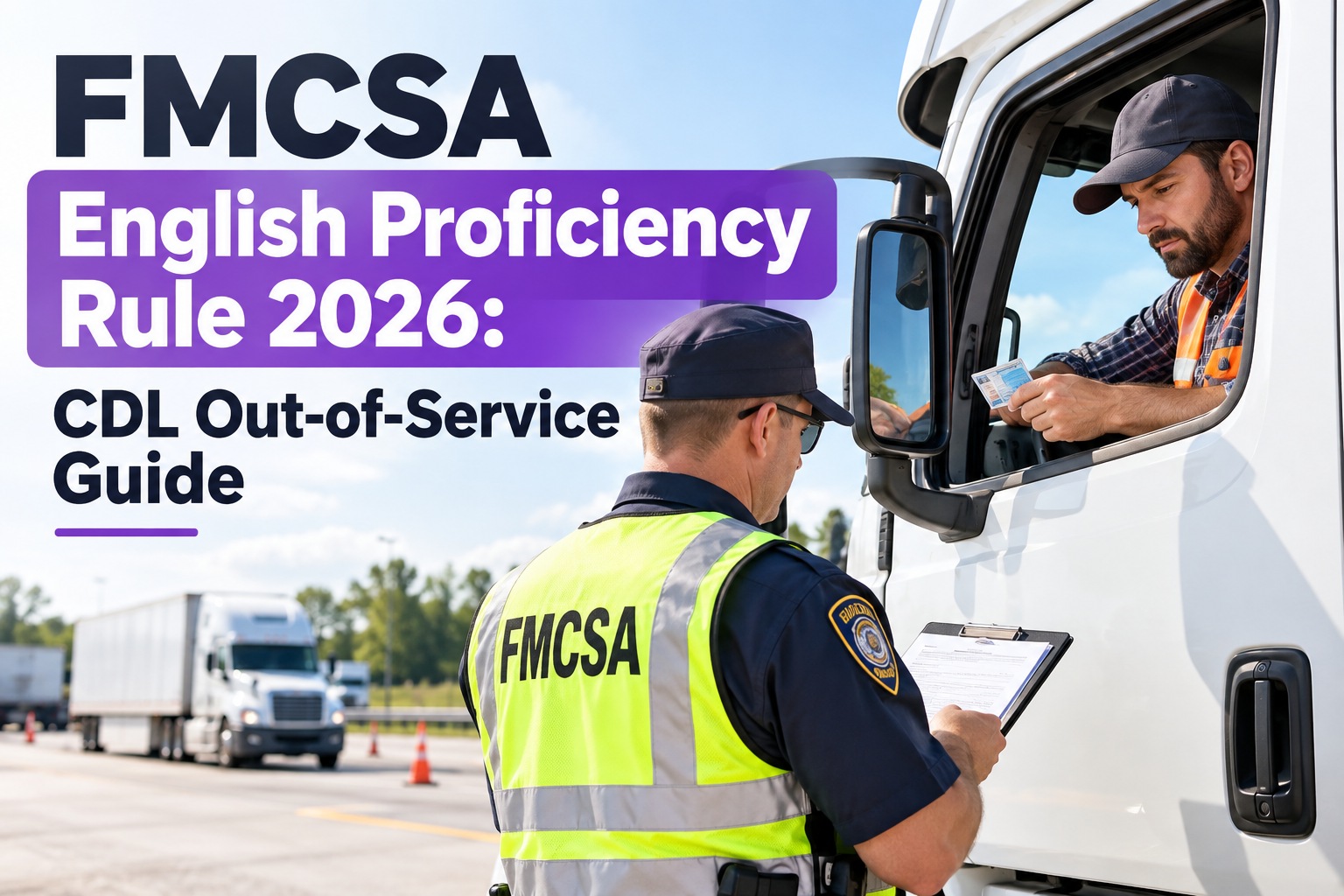
The FMCSA English Language Proficiency rule under 49 CFR §391.11(b)(2) went from dormant policy to an active out-of-service violation on June 25, 2025, and H.R. 7148 codified it into statutory federal law in early 2026. For a CDL driver, this is the difference between a citation and a truck sitting on the shoulder — a failed 2-step ELP assessment now ends the trip on the spot. This guide walks the OOS event itself: what happens at the roadside, what it costs the driver, and how the violation flows into the 2026 CSA scoring system. Truck Inspection & Maintenance Management Software captures the roadside event and preserves the DataQs-ready audit chain. Start free and log roadside events in TIM before the CSA hit lands.
An ELP Fail Isn't a Ticket — It's an Out-of-Service Order That Stays With the Driver for 24 Months
A failed ELP assessment grounds the truck at the roadside, hits the carrier's Unsafe Driving score, and follows the driver through PSP for three years. TIM captures the inspection event as it happens — inspector, time, outcome, notes — so the record that reaches DataQs is complete.
The OOS Event Lifecycle — What Happens Before, During, and After the Assessment
An ELP OOS isn't a single moment — it's a sequence with three phases, each with its own consequences for the driver, the carrier, and the truck. Below is the phase-by-phase reference.
- Roadside inspection begins in English — Level I, II, or III
- Inspector notes signs of struggling to understand instructions
- Two-step assessment triggered per FMCSA memo MC-SEE-2026-0002
- Driver informed the assessment is now underway
- Step 01 — verbal interview in English, no assistive aids permitted
- Step 02 — MUTCD highway sign recognition assessment
- No interpreters, phone translation apps, or cue cards allowed
- Inspector evaluates responses against §391.11(b)(2) capabilities
- OOS order issued — driver cannot operate the CMV
- Carrier dispatches a qualified driver to take custody
- Inspection report filed against carrier's DOT number + driver's PSP
- Load consequences: demurrage, missed delivery, potential abandonment
The recovery costs alone dwarf the citation itself — this is why documentation of the pre-inspection driver-qualification file matters. Contact our team to see how TIM preserves the DQ record for DataQs challenges.
How the ELP Violation Flows Into the 2026 CSA SMS Score
FMCSA reorganized CSA in 2026 into seven Compliance Categories with a simplified 1-or-2 severity scale (down from the previous 1–10). ELP OOS lands in Unsafe Driving. Below is where the violation actually goes.
| Element | What it means | Value for ELP OOS |
|---|---|---|
| Compliance Category | 2026 SMS bucket the violation lands in | Unsafe Driving |
| Severity weight | New 1-or-2 scale (was 1–10 pre-2026) | 2 · OOS |
| Time-weight tier 1 | Violation age 0–6 months | Highest weight |
| Time-weight tier 2 | Violation age 6–12 months | Reduced |
| Time-weight tier 3 | Violation age 12–24 months | Further reduced |
| Retention window | Point where the violation falls off SMS | 24 months |
| Driver PSP retention | Pre-Employment Screening Program record | 36 months |
| Follows the driver | PSP moves with the CDL — new job, same record | Yes |
The 4 Requirements Under §391.11(b)(2) — What Every CDL Driver Must Demonstrate
The underlying rule hasn't changed — only enforcement has. Below are the four capabilities every CDL driver operating in interstate commerce must maintain.
All four capabilities are qualification-file items TIM tracks per driver alongside CDL, medical card, MVR, and D&A. Start free and centralize driver qualification files in TIM.
The Driver + Carrier Cost Split — Where the OOS Bill Actually Lands
An ELP OOS is a shared cost event — the driver takes the PSP hit, the carrier takes the CSA hit, and both take the operational loss. Below is the working breakdown of who pays what.
- OOS violation on Pre-Employment Screening record for 36 months
- Every future carrier sees the ELP OOS during hiring review
- Lost driving hours during the roadside grounding
- Potential termination if repeat pattern emerges
- Severity-weight 2 violation into Unsafe Driving Compliance Category
- 24-month time-weighted impact on SMS percentile
- Replacement driver dispatch + potential tow costs
- Load abandonment, demurrage, missed-delivery penalties
- Insurance premium exposure at renewal
Roadside Event Capture · Driver Qualification · DataQs Audit Trail — All in TIM
TIM records ELP assessment results per driver in the qualification file, captures roadside inspection events with photo evidence and inspector notes, tracks CSA impact per BASIC, and produces the DataQs-ready audit chain regulators expect. The rule is subjective at the roadside; your documentation doesn't have to be.
Frequently Asked Questions
Roadside Documentation Is the Only Defense Against a Subjective Call
TIM captures the roadside event as it happens — inspector, time, outcome, notes, photo — and preserves the qualification file that DataQs will ask for. The rule is subjective; your evidence chain doesn't have to be.