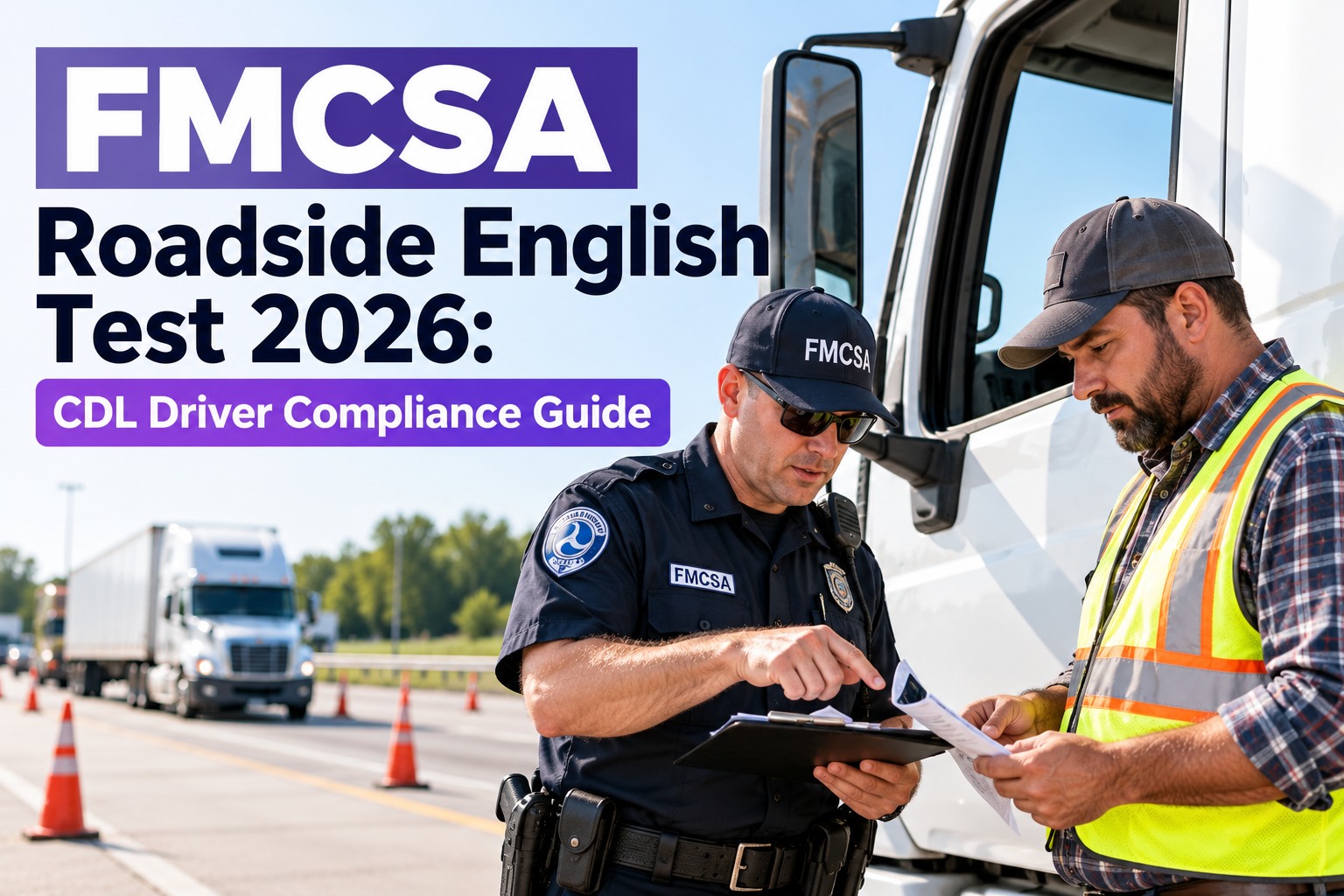
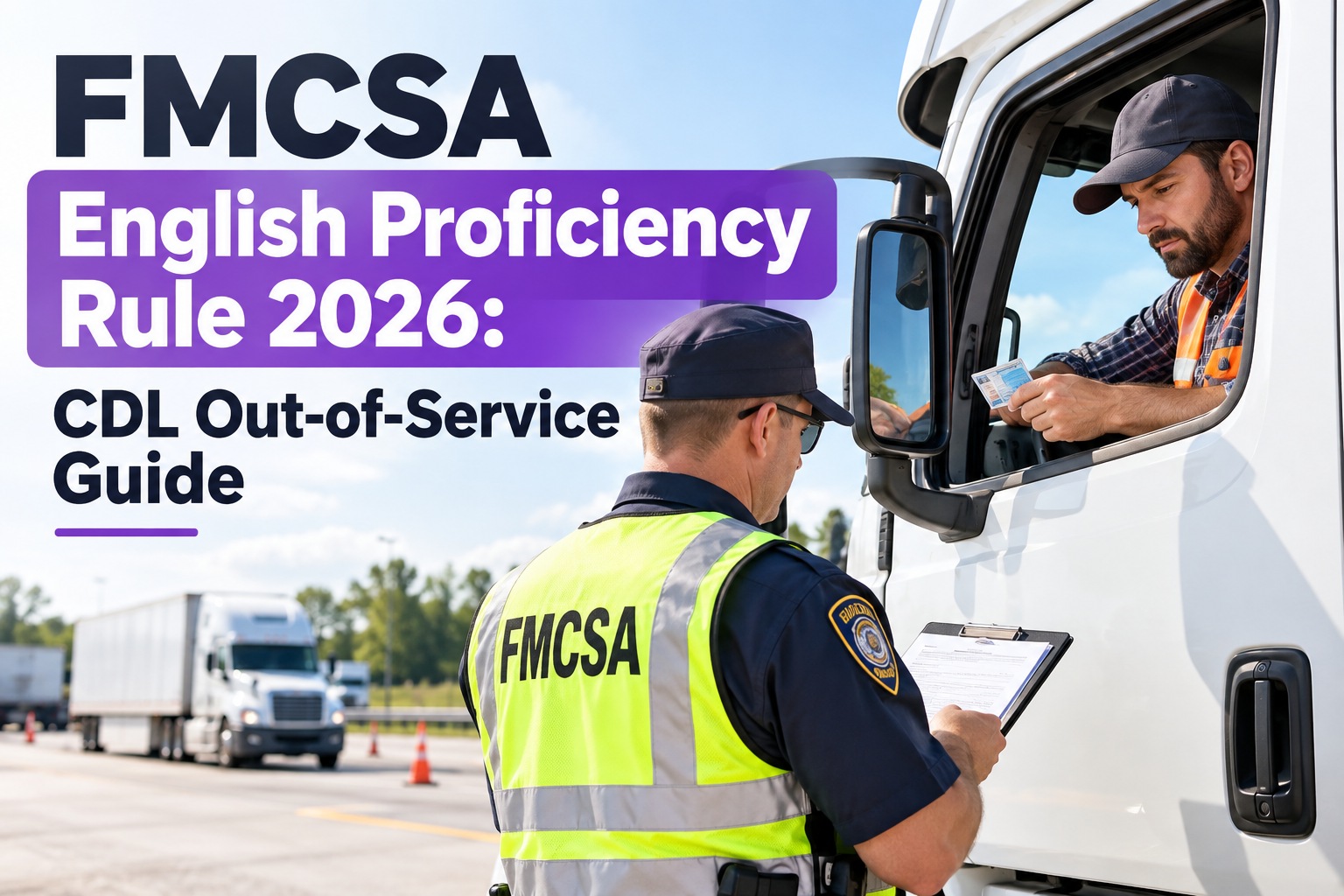
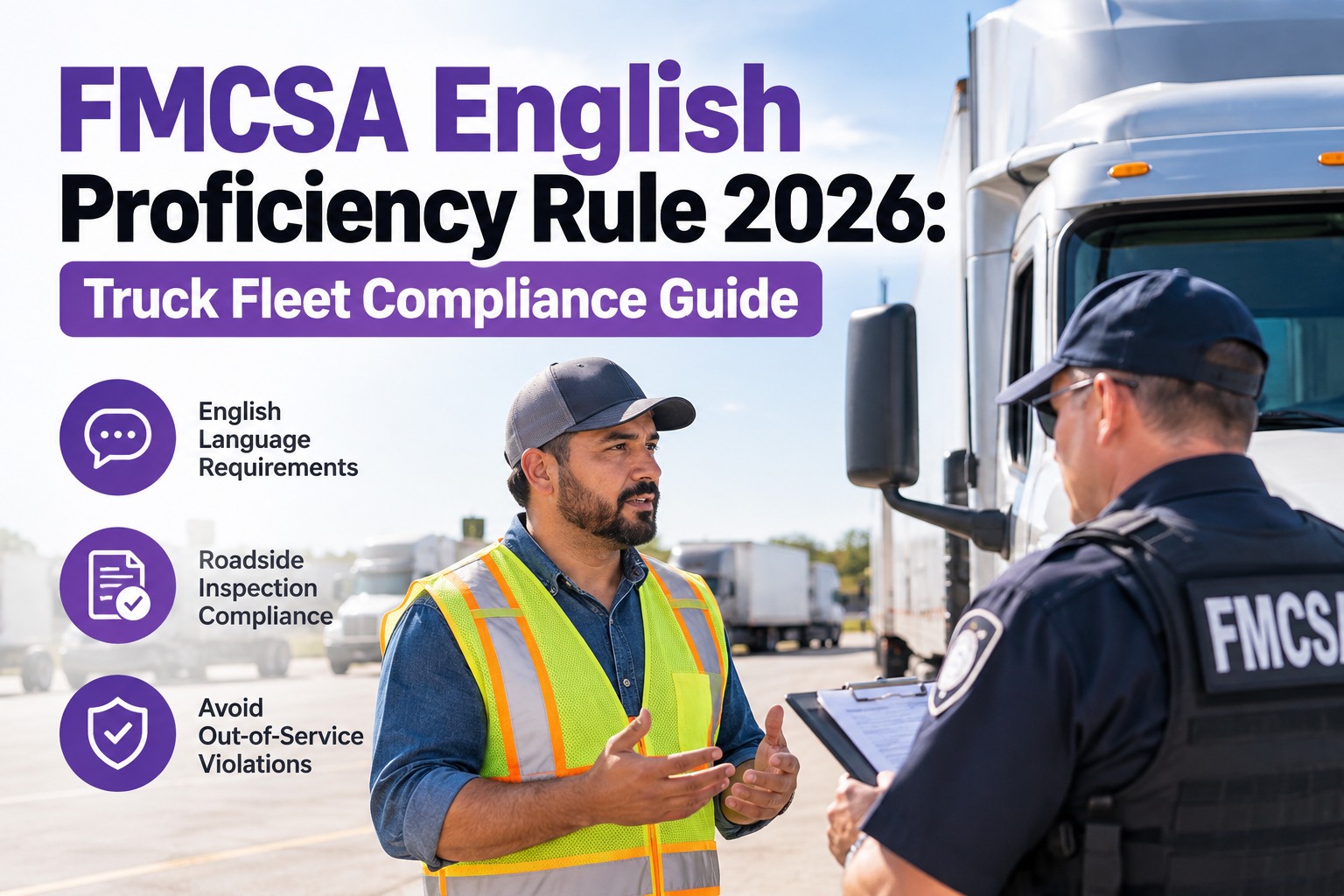
The FMCSA roadside English test isn't a paper exam — it's an in-person, on-camera, on-shoulder assessment that decides whether the trip continues. Under 49 CFR §391.11(b)(2), if the inspector detects signs of struggling during the opening in-English exchange, a two-step assessment starts on the spot: verbal interview, then MUTCD sign recognition. No interpreters, no phone apps, no cue cards, no do-overs. This guide walks the roadside sequence from the driver's window — what the inspector says, the categories of questions asked, the sign types shown — so the first time a driver sees this protocol isn't at the shoulder. Truck Inspection & Maintenance Management Software captures the event, preserves the qualification record, and produces the DataQs audit trail if the call is challenged. Start free and get drivers roadside-ready in TIM.
49 CFR §391.11(b)(2) · MC-SEE-2026-0002 · Roadside · Every Level I / II / III
Every Roadside Inspection Now Opens in English — Here's Exactly What Happens Next
The test isn't announced. It's triggered the moment the inspector sees the driver struggle. TIM records every roadside event as it happens and keeps the driver-qualification file on standby for the DataQs challenge that follows.
2 stepsverbal interview + MUTCD sign recognition
0 aidsno interpreter · app · or cue card
1 outcomepass or immediate OOS
The Roadside Sequence — From Window-Down to Verdict, Minute by Minute
Below is the working walk-through of the ELP assessment from the driver's perspective. Not every inspection triggers the two-step — only ones where the inspector detects the driver struggling with the initial in-English exchange.
0:00
Window down · initial contact in English
Inspector greets the driver in English and asks for license, medical card, and paperwork. Nothing about the ELP protocol has started yet — this is a normal Level I / II / III inspection opening.
0:30
Inspector observes signs of struggling
Repeated requests to clarify, one-word answers when open-ended questions were asked, driver pointing to a translation app, or asking a passenger to translate. Any of these can trigger the two-step assessment under MC-SEE-2026-0002.
2:00
Step 01 · verbal interview begins
Inspector conducts a structured English-only interview. No interpreter allowed, no phone translation app permitted, no cue cards. Driver must respond in English to demonstrate §391.11(b)(2) capability.
10:00
Step 02 · MUTCD sign recognition
Inspector shows a set of standard highway traffic signs and evaluates whether the driver understands the message conveyed — not just identifies the sign, but explains what it directs the driver to do.
15:00
Verdict · pass and continue, or OOS on the spot
Pass means the inspection continues to vehicle checks. Fail means an OOS order is issued, the driver cannot operate the CMV, the load waits, and the carrier dispatches a qualified replacement.
The specific questions and sign examples in the FMCSA memo are redacted in the public version. What is public: the categories of questions and the source of the signs. Contact our team to prep drivers on the roadside sequence in TIM.
Step 01 · The Verbal Interview — What Categories of Questions the Inspector Asks
The exact question wording in the current memo is redacted. FMCSA's earlier 2012 guidance, however, established the categories inspectors draw from — and those categories still fit the current protocol. Below is the working reference.
A
Confirmation of English capability
Open-ended prompts that require more than yes/no — driver's ability to converse with the general public
B
Trip origin details
Where the trip started, when, from which shipper — checked against BOL and log
C
Next destination information
Where the trip is going, delivery window, receiver details
D
Hours of duty inquiries
Time on duty, remaining drive time, last rest period — cross-checked against ELD
E
Document provision requests
Driver produces CDL, medical card, registration, permits when asked
F
Vehicle component questions
Basic questions about the tractor, trailer, cargo, brake system, and load securement
What "aids" are banned No interpreter (including a passenger or dispatcher on the phone), no translation app on the driver's phone, no printed cue cards, no dictionary. The driver must answer in English without any assistive device. Aids observed during the assessment convert a borderline result into a definitive fail.
Step 02 · The MUTCD Sign Recognition Panel — What the Driver Will See
The FMCSA memo's Attachment 2 (the actual sign panel) is redacted, but the source catalog is public: the Federal Highway Administration's Manual on Uniform Traffic Control Devices. Below are the categories the driver should recognize on sight.
REGULATORY
Commands + prohibitions
- STOP · YIELD · DO NOT ENTER
- WRONG WAY · ONE WAY · NO TRUCKS
- SPEED LIMIT · NO PARKING · NO TURN
Red + white · octagon, triangle, rectangle
WARNING
Hazard + caution ahead
- LOW CLEARANCE · WEIGHT LIMIT
- SHARP CURVE · STEEP GRADE · BRIDGE ICES
- DEER CROSSING · MERGE · REDUCED LANES
Yellow + black · diamond, pentagon
GUIDANCE
Route + destination
- Route markers (I-, US-, state)
- Exit numbers + distances
- Rest area · truck stop · weigh station
Green + white · rectangular
Recognition means the driver names what the sign directs — "STOP means come to a complete stop" — not just identifies the shape. Start free and add MUTCD sign practice to onboarding in TIM.
Pre-Roadside Prep — What Every CDL Driver Should Practice Before the First Inspection
An ELP OOS is largely preventable at the hiring desk. The practice pattern below mirrors the roadside protocol so the assessment is not a first-time experience.
✓
Practice all six interview categories in English aloud
Trip origin, destination, HOS status, document handover, vehicle component questions — rehearsed weekly, not memorized once
✓
Study the FHWA MUTCD sign catalog
Regulatory + warning + guidance categories — recognize the message, not just the shape or color
✓
Remove translation apps from the driver's active phone during inspections
Reaching for an app mid-assessment is itself a fail trigger — practice without one
✓
Rehearse the paperwork handover sequence in English
License, medical card, registration, permits, BOL, ELD status — named and produced without translation aid
✓
Run a mock 2-step assessment during onboarding + annually
Dated internal record filed under the driver's DQ file — the strongest DataQs defense
Roadside Prep · Roadside Capture · DataQs Audit Trail — All in TIM
TIM keeps the driver-qualification file with the internal 2-step assessment record, captures every roadside inspection event with photo + narrative + inspector name, and produces the DataQs-ready audit chain if the OOS call is challenged. The rule is subjective at the roadside; the documentation doesn't have to be.
Frequently Asked Questions
Are the exact interview questions and sign panel publicly available?
No — the FMCSA memorandum's Attachment 1 (interview strategies) and Attachment 2 (sign examples) are redacted in the public version. What is public: the categories of questions (drawn from the 2012 guidance) and the source catalog for the signs (FHWA MUTCD). Fleets prepare drivers against those categories rather than a fixed list.
Contact us for the category-based prep flow in TIM.
Can a driver refuse the ELP assessment?
No — the assessment is part of the roadside inspection under CVSA authority. Refusing to cooperate with a roadside inspection is itself a separate violation. The correct approach is to respond in English to the best of the driver's ability without reaching for a translation aid.
Start free with roadside-inspection guidance built into TIM.
Does every roadside inspection trigger the two-step ELP assessment?
No — only inspections where the inspector detects signs of struggling during the initial English exchange. The trigger is discretionary and subjective, which is why fleets keep an internal dated ELP assessment on file — it documents the driver's demonstrated capability outside of one inspector's judgment.
Contact support to set up the internal-assessment record in TIM.
How does TIM support driver preparation for the roadside test?
TIM tracks the internal 2-step assessment per driver, records MUTCD sign-recognition practice results, dates the paperwork-handover rehearsal, and files everything to the DQ record. When a roadside OOS lands, the DataQs submission has a pre-hire and periodic assessment chain to attach.
Start free and run the driver-prep loop in TIM.
§391.11(b)(2) · 2-Step · MUTCD · MC-SEE-2026-0002 · TIM-Ready
The Roadside Test Is Coming — Prep the Driver Before the Trigger Fires
TIM keeps the internal ELP assessment on file, records MUTCD practice, captures every roadside event, and hands DataQs a documented driver-qualification chain. The trigger is subjective; the defense doesn't have to be.
No credit card required · Free for up to 3 trucks · Internal ELP assessment + roadside capture built in