Every load that rolls is a bet that the driver is legal, the clock is clean, the credentials are current, and the truck is roadside-ready. Get one wrong and the cost is brutal: an HOS or ELD violation runs up to $19,246, operating under an out-of-service order is $2,364 a shot, and a single roadside stop can cascade into a full inspection and a CSA score hit that follows you for two years. The fix isn't more paperwork — it's a fast, repeatable check before the wheels turn. This guide lays out the daily pre-dispatch compliance checklist every driver and dispatcher should run, the four things that must be confirmed every single time, and how to turn it into a 60-second tap-through. Put the daily check in every cab free.
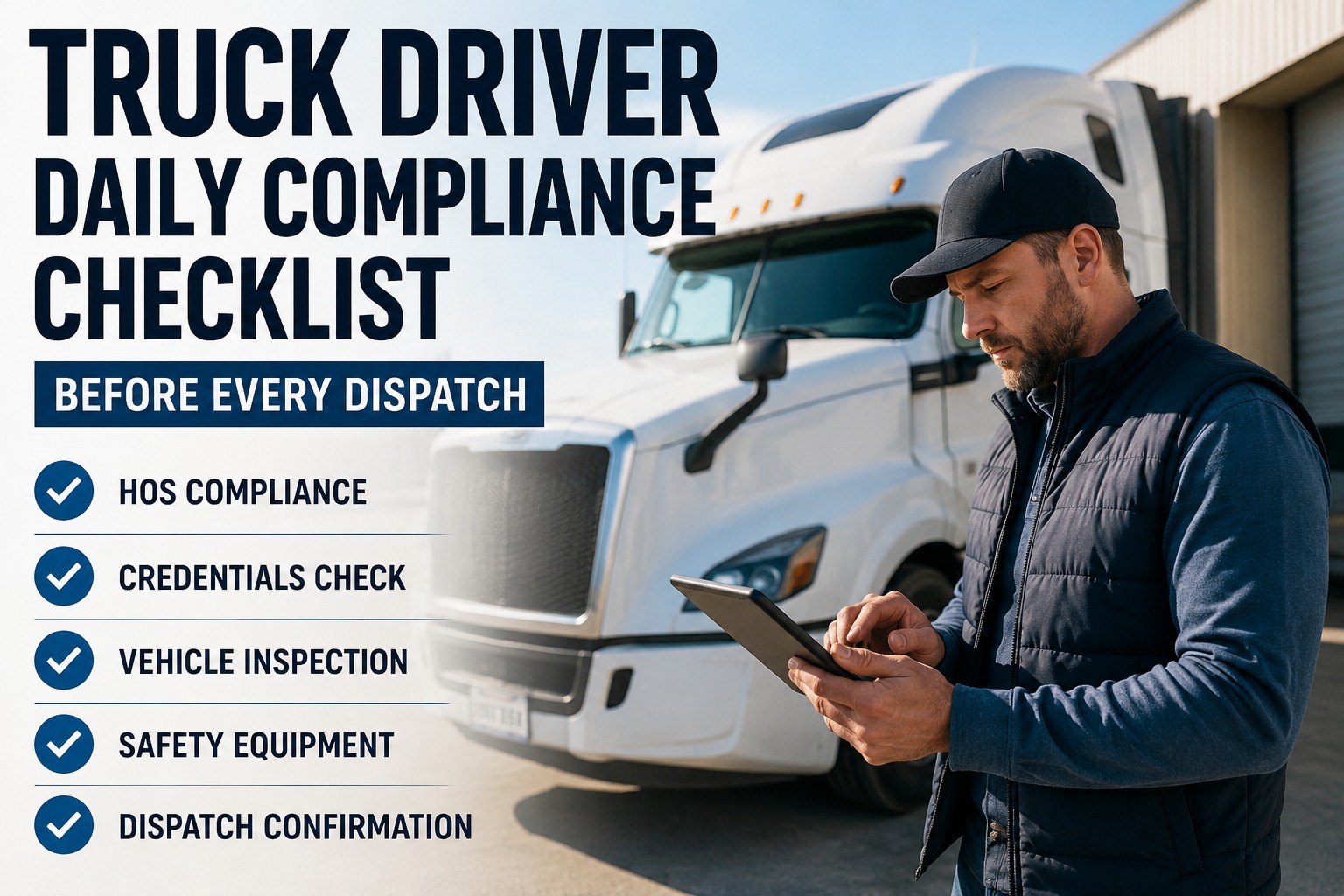
Truck Driver Daily Compliance Checklist: Before Every Dispatch
Before dispatch, confirm HOS, credentials, and vehicle status. Make the daily compliance check a fast tap-through that keeps every load legal — and every driver out of service.
Why a Daily Check Beats a Monthly Audit
Compliance failures don't wait for audit season — they happen at the roadside, mid-shift, on a load that's already moving. By then the violation is written and the score is hit. A 60-second check before dispatch is the only point where a problem is still cheap to fix.
The Four Pillars to Confirm Every Time
A daily compliance check isn't forty items — it's four questions, each with a clear yes-or-no answer. Confirm all four before the truck moves and the load is legal. Miss one and you're gambling on the roadside.
Is the driver qualified and fit to drive today? Valid CDL for the class, current medical certification, and no Clearinghouse prohibited status.
Are all four HOS clocks within limits — before, not during, the run? This is the most common roadside finding, and each clock is a separate violation.
Is the ELD registered and working, with the required in-cab materials on board? A delisted device puts you out of service even with clean logs.
Did the pre-trip clear the truck under 49 CFR 392.7? Brake, tire, and light defects are the fastest path to an out-of-service order.
The Four HOS Clocks — All Must Pass
Hours of Service is where good drivers get caught, because all four clocks run at once and any single one can fail you. Check every clock before dispatch, not when the ELD warns you mid-shift.
Maximum driving after 10 consecutive hours off duty.
From first on-duty activity — loading and unloading count, not just driving.
After 8 cumulative hours of driving, before more driving is allowed.
Across 7 or 8 consecutive days, depending on your operation's schedule.
Turn Four Pillars Into a 60-Second Tap-Through
Truck Inspection & Maintenance puts the daily check on the driver's phone — HOS status, credential alerts, ELD health, and pre-trip in one flow that won't let a load roll with a gap.
The Daily Pre-Dispatch Checklist
Run this every shift, in order, before the wheels turn. Each item has a clear pass condition — if any answer is no, the truck doesn't roll until it's fixed.
The 2026 Changes That Trip Drivers Up
Enforcement tightened this year, and several rules that worked last year now create violations. These are the ones that catch drivers and dispatchers off guard at the roadside.
Medical certification now verifies through state MVR/CDLIS — a paper card alone no longer satisfies. Build a 90-day pre-expiration check so it never lapses.
Devices are revoked from the FMCSA registered list with a 60-day replacement window. A delisted ELD means out-of-service — verify yours at eld.fmcsa.dot.gov.
The 2026 overhaul scores defects a driver should have caught in the pre-trip as a separate category — so a rushed walk-around now hits your safety profile directly.
Positive tests, refusals, and return-to-duty completions must be reported within 24 hours, and prohibited-status CDLs are now actively enforced.
Frequently Asked Questions
Four things: driver fitness (valid CDL, current medical certification, clean Clearinghouse status), Hours of Service (all four clocks within limits), ELD and documents (registered working device with required in-cab materials), and vehicle status (a completed pre-trip with no open defects). Confirm all four and the load is legal to move.
The 11-hour driving limit (after 10 hours off duty), the 14-hour on-duty window (from first on-duty activity, including loading), the 30-minute break (required after 8 cumulative hours driving), and the 60/70-hour weekly cap (over 7 or 8 days). All four run simultaneously, and exceeding any one is a separate violation — which is why checking them before dispatch matters.
Because FMCSA periodically revokes devices from its registered list. If your ELD is delisted and you keep using it past the 60-day replacement window, you can be placed out of service regardless of how accurate your logs are. Verify your device stays registered at eld.fmcsa.dot.gov, and keep paper logs as backup during any malfunction.
With a guided digital flow, about a minute — the HOS clocks, credential status, and ELD health can be confirmed at a glance, and the pre-trip is the only hands-on part. The point isn't to add time; it's to replace scattered checks with one fast, repeatable tap-through that won't let a load roll with a gap.
It consolidates the four pillars into one screen. Truck Inspection & Maintenance surfaces HOS status, flags expiring medical cards and licenses before they lapse, links the pre-trip to defect-to-repair tracking, and keeps every check timestamped for audit. Instead of chasing four separate systems, the dispatcher sees one clear go or no-go.
Make Every Dispatch a Confirmed Go
Truck Inspection & Maintenance turns the daily compliance check into a 60-second tap-through — HOS clocks, credential alerts, ELD health, and a guided pre-trip in one flow, timestamped for audit — so every load leaves legal and no driver gets caught at the roadside.