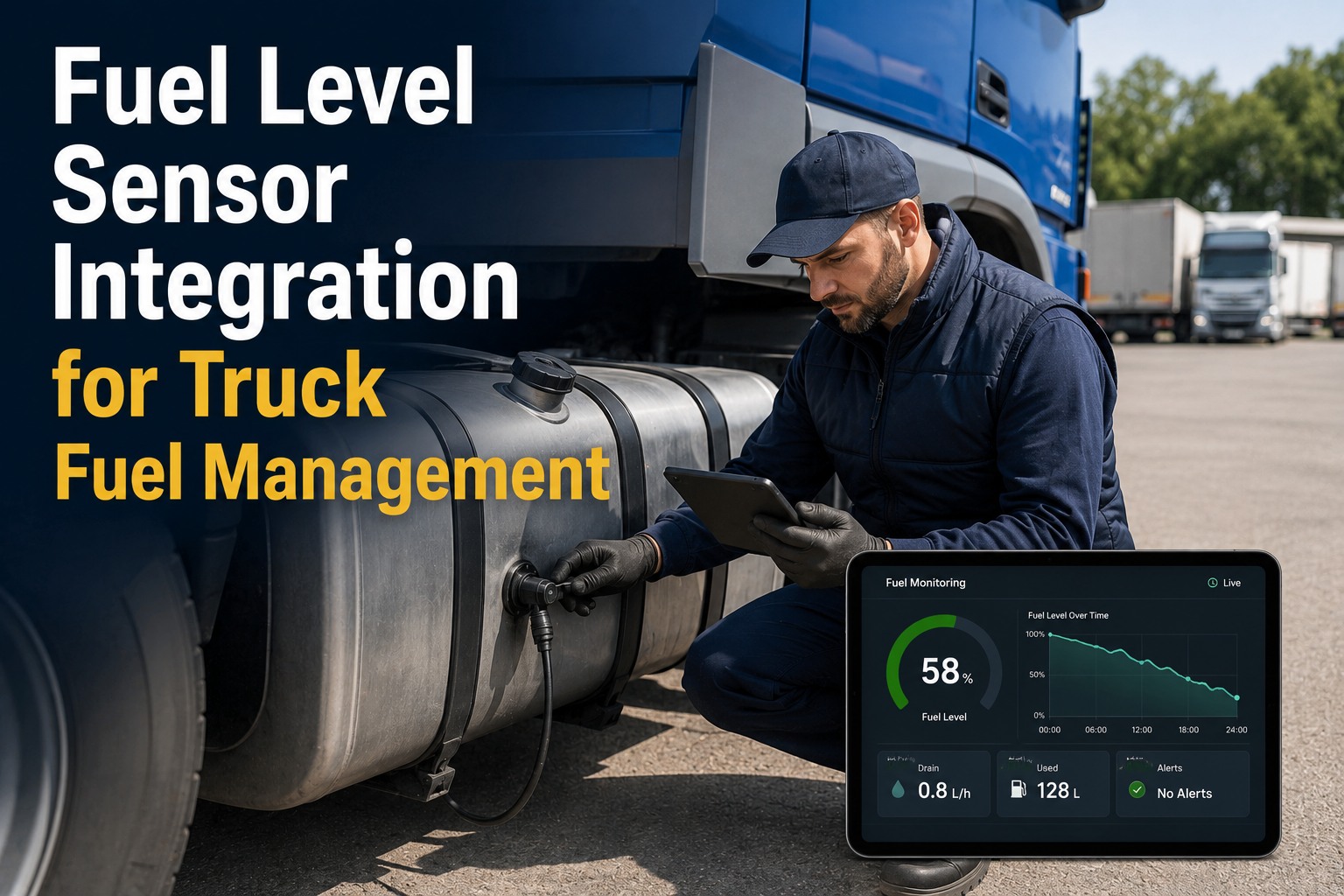
Plot a truck's fuel level over a week and you get a line that tells you almost everything. It slopes gently down as the engine burns diesel. It jumps vertically when the driver fills up. And every so often — usually around 4 a.m., usually while the truck is parked — it drops off a cliff in twenty minutes with the engine off. That cliff is fuel theft, and without a fuel level sensor feeding your platform, nobody sees it. You just notice, months later, that your cost per mile has quietly crept up and no one can explain why. A fuel level sensor integration turns that invisible line into a live, readable signal: a capacitive probe accurate to within a litre or two, streaming tank volume into a system that knows the difference between a legitimate fill and a siphon. This guide covers how the sensors work, why calibration decides whether you trust the alerts, and how Truck fleet management software turns tank data into theft detection, efficiency, and maintenance insight.
Fuel Management Guide · Level Sensor Integration · 2026
Fuel Level Sensor Integration for Truck Fuel Management
Read the tank, not the receipt — real-time fuel volume that exposes theft the moment it happens and turns consumption into an early maintenance signal.
One week of tank volume. The gentle slopes are diesel doing its job. The vertical jumps are fills. The red cliff is 60 litres leaving a parked truck at 4 a.m.
Three Signatures in the Line
Every meaningful fuel event has a distinct shape, and a well-tuned system reads them apart automatically. This is the core intelligence of level-sensor integration — not just knowing the volume, but knowing what a change means:
Normal burn
A gentle, steady decline while the engine runs. Slope tracks load, terrain, and driving style — the baseline everything else is measured against.
Legitimate fill
A sharp vertical rise at a known station, matching a fuel-card transaction in volume, time, and place. Verified and logged, no alert.
Theft drop
A steep fall while the vehicle is stationary and the engine is off — no card transaction, often overnight. This fires the alert.
The tell is context, not just volume: a drop only means theft when the engine is off, the vehicle is parked, no fuel-card purchase explains it, and the location is outside an approved zone. Cross-referencing tank level with ignition state, GPS, and card data is what turns a number into a verdict.
Two Ways to Read the Tank
There are exactly two routes to get fuel level into your platform, and choosing between them is the first real decision. They trade convenience against precision:
The vehicle's CAN bus
Read the fuel level the truck already reports over its CAN bus or J1939 network, via your existing telematics gateway. Nothing to install, no tank work.
Trade-off: accuracy is generally lower — it's the factory float sender feeding the dashboard gauge, good for a rough gauge, weak for catching a small siphon.
A dedicated fuel level sensor
A purpose-built probe mounted in the tank, streaming precise volume to the same gateway. One sealed hole in the tank top, three wires — power, ground, signal.
Trade-off: a small install, in exchange for the precision that actually detects theft — down to a couple of litres in a full tank.
Which Sensor, and Why It Matters
Not all probes are equal, and the choice should follow your tank, fuel, and environment — not the price tag. Retrofitting the wrong sensor after installation is expensive:
Capacitive
±0.5-1%Fuel between coaxial pipes changes capacitance, converted to a precise reading. No floats, no moving parts, no mechanical wear — the standard for logistics fleets and heavy equipment, and accurate enough to see 1-2 litres move in a 400-litre tank.
Ultrasonic
ContactlessMeasures level with sound waves without touching the fuel, and mounts outside the tank — easier installation where cutting into the tank isn't an option.
Float-arm (factory)
Gauge-gradeThe original sender behind your dashboard gauge. Fine for telling a driver they're low; too coarse and wear-prone to be the backbone of theft detection.
Free · Up to 3 Vehicles
See the drop while it's still happening
Truck fleet management software streams live tank volume from capacitive, ultrasonic, or CAN-bus sources, distinguishes real theft from sloshing and drift, and alerts with driver, location, and volume attached — while fills reconcile automatically against your fuel-card data. It works with the sensors and gateways you already run, so there's no rip-and-replace. Sign up free for up to 3 vehicles and start reading your tanks today.
Calibration Decides Whether You Trust It
This is the part vendors skip, and it's the part that determines whether your team acts on alerts or mutes them. A fuel sensor is only as honest as the model interpreting it — and physics is working against you in four specific ways:
Tanks aren't perfect cylinders
Irregular shapes mean volume doesn't map linearly to depth. Without a proper calibration table, every reading is subtly wrong.
Temperature changes density
Diesel expands and contracts. A model that ignores it reports phantom losses on cold nights and phantom gains on hot afternoons.
Fuel sloshes
Movement, braking, and grade tilt the surface. Raw readings swing wildly; filtering and tilt-awareness are what steady them.
Signal gaps happen
Dead zones are unavoidable. Readings must buffer locally and sync on reconnect — losing data during a gap is losing the theft window.
The trust equation: a poorly tuned system flags an AC compressor working hard on a hot day as theft. After a few of those, nobody believes the alerts — and a muted alert saves no fuel. Good platforms separate genuine theft from calibration drift, sensor noise, and tilt, and fire a tamper alert within seconds if a sensor is disconnected. Calibration itself is quick: minutes with a proper tool, or a pre-built table for hundreds of common OEM tanks.
From Drop to Response
Detection only matters if it reaches someone. When the line falls where it shouldn't, an integrated system moves immediately — and every event lands with the context needed to act:
Anomaly confirmed
The drop is checked against ignition state, GPS, and card data — and cleared as real, not drift or slosh.
Alert with evidence
A notification fires with volume lost, exact time, location, and driver ID — immutably logged with a timestamp.
Reconciled & costed
Fills auto-match to fuel-card transactions; losses post against the vehicle's cost record instead of vanishing into cost-per-mile.
Beyond Theft: Fuel as a Maintenance Signal
The same probe that catches a siphon quietly watches your engines. Fuel data is one of the earliest indicators that something mechanical is going wrong — often before a fault code appears:
Consumption creep
A truck burning steadily more than its own baseline is telling you something — injectors, tire pressure, a clogged filter — worth an inspection before it becomes a failure.
Fuel contamination
Diesel mixed with water or waste oil leads to early engine breakdown and expensive repairs. Level and quality monitoring can flag the change before the damage compounds.
Idle waste
Tank data paired with ignition state exposes how much fuel disappears while parked and running — the cost nobody budgets for.
Supplier comparison
Consistent volume readings let you compare what you actually received against what you paid for, station by station.
Frequently Asked Questions
How does a fuel level sensor detect theft?
By reading tank volume continuously and watching for a drop that physics can't explain. A capacitive probe can detect a change of as little as 1-2 litres in a 400-litre tank, so a siphon is visible in near-real time. The system confirms it's theft by checking that the engine was off, the vehicle was stationary, and no fuel-card purchase accounts for the change — then alerts with volume, time, location, and driver attached.
Can't I just use the truck's existing fuel gauge data?
You can read fuel level from the CAN bus or J1939 network without installing anything, and it's a reasonable starting point. But that's the factory float sender feeding the dashboard gauge — accuracy is generally lower. It'll tell you the tank is getting low; it won't reliably catch someone drawing off 40 litres. For genuine theft detection, a dedicated capacitive sensor is the difference-maker. Contact our team to work out which fits your fleet.
Which sensor type is most accurate?
Capacitive sensors consistently deliver the best combination of accuracy and reliability for diesel — typically ±0.5% to ±1% of full scale in a well-calibrated installation. They work by measuring capacitance change as fuel fills the space between coaxial pipes, with no floats or moving parts to wear out. Ultrasonic sensors are a good alternative where mounting outside the tank matters, and float-arm senders are really only gauge-grade.
How hard is installation and calibration?
Less than people expect. A typical capacitive probe needs one sealed mounting hole in the top of the tank and three wires — power, ground, and signal — connected to your existing telematics gateway. Calibration takes minutes with the right software, and many tanks have pre-built calibration tables available. The bigger project is usually integrating with older fleet systems, not the sensor itself.
Will I get false theft alerts?
Only from a poorly tuned system — and that's the real risk, because false alerts destroy trust fast. Tanks aren't perfect cylinders, diesel density shifts with temperature, and fuel sloshes as the vehicle moves; a model that ignores those flags normal events as theft. A well-built platform separates genuine theft from calibration drift, sensor noise, and tilt, so the alerts you get are ones worth acting on.
What's the actual payoff?
Fleets deploying sensor-based fuel monitoring commonly report fuel-loss reductions in the range of 15-25%, driven as much by deterrence as by detection — people stop siphoning a tank they know is watched. On top of that you get accurate consumption data per vehicle, automatic reconciliation of fills against fuel-card records, and early warning of mechanical problems hiding in your fuel curve. Sign up free to see it on your fleet.
Every Litre Accounted For
Stop guessing where your diesel goes.
Truck fleet management software turns fuel level sensor data into real-time theft alerts, automatic fill reconciliation, per-vehicle consumption tracking, and maintenance early-warning — with calibration-aware logic that keeps false alarms out of your inbox. Free for up to 3 vehicles. Works with your existing sensors and gateways, no rip-and-replace, no contracts.